

SMS routing is the process that determines how an SMS message moves from a sending application or messaging platform to the recipient’s mobile network. For business messaging, however, routing is more than a technical path. It is a quality layer that can affect whether messages reach the right destination network, how consistently they arrive, how quickly they are delivered, and how much operational risk a sender carries when traffic scales.
This matters because business SMS is rarely sent in a simple one-to-one context. A company may be sending OTPs, order updates, appointment reminders, fraud alerts, marketing campaigns, or cross-border notifications across many countries, carriers, and traffic conditions. In those situations, the route behind the message can influence performance just as much as the content, consent model, sender identity, or messaging platform.
A strong SMS routing setup does not guarantee that every message will be delivered in every market. No serious provider should make that promise. But routing quality can make the difference between a setup that is visible, stable, and manageable and one that becomes difficult to diagnose when delivery issues appear.
What Is SMS Routing?
SMS routing is the way an SMS message is directed through messaging systems, providers, carrier connections, and destination networks before reaching a recipient’s mobile device.
In a simple explanation, routing answers one question: which path should this message take to reach this phone number?
In business messaging, the better question is broader: which route gives this message the best practical chance of reaching the correct destination network with the right balance of reliability, speed, visibility, compliance awareness, and cost?
SMS routing is more than a message path
It is easy to describe SMS routing as a delivery path. That definition is not wrong, but it is incomplete.
A route is not only a line between a sender and a mobile network. It may involve decisions about provider connections, carrier access, fallback behavior, traffic classification, sender identity, market rules, filtering exposure, and cost constraints. Two providers may both say they can send SMS to the same destination, but the route quality behind that coverage can be very different.
For example, one route may provide stronger visibility, more consistent latency, and better support escalation. Another route may look cheaper at first, but become unstable during high traffic, sensitive use cases, or stricter filtering conditions. For a business sending time-sensitive messages, that difference can directly affect customer experience.
That is why route quality matters. The route is part of the infrastructure behind the message result.
SMS routing in business messaging
Business SMS usually refers to A2P messaging: application-to-person SMS sent by a company, platform, or automated system to users. This includes messages such as OTP codes, delivery updates, payment alerts, booking confirmations, account notifications, and promotional campaigns.
A2P traffic is different from ordinary person-to-person texting. It often has higher volume, repeated templates, automated sending patterns, branded sender identities, specific destination rules, and clearer business consequences when messages fail.
Because of that, SMS routing in business messaging is not just about finding any available route. It is about selecting and managing routes that fit the use case.
An OTP message may need low latency and strong reliability. A promotional campaign may need high-volume handling and careful filtering exposure control. A cross-border notification may need market-specific routing knowledge. A transactional update may need consistent delivery performance over time, not only a successful one-time test.
The routing layer helps determine whether those different use cases are handled appropriately.
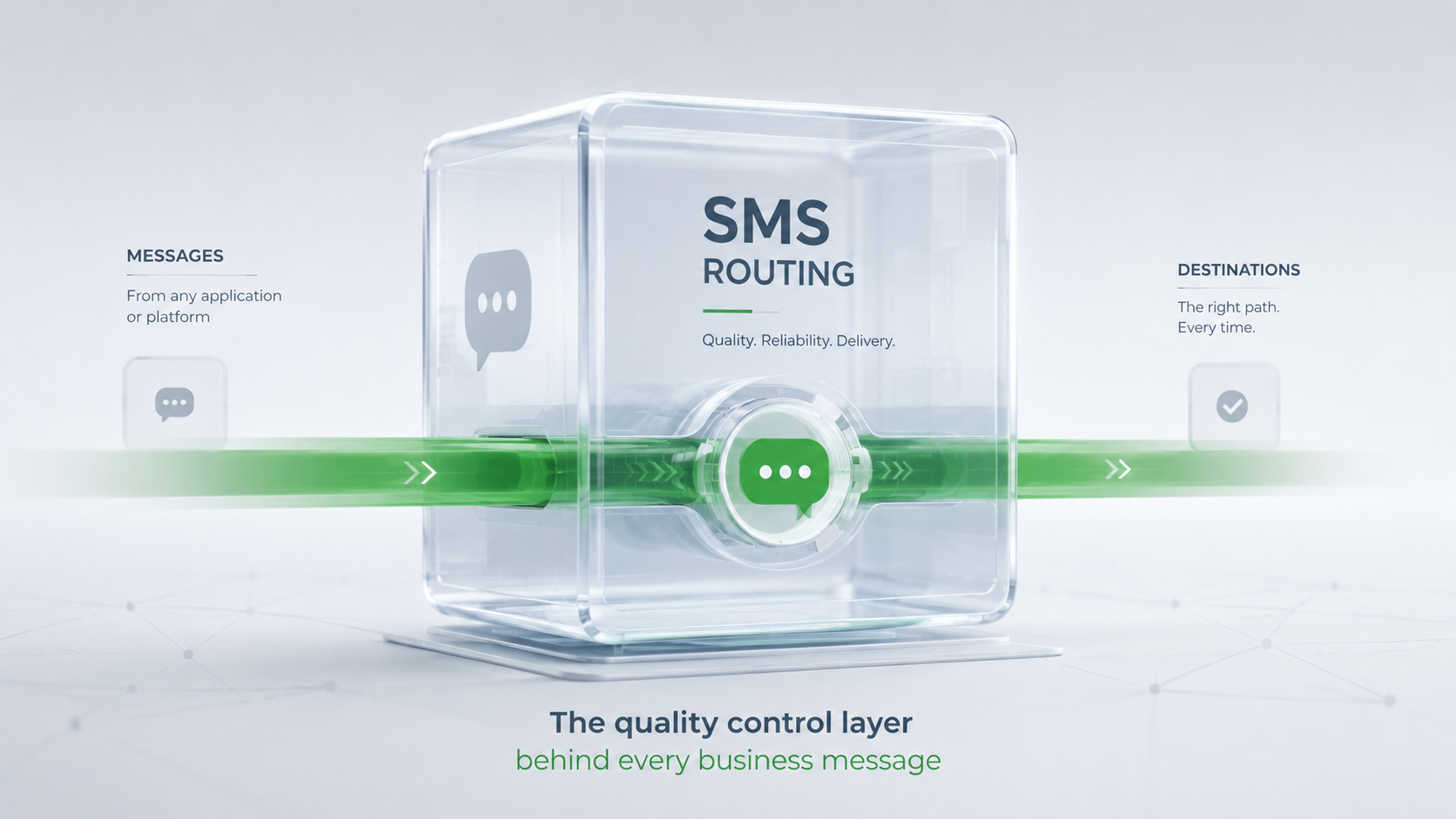
How SMS Routing Works in Business Messaging
The exact routing path can vary by provider, destination market, carrier relationship, sender identity, and message type. However, the general flow is usually easier to understand when broken into several layers.
A business message often moves from an application or platform, to a messaging provider, through one or more routing or carrier partners, and finally toward the destination mobile network.
From application or SMS platform to messaging provider
The journey usually begins inside a business system. This may be a CRM, ecommerce platform, fintech app, SaaS product, marketing automation tool, authentication system, or internal backend.
The business system sends a message request through an SMS API, dashboard, or messaging integration. That request typically includes the destination number, message body, sender identity, and sometimes campaign or use-case metadata.
The SMS platform or messaging provider then prepares the message for routing. Depending on the provider setup, this may include formatting, country detection, sender validation, traffic classification, compliance checks, or queue management.
At this stage, the message has not simply “gone to the carrier.” It has entered a routing decision process.
From routing partner to carrier or destination network
After the provider receives the message, the routing layer determines how to move it toward the destination network. This may involve a direct carrier connection, an aggregator, a hub, an interconnect partner, or another route depending on the market and provider network.
In the SMS industry, protocols such as SMPP are commonly used to exchange short message data between external applications, routing entities, and message centres. For business readers, the important point is not the protocol detail. The important point is that SMS delivery depends on a chain of technical and commercial relationships between systems and networks.
That chain may be short and transparent, or it may involve multiple intermediaries. The more complex the route, the more important it becomes to understand visibility, reliability, accountability, and fallback behavior.
Where delivery controls, fallback paths, and route decisions may apply
Routing is not always a fixed path. Providers may apply route selection logic based on destination, traffic type, sender identity, price, delivery performance, error rates, carrier availability, or route health.
For example, if a primary route becomes unstable, a provider may use a fallback route. In some cases, fallback routing helps maintain continuity. In other cases, uncontrolled fallback behavior can create inconsistent performance, different delivery speeds, or weaker visibility.
This is why businesses should not only ask whether a provider has destination coverage. They should also ask how route quality is managed when traffic conditions change.
Important routing questions include:
- What route is used for this destination and use case?
- Is the route stable under higher volume?
- What happens if the primary route has issues?
- Can performance be reviewed by market, carrier, or message type?
- Does the provider have enough visibility to diagnose route-level problems?
These questions become especially important for OTP, transactional alerts, high-volume campaigns, and cross-border messaging.
Why Route Quality Matters for Business SMS
Route quality matters because it affects the practical business outcome of SMS. A message may be submitted successfully from the sender’s system, but that does not mean the route will deliver consistent results across networks, time periods, or markets.
For business teams, the most useful way to think about route quality is through five dimensions: reachability, stability, latency, filtering exposure, and cost-risk balance.

Reachability: whether messages can access the right destination networks
Reachability means whether a message can access the intended destination network through a usable route.
A provider may list a country as covered, but coverage alone does not always answer whether a route is suitable for a specific use case. Some markets have stricter rules for sender IDs, templates, promotional traffic, OTP traffic, or business messaging registration. Some carriers may treat certain traffic types differently. Some routes may be available but unstable, restricted, or unsuitable for long-term business use.
Reachability is especially important for international SMS. A business sending to one country may see strong performance, while the same setup performs differently in another country because the destination networks, local rules, and routing relationships are different.
This is why routing should be evaluated by destination market, not only by global coverage claims.
Stability: whether performance stays consistent across traffic conditions
Stability means route performance remains reasonably consistent over time.
A route that works during a small test may not perform the same way during peak traffic. It may also behave differently during seasonal campaigns, sudden authentication spikes, carrier maintenance windows, or market-level filtering changes.
For business teams, route stability is often more important than a single successful test. A test message can show that a route is available. It does not prove that the route can handle sustained traffic, repeated templates, time-sensitive alerts, or multiple destination networks over time.
Signs of unstable routing may include:
- delivery performance changing sharply without a clear content change
- sudden latency spikes in one market
- inconsistent results across carriers in the same country
- repeated failures during high-volume periods
- support teams being unable to explain route-level changes
Stability is one reason routing should be monitored continuously, not checked only during onboarding.
Latency: how quickly time-sensitive messages arrive
Latency is the time between message submission and message arrival or final delivery status.
For some use cases, a delay of several minutes may be acceptable. For others, it can break the user journey. OTP messages, fraud alerts, login verification codes, payment confirmations, delivery updates, and booking reminders often depend on timely arrival.
Routing affects latency because different routes may have different queue behavior, network hops, carrier handling, congestion exposure, and fallback logic. A message that eventually arrives may still fail the business goal if it arrives too late for the user to act.
This is why teams should not evaluate SMS performance only by whether messages were delivered. They should also review when they were delivered, especially when SMS delivery speed matters for OTP, alerts, or other time-sensitive workflows.
Latency patterns are often more useful than isolated examples. If delays cluster around a destination, carrier, message type, or traffic window, the routing layer may be worth reviewing.
Filtering exposure: how route context can affect risk
Filtering exposure refers to the chance that a message is blocked, delayed, or treated suspiciously by carrier or network filtering systems.
Filtering is not caused by routing alone. Content, consent, sender identity, message volume, URL behavior, user complaints, and local rules can all influence SMS filtering. However, routing can affect the context in which a message reaches a destination network.
A transparent, well-managed route may provide better accountability and clearer support escalation. A less transparent route may make it harder to understand why messages were filtered, where they were blocked, or whether the issue came from content, sender setup, traffic pattern, or route quality.
Grey or unauthorized routes can also introduce risk because they may avoid expected commercial or technical paths. This does not mean every route issue is a grey route issue. It does mean that businesses should treat route transparency as part of risk management.
For regulated, high-volume, or customer-critical messaging, route visibility is not a technical luxury. It is part of operational control.
Cost-risk balance: why the cheapest route is not always the safest route
SMS pricing matters, especially for businesses sending at scale. But cost should not be evaluated without risk.
A cheaper route may look attractive if the only metric is price per message. Yet if that route causes unstable delivery, poor latency, limited diagnostics, higher filtering exposure, or weak escalation support, the total cost can become higher than expected.
The hidden cost may appear as failed OTP conversions, delayed customer updates, support tickets, campaign underperformance, or engineering time spent investigating unclear delivery issues.
The right question is not “Which route is cheapest?” The better question is: Which route gives the right balance of cost, reliability, visibility, and risk for this use case and destination market?
For low-risk traffic, a lower-cost route may be acceptable. For OTP, fraud alerts, transactional notifications, financial messages, or critical customer updates, route quality often deserves a higher priority.
Common SMS Route Types Business Teams May Hear About
Business teams may hear terms such as direct route, grey route, fallback route, premium route, or wholesale route. These terms are often used inconsistently in the market, so they should be handled carefully.
This Pillar article only introduces the basic idea. A detailed comparison belongs in a dedicated direct route vs grey route article.

Direct routes
A direct route usually refers to a route with a more direct commercial or technical relationship to the destination carrier or authorized network path. In many cases, direct routes can provide better transparency, stability, and support escalation.
However, direct does not automatically mean perfect. A direct route can still have issues if it is poorly managed, overloaded, affected by local filtering rules, or mismatched with the sender’s use case.
The value of a direct route depends on the destination market, traffic type, carrier relationship, route monitoring, and provider support.
Grey routes
A grey route generally refers to a route that delivers messages through indirect, less transparent, or unintended paths. Grey routes are often associated with lower cost, but they may introduce concerns around stability, transparency, compliance exposure, filtering risk, and long-term reliability.
The business risk is not only that a message may fail. The deeper issue is that a grey route may be harder to diagnose when performance changes. If a route is not transparent, the provider may have limited ability to explain failures, adjust routing, or escalate with the right network partner.
For this reason, businesses should be careful when extremely low prices are paired with vague route explanations.
Fallback or alternative routes
Fallback routes are alternative routes used when a primary route is unavailable, degraded, or unsuitable for a certain traffic condition.
Fallback routing can be helpful when it is controlled and visible. It can reduce disruption and keep traffic moving during route-level problems. But fallback routing can also create inconsistent results if the business does not know when fallback occurs, which route is used, or how performance changes after fallback.
For high-value traffic, fallback behavior should be part of the route quality discussion. The question is not only whether fallback exists. The question is whether fallback is monitored, explained, and aligned with business risk.
SMS Routing and Deliverability: How They Are Related but Not the Same
SMS routing and SMS deliverability are closely related, but they are not the same thing.
SMS routing describes how the message moves through providers, partners, carriers, and destination networks. SMS deliverability describes the broader ability of messages to successfully reach recipients in a usable, expected way.
Routing is one factor that can influence deliverability. But deliverability also depends on consent, sender identity, message content, opt-out handling, traffic pattern, local regulations, user complaints, carrier filtering, and destination rules.
This distinction matters because teams can misdiagnose SMS problems when they look at only one layer.
If messages are failing, the issue may be caused by routing quality. It may also be caused by poor list quality, non-compliant content, suspicious URLs, unregistered sender identity, high complaint rates, or market-specific filtering rules.
A routing review is valuable, but it should be part of a larger delivery performance review.
Why a delivery report does not show the full route picture
Delivery reports and message status updates are useful. They can show whether a message was queued, sent, delivered, undelivered, failed, or updated to another status depending on the provider and destination network.
However, a delivery status does not always explain the full route context behind the result.
For example, an undelivered status may tell you that delivery failed, but it may not clearly show whether the cause was an invalid number, carrier filtering, sender ID issue, content restriction, local registration requirement, route instability, or temporary network condition.
Similarly, a delivered status confirms an important outcome, but it does not necessarily show whether the route was optimal, whether latency was acceptable, or whether the same result will remain stable at scale.
That is why routing analysis should look beyond basic status fields. Teams should review patterns across destinations, carriers, message types, time windows, and route changes.
When a deliverability issue may point to routing quality
Routing may be worth reviewing when delivery issues appear in patterns that match network or destination behavior.
Examples include:
- one country performs worse than similar markets
- one carrier has significantly higher failures
- latency increases after volume grows
- OTP messages arrive too late during peak periods
- performance changes without major content or consent changes
- support cannot clearly explain route behavior
- delivery results vary sharply between provider routes
These signs do not prove that routing is the only cause. But they are strong reasons to investigate route quality alongside content, sender identity, compliance, and traffic pattern. For a broader diagnostic path, see why SMS messages are not delivered and what teams should check first.
Where SMS Routing Gets More Complex
SMS routing becomes more complex when messages involve business traffic, multiple markets, high volume, strict timing, or sensitive use cases.
The more business-critical the message, the more routing decisions matter.
A2P SMS routing for business traffic
A2P SMS routing is more complex than ordinary person-to-person messaging because business traffic has recognizable patterns. It may involve automation, repeated templates, sender IDs, campaign identifiers, OTP codes, links, short time windows, and large volume.
Destination networks may treat A2P traffic differently from personal messages. Some markets require sender registration. Some have special rules for promotional traffic. Some apply stricter filtering to high-volume or repeated-message patterns.
A2P routing therefore needs to account for more than network reach. It should consider the use case, message class, sender setup, traffic pattern, destination rules, and support visibility.
This is why a dedicated A2P SMS routing article should explain how business messages move across networks in more detail.
Cross-border SMS routing across different markets
Cross-border SMS routing is complex because each destination market may have different carrier relationships, sender ID rules, filtering expectations, registration processes, and traffic restrictions.
A route that performs well in one market may not be suitable in another. Even within the same region, different networks may handle sender identity, promotional content, OTP traffic, or URL filtering differently.
For cross-border teams, the main risk is assuming that global coverage means uniform performance. It does not. International routing should be reviewed market by market, especially for high-volume campaigns, critical notifications, or regulated industries.
A dedicated cross-border SMS routing checklist should help teams evaluate destination coverage, sender identity, route stability, local filtering risk, market-specific restrictions, and support escalation before sending.
High-volume campaigns, OTP traffic, and time-sensitive use cases
High-volume and time-sensitive traffic puts routing quality under pressure.
A marketing campaign may create a sudden spike in message volume. An OTP system may require fast delivery within a short user session. A logistics platform may need consistent delivery updates across multiple countries. A fintech product may need fraud alerts and transaction notifications to arrive reliably.
In each case, the route must be judged by the use case.
For a campaign, throughput and filtering exposure may be key. For OTP, latency and stability are critical. For transactional messages, consistency and visibility matter. For cross-border notifications, destination-specific routing knowledge becomes important.
This is why one route strategy rarely fits every business SMS use case.
How Business Teams Can Think About Route Quality
Business teams do not need to become telecom engineers to evaluate SMS routing. But they should know which signals suggest whether route quality is strong, weak, or worth reviewing.
A practical route quality review starts with patterns, not isolated examples.

Check consistency, not only one-time delivery results
A single successful test message is not enough to prove route quality.
Teams should look at whether performance remains consistent over time, across volume changes, and across destination networks. A good route should not only work during onboarding. It should remain manageable when traffic grows, campaigns launch, or time-sensitive messages increase.
Useful questions include:
- Does performance remain stable week by week?
- Do failures increase during peak traffic?
- Are some carriers consistently weaker than others?
- Does latency change when volume increases?
- Are support explanations clear when performance changes?
Consistency is one of the clearest signs of route quality.
Compare performance by market, carrier, and use case
Aggregated delivery numbers can hide routing problems.
For example, a global delivery rate may look acceptable while one important market performs poorly. A campaign average may look fine while OTP traffic suffers from latency. A country-level report may look stable while one carrier creates most of the failures.
Route quality should be reviewed by practical business segments:
- destination country
- mobile carrier
- message type
- sender identity
- traffic volume
- campaign window
- time-sensitive versus non-time-sensitive use cases
This type of segmentation helps teams avoid broad conclusions from incomplete data.
Review latency, error patterns, and support visibility
A useful routing review should include more than delivered versus undelivered.
Latency patterns can show whether messages arrive in time for the use case. Error patterns can show whether failures are concentrated around certain networks or message types. Support visibility can show whether the provider can explain what is happening and what can be changed.
For example, if OTP messages are delivered but often arrive too late, the issue may not appear as a simple delivery failure. It may show up as lower verification completion, repeated resend requests, or higher support volume.
In that case, route quality should be evaluated alongside user behavior and product metrics.
Understand what happens when a primary route becomes unstable
Fallback behavior is often ignored until something goes wrong.
Businesses should understand how their provider handles route degradation. Does traffic move to an alternative route? Is the alternative route comparable in quality? Is the change visible? Can the provider explain when and why fallback happened? Does fallback affect latency, delivery rate, or filtering risk?
A route setup with clear fallback logic is usually easier to manage than one where route changes happen without transparency.
For business-critical SMS, the fallback plan should be part of the routing discussion before problems scale.
Read Next: SMS Routing Topics to Explore
This article is the Pillar overview for SMS routing. The next step is to explore the specific routing questions that matter most to your use case.
A2P SMS routing
Read this if you want to understand how business messages move across platforms, providers, carriers, destination networks, and delivery controls.
This topic is especially useful for teams sending OTP, transactional alerts, lifecycle messages, or automated customer notifications.
Cross-border SMS routing
Read this if your team sends SMS across multiple countries and needs to know what to check before sending across markets.
This topic should focus on destination coverage, sender identity, route stability, local filtering risk, market-specific restrictions, and escalation paths.
Direct route vs grey route SMS
Read this if you are comparing route types or trying to understand why low-cost routes can sometimes create hidden business risks.
This topic should explain direct routes, grey routes, transparency, stability, cost assumptions, and decision criteria without turning route choice into a one-size-fits-all answer.
SMS routing reliability
Read this if you want to evaluate route quality before problems become visible at scale.
This topic should focus on delivery consistency, latency patterns, error patterns, market variance, fallback behavior, visibility, and support escalation.
Need help reviewing SMS route quality?
If your team is reviewing SMS performance across markets, SMSBoosting can help evaluate route quality by destination, traffic pattern, and business use case before volume and risk increase.
Talk to an SMS expertFAQ
What is SMS routing?
SMS routing is the process that determines how an SMS message moves from a sending system or messaging provider toward the recipient’s mobile network. In business messaging, it includes route selection, provider connections, carrier access, fallback behavior, and quality control.
Why does SMS route quality matter?
SMS route quality matters because it can affect reachability, delivery consistency, latency, filtering exposure, visibility, support escalation, and cost-risk balance. For business SMS, those factors can influence customer experience and operational performance.
Is SMS routing the same as SMS deliverability?
No. SMS routing is one factor that can affect deliverability, but deliverability is broader. It also depends on consent, sender identity, content, traffic pattern, local rules, filtering, and recipient data quality.
Is a direct route always better than a grey route?
Not always in every possible situation, but direct routes often provide better transparency, stability, and support accountability when properly managed. Grey routes may appear cheaper, but they can introduce visibility, reliability, and risk concerns. The right evaluation depends on use case, destination, traffic volume, and business risk tolerance.
How can I tell whether routing is causing SMS delivery issues?
Routing may be worth reviewing if issues cluster by country, carrier, traffic window, use case, or volume change. Signs include sudden latency spikes, inconsistent delivery across networks, unexplained failures, weak support visibility, or performance changes without major content or consent changes.
Do businesses need different SMS routes for different countries?
Often, yes. Different countries and carriers may have different sender ID rules, filtering behavior, registration requirements, commercial relationships, and route quality conditions. Cross-border SMS should be reviewed by destination market rather than managed as one uniform global setup.
Conclusion
SMS routing is more than the path an SMS message takes. For business messaging, it is a core capability layer that affects how messages move through providers, carriers, and destination networks.
Good routing does not remove every delivery challenge. Content, consent, sender identity, data quality, local rules, and filtering still matter. But route quality can strongly influence whether SMS performance is stable, visible, timely, and manageable across real business conditions.
For teams sending high-volume, OTP, transactional, promotional, or cross-border SMS, routing should not be evaluated by price alone. It should be reviewed by destination, use case, latency pattern, delivery consistency, fallback behavior, visibility, and support quality.
If your team is reviewing SMS performance across markets, a practical next step is to evaluate route quality by destination, traffic pattern, and business use case. SMSBoosting helps businesses review SMS routing and delivery performance with an SMS-first focus on reliable, cost-efficient A2P messaging.
References
SMPP.org. “SMPP – Short Message Peer-to-Peer Protocol.”
Twilio Docs. “Track the Message Status of Outbound Messages.”
Twilio Help Center. “What are the Possible SMS and MMS Message Statuses and What do They Mean?”
GSMA Security. “Interworking Security.”



