
The Two-Sentence Answer: Why an SMS Platform Feature List Can Mislead Buyers
An SMS platform feature list is a useful starting point when you compare providers. It helps you see which tools, channels, and controls a platform offers before you go deeper.
But a feature list alone cannot show how your traffic will behave in real markets. Delivery outcomes still depend on factors like destination rules, sender fit, routing behavior, and how the provider operates under real traffic conditions.
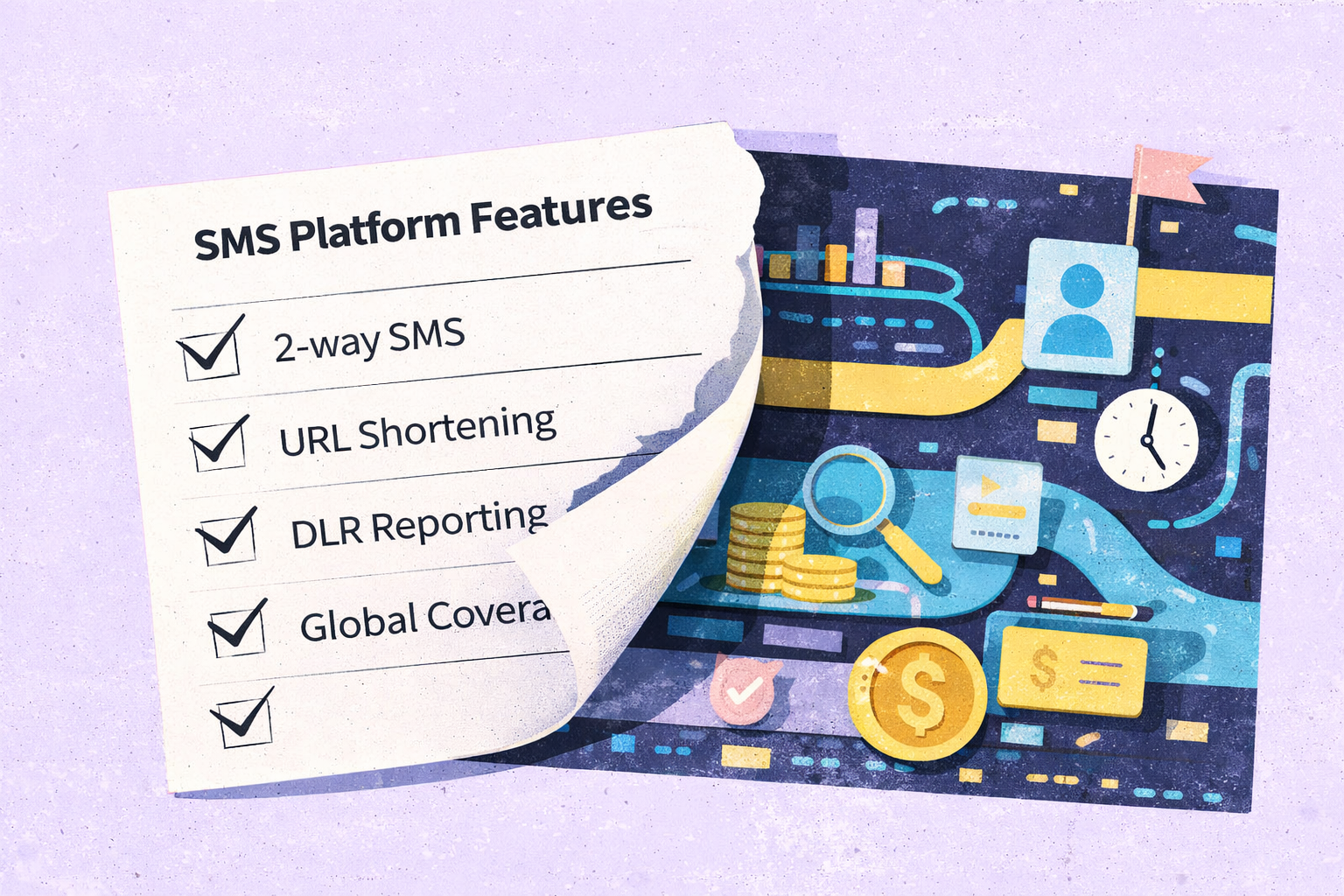
The Feature-List Trap: Why “Same Features” Can Still Lead to Different Results
Most first-time buyers do the sensible thing. They compare vendors side by side, line up the features, and choose the one that appears to cover more.
It feels objective. Clean. Low risk.
And it is exactly how teams end up surprised after go-live.
In business texting, the same feature set can sit on top of very different delivery realities. Two providers can both offer two-way SMS, DLR reporting, URL shortening, opt-outs, global coverage, and number management, yet still behave very differently once real traffic starts moving.
That does not always mean one vendor is lying. More often, it means the feature list describes capability, while SMS outcomes depend on what happens underneath the interface.
That gap is the story buyers need to evaluate.
Inputs vs Outcomes in Business Texting
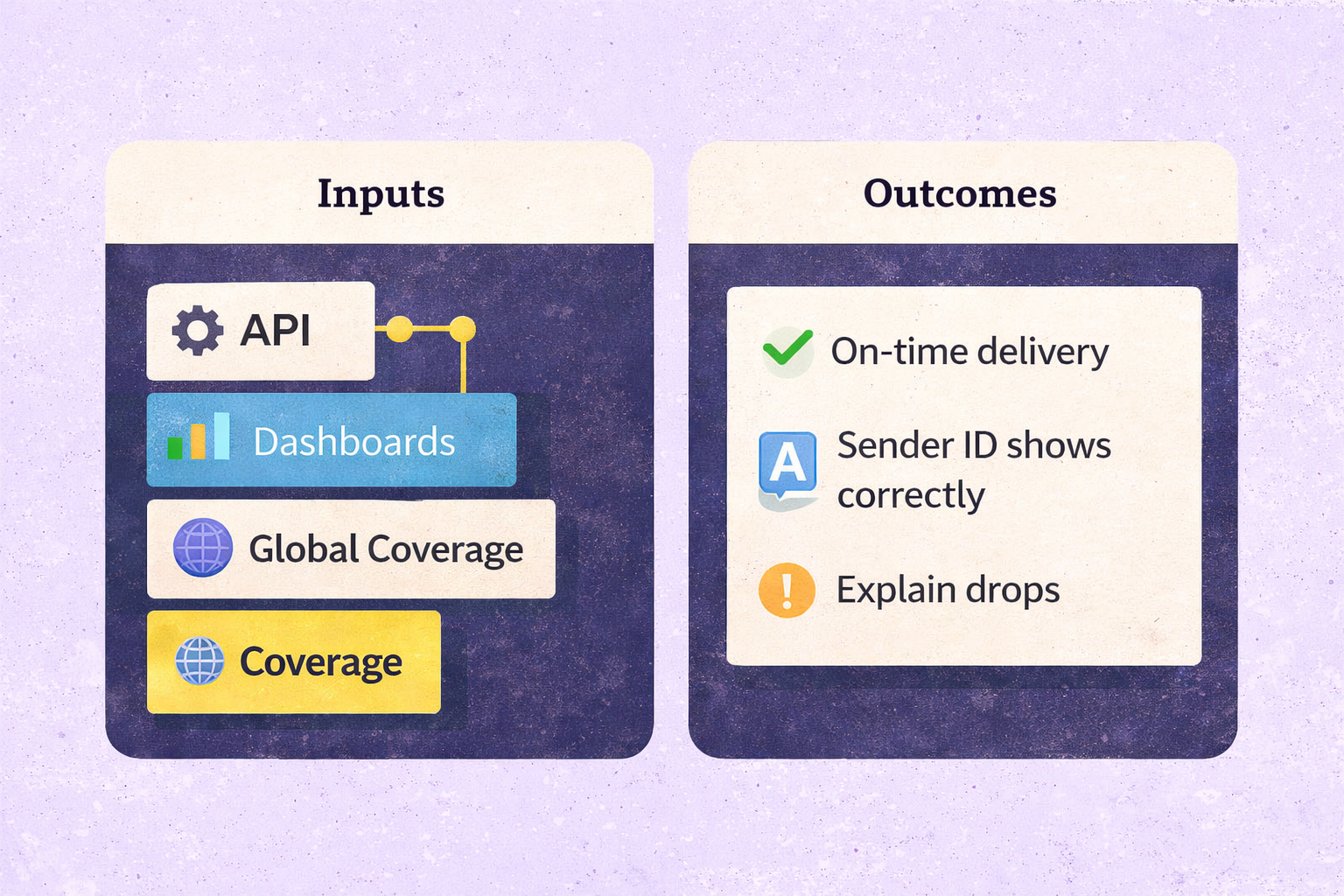
A checklist usually measures inputs:
- what the platform exposes through APIs, dashboards, and webhooks,
- what the platform supports in theory across countries and sender types,
- what the platform can configure through templates, routing rules, or reporting settings.
But buyers do not actually purchase inputs. They purchase outcomes:
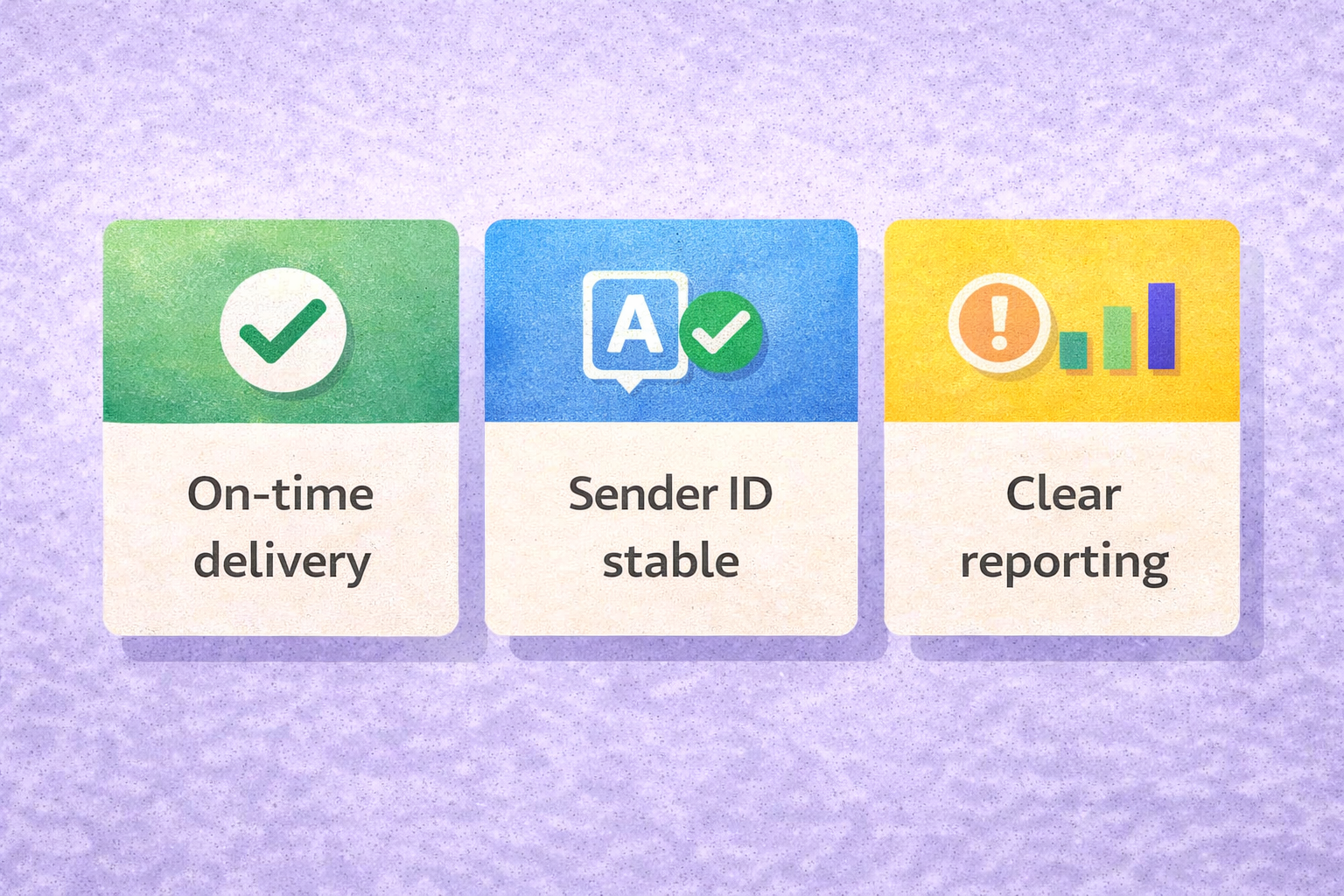
- Do messages arrive on time in the countries that matter?
- Does sender identity show up consistently?
- When performance drops, can someone explain what changed?
- Can cost still be predicted when volume grows?
Features are easy to list. Outcomes are harder to earn.
And outcomes are often shaped by things that never fit neatly on a marketing page: destination rules, route behavior, filtering pressure, traffic patterns, and whether the provider can notice change early and respond well.
If your team still treats the platform as the final controller after send, it helps to first understand what an SMS platform cannot control.
7 Things a Feature List Cannot Guarantee
1) Destination-specific rules can override “supported features”
A platform can technically support a sender type and still see it behave differently across destinations.
Alphanumeric sender IDs, long codes, short codes, toll-free numbers, and registered sender programs do not behave the same way everywhere. Whether a sender displays correctly, needs registration, gets replaced, or is treated cautiously can depend on local rules and carrier policy.
That is why “supported” is not the same as “works reliably in your top markets.”
A better mindset is simple: treat every destination like its own environment until proven otherwise.
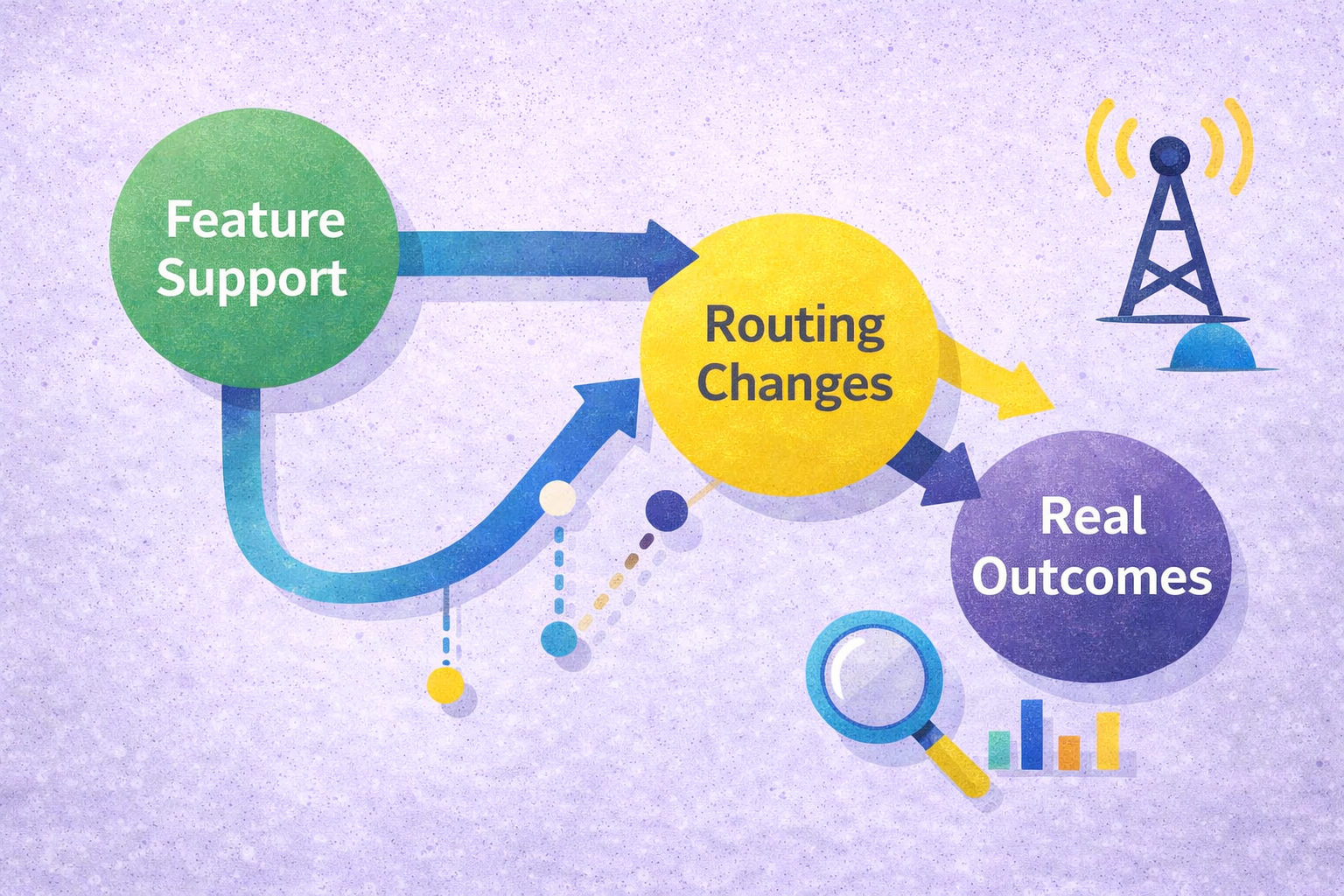
2) Routing changes can affect results even when your code does not change
Teams often investigate SMS problems like software problems: “What changed in our application?”
Sometimes nothing changed.
Routes can shift because a provider changes routing policy, adds a fallback, reacts to congestion, swaps suppliers, or rebalances cost and performance. Those changes can affect delivery time, delivery rate, or content treatment even when your payload is unchanged.
If your evaluation stops at “Do you support feature X,” you are ignoring the layer that often explains real-world variance.
For a clearer beginner map of that underlying path, see how SMS platforms connect to mobile networks.
3) Sender identity behaves differently by country and carrier
Sender identity is not just a field in a dashboard. It is a set of operational constraints.
- Some destinations strongly prefer registered senders.
- Some carriers treat unknown senders harshly at scale.
- Some sender types are acceptable for marketing but risky for urgent alerts.
- A sender that works during a small pilot may behave differently once volume ramps.
You do not need to memorize every country rule. You do need to force the vendor conversation to become country-specific.
4) Filtering and throttling respond to trust signals and traffic patterns
This is the part that surprises many first-time buyers.
Carriers protect users and network stability. They may delay, throttle, filter, or reject traffic based on signals such as complaint rates, opt-out handling, content patterns, sudden spikes, or sender reputation.
A vendor can list “high throughput” as a feature. That does not mean your traffic will be treated the same at 10,000 messages per day and at 1 million per day. It also does not mean every destination will allow the same pacing.
When urgency matters, being late can be functionally close to not being delivered at all.
5) Reporting quality determines how quickly you can explain a drop
Most vendors have “reporting.” The real question is whether reporting helps you answer the only question that matters during an incident:
What changed, where, and why?
A feature list may promise DLRs, dashboards, and analytics. In practice, what you need is:
- country-level and carrier-level visibility where available,
- clear segmentation by sender, route, and message type,
- exportable logs,
- a way to distinguish queued, sent, accepted, delivered, and delayed states.
Weak reporting does not just reduce visibility. It increases response time, stress, and internal guesswork.
6) Support and escalation determine how long a problem lasts
Feature lists rarely explain what happens when performance drops on a Tuesday afternoon.
Who do you contact? How fast do you get a real response? What information do you receive? Do updates come to you, or do you chase them?
In SMS, even a “small” delivery issue can create a business issue quickly: missed alerts, broken onboarding, support tickets, churn, or wasted spend.
Operational response time is part of product quality, even when it is not presented as a feature.
7) Pricing terms decide the real cost per successful message
“Low price per SMS” is one of the easiest checkboxes to love and one of the easiest to misread.
Real cost is shaped by:
- destination-specific fees and surcharges,
- sender registration costs or timelines in some markets,
- retry behavior and failure billing,
- routing decisions that affect downstream performance,
- minimum commits, overages, and contract terms.
A cheap message that arrives late can become an expensive business outcome.
7 Questions That Beat Any Feature Checklist in a Vendor Call
The goal of these questions is not to trap the vendor. It is to move the conversation from claims to evidence.
1) Which routes will carry our top destinations, and what is the fallback plan?
Ask for a destination-by-destination answer for your priority markets.
A solid answer explains routing posture by country, how fallback works, and what the provider optimizes for when routes change.
2) How do you detect, approve, and communicate route changes?
Route changes happen. The real issue is how they are handled.
Look for monitoring, approval logic, notification behavior, and rollback thinking. “We handle that for you” is not enough if you get no visibility.
3) Which sender types work per country, and what requires pre-registration?
This is where many feature-list comparisons collapse.
Ask for concrete country notes, onboarding steps for registration-heavy markets, and how sender behavior is tested before scale.
4) What delivery and latency visibility will we get by country and carrier?
You are not buying charts. You are buying the ability to explain outcomes.
Ask to see a real report sample, exportable logs, and whether delay can be viewed or inferred by destination.
5) How do you handle filtering spikes, throttling, and carrier incidents?
A mature provider treats these as normal operating realities, not rare surprises.
Listen for monitoring signals, response playbooks, mitigation order, and incident communication cadence.
6) What does escalation look like when delivery drops today?
Ask for the human process, not just the support email.
You want to hear escalation tiers, expected response speed, what information you will receive, and whether updates are proactive.
7) Which fees and terms change the real cost at scale?
Ask directly about surcharges, retries, minimums, overages, contract flexibility, and how pricing interacts with routing choices.
If pricing cannot be explained simply, it will be difficult to forecast and defend internally.
What “Proof” Looks Like Before You Trust the Feature List
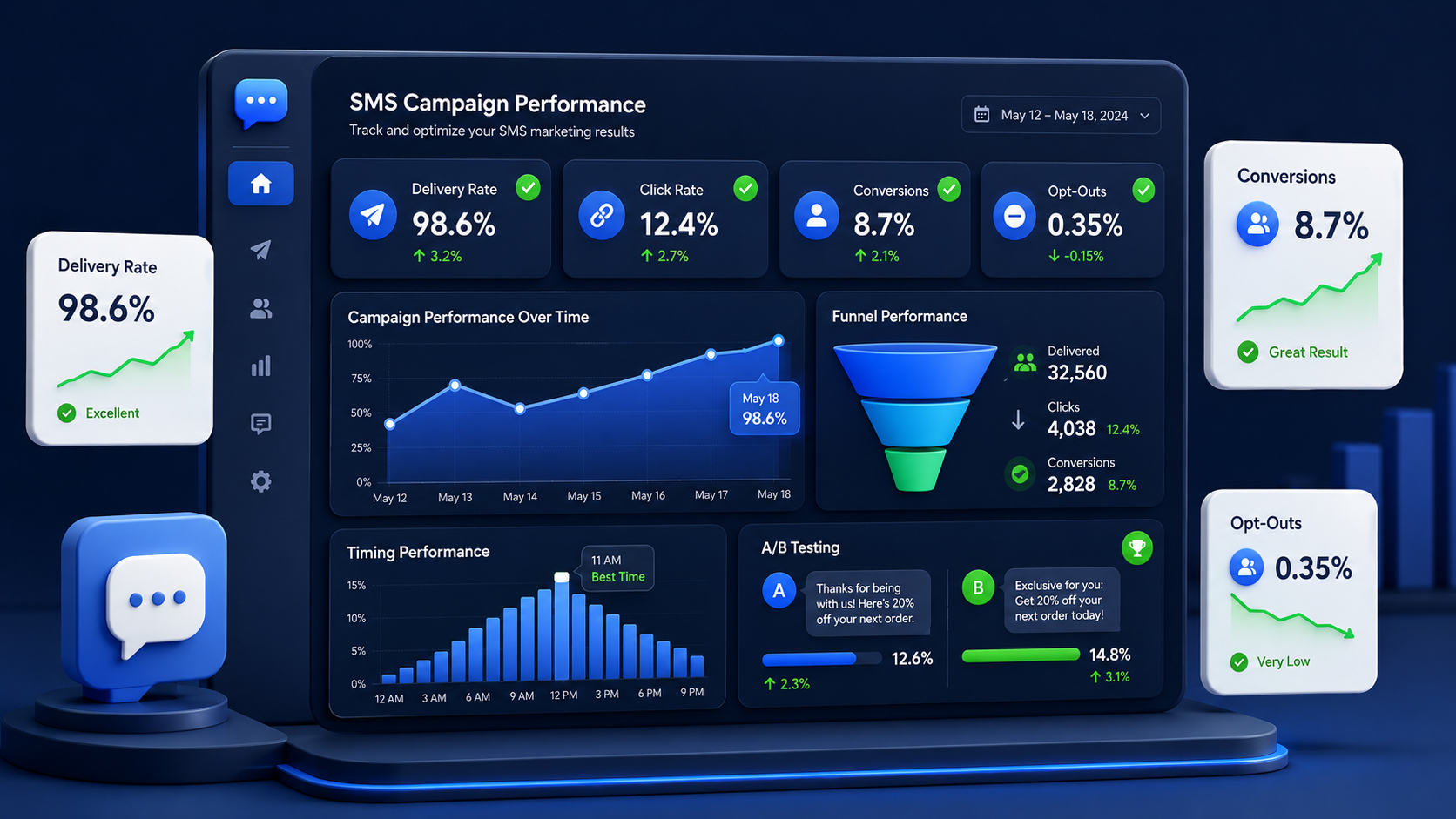
A real delivery report sample and exportable logs
Ask to see an actual export.
You want to know whether performance can be segmented by destination, sender, message type, and where possible by carrier. You also want enough status clarity to distinguish delayed traffic from healthy traffic.
If reporting cannot be demonstrated, you are being asked to buy blind.
Country coverage notes with sender constraints and compliance requirements
A serious provider should be able to show usable country notes covering:
- recommended sender types,
- registration requirements and timelines where relevant,
- known restrictions,
- opt-out expectations and handling.
This does not need to be a giant document. It needs to be honest and usable.
Incident examples with timelines, root causes, and fixes
Ask for anonymized incident examples.
A useful example shows what changed, how it was detected, what mitigation happened first, how long stabilization took, and what changed afterward to reduce recurrence.
Operational commitments that match the contract
Feature pages are marketing. Contracts and operating commitments are reality.
Check whether response expectations, change communication, data access, and service boundaries all match what the vendor is promising verbally.
A Beginner-Friendly Pilot Plan Before You Commit
If you only take one action beyond reading an SMS platform feature list, make it this: pilot with intent.
Pick 3–5 priority countries and 2 message types
Choose destinations that reflect real business risk, not just the easiest markets.
Then test at least two message types, such as:
- marketing or engagement traffic,
- transactional alerts.
If you send verification codes, treat those as a stricter test case because the tolerance for delay is much lower.
Define success as on-time outcomes, not “sent” status
Before the pilot starts, define what “good” looks like.
Examples:
- delivery within a use-case-specific time window,
- stable sender display behavior,
- low day-to-day variance,
- clear visibility into failures and delays.
A pilot that only measures API accepted or delivered eventually is a pilot that hides risk.
Test sender behavior, opt-out handling, and peak pacing
Include at least one controlled ramp:
- start at low volume,
- increase in steps,
- include a time-of-day spike that resembles real traffic.
The point is to see whether performance remains stable as traffic patterns change.
Track variance, not just averages
Averages can look healthy while the slower tail gets worse.
That slower tail is often where business pain starts, especially for time-sensitive traffic.
If this is part of a broader quality review, how to improve SMS deliverability is a useful companion read.
Use a simple pass / needs work / no-go rubric
For each priority country and message type, decide:
- Pass: performance and visibility match requirements.
- Needs work: acceptable with changes such as sender registration, pacing changes, or route adjustments.
- No-go: not acceptable for the intended use case.
This keeps the evaluation usable even for non-technical buyers.
Red Flags: When Feature Talk Is Hiding Operational Risk
“Global coverage” with no country-level constraints
Coverage without constraints is a slogan.
If a vendor will not discuss sender limitations, registration requirements, or destination differences, expect surprises.
“We’re direct” used as a shortcut instead of evidence
Labels like “direct” or “aggregator” do not guarantee outcomes by themselves.
What matters is whether the provider can explain routing posture by destination, show performance evidence, and describe fallback behavior.
No reporting sample, no escalation path, no change communication
If you cannot see the reporting artifact, you do not know what you will be able to debug.
If you cannot see the escalation path, you do not know how long a problem might last.
If you cannot hear how changes are communicated, you do not know what may shift underneath you.
Pricing that blurs surcharges, retries, minimums, or routing tradeoffs
If pricing cannot be explained clearly, it will be hard to forecast and harder to defend later.
One-Page Buyer Checklist for Internal Alignment
| What to validate | Ask the vendor | What a solid answer includes |
|---|---|---|
| Top destinations | “Which routes carry our top 5 countries?” | Country-by-country routing posture and fallback plan |
| Route change handling | “How do you approve and communicate route changes?” | Monitoring, approval process, notification, and rollback behavior |
| Sender constraints | “Which sender types work per destination?” | Country notes, registration requirements, and timeline expectations |
| Visibility | “Can you show a real delivery report export?” | Segmentation by destination, sender, type, plus clear statuses |
| Incident response | “What happens when delivery drops today?” | Escalation tiers, response expectations, and update cadence |
| Filtering and throttling | “How do you mitigate filtering spikes?” | Pacing, routing, sender, and content playbooks with examples |
| Cost clarity | “What changes total cost at scale?” | Surcharges, retries, minimums, overages, and fee presentation |
If you only use feature checklists, you compare vendors on what is easiest to claim. This checklist forces the comparison onto what is harder to fake.
Where This Fits in a Broader SMS Platform Comparison
Feature lists still have value. They help you avoid obvious mismatches.
But after you confirm the basics, your evaluation should shift toward the factors that affect outcomes most:
- routing stability in your real markets,
- sender identity reliability by destination,
- visibility when performance changes,
- operational response when delivery drops,
- cost predictability as volume and country count expand.
If your stakeholders are still mixing up the operational layer and the send interface, SMS platform vs SMS gateway can help clarify the difference between connectivity language and actual operating control.
FAQ
Are SMS platform features still useful when comparing vendors?
Yes. A feature list is still a useful starting point because it helps you quickly see what a platform offers. The problem is not the feature list itself. The problem is treating it as enough evidence to predict delivery outcomes, sender behavior, reporting quality, or operating reliability in real markets.
Why can two SMS providers with similar features perform so differently?
Because similar features do not guarantee similar operating conditions underneath the platform. Results can differ based on routing choices, destination rules, sender registration requirements, filtering pressure, reporting visibility, and how the provider responds when performance changes.
What matters more than an SMS platform feature list?
For most buyers, the higher-value checks are country-by-country routing posture, sender fit by destination, visibility into delays or failures, escalation quality, and whether pricing stays predictable as traffic scales. Those are the factors that usually explain what happens after messages are submitted.
Should I ignore “global coverage” claims?
No, but you should treat them as a starting claim, not a final answer. “Global coverage” only becomes meaningful when the provider can explain destination constraints, sender requirements, fallback behavior, and any limits that affect your actual use case.
What is the best way to test an SMS provider before signing?
Run a small but realistic pilot. Choose a few priority countries, test more than one message type, ramp traffic in steps, and define success based on on-time outcomes rather than “sent” status alone. That is usually a more reliable evaluation method than comparing feature pages side by side.
Can a low SMS price still become expensive in practice?
Yes. A low per-message rate can still lead to higher real cost if surcharges, retries, delivery delays, sender registration requirements, or weak routing decisions create business loss later. That is why buyers should compare cost per successful outcome, not just cost per submitted SMS.