An SMS platform connects to mobile networks by passing your message into carrier-facing connections (directly or via aggregators) and managing the “rules of acceptance” around identity, routing, pacing, and reporting.
That’s why an API request can succeed while real-world delivery still varies by country, carrier filtering, and route quality. Many teams first notice this gap when messages look “sent” in logs, but customers never receive them.
This guide focuses on connectivity: how messages are accepted, routed, filtered, and reported after your API call—rather than a general ‘what is an SMS platform’ overview. If you’re new to telecom, here’s the promise of this guide: you’ll be able to explain the SMS delivery path in plain English, understand the two common connectivity models, and know what to verify before you scale.
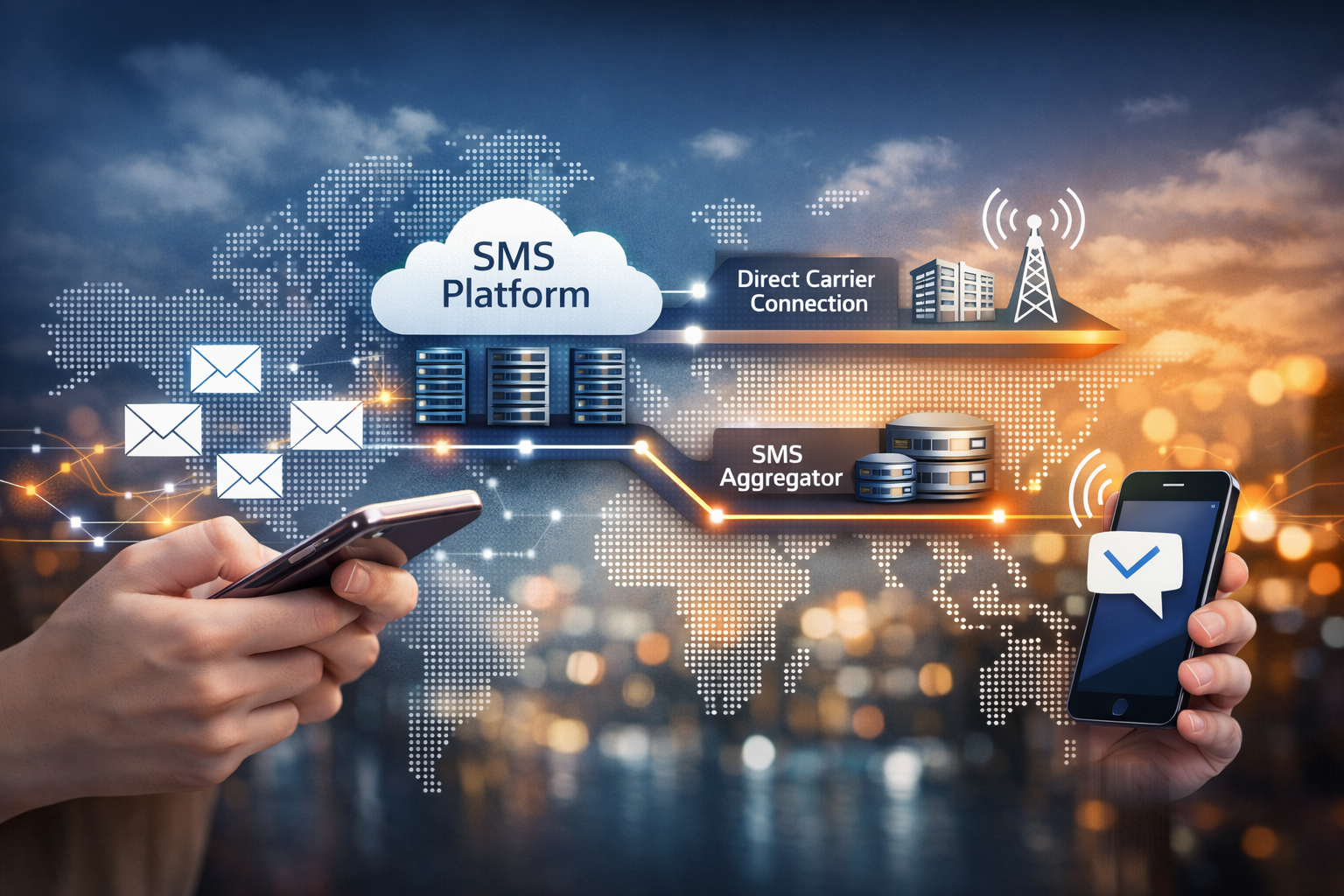
SMS Platform Carrier Connectivity, in Plain English: What It Actually Means
What “carrier connectivity” includes (routing, identity, reporting)
Carrier connectivity means an SMS platform’s ability to get business messages accepted, routed, and reported across multiple mobile networks—not just being technically “connected” to one carrier.
They mean the practical ability to get business SMS accepted and delivered across many mobile networks—consistently—while giving you enough visibility to debug when things go wrong.
In plain English, carrier connectivity usually includes three things:
- Routing: choosing which network path your message will take to reach the destination operator.
- Identity: presenting the sender information (and any required registration context) in a way carriers will accept.
- Reporting: returning delivery outcomes (delivery reports / DLRs) so your team can measure and troubleshoot.
Definition box (keep this mental model):
Connectivity = acceptance + routing + observability.
If any one of those breaks, your “send” may succeed while the customer experience still fails.
Why “API 200 OK” is not the same as mobile network acceptance
An API 200 OK only confirms that your SMS platform accepted the request—it does not mean the mobile network accepted or delivered the message.
It does not automatically mean:
- the carrier accepted the message,
- the route was stable,
- the message cleared filtering,
- the network wasn’t throttling your traffic,
- or the recipient device was reachable.
SMS is ultimately delivered through mobile network infrastructure that is optimized to protect users and keep networks stable. Those networks can delay, throttle, filter, or reject traffic—even if your API request was processed correctly upstream.
The one-sentence mental model beginners can repeat internally
If you need one sentence to align your team:
“An SMS platform isn’t a send button—it’s the layer that gets carrier networks to accept, route, and report on business texts reliably.”
The SMS Delivery Path From Your App to a Phone Number (5 Roles, Not 1 Button)
Where an SMS platform sits between your application and carriers
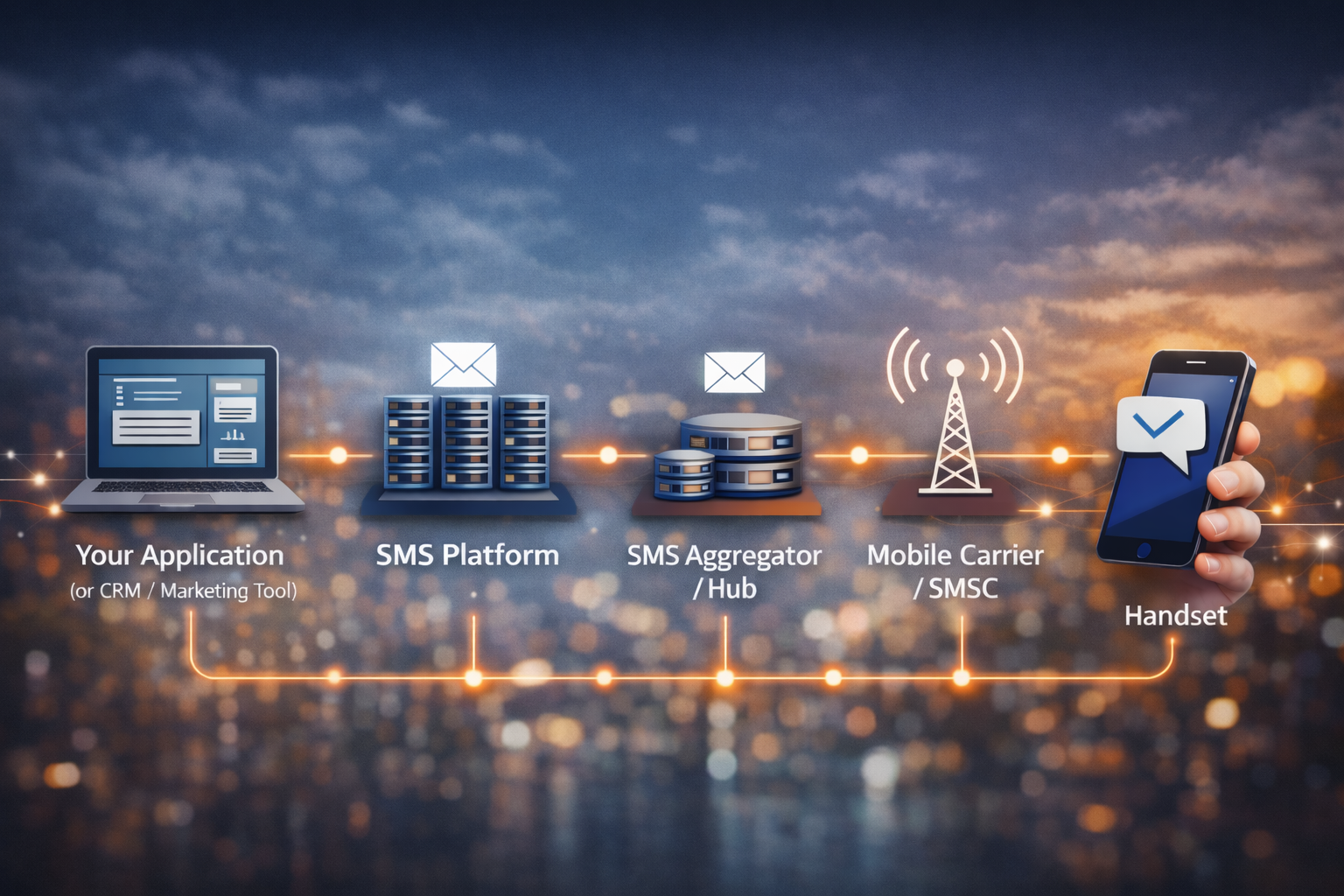
An SMS message passes through several distinct roles—from your application to the handset—and each one can change the final delivery outcome. In most business SMS programs, you’ll see these five:
- Your application(or CRM / marketing tool) decides what to send and to whom.
- The SMS platform takes the request, validates it, applies your sending rules, and chooses a path outward.
- An SMS aggregator or hub may sit in the middle (depending on your provider’s connectivity model).
- The mobile carrier network receives the message and tries to deliver it to the device.
- The handset (recipient device) finally receives the SMS—if it can be reached.
Here’s the key: each role can change the outcome. That’s why “we sent it” can be true, while “they received it” is not.
When delivery rate still looks acceptable but route quality or timing starts to drift, this guide on why delivery rate is not the same as SMS reliability helps explain what to measure next.
Where an SMS aggregator fits when you don’t have direct carrier connections
An aggregator is a company (or network of companies) that already has connectivity into many carriers. Your SMS platform can use aggregators to reach countries and operators where it doesn’t have direct connections.
This is common and often perfectly legitimate. It’s also where a lot of confusion starts—because two providers can both claim “global coverage,” but one might rely heavily on third parties while another has more direct relationships in specific regions.
You don’t need to become an expert in telecom contracts to understand the practical impact. Just remember:
- More intermediaries can mean more variability (routes can change, policies differ, visibility can be weaker).
- Fewer intermediaries can mean more control, but not always more countries.
- “Direct” and “aggregator” are not moral categories. They’re design choices with trade-offs.
SMSC, in plain English: the carrier system that receives and forwards SMS
On the carrier side, you’ll often hear SMSC (Short Message Service Center). You don’t need to memorize the acronym, but you do need the idea:
The SMSC is the carrier’s system that receives SMS messages and forwards them toward the destination device.
Think of it like a carrier’s dispatch center. It decides what to do with your message based on the carrier’s rules, current network conditions, and the destination’s reachability.
Direct Carrier Connection vs SMS Aggregator: What Changes in the Real World
Coverage: what “global SMS coverage” really means at carrier level
“Global SMS coverage” varies by country and operator, because connectivity quality differs even within the same market.
“Global coverage” is not one number. It’s a map.
A provider can cover 200+ “countries” on paper while still having weak connectivity to certain operators within those countries, or limited sender identity options, or restricted throughput for your use case.
When enterprise providers talk about connectivity, they often use proof points like the scale of direct operator connections and global reach as shorthand for network breadth. Treat these as signals, then validate with operator-level performance in your target countries and sender types.
What you should ask is: coverage for my traffic—my countries, my sender type, my message type.
Cost vs stability: why route quality affects delivery outcomes
Route quality directly affects delivery speed, filtering risk, and long-term stability of SMS traffic.
- delivery speed (seconds vs minutes vs “eventually”),
- filtering risk (how aggressively your traffic is inspected),
- blocking and throttling patterns (spikes, sudden drops, inconsistent day-to-day results),
- and long-term stability (whether the path stays consistent as carriers change policies).
Lower-cost routes can be fine for certain use cases, especially early testing. But if your business depends on reliable delivery—password resets, account alerts, time-sensitive promos, or OTP SMS for login verification—route quality can be the difference between “works in staging” and “works every day.”
Visibility: what a provider should show you in delivery reports (DLRs)
Delivery visibility determines whether you can diagnose SMS issues or simply guess when delivery performance drops.
A provider should be able to show you, at minimum:
- delivery status (and meaningful failure reasons, not just “failed”),
- timestamps (queued, sent to carrier, delivered/expired),
- country/operator-level breakdowns (especially for international traffic),
- and the ability to correlate outcomes to sender type and traffic patterns.
If you can’t see where delays or failures happen, you’re not operating SMS—you’re hoping.
Quick comparison box
| Factor | More direct connectivity can help with… | Aggregator-led connectivity can help with… | What to verify either way |
| Coverage | Strength in specific carriers/regions | Faster expansion across many carriers | Which carriers are “strong” for your countries |
| Stability | More consistent paths in some markets | May vary by downstream partners | How often routes change and why |
| Cost | Sometimes higher for premium paths | Sometimes lower and flexible | What quality tier you’re buying |
| Reporting | Potentially clearer handoff points | Can be limited by downstream visibility | Whether DLRs include meaningful failure reasons |
| Support | Direct escalation paths in some cases | Depends on partner chain | Response time and troubleshooting process |

SMS Routing Explained for Beginners: Why Results Vary by Country
How routing decisions are made (preferred routes, fallback, shared routes)
Routing is the decision-making process of choosing _how_ to reach a destination network.
Most SMS platforms use a mix of:
- preferred routes (the default best option for a given destination),
- fallback routes (used when the preferred path fails or degrades),
- and sometimes shared routes (traffic pooled across customers).
This is normal. What surprises beginners is that routing can change underneath them.
That means you can send the same message, with the same code and the same copy, and still see different outcomes from one week to the next.
We’ve seen teams ship the same campaign copy and code, then watch delivery swing week to week—because the route underneath changed, or the network started throttling similar traffic patterns.
Why number portability can change the network behind the same phone number
In many countries, people can keep their phone number when they switch carriers. That’s called number portability.
For your SMS program, the practical implication is simple:
A phone number prefix doesn’t always tell you which carrier owns the destination today.
So routing systems may need extra intelligence to determine the current destination network. If that step is missing or stale, your message can be routed inefficiently or incorrectly, increasing delays and failures.
You don’t need to implement telecom databases yourself to benefit from this insight. You just need to know that “same number format” does not guarantee “same network handling.”
Why latency and queuing make delivery time swing without code changes
Even when messages eventually deliver, delivery time can vary because of:
- queuing (messages waiting inside a platform or downstream partner),
- carrier throttling (networks accepting traffic more slowly during certain periods),
- temporary congestion (regional events, seasonal spikes, major promotions),
- and filtering review (some traffic patterns get extra scrutiny).
This is why “delivery time” is an operational metric, not just a technical one. It can swing even when nothing in your application changes.
Carrier Filtering and SMS Firewalls: Why Messages Get Blocked or Throttled
The beginner triggers that commonly trip carrier spam filters
Carriers don’t treat business SMS as “neutral.” They treat it as traffic that must be evaluated.
Many carriers use filtering systems—often firewall-like in behavior—to inspect and classify SMS traffic before it reaches users.
Common triggers that increase filtering risk for high-volume traffic—especially SMS marketing campaigns—include:
- no clear consent expectation (users didn’t opt in, or it’s not obvious why they’re receiving the message),
- missing or inconsistent opt-out handling (no STOP/HELP behavior where expected),
- sudden volume spikes (going from 0 to very high send rates with no warm-up),
- repetitive content patterns (same copy across huge batches, especially with short links),
- suspicious wording (urgent claims, financial bait, “verify now” style text outside trusted contexts),
- sender identity mismatch (sender type not appropriate for the use case or country).
Filtering isn’t a punishment. It’s the network protecting its users and stability. But it does mean your program must be designed to look trustworthy.
Grey routes explained by outcomes: instability, spikes, and sudden drops
You’ll hear the term grey routes in the industry. The definition varies, but for a non-technical team, the useful understanding is outcome-based:
If a route is “grey,” you often see patterns like:
- delivery looks fine… until it suddenly doesn’t,
- results differ wildly across carriers in the same country,
- throughput is inconsistent (fast one day, throttled the next),
- reporting is vague,
- and troubleshooting becomes “we’ll investigate” without clear explanations.
Whether or not you ever use the term “grey,” you should treat unexplained instability as a routing and trust problem until proven otherwise.
The “safe defaults” checklist: consent, STOP/HELP handling, pacing, content hygiene
If you want a beginner-safe starting posture, adopt defaults that make you look legitimate to networks:
- Consent first: only message users who reasonably expect your texts.
- Clear identity: use the sender type appropriate for that country and use case.
- Pacing controls: avoid sudden spikes; ramp volume; respect quiet hours.
- Content hygiene: keep language clear, avoid overly scam-like urgency, and be careful with links.
- Unsubscribe handling: make it easy, predictable, and consistent.
One more piece matters here: trust. Spoofing and fraud attempts exploit trust, and carriers respond by tightening checks. The stricter the environment becomes, the more your identity and pacing choices affect whether traffic is treated as legitimate.
Delivery Reports (DLRs) Explained: What You Can and Can’t Know From Status Updates
The few SMS delivery statuses that matter for non-technical teams
Most teams only need a small set of SMS delivery statuses to understand whether messages actually reached users. They don’t need 40 status codes. They need a handful of categories:
- Accepted/queued: the platform accepted the request and will attempt delivery.
- Sent to carrier / handed off: the message was passed into the carrier-facing connection.
- Delivered: the carrier reports the message reached the handset (when available).
- Failed / undeliverable: the message could not be delivered (often with a reason).
- Expired: the network stopped trying (time-to-live exceeded).
The key point: many “success” statuses are handoff statuses, not customer-experience statuses.
Where “sent” ends and where “delivered” begins in the chain
“Sent” often means: your provider handed the message to the next system.
“Delivered” usually means: the carrier reports the message reached the device.
Between those two, a lot can happen:
- the carrier can throttle acceptance,
- filtering can delay or block,
- the device can be out of coverage,
- the number can be invalid or unreachable,
- or the destination network can behave differently than expected.
So when someone asks, “Did it go out?” a better operational question is:
“Which system is saying what—and at what timestamp?”
What to log to debug connectivity issues without deep telecom expertise
To debug like a grown-up (without becoming a telecom engineer), log the minimum evidence:
- message ID
- destination country (and operator, if available)
- sender type/sender ID
- timestamps: requested → queued → handed off → final status
- final status + failure reason (if any)
- send rate at the time (approximate throughput / batch size)
Then use a simple rule: change one variable at a time when testing.
If results differ only by country, you likely have a connectivity or policy difference.
If results differ only by volume, you likely have pacing, filtering, or throughput constraints.
If results differ only by content, you likely triggered filtering.
A Beginner Connectivity Verification Checklist Before You Scale Business SMS
Questions to ask an SMS provider about carrier connectivity and routing transparency
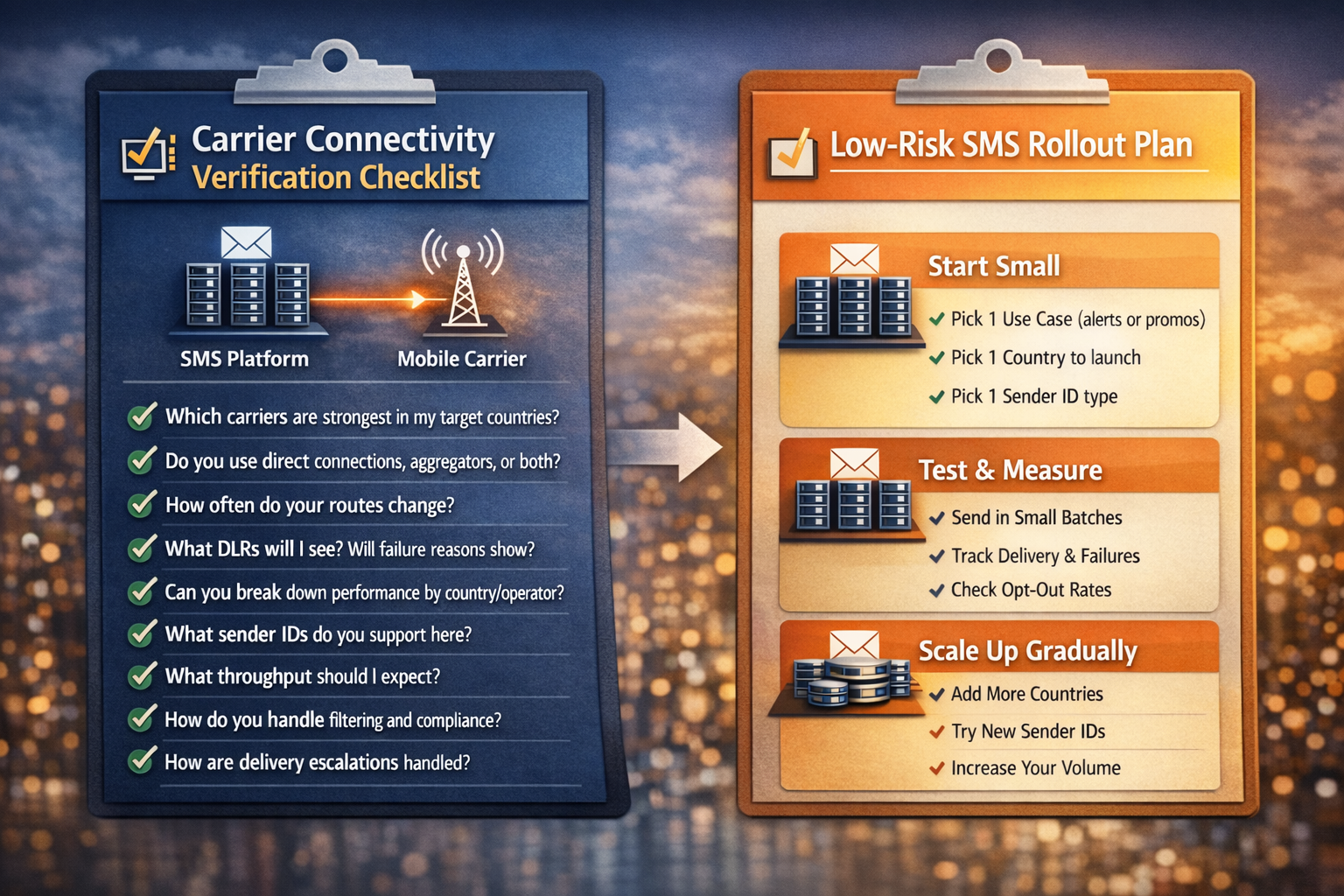
Here’s a copy/paste checklist you can use with any provider. You’re looking for clarity, not buzzwords:
- For my top countries, which carriers are strongest for your traffic today?
- Do you use direct connections, aggregators, or a mix—and where?
- How do you handle route changes? What triggers a change? How often do they happen?
- What visibility do I get in DLRs? Can I see failure reasons and timestamps?
- Can you break down performance by country and operator?
- What sender types do you support per country? Any registration requirements?
- What throughput should I expect for my use case? What throttling is normal?
- What are your default pacing and retry behaviors? Can I control them?
- How do you handle filtering and trust issues? What do you recommend as safe defaults?
- What does escalation look like when delivery drops? Response times, process, and required evidence.
Mid-article nudge (light, not sales):
If you’re comparing vendors, use this checklist to force the conversation into specifics. The “connectivity story” should become measurable within a week of small-scale testing.
A low-risk rollout plan: small batches by country, sender type, and use case
A beginner-safe rollout is boring on purpose:
- Pick one use case (e.g., account alerts through an SMS notification service or promotions, not both).
- Pick one country (or a small set with similar rules).
- Pick one sender type appropriate for that market.
- Send small batches, measure outcomes, and only then expand.
Then scale by changing one dimension at a time:
- add countries,
- add sender types,
- increase volume,
- expand use cases.
This prevents the classic mistake: launching globally, at peak volume, with no baseline.
Pacing and retry defaults that reduce throttling and surprise blocking
You don’t need perfect rules on day one. You need safe defaults:
- rate limit by destination (so one country doesn’t overwhelm a shared queue),
- ramp up volume instead of spiking,
- use sensible retries (retrying too aggressively can look like spam),
- avoid sending promotional SMS late at night in the recipient’s local time,
- and monitor opt-outs and complaints as early warning signals.
Scaling SMS is less about clever copy and more about consistent operations.
When You Want a Second Set of Eyes: What to Bring to a Connectivity Review
Your use case, target countries, and sender identity plan in one page
If you want meaningful feedback from a provider (or a specialist), bring a one-pager that answers:
- What is the message type (transactional, marketing, OTP/2FA)?
- Which countries and regions matter most?
- What sender identity do you intend to use in each market?
- What does “success” mean (delivery rate, latency, opt-outs, conversions)?
The goal is to avoid vague advice. Specific inputs produce useful outputs.
One week of delivery data: the minimum evidence that makes a review useful
Bring one week of logs at minimum:
- totals by country
- delivery outcomes and delay distribution
- top failure reasons (if available)
- volume patterns (spikes, schedules)
- content patterns (are you repeating the same template?)
Even a small dataset is enough to spot common issues: route instability, filtering patterns, throughput caps, and sender mismatches.
What a practical rollout plan should include (without overengineering)
A good rollout plan doesn’t read like a telecom textbook. It includes:
- which markets you’ll launch first and why,
- what sender types you’ll use (and required registrations),
- pacing and retry rules,
- monitoring and alerting thresholds,
- and an escalation path when performance changes.
If your team is about to launch in new countries—or you’re seeing unexplained swings—ask your provider for a connectivity review and a rollout plan. You’ll get value faster when the conversation is anchored in real delivery data, not platform buzzwords.
And if you’d like a second set of eyes, the team at SMS Boosting regularly reviews carrier connectivity, routing stability, and sender configuration for growing SMS programs. Bring your data. We’ll help you identify where the chain breaks and what to fix first.
FAQs: Questions Beginners Ask About How SMS Platforms Connect to Mobile Networks
Can I send business SMS without an SMS platform?
Sometimes, yes—especially for small volumes or very limited local use cases.
But once you care about reliability, reporting, pacing controls, sender identity options, and multi-country behavior, you’ll end up recreating pieces of an SMS platform anyway (or living without them). Most teams choose a platform because operations matter more than the first API call.
Is direct carrier connectivity always better than an aggregator?
Not always.
Direct connectivity can improve stability and visibility in certain markets. Aggregators can expand reach quickly and simplify global coverage. The right answer depends on your countries, your sender type, your volume, and how much transparency you need.
Ask for measurable evidence: performance by operator, reporting detail, and route-change behavior.
Why do two countries behave differently with the same message?
Because the network environment is different:
- sender identity rules differ,
- filtering policies differ,
- throughput constraints differ,
- and routing options differ.
Treat each country like a distinct operating environment. Start small, measure, then expand.
Why do I see ‘sent’ but not reliable delivery?
Because “sent” often means your provider accepted the request or handed it off—not that the handset received it.
Unreliable delivery commonly traces back to:
- filtering and trust signals,
- route changes,
- sender identity mismatch,
- throughput/pacing issues,
- or market-specific restrictions.
Use delivery timestamps and failure reasons (when available) to locate where the chain breaks.
What is SMPP, and do I need to understand it?
SMPP is a protocol commonly used for carrier-facing SMS connections. You don’t need to master it to operate SMS.
What you do need is the operational understanding: **there are multiple connection layers**, and some are closer to carriers than others. That closeness can affect speed, stability, visibility, and what controls are available.
What should I measure first: delivery rate, delay, or opt-outs?
Start with three basics:
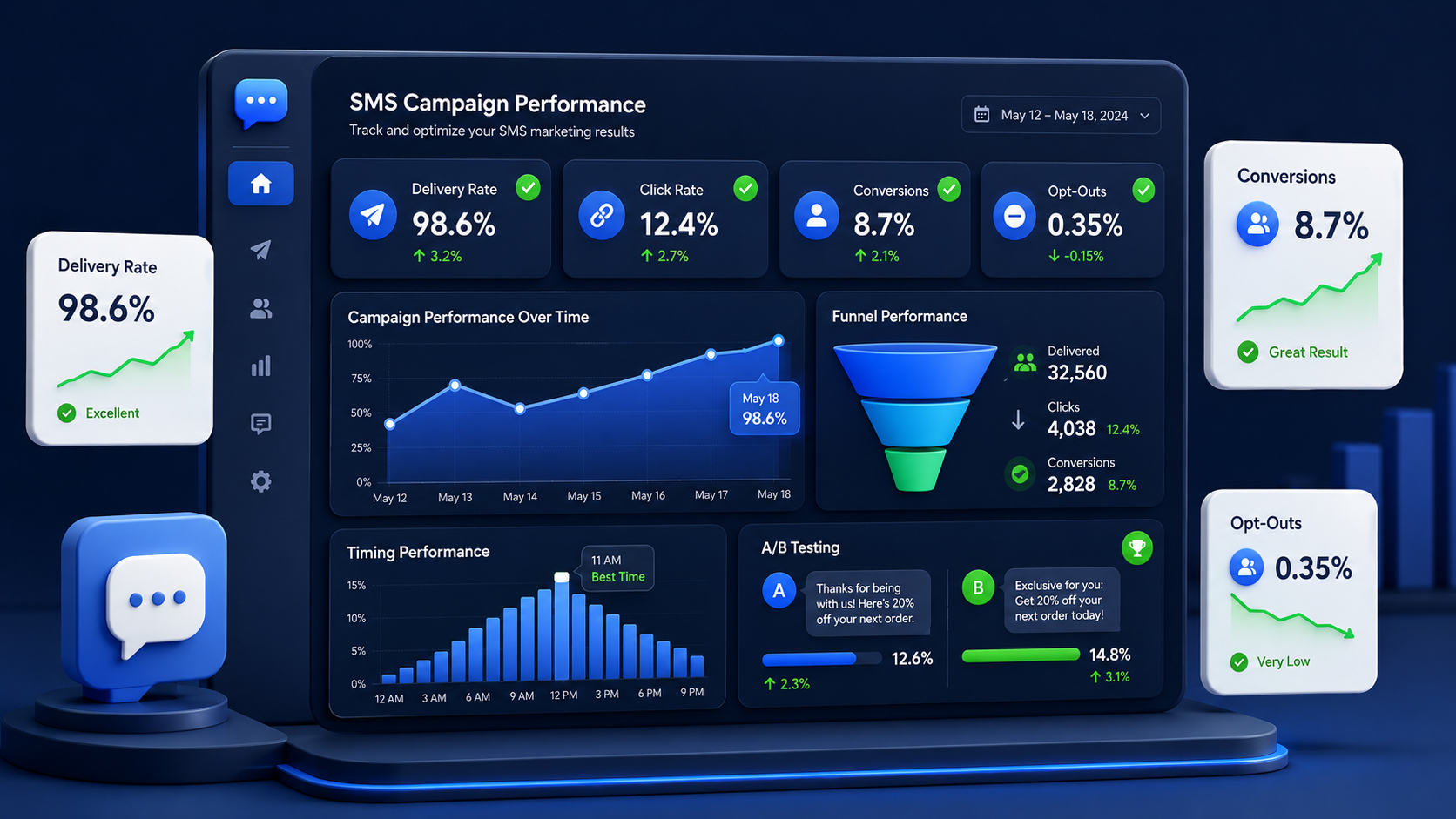
- Delivery rate (are messages arriving at all?)
- Delay distribution (are they arriving quickly enough for the use case?)
- Opt-outs/complaints (are you damaging trust?)
If you only optimize delivery rate while ignoring opt-outs, you can “win the network” and lose the customer.