
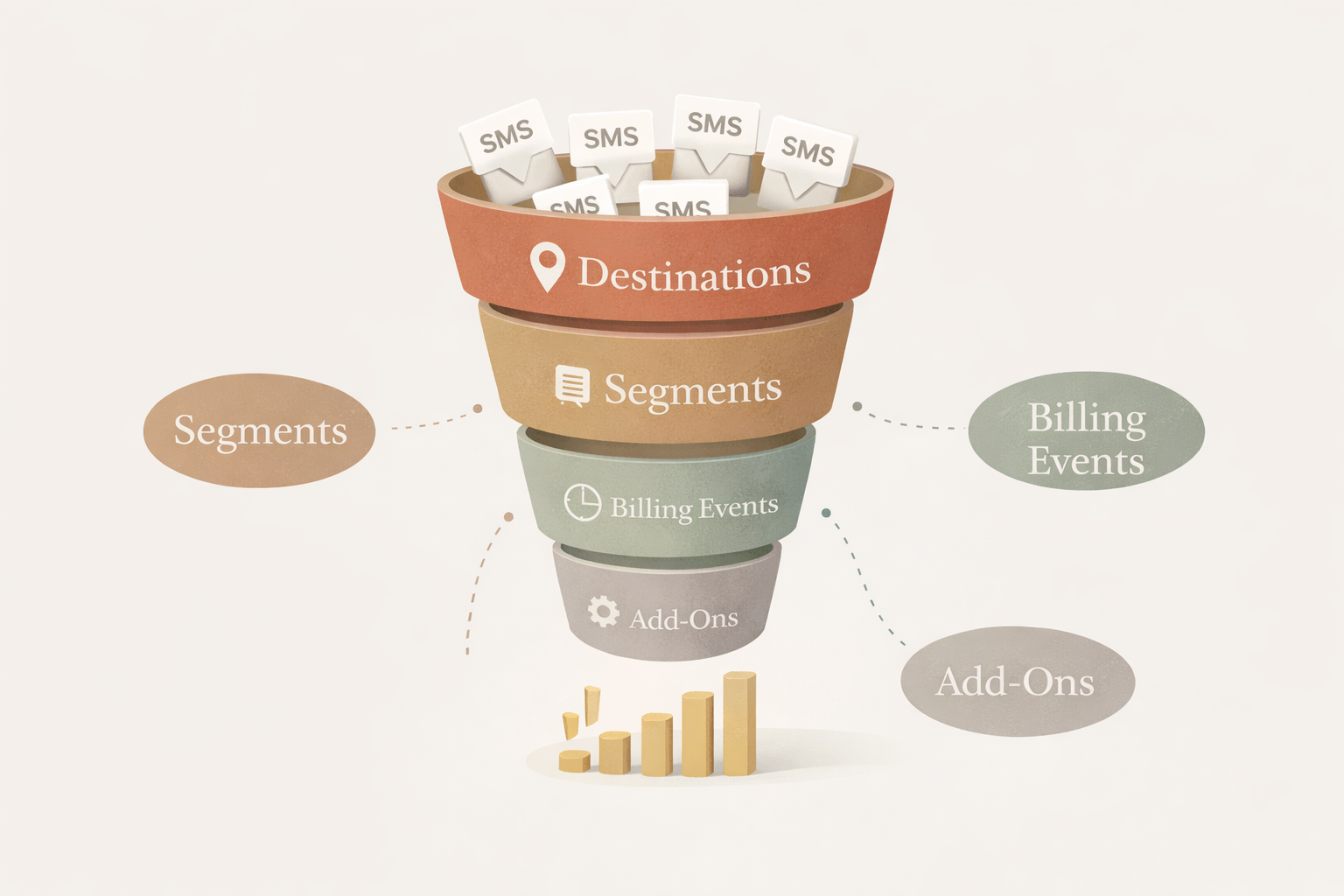
At scale, SMS costs are driven less by the headline per-message rate and more by billing rules that multiply—segments, destination mix, billing events, and add-on fees. Once volume grows, small assumptions in any one of those areas can turn a stable budget into a moving target.
What Counts as “One SMS” in SMS Pricing Models
Here’s the first gotcha that shows up on real invoices: you don’t always pay for “a message.” You often pay for message segments.
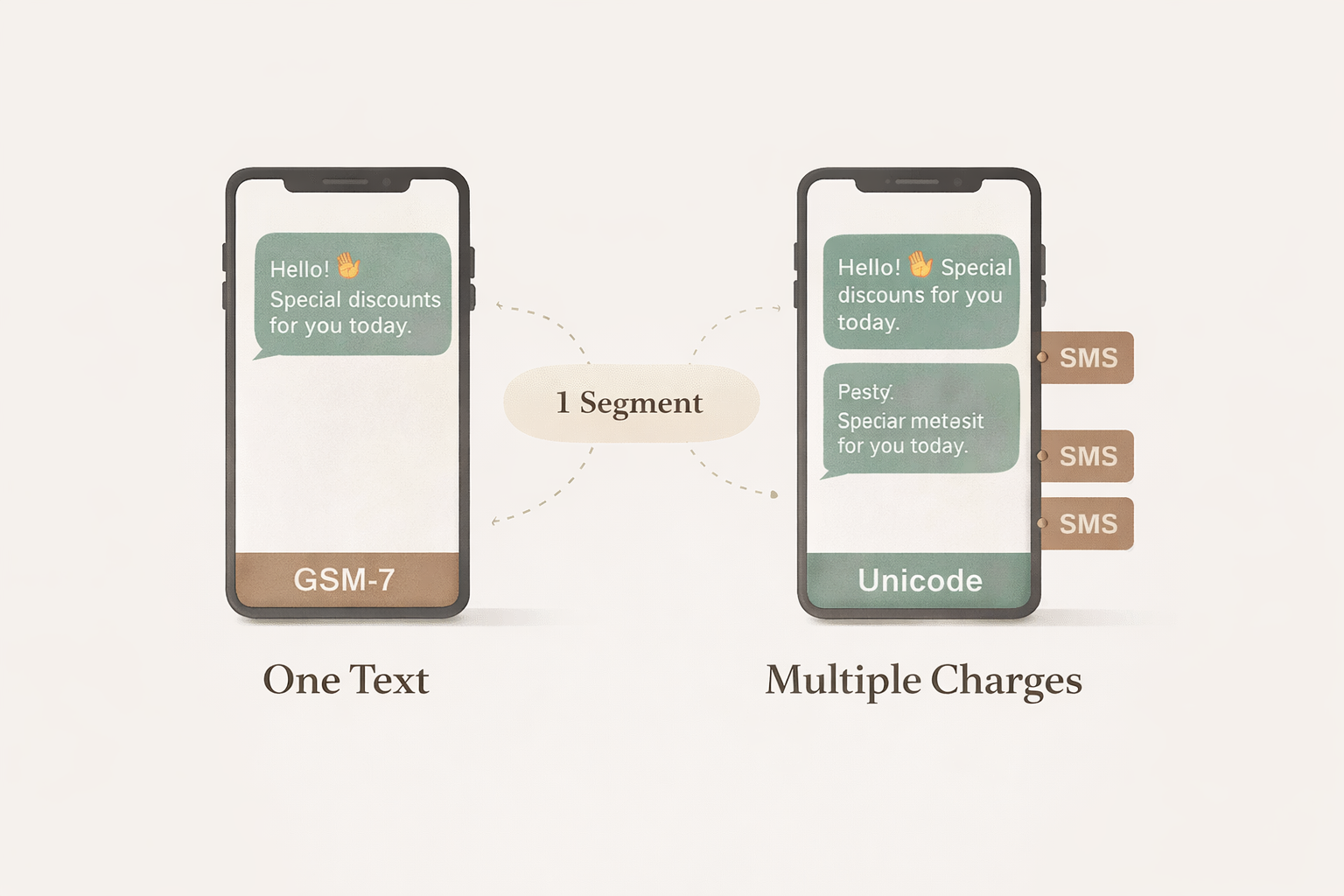
A segment is the billable unit many providers use behind the scenes. If your content does not fit in one segment, it is split (concatenated) into multiple segments and billed accordingly.
How GSM-7 vs Unicode Changes Your Billable SMS Segments
SMS can be encoded in different character sets:
- GSM-7: common Latin letters, numbers, and basic punctuation
- Unicode (often UCS-2): anything outside GSM-7, such as emojis, many non-Latin scripts, and special symbols
Why you care: Unicode typically allows fewer characters per segment, so the same message can cost more.
How Concatenation Turns 1 Message Into 2–4 Billable Segments
Two rules of thumb most teams use:
- GSM-7: around 160 characters for a single segment; 153 per segment when concatenated
- Unicode: around 70 characters for a single segment; 67 per segment when concatenated
So a message that looks like “one text” to a marketer can be 2–4 billable segments on your invoice.
How to Estimate Segment Count Before You Send (A 30-Second Rule)
A quick way to avoid surprises:
- Check whether the message contains Unicode, such as emoji, non-Latin characters, or special symbols.
- Count characters.
- Estimate segments using the 160/153 or 70/67 thresholds.
If you want a practical habit, keep a simple segment factor in your budget model, such as 1.0, 1.2, or 1.5, and update it monthly based on what you actually send.
How Destination Mix Changes SMS Costs at Scale (3 Ways Blended Cost Drifts)
Scaling SMS almost always means adding destinations: new countries, new carriers, and new user bases. That is where a cheap per-message quote turns into “why did our blended cost change?”
How Country Rate Cards Work (and What They Don’t Tell You)
Most providers price SMS by destination using a rate card. Even if your product is the same, costs can vary widely across countries and networks.
What rate cards rarely tell you clearly, unless you ask:
- whether fees are submit-based or delivered-based
- whether there are pass-through fees or surcharges
- whether specific sender types require registration in that country
Why Adding 1 Country Can Change Your Average SMS Cost
This is the math that catches people off guard:
Your blended cost =
(messages to Country A × rate A + messages to Country B × rate B + …) ÷ total messages
If your traffic shifts—for example, Country B grows from 5% to 20%—your blended cost can move a lot even if your total volume barely changes.
How Local Sender Rules Create Extra Fees or Forced Sender Changes
Sender behavior is not universal. Some destinations:
- restrict alphanumeric sender IDs
- require pre-registration for certain sender types
- have compliance steps that introduce setup fees or delays
Even when your base rate stays the same, sender requirements can introduce new fixed costs or force you into a different sender option with different pricing.
If destination-level variance still feels abstract, why business text messages fail is a useful companion read before you assume one sender setup behaves the same way everywhere.
Which Billing Event Your Provider Charges For (Submit vs Attempt vs Delivered)
When two providers quote the same rate, they can still bill very differently.
The difference is often the billing event: what moment triggers the charge.
If you need a simpler mental model for who controls what after the API call, review what an SMS platform cannot control before you assume a provider owns every downstream decision.
How Submit-Based Billing Impacts Budget Predictability
Submit-based billing means you are billed when the provider accepts the API request and submits to downstream routes.
Pros:
- easier to forecast
- simpler reconciliation
Tradeoff:
- you may pay even when a message fails later because of downstream rules
When Delivered-Based Billing Helps (and When It Doesn’t)
Delivered-based billing charges when a delivery receipt indicates delivery.
Pros:
- closer to a successful outcome for many transactional use cases
Tradeoffs:
- delivery receipts can vary by destination
- delivered does not mean read
- it can create gray areas in dispute or reconciliation
What to Ask About Retries, Replays, and Billable Attempts
This is the quiet budget killer: attempts.
Ask directly:
- Are retries billable?
- If a provider replays the same message on a backup route, is that billed again?
- Are attempts counted separately from messages?
If you do not get a crisp answer, do not assume the best case.
If the handoff path itself still feels fuzzy, how SMS platforms connect to mobile networks gives a clearer beginner-friendly model for what happens between your API request and the destination network.
What Add-On Fees Matter Most in SMS Pricing Models (One-Time vs Monthly vs Per-Message)
New buyers often model SMS cost as:
total spend = volume × rate
In production, it is closer to:
total spend = volume × (segments × destination rate) + billing-event effects + add-ons
Registration and Sender Setup Fees That Hit Before Volume
Some costs arrive before you scale:
- sender registration, depending on destination
- compliance setup
- sender provisioning or activation costs
These can dominate early invoices even at low volume.
Surcharges and Pass-Through Fees That Grow With Destinations
Some destinations include pass-through fees that show up as line items. Even if your per-message rate is stable, these can grow as you add countries or change traffic mix.
Reporting, Support, and Feature Add-Ons That Scale Quietly
As you scale, you start needing:
- better reporting
- more granular status visibility
- support workflows
- cost allocation by product or region
Sometimes these come as add-ons. Sometimes they are included but capped.
How to Explain Any Invoice Spike With a 4-Part Cost Amplification Map
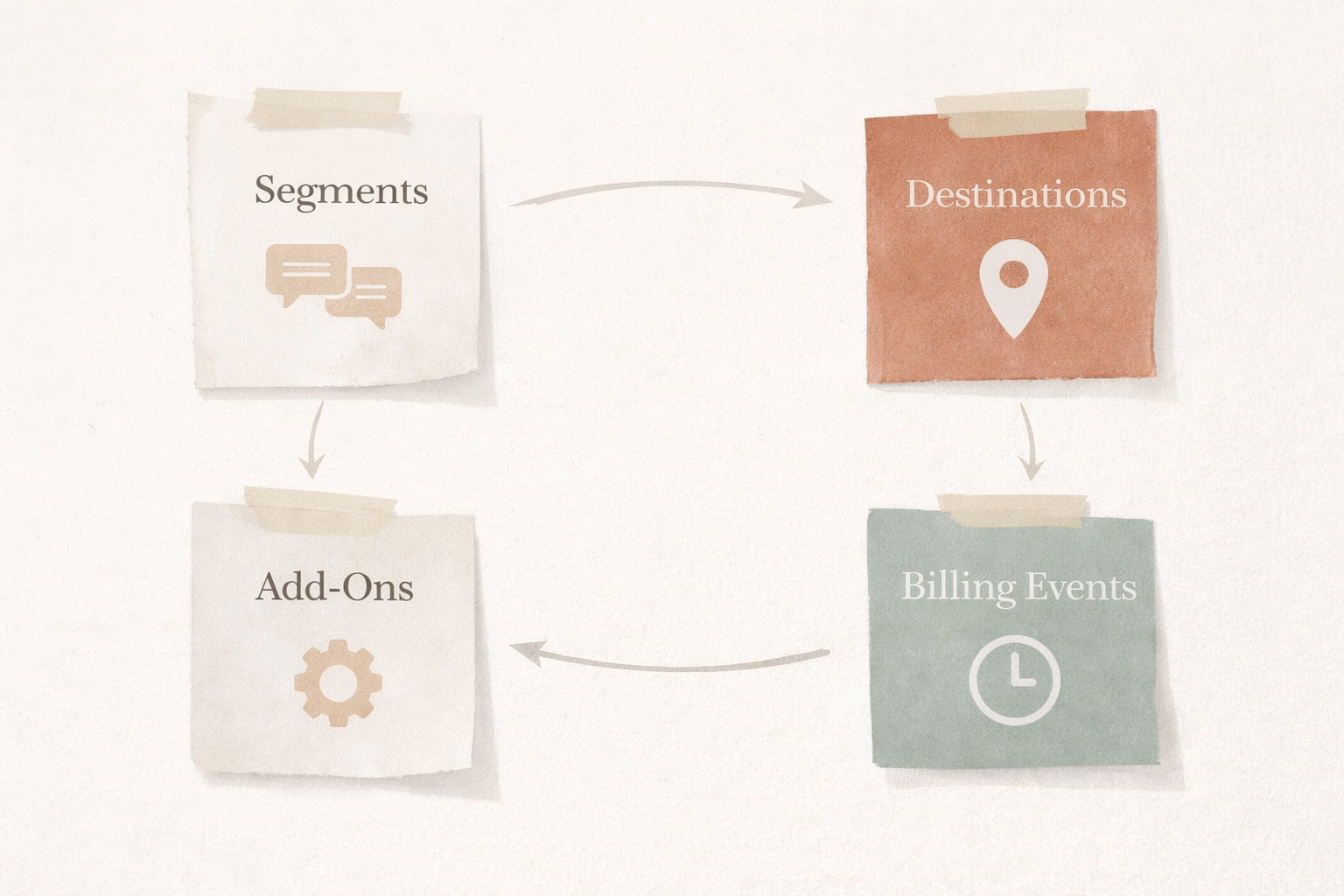
When your invoice spikes, do not guess. Map it.
The 4 Amplifiers: Segments, Destinations, Billing Events, Add-Ons
Use this as your diagnosis frame:
- Segments: Did your average segment count rise because of longer messages or Unicode?
- Destinations: Did traffic shift toward higher-cost countries or carriers?
- Billing events: Are retries or attempts counted differently than you assumed?
- Add-ons: Did new registrations, surcharges, or feature fees appear?
A small change in any one amplifier can move the bill. Two changes at once? That is the “it doubled overnight” story.
If you already have a quote or an invoice that looks confusing, run it through this map first. If you want a second set of eyes on the assumptions—segments, destinations, billing trigger, and add-ons—a short review can save weeks of back-and-forth later.
The 2-Minute Formula for Estimating Real SMS Cost
A simple planning formula:
Estimated monthly spend ≈
(total messages × average segments per message × blended destination rate)
- fixed fees (registrations, recurring plans)
- variable add-ons (surcharges, billable retries, or attempts if applicable)
You do not need perfect precision. You need the right levers.
A Worked Example: 1 Campaign, 2 Countries, 2 Different Bills
Say you send 100,000 messages:
- 60% to Country A at $0.006
- 40% to Country B at $0.012
- average segment factor = 1.3, including some long or Unicode content
Blended rate = (0.6 × 0.006 + 0.4 × 0.012) = $0.0084
Base estimate = 100,000 × 1.3 × 0.0084 = $1,092
Now imagine:
- Country B share rises to 55% next month, and
- segment factor rises from 1.3 to 1.5 because of longer content
Same campaign, similar volume, noticeably different invoice.
How to Sanity-Check SMS Pricing Models in 10 Questions (Before You Compare Rates)
If you do only one thing before choosing a provider, ask these questions.
What to Normalize in Every Quote (Segments, Destinations, Billing Event, Fees)
- What is the billing unit: message, segment, or something else?
- How do you treat Unicode and concatenation?
- Do you provide a destination rate card, and does it match my target countries?
- Is billing submit-based, delivered-based, or attempt-based?
- Are retries billable? Are replays on backup routes billable?
- What sender registrations are required for my destinations and use cases?
- Are there pass-through fees or surcharges, and how are they itemized?
- Are there minimums, tiers, commits, or overage rules that change the curve?
- What reporting is included versus add-on, and are there caps?
- How do you handle disputes or credits for failures, and what evidence is required?
5 Red Flags That Signal Future Cost Volatility
- “Our rate is $X worldwide.”
- No clear answer on Unicode or segments.
- Vague billing trigger such as “successful sends” without a definition.
- “Retries are free” with no written detail.
- No itemized view of surcharges and registrations.
3 Monthly Metrics to Track So Costs Don’t Drift
- average segments per message
- destination mix share by volume and spend
- billable attempts versus messages, if retries or attempt-based billing exists

FAQ
Why Does SMS Cost per Message Change Month to Month?
Because your unit cost is often a moving blend of segments, destination mix, billing triggers, and add-ons, even when the headline rate does not change.
How Do I Forecast SMS Spend for the Next 30 Days?
Use a simple model with three inputs:
- expected volume
- expected segment factor
- expected destination mix and rates
Then add fixed fees and any known registrations.
Which Pricing Model Is Safest for Unpredictable Volume?
The safest model is the one that matches your uncertainty:
- if volume is unpredictable, avoid commitments that punish overage or underuse
- if volume is stable, commitments can reduce unit price, but only if your destination mix does not surprise you
How Do Unicode Emojis Affect SMS Costs?
They can push messages into Unicode encoding, reduce characters per segment, and increase segment count, so one text becomes multiple billable segments.
How Does International SMS Pricing Change the Cost Curve?
International costs vary by destination. As you expand countries, your blended rate can shift even if total volume does not.
Do I Pay for Failed SMS Messages?
It depends on the billing event, such as submit versus delivered, and whether retries or attempts are billable. Get the definition in writing, then reconcile it against real traffic.
How Should I Budget for OTP SMS Without Overcommitting?
Treat OTP as a spiky workload: model a base volume and a peak scenario, keep destination assumptions explicit, and track segment factor. OTP is often short, but localization can change that. Keep your pricing model flexible if your peak periods are seasonal.