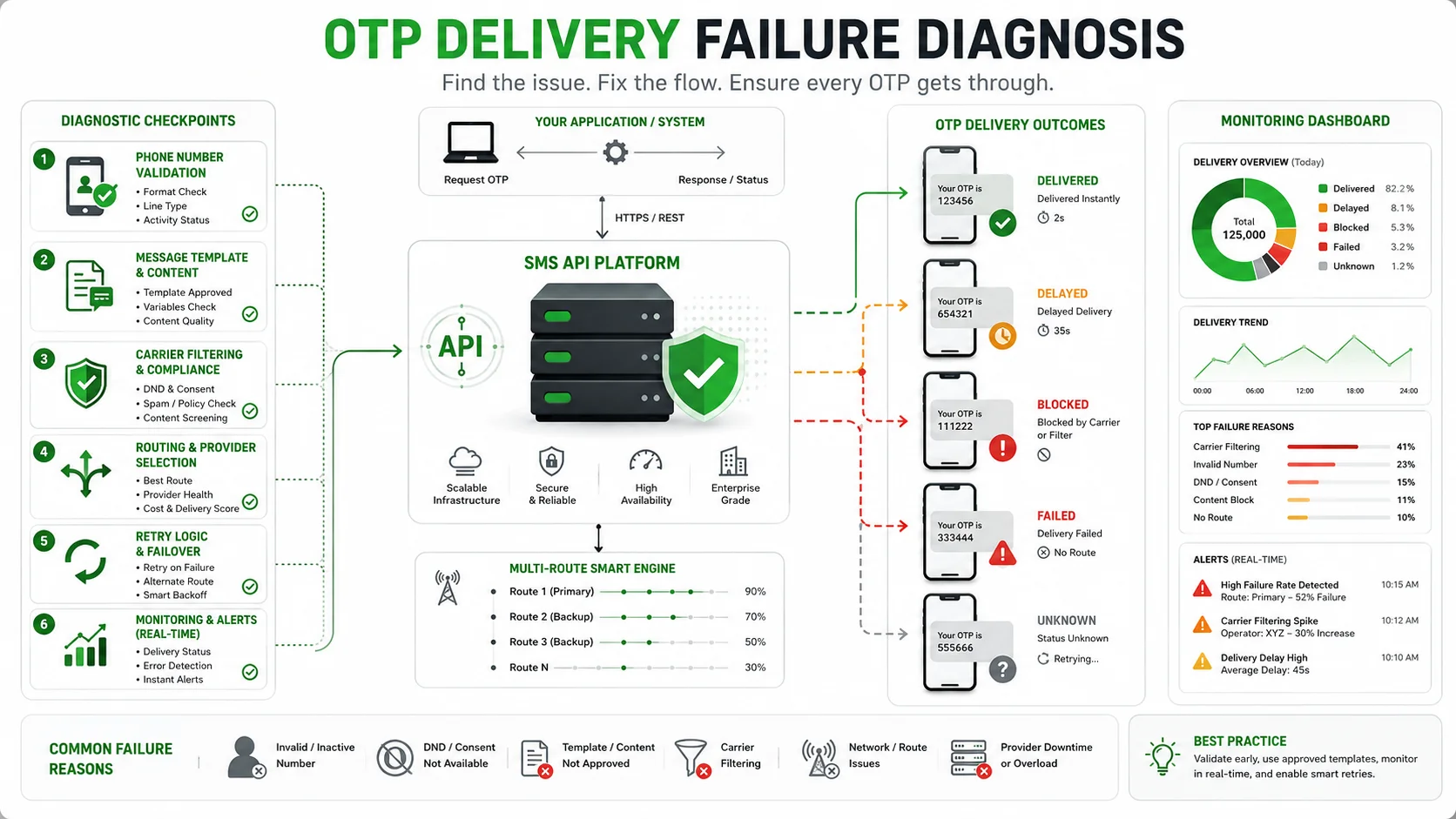
Every time an OTP fails, something expensive breaks — a signup stalls, a payment cannot complete. Most teams respond by resending the code, then switching providers in frustration. None of these fixes the actual problem because they never diagnosed where the failure started.
At SMSBoosting, we troubleshoot OTP delivery across global markets every day. The same problems show up again and again — invalid numbers, spam-flagged templates, carrier filtering, routing congestion, broken retry logic, and monitoring gaps. They almost always trace back to one of six layers. This guide walks you through all six, from bad phone numbers to routing failures, with specific fixes you can implement today.
Why OTP Verification Codes Fail: The 6 Most Common Causes
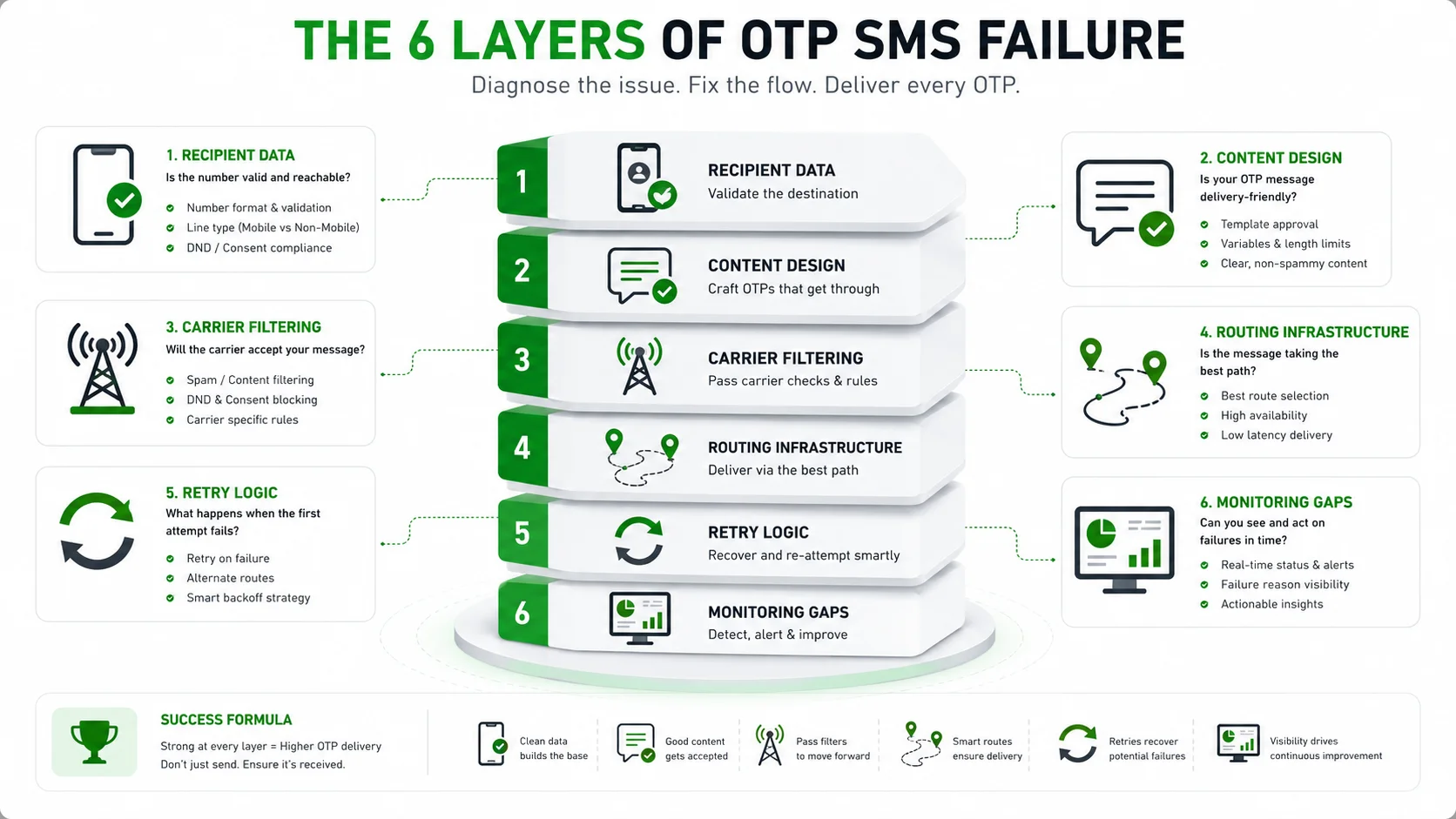
| Layer | Typical Cause | Quick Fix |
| 1. Recipient data | Invalid number, missing country code, landline | Validate and clean your number database |
| 2. Content design | Spam-like wording, unregistered sender ID | Use clean templates and register sender IDs |
| 3. Carrier filtering | Volume spikes, repetitive content, suspicious links | Spread traffic, vary templates, avoid short URLs |
| 4. Routing | Single route failure, peak congestion, provider outage | Use a provider with multiple routes per country |
| 5. Retry logic | Retry storms, no backoff, duplicate codes | Limit retries, use same code, add exponential backoff |
| 6. Monitoring gaps | No visibility into failures by country/carrier | Track delivery rates per destination and alert on drops |
Most OTP delivery problems sit in layers 1–3. Fix your number validation and template design before blaming your SMS provider.
Layer 1: Recipient Data Issues
Bad phone numbers are the most common cause of OTP failure. A user types +1 415 555 2671, your system stores it as 4155552671 without the country code, and your provider routes it to the wrong country. Other failures include disconnected numbers, switched carriers, and landlines.
A common mistake is relying on client-side validation only. The browser might accept 415-555-2671, but your SMS gateway needs +14155552671 in E.164 format. If your database stores numbers in local format, every international send fails silently.
Fix: Validate at collection. Parse to E.164 format, confirm the country code matches the user’s region, run a carrier lookup to check the line is active and mobile, then flag invalid entries before they hit your send queue. Re-validate periodically — numbers go stale.
Layer 2: Content and Template Design
Carriers scan every message for spam signals. Shortened URLs, all-caps words, repeated identical messages, and urgency language like “Your account will be locked” all raise flags. Unregistered sender IDs are automatically blocked in many markets — using an unregistered ID in India or the UAE almost guarantees failure.
A good OTP template follows a simple formula: brand name + code + expiry. For example: Your ACME code is 847291. Valid for 5 minutes. No URLs, no urgency language, no personalization beyond the code itself. The more predictable your template, the less likely carriers flag it.
Fix: Use plain language, start with your brand name, state the code clearly with an expiry window, avoid URLs, and keep it under 160 characters. Check sender ID requirements for your top 5 markets and register where required. Test new templates in a small market before rolling out globally. (GSMA A2P SMS guidelines provide country-specific sender ID requirements.)
Layer 3: Carrier Filtering and Blocking
If your numbers and templates are clean but OTPs still vanish, carriers are probably filtering them. Carriers filter messages based on volume, frequency, content patterns, and sender reputation. Volume spikes (10,000 OTPs in 10 minutes from a sender that normally sends 100), frequency to the same recipient, content repetition, and link presence are all common flags.
Carriers do not publish their exact filtering rules, but the patterns are consistent. A new sender ID blasting 1,000 messages to the same area code triggers scrutiny. Identical messages sent to sequential numbers look like automated attacks.
| Market | Filtering Rule |
| India | Alphanumeric sender IDs must be registered with TRAI |
| UAE | Unregistered sender IDs blocked |
| Indonesia | Content scanned for gambling/financial keywords |
| United States | A2P 10DLC registration required |
| Nigeria | Foreign sender IDs often replaced or blocked; DND list enforced |
| Brazil | ANATEL requires registered sender IDs; long-code registration mandatory |
| Philippines | NTC requires sender ID registration; foreign IDs typically blocked |
Fix: Spread traffic to avoid spikes, use rate limiting, and notify your provider before known surges. Test delivery in target markets before launch. (Regulatory sources: TRAI for India; CTIA Messaging Security Best Practices and A2P 10DLC registration for the US.)
Layer 4: Routing and Infrastructure
Even with clean numbers and templates, the OTP still has to travel through your provider’s routing infrastructure. This is where visibility often ends.
Routing failures happen at four points: API timeouts (HTTP 5xx), primary route congestion, carrier handoff failures (“delivered to network” but not to handset), and cross-border delays. You need a provider that exposes carrier-level delivery status — “Accepted” is not “Delivered.”
Direct Carrier vs Aggregator Failure Patterns
| Factor | Direct Carrier | Aggregator |
| Typical failure mode | Route down = no backup path | Route A fails, traffic shifts to Route B |
| Failure detection | Fast (direct relationship) | Depends on provider monitoring |
| Recovery speed | Slow (must fix or negotiate) | Fast (automatic failover) |
| Best for | Stable markets with predictable volume | Global reach with variable demand |
Direct carrier providers fail visibly: when their route goes down, all traffic to that destination stops. Aggregators have fallbacks, but quality varies. A poorly managed aggregator might shift traffic to a low-quality backup.
Fix: Ask your provider how many routes they maintain per country. If they cannot give specific numbers, you do not have real redundancy.
OTP traffic is bursty. A flash sale can spike volume 10× in minutes. Direct routes have fixed capacity and queue messages when saturated. Load-test before major events and confirm your provider maintains 98–99%+ delivery at peak.
Some regions are harder: Southeast Asia and the Middle East have strict rules and variable quality. Africa faces interconnection gaps. If delivery rates drop across all destinations at once, the problem is provider-side. Have a backup ready.
Layer 5: Retry Logic and Idempotency
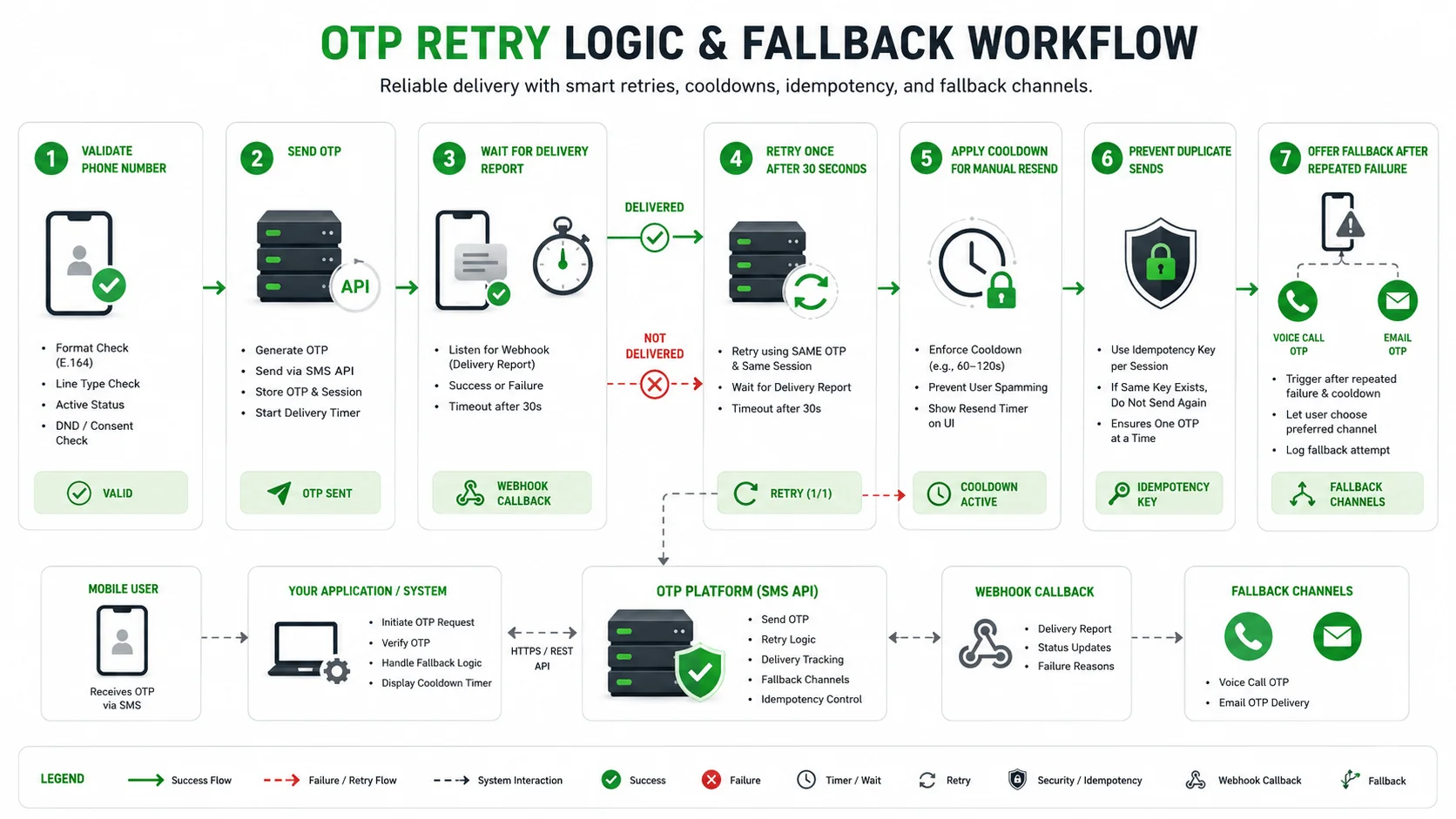
Unlimited “Resend” clicks flood users with codes and trigger carrier filtering. Rate-limit retries at the API level with a 60-second cooldown.
Same-Code Retry vs New-Code Retry
| Approach | Pros | Cons |
| Same code on retry | User only has one valid code | Code valid longer = slightly more risk |
| New code on retry | Old code invalid immediately | User receives multiple codes, confusion |
Use same-code retries: retry once automatically after 30 seconds on delivery failure. Allow up to two manual resends with cooldowns, then offer voice or email fallback. Cap total attempts at 3–5 per session.
Idempotency Keys and Session Management
An idempotency key prevents duplicate sends. Tie it to the verification session: generate a code with session_id and idempotency_key, store all three server-side, send the SMS, and on retry check the key. If already sent within the cooldown window, return the existing status. Expire the session after 5 minutes regardless of outcome.
Never retry more than twice automatically — if delivery fails twice, the problem will not resolve itself quickly.
Layer 6: Monitoring and Alerting
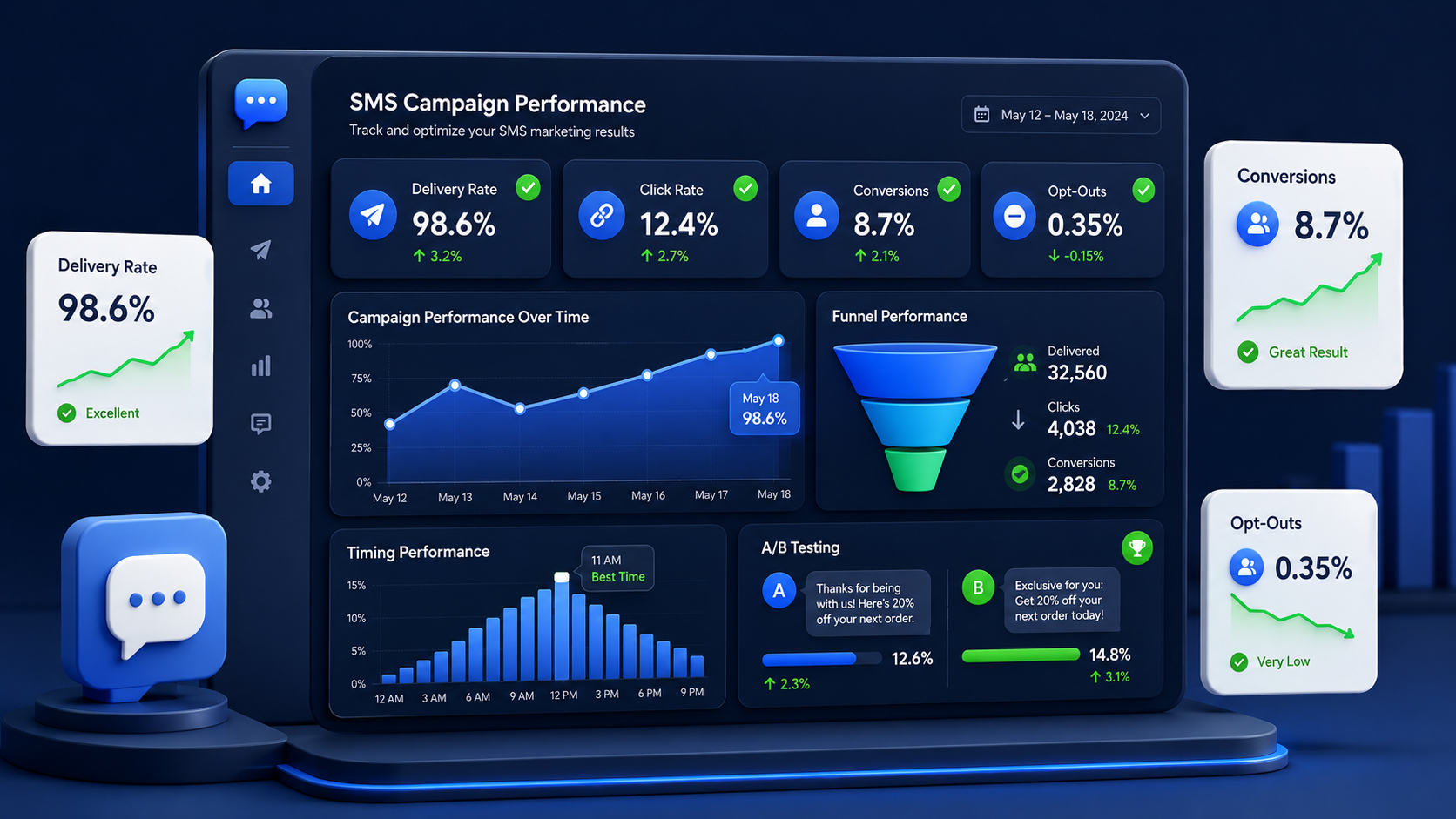
Most teams discover delivery problems when users complain. Track four metrics: delivery rate by country and carrier, latency percentiles (p95 above 10 seconds creates friction; beyond 30 seconds most users resend or drop off), failure rate trends, and retry rate (rising retries mean higher costs and worse first-pass delivery).
Setting Useful Alert Thresholds
Set thresholds based on operational experience. Adjust these to match your business impact:
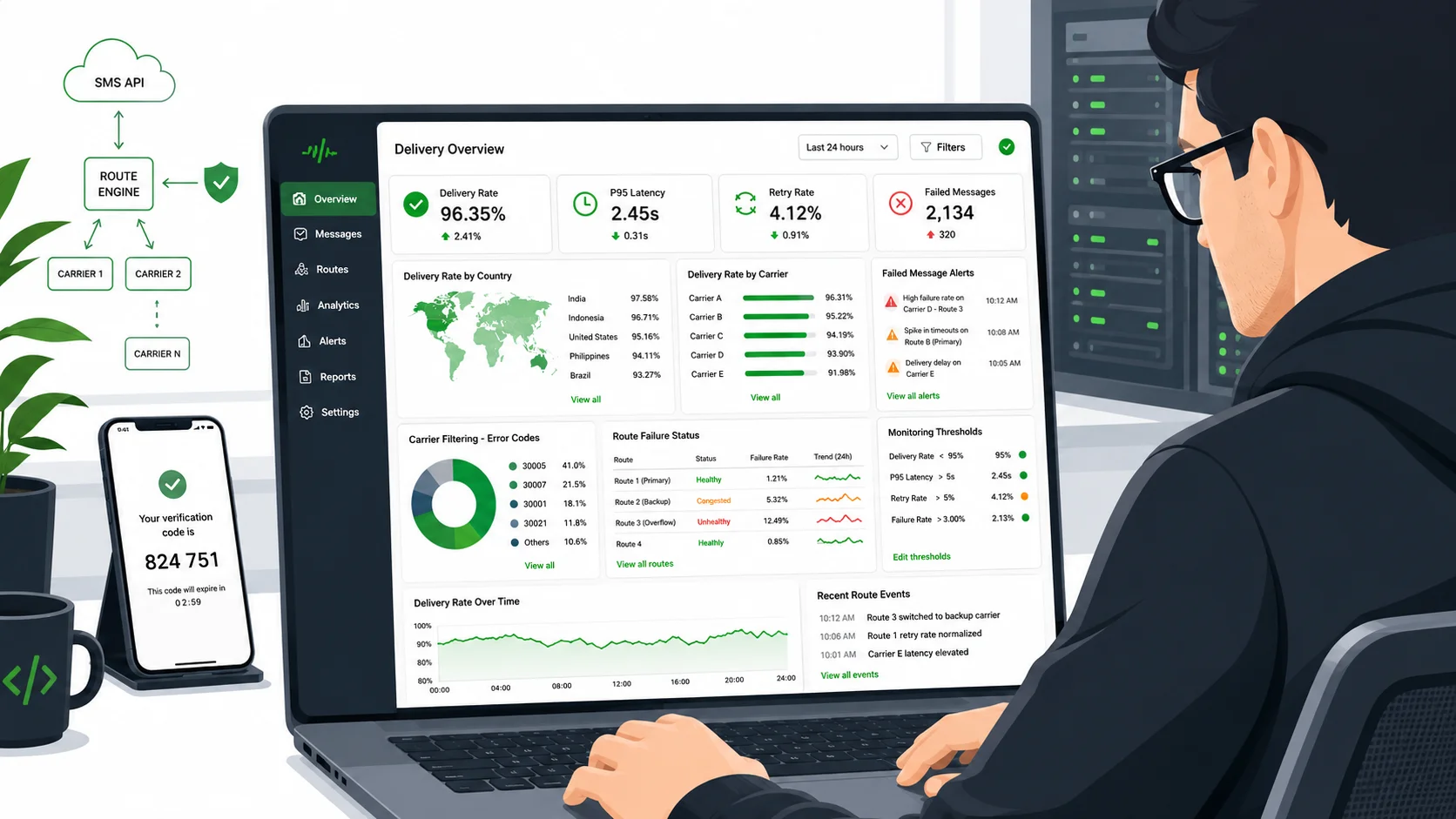
| Metric | Warning Threshold | Urgent Threshold |
| Global delivery rate | Drops below 98% | Drops below 95% |
| Per-country delivery rate | Drops below 95% in top 5 markets | Drops below 90% in any market |
| p95 latency | Exceeds 10 seconds | Exceeds 30 seconds |
| Retry rate | Exceeds 5% of sends | Exceeds 10% of sends |
Fix: Alert on per-country rates, not just global averages. A global rate of 98% can hide a single market at 80%.
Common OTP Delivery Error Codes
Track these error patterns in your logs:
| Code | Meaning | Action |
| 30007 | Message filtered by carrier | Review template content and sender ID registration |
| 21211 | Invalid phone number | Validate format and country code before sending |
| 21614 | Number not reachable | Check if line is inactive or disconnected |
| 30003 | Route failure | Retry once; if persists, check provider status |
| 30008 | Unknown error | Monitor for patterns; may indicate provider outage |
Your SMS provider may use different codes, but these patterns show up everywhere.
What Is a Good OTP Delivery Rate?
Leading OTP providers target 98–99% in primary markets. Any provider delivering below 95% in markets like the US, UK, or Germany has a real problem — at 95%, one in twenty users does not receive their code. For a fintech app with 100,000 daily logins, that is 5,000 failed authentications per day.
In emerging markets, delivery rates vary widely — 85–95% depending on carrier infrastructure and local regulations. Southeast Asia, Africa, and parts of Latin America have more variable carrier quality.
Note on benchmarks: These delivery rate and latency figures reflect industry operational experience rather than independent research. Actual performance varies by provider, route quality, time of day, and local carrier conditions. Use them as starting points, but calibrate thresholds against your own delivery data.
Why Global Averages Hide Problems
A provider reporting 99.5% global delivery might deliver 99.9% in the US and 80–90% in a specific emerging market. The global number looks excellent. Your users in that market disagree. Always measure delivery rate by country and carrier, not as a single global figure.
Conclusion
OTP delivery failures are not random. They follow patterns. Most problems sit in the first three layers — bad numbers, poor templates, or carrier filtering — and can be fixed without changing providers.
Start your diagnosis at the top of the stack. Validate your phone numbers. Review your templates for filtering flags. Check your sending patterns. Only after those layers are clean should you look at routing and infrastructure.
When routing itself is the problem, you need a provider with real redundancy. A single route per country will fail eventually. Multiple routes with automatic failover give you the coverage you need.
Your next step: Run your current OTP delivery through the six-layer checklist. Measure delivery rates by country and carrier. Fix the obvious issues in layers 1–3 first. If routing is where your failures cluster, test a provider with multiple routes per market.
FAQ
How long should an OTP expiry window be?
Most OTPs expire in 3 to 10 minutes, with 5 minutes being the most common. Shorter windows improve security but increase failure rates if delivery is slow. For most consumer applications, 5 minutes is the right balance. For high-risk transactions, use 3 minutes with voice fallback.
Can I use the same provider for OTP and marketing SMS?
Yes, but keep the traffic separate. Marketing SMS carries a higher filtering risk. If your marketing traffic draws carrier scrutiny, it can affect your OTP delivery from the same sender ID. Use separate sender IDs and routing profiles to isolate reputational risk.
Why do OTPs fail more in some countries than others?
Carrier infrastructure, regulations, and filtering intensity vary by market. Some countries require sender ID registration. Others have strict content rules or limited carrier interconnection. Always test OTP delivery in your target markets before launch.
How many retry attempts should I allow?
Limit total attempts to 3–5 per session. Allow one automatic retry on delivery failure after 30 seconds. Allow up to two user-initiated resends with a 60-second cooldown between each. After that, offer a fallback channel like voice or email. Never allow unlimited retries — it annoys users and prompts carrier throttling.
What is the difference between delivery failed and filtered?
Delivery failed means the message could not reach the handset for technical reasons: invalid number, unreachable device, or route failure. Filtered means a carrier actively blocked the message based on content, sender reputation, or compliance rules. Filtered messages often show specific error codes (like 30007). Failed messages show codes like invalid destination or timeout.