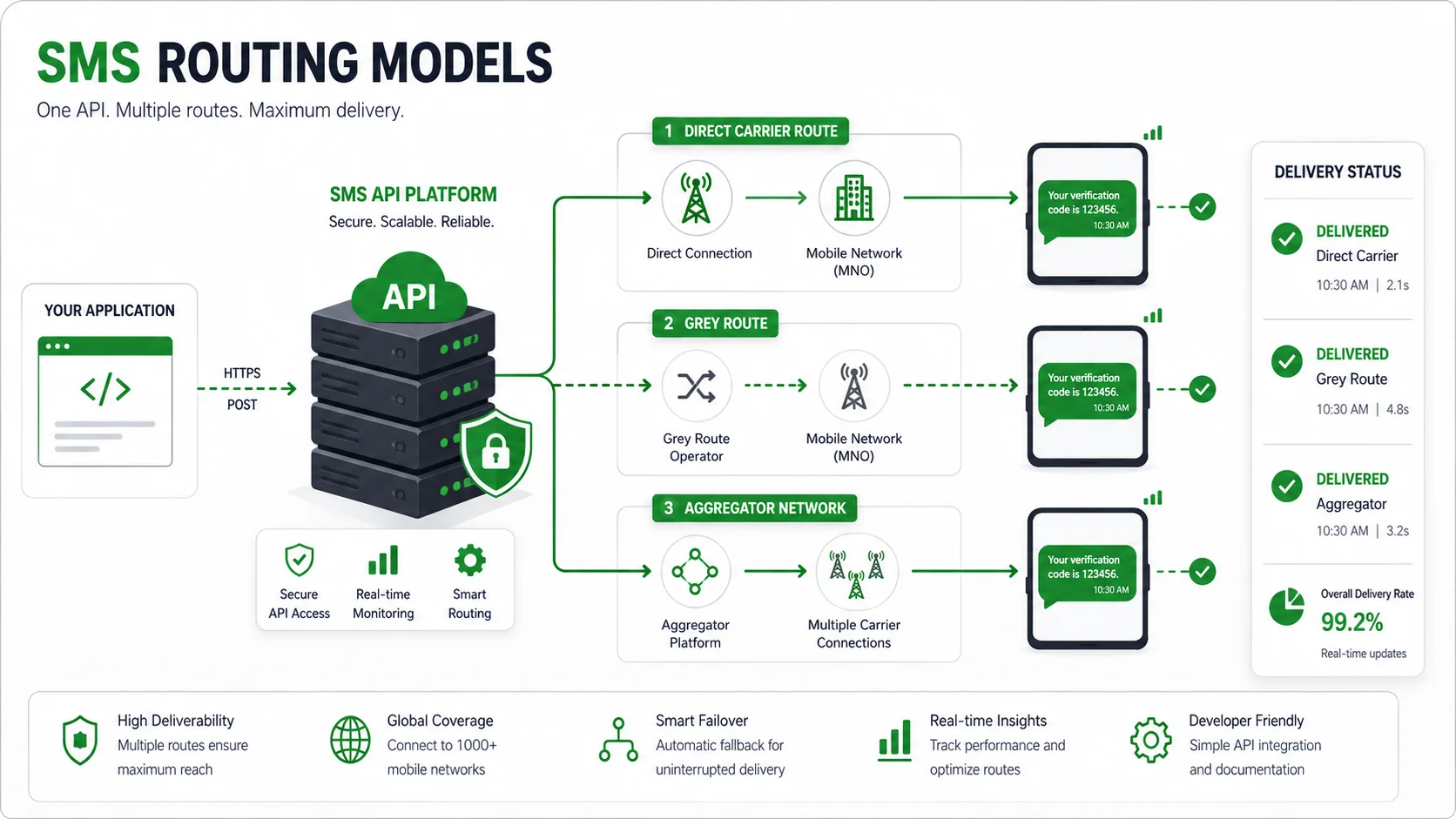
Not all SMS messages take the same path to reach a phone. Some travel through official carrier agreements with guaranteed delivery. Others take unofficial shortcuts that save money but fail unpredictably. The path your provider chooses — the route — directly affects delivery rates, speed, and cost.
If you are evaluating SMS providers, you need to understand routing. Providers rarely advertise which routes they use, yet routing quality is one of the biggest factors in whether your messages actually arrive.
This article explains the three SMS routing models, how they differ, and which one fits your use case.
What Is an SMS Route?
An SMS route is the path a text message takes from your application to the recipient’s phone. Think of it like shipping a package: you can send it through official postal channels with tracking, through an independent courier, or through a network of local distributors.
Here is the basic journey:
- Your application sends a message via an SMS API
- The provider’s platform receives the message and selects a route
- The route carries the message through one or more carrier networks
- The recipient’s carrier delivers the message to the handset
The provider’s choice at step 2 determines everything: cost, delivery speed, reliability, and whether the message arrives at all.
Routes are categorized by how the provider connects to the recipient’s carrier:
- Direct connections: Official agreements with the carrier
- Indirect connections: Third-party intermediaries, sometimes unauthorized
- Hybrid networks: Multiple connections with automatic switching
The terminology can be confusing. “White route,” “grey route,” and “direct route” are often used loosely. Here is what they actually mean.
Three SMS Routing Models Explained
There are three ways SMS providers connect to carrier networks. Each has different cost, reliability, and delivery characteristics.
Direct Carrier Routes (White Routes)
Direct carrier routes are official, signed agreements between your SMS provider and the recipient’s mobile carrier. The message travels through authorized channels with proper delivery reporting.
How it works: Your provider has a commercial contract with Vodafone UK, for example. When you send a message to a Vodafone subscriber, it enters Vodafone’s network directly through a secure, monitored connection.
What you gain: Direct routes deliver reliably — typically 95–99% in most markets — with accurate delivery reports, consistent latency, and carrier-approved sender IDs. For use cases where a missed message means a lost customer or failed compliance check, this predictability is worth the premium.
What you give up: That reliability comes at a higher per-message cost. Direct agreements are also limited to markets where your provider has invested in carrier relationships. If the direct route fails, there is no automatic backup — your message stops until the route recovers.
Best for: OTP delivery, financial notifications, and any use case where delivery failure has a business cost.
Grey Routes
Grey routes are unofficial connections that bypass direct carrier agreements. An aggregator finds a way into a carrier’s network through intermediaries, international gateways, or other backdoors — without the carrier’s explicit authorization.
How it works: Your message to a Vodafone UK subscriber might enter the network through a SIM box in another country, a third-party aggregator with a loose agreement, or an international hub that obscures the message origin.
Pros:
- 30–50% lower cost than direct routes
- Works in markets where direct agreements are hard to secure
Cons:
- Unpredictable delivery (60–85% depending on market)
- Can be blocked by carriers without warning
- Inaccurate or missing delivery reports
- Sender ID often replaced or stripped
- Legal and compliance risks in some markets
Best for: Marketing campaigns where occasional delivery failure is acceptable and cost is the primary concern.
Aggregator Networks (Hybrid)
Aggregator networks combine multiple connection types. The provider partners with dozens or hundreds of local suppliers per country. Some suppliers use direct carrier agreements; others use grey routes. The platform monitors all routes in real time and shifts traffic automatically when one route degrades.
How it works: A message to India might enter through Supplier A (direct route) first. If delivery rates on that path drop, the platform shifts automatically to Supplier B or C — whichever offers the best available path at that moment. The switch happens in seconds, without requiring your team to change API configuration or open a support ticket.
The hybrid advantage: This model gives you route redundancy without managing multiple providers. When one path fails, traffic switches to a backup within seconds. Wholesale aggregation also keeps costs competitive — you get delivery rates close to direct routes at prices closer to grey routes. Coverage scales across many countries because you are not dependent on a single provider’s direct agreements. Providers like SMSBoosting use this architecture with 1,000+ supplier partnerships.
The trade-off: Not every route in the network is direct. Some suppliers use grey routes, which means delivery reports and sender ID control vary by supplier. You need a provider with a sophisticated routing platform to manage this complexity well.
Best for: Global OTP and transactional messaging where cost and reliability both matter.
For more on how SMS API pricing differs by route type, see our pricing guide.
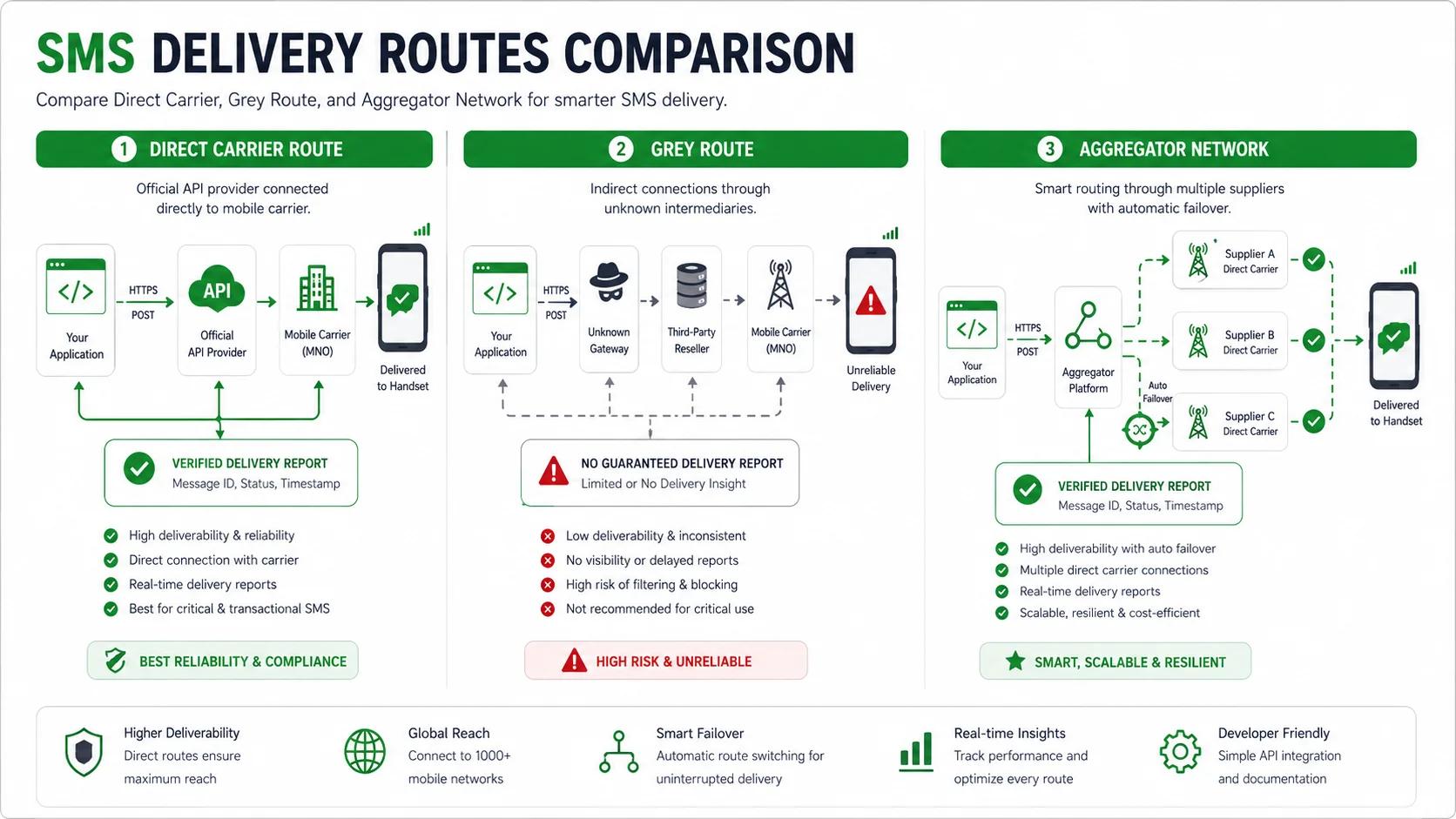
Direct Carrier vs Grey Route vs Aggregator: At a Glance
| Factor | Direct Carrier | Grey Route | Aggregator Network |
|---|---|---|---|
| Cost per message | High | Low | Medium |
| Delivery rate | 95–99% | 60–85% | 90–97% |
| Latency | Consistent | Variable | Generally consistent |
| Delivery reports | Accurate | Often missing | Usually accurate |
| Sender ID control | Full | Limited | Good |
| Route redundancy | None | None | Automatic failover |
| Carrier approval | Yes | No | Mixed |
| Best for | OTP, alerts | Marketing | Global transactional |
Which Routing Model Should You Choose?
The right routing model depends on what you are sending and what failure costs you.

Choose direct carrier routes when:
- OTPs and Security Alerts: You send OTPs, payment confirmations, or security alerts.
- Revenue at Risk: Delivery failure directly impacts revenue or user trust.
- Compliance Requirements: You need accurate delivery reports for compliance.
- Regulated Industries: You operate in regulated industries (fintech, healthcare, government).
- Concentrated Markets: Your volumes are concentrated in a few countries where direct agreements exist.
Choose grey routes when:
- Promotional Campaigns: You send promotional or marketing SMS.
- Cost Priority: Cost per message is the primary decision factor.
- Acceptable Failure Rate: A delivery rate of 70–80% is acceptable.
- No Compliance Needs: You have no compliance requirements for delivery reporting.
- Risk Awareness: You understand that routes can be blocked without notice.
Choose an aggregator network when:
- Global Transactional SMS: You send transactional SMS globally.
- Balanced Pricing: You need competitive pricing without sacrificing reliability.
- Multi-Country Traffic: Your traffic spans many countries (some with weak direct route coverage).
- Hands-Off Failover: You want automatic failover without managing multiple providers.
- Reliability-Cost Balance: You need a balance between direct route reliability and grey route cost.
A Practical Example
A fintech app sending payment OTPs to users in 40 countries should not rely on grey routes. A single route block during a high-value transaction means a lost sale and a frustrated user. Direct routes or an aggregator network with route redundancy are the safer choice.
A retailer sending weekly promotional SMS to a domestic list might accept grey route risk if the cost savings justify occasional delivery failures.
How to Verify What Routes Your Provider Uses
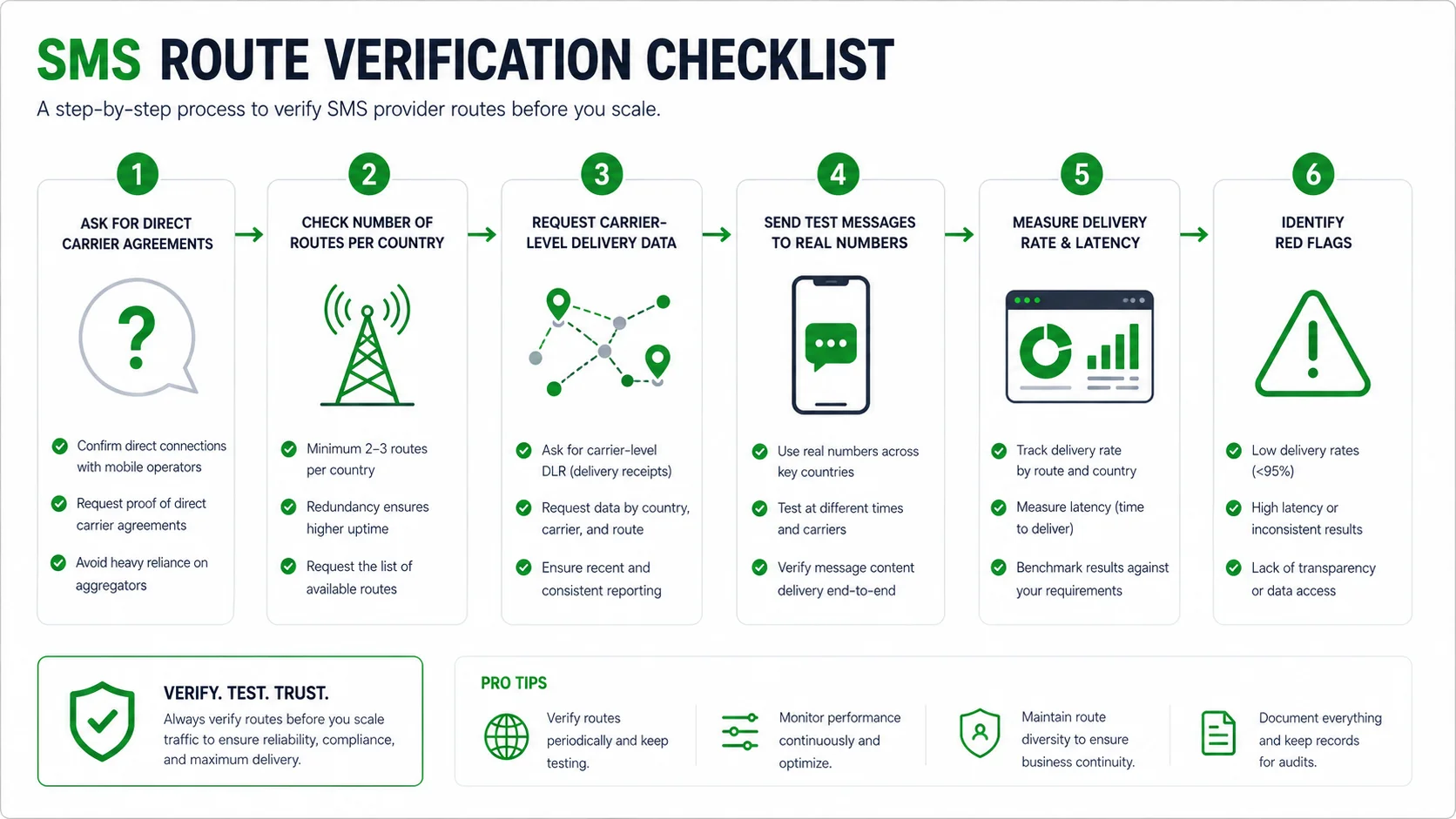
Most providers do not advertise their routing openly. Ask these three questions:
- “Do you have direct carrier agreements in [your top 3 countries]?” If they cannot name specific carriers, they likely use grey routes or intermediaries.
- “How many routes per country do you have?” One route means no failover. Multiple routes suggest an aggregator model with redundancy.
- “What is your delivery rate in [specific country], and can you show carrier-level breakdowns?” Vague answers or refusal to share data are red flags.
Test delivery yourself. Send messages to real numbers in your target markets and measure actual delivery rates over a week. Do not trust marketing claims about delivery rates without data.
Conclusion
Routing is not a detail — it is a decision that affects whether your messages arrive. Direct carrier routes offer reliability. Grey routes offer low cost. Aggregator networks offer both through intelligent failover.
Want to see route redundancy in action? Test SMSBoosting’s OTP SMS with 1,000+ supplier partnerships and automatic route switching. Start a free trial to compare delivery in your markets.