
March Madness (the NCAA Men’s Basketball Tournament) creates predictable tip-off spikes in attention—and predictable spikes should not create unpredictable SMS results. This playbook shows how to keep messages landing on time (not “30 minutes late”) by controlling throughput vs concurrency, building a paced send curve, and preparing primary + fallback routing for peak windows.
If you’re running coupon drops, “watch with us” reminders, or pickup-ready promos during tournament weeks, the biggest risk usually isn’t your offer. It’s variance: the same send that looks fine at noon can drift at 7pm, even with identical copy.
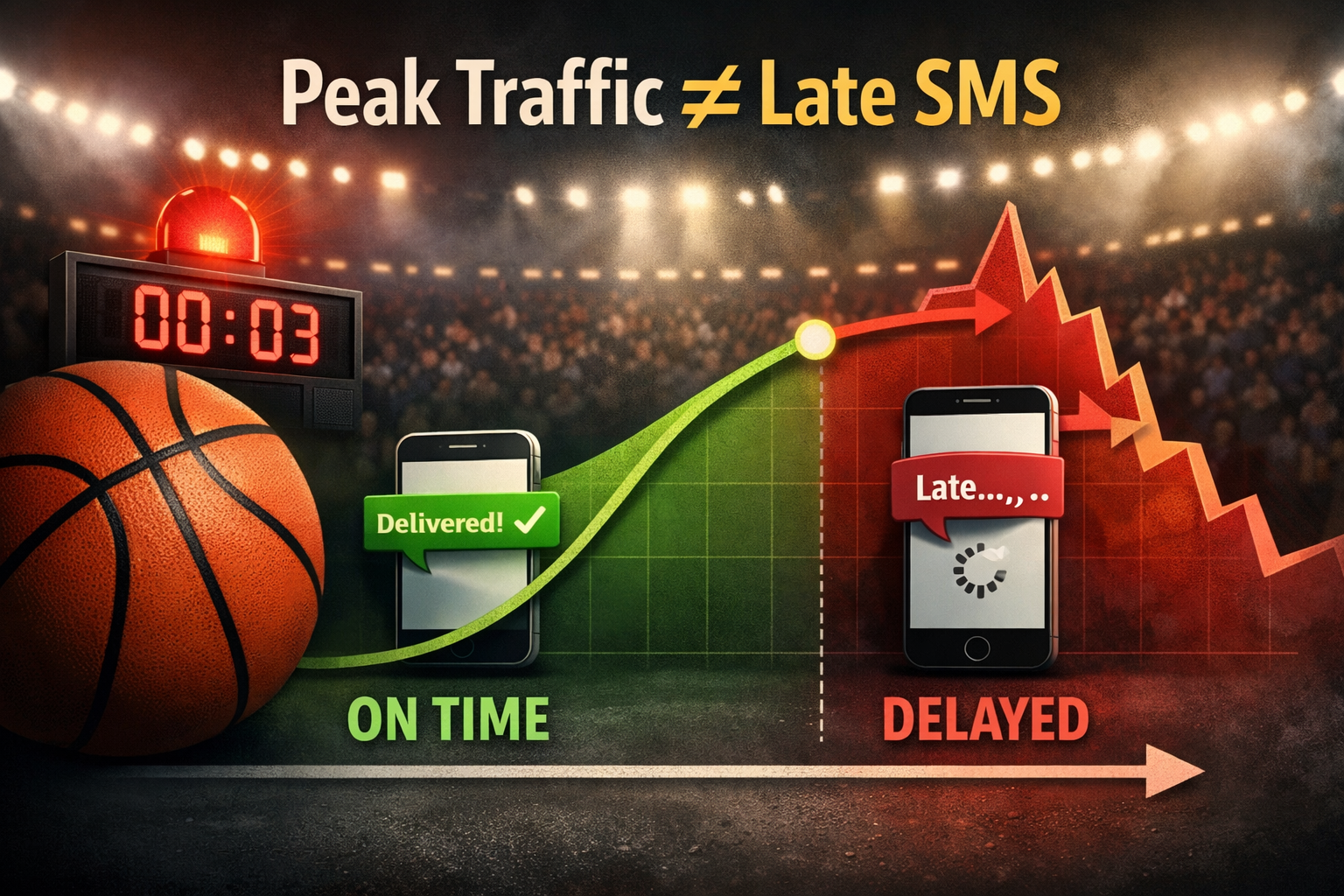
Why March Madness Peak SMS Traffic Breaks at Tip-Off
Why “sent” is not the same as “arrived on time” during peak windows
Most first-time teams evaluate SMS like email: “We hit send. It went out.”
Peak windows expose the uncomfortable truth: an SMS system can accept your request while the network path is congested, rate-limited, or filtered. That means your message may still deliver—just too late to matter.
For March Madness campaigns, timing is the product:
- A 60-minute flash deal that lands 25 minutes late is not a 60-minute deal.
- A watch-party reminder that arrives after tip-off isn’t a reminder—it’s noise.
- A curbside pickup nudge that lands after the customer has already left is a missed save.
The three peak failure modes in plain terms: delay vs throttling vs filtering
During tip-off spikes, performance problems often look similar from the marketer’s seat. They aren’t.
- Delay: Messages are still going through, but the “time-to-arrive” stretches.
- Throttling (back-pressure): Your send speed is forced down (by queues, rate limits, carrier policies, or route constraints).
- Filtering: More messages are blocked or diverted due to content patterns, link reputation, frequency spikes, or sender trust issues.
The hidden cost of being late: what a 10–30 minute slip does to conversions
A peak send isn’t just traffic—it’s a shared time window. Customers are watching, browsing, buying, and talking right now. If your SMS arrives after that moment passes, you don’t just lose a click. You lose context.
A real example pattern we’ve seen:
Teams hit strong on-time outcomes at noon, then slip hard in a 7pm tip-off window—without changing copy or code—because burst pacing and routing changed underneath them.
If you treat March Madness peaks like predictable infrastructure events, you can prevent most of this.
Throughput vs Concurrency for SMS Marketing for Ecommerce
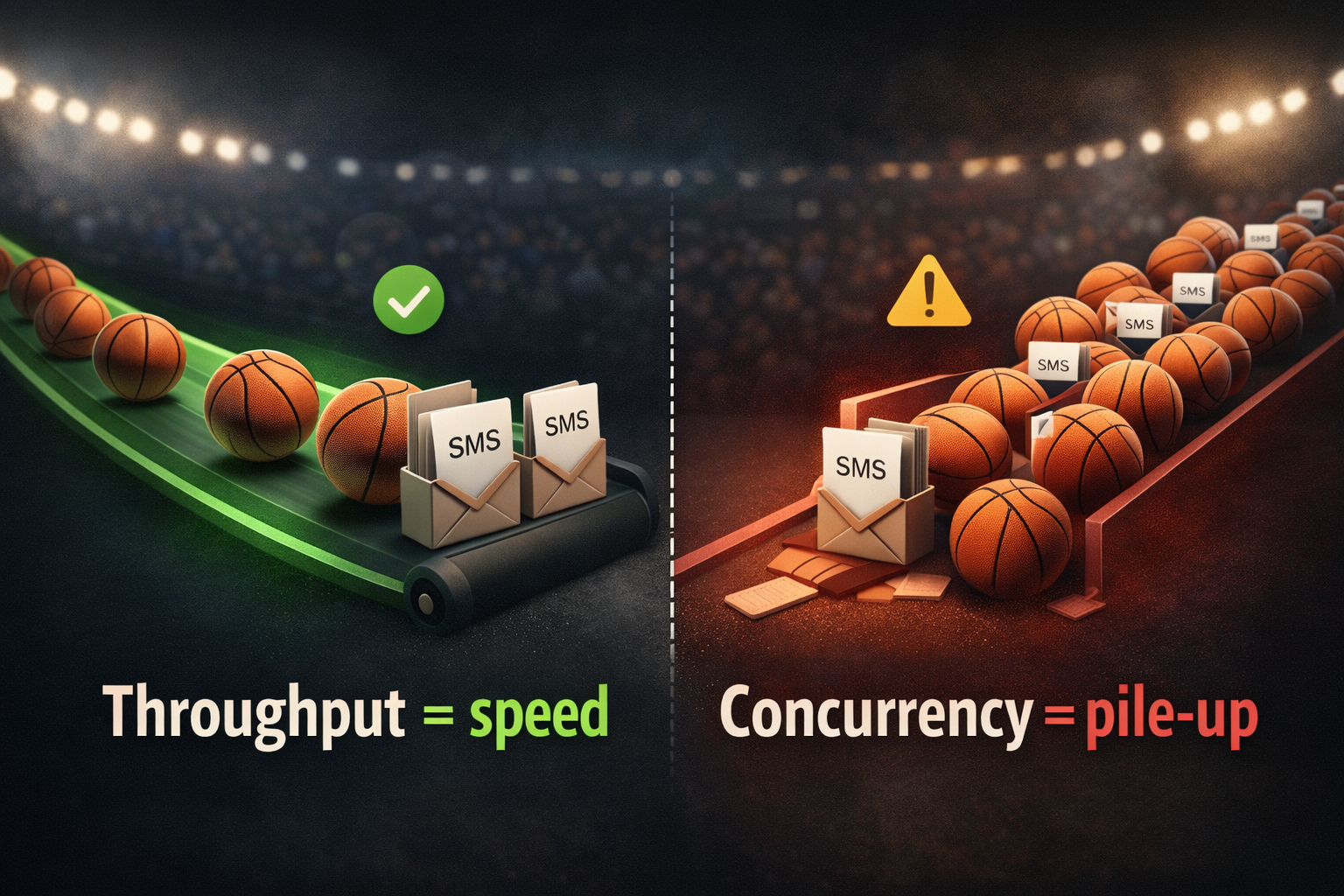
Throughput explained: what “messages per second” really buys you
Throughput is how many messages your system can push through per second (or per minute) when everything is healthy.
It answers: “How fast can we move?”
But throughput numbers are often misunderstood because they depend on:
- Destination behavior (even within the US, performance can vary by carrier conditions)
- Sender type / trust posture
- Route capacity during peaks
- Your own pacing and queue configuration
Concurrency explained: why bursts break even “high throughput” systems
Concurrency is what happens when you create a burst—a huge number of messages entering the system at the same moment.
It answers: “How big is the pile-up if everyone goes at once?”
A “high throughput” platform can still struggle if your campaign design creates a “cliff”:
- You schedule 50,000 sends at 6:00pm sharp
- Everyone tries to push through the same narrow window
- Queues form, retries amplify load, and latency balloons
That’s not a throughput problem. It’s a concurrency problem you created by timing.
A quick peak-load estimate using your list size and a 15–60 minute send window
You don’t need telecom math to plan safely. Use this simple estimate:
- Pick the true window your offer needs (e.g., 60 minutes).
- Decide a send window inside it (e.g., 30 minutes).
- Estimate your average send rate:
Average rate (msgs/min) = List size ÷ Send window (min)
Example:
- 24,000 subscribers
- 30-minute send window→ 800 msgs/min on average
Now add your real-world reality:
- You won’t send perfectly evenly
- Some segments should be earlier
- Peaks create more variance
So you plan a send curve (next section) instead of “one giant blast.”
Build a Peak-Safe Send Curve for SMS Marketing for Ecommerce
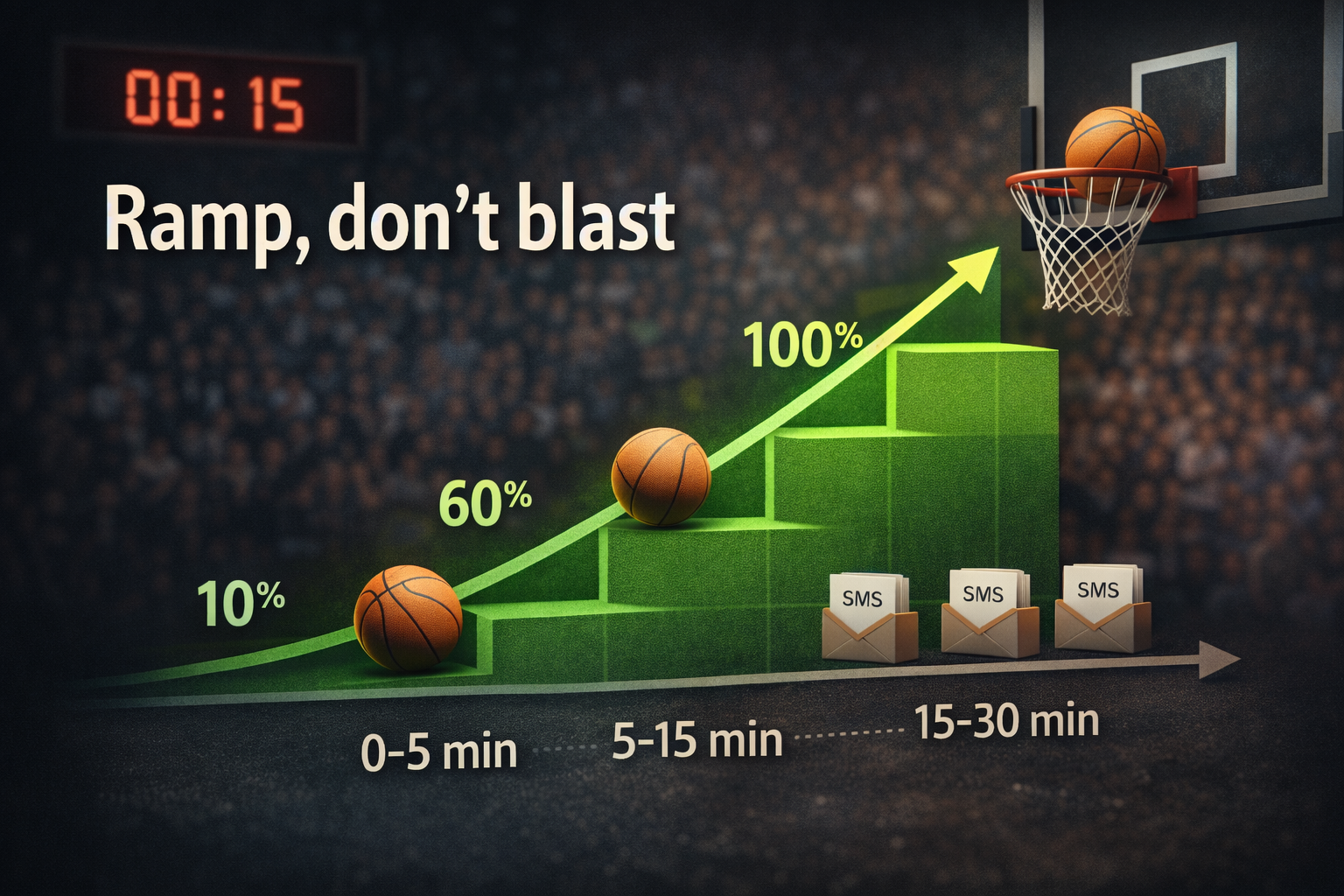
Pacing recipes for 15–90 minute spikes (fast ramp vs steady ramp)
Your goal is not “maximum speed.” Your goal is on-time arrival.
Two safe patterns for March Madness windows:
Recipe A: Fast ramp (for short windows, high urgency)
- 0–5 min: 10% of your target send rate
- 5–15 min: ramp to 60%
- 15–30 min: ramp to 100%
Use this when your offer is tight but you still want to avoid a concurrency cliff.
Recipe B: Steady ramp (for longer windows, stability first)
- 0–10 min: 25%
- 10–30 min: 60%
- 30–60 min: 100%
Use this when “arriving on time” matters more than “arriving instantly.”
Either way, the principle is the same: start smaller, observe early signals, then scale up.
Batching by intent segment, not by “entire list”
Peak safety improves dramatically when you batch by intent:
- High intent (recent buyers, VIP, loyalty members) → earlier in the window
- Medium intent (engaged clickers, browse-heavy users) → mid window
- Low intent (cold subscribers) → later, or skip entirely during peaks
This is how you reduce both:
- late deliveries (because the most valuable people go first)
- filtering/opt-outs (because you don’t over-message low intent groups)
Frequency caps that prevent opt-outs during a 4-week tournament calendar
March Madness is not one event. It’s a series of peak moments. If you run “game-time messaging” for four weeks, fatigue becomes a real risk.
A practical cap for most ecommerce lists:
- 1 message/day for general segments
- 2 messages/day max for high-intent segments (only on key days)
- 3/day is reserved for explicitly opted-in “alerts” cohorts (rare; use carefully)
If you can’t explain why someone should receive the third message, don’t send it.
Trigger Timing Before Tip-Off
The pre-game “heads-up” vs the last-hour countdown vs the post-game follow-up
Peak-friendly March Madness messaging usually works as a three-step rhythm:
- Heads-up (6–24 hours before tip-off)
Purpose: awareness, planning, browsing
Good for: “Tomorrow’s watch deal,” “doorbusters,” “pickup slots,” “store hours” - Countdown (60–15 minutes before)
Purpose: urgency, action
Good for: “1-hour offer,” “game-time bundle,” “watch-party seating,” “last call” - Follow-up (post-game, or next morning)
Purpose: retention, second chance
Good for: “Missed it? Here’s the replay deal,” “thank-you + next round reminder”
This sequence naturally spreads load and reduces concurrency spikes.
Timezone guardrails for US audiences: ET/CT/MT/PT sends without confusion
Tournament attention often clusters around national broadcast windows, but your list is still distributed.
Practical guardrails:
- Segment by timezone if possible (ET/CT/MT/PT)
- If you can’t, choose “local time” scheduling
- Avoid sending “countdown” messages too early in PT while ET is already near tip-off
If you want a beginner-friendly schedule you can test outside tournament days, see our guide on the best time to send SMS marketing.
When to skip a send: fatigue signals, low-intent segments, and quiet-hour rules
Skipping is a peak strategy.
Skip a countdown send when:
- opt-outs spike above your normal baseline
- latency is already elevated (you’re behind before you start)
- the segment hasn’t clicked or bought in the last 60–90 days
- it violates quiet-hour policies or your own brand standards
Peak windows reward discipline.
Routing Strategy During Peaks
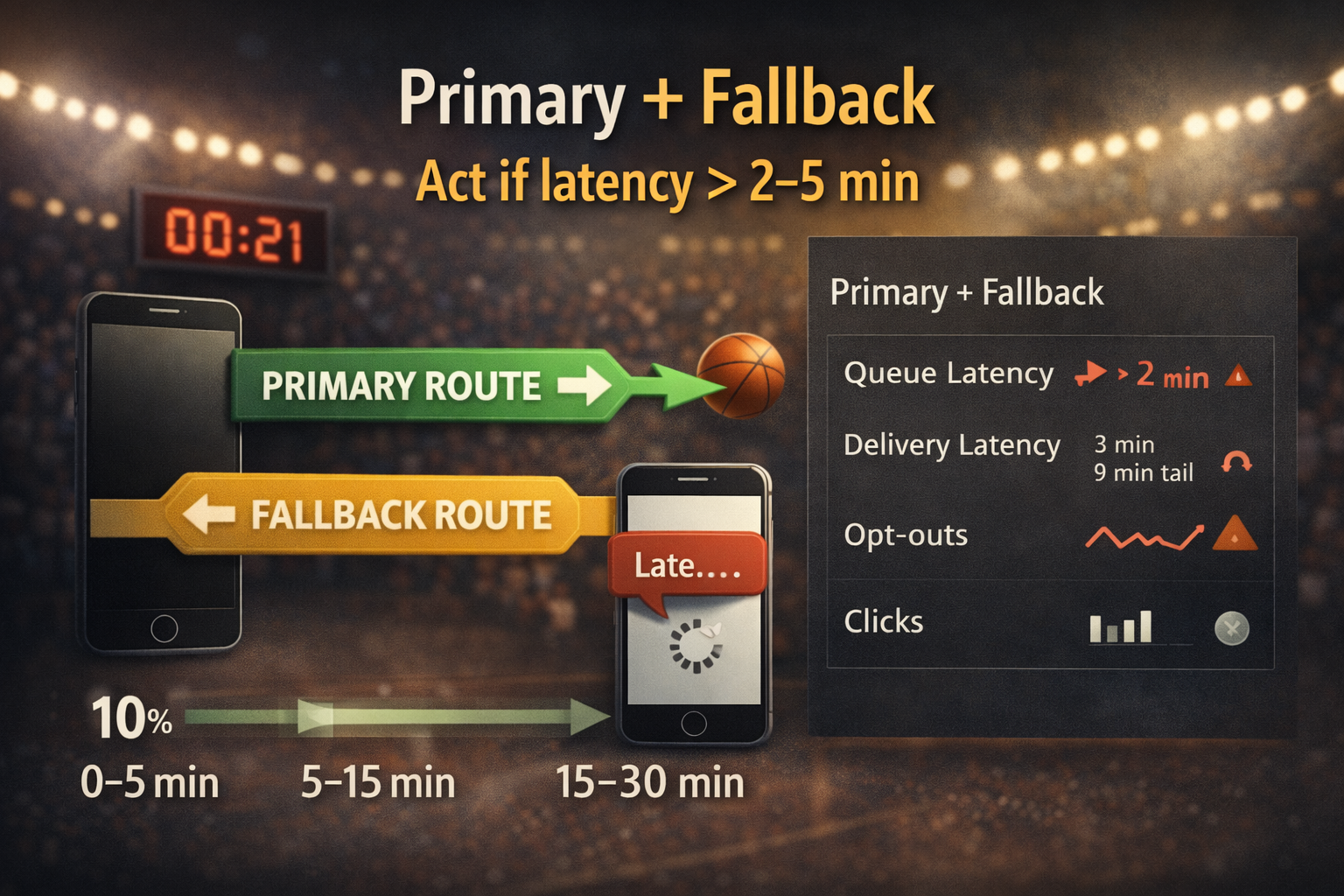
What SMS routing means for non-telecom teams: paths, not promises
Think of routing like shipping lanes.
Your message doesn’t teleport from your app to a phone. It travels through a path—and paths behave differently under load.
During March Madness peaks, routing matters because:
- some paths get congested faster
- some paths trigger stricter filtering
- some paths provide better visibility when something changes
If you’re new to routing, this beginner guide explains how SMS platforms connect to mobile networks—and how preferred vs fallback routes change outcomes.
Primary route vs fallback route: what changes, what should not change
A strong peak plan uses:
- a primary route for normal traffic
- a fallback route that you can switch to when performance drifts
What can change:
- the path used for delivery
- the pacing configuration
- segment priorities
What should not change:
- compliance fundamentals (opt-out language, consent)
- misleading sender identity behavior
- the integrity of your measurement (UTMs, link hygiene)
Switch rules you can agree on in advance: latency thresholds, failure spikes, and drift detection
Don’t wait for a panic moment to decide what “bad” means.
Agree on switch rules like:
- Latency threshold: if median delivery latency exceeds 2–5 minutes for a sustained period during a peak window
- Failure spike: if specific failure/blocked patterns increase sharply (destination-specific)
- Drift detection: if performance drops only in one segment or destination, route switching may be less effective than pacing + content adjustments
The win is not switching fast. The win is switching correctly.
Monitoring Thresholds That Matter
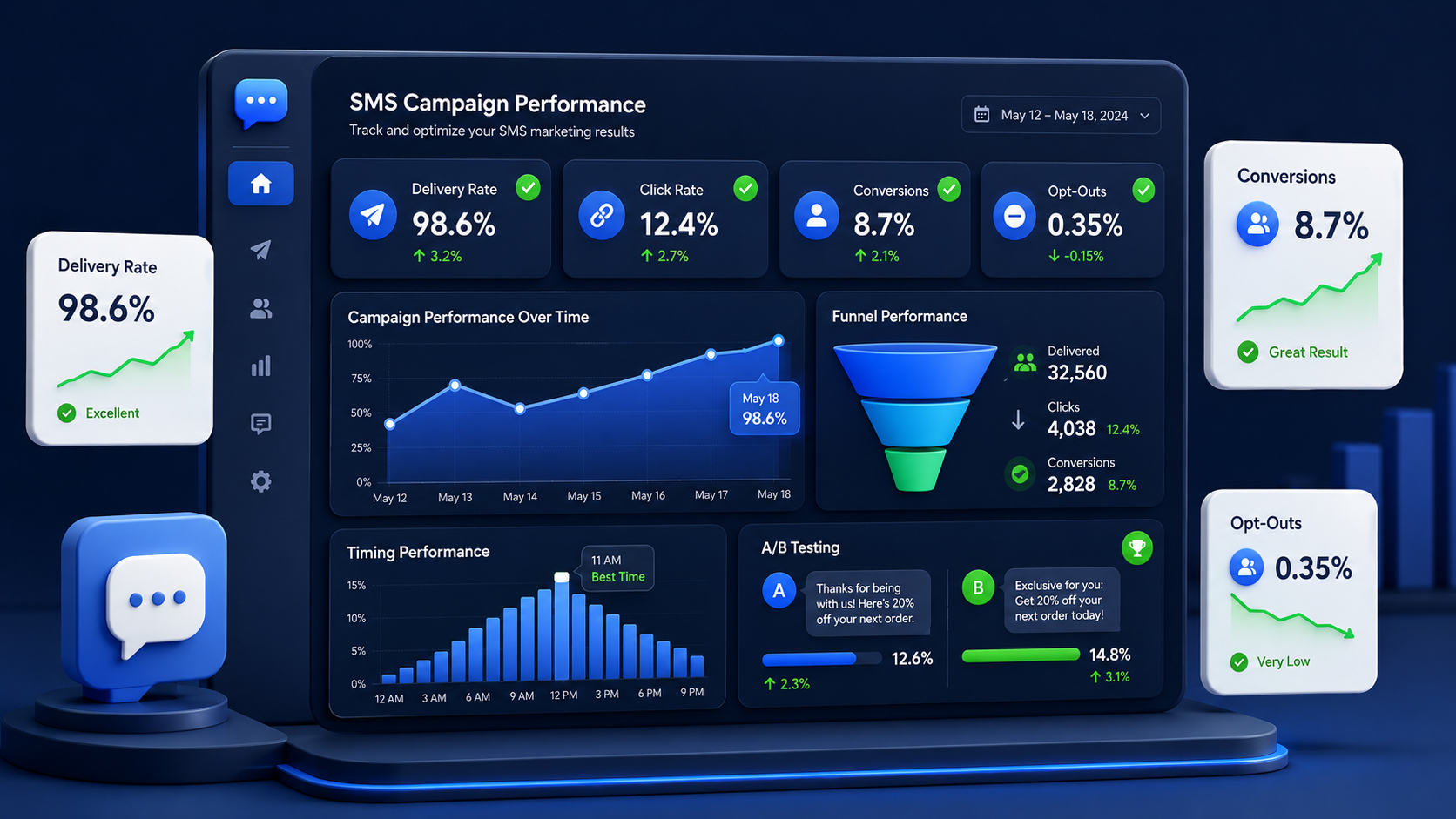
The minimum “peak dashboard” for tournament days
You don’t need 40 charts. You need a few signals you’ll actually use.
A tournament-day dashboard can be:
- Send queue latency (how long messages wait before leaving your system)
- Submission success rate (are requests accepted or rejected upstream?)
- Delivery latency distribution (median + “late tail”)
- Opt-out rate (spikes = fatigue or trust issues)
- Click rate (helps distinguish “late” from “irrelevant”)
Early warning signals that appear 10–20 minutes before delivery rate drops
Peak problems often show up as:
- queue time increasing
- latency tail stretching (more messages arriving “late”)
- retry behavior increasing (if visible)
- opt-outs nudging upward during countdown sends
If you catch these early, you can fix them with pacing—before you need route-level action.
A fast triage map: delay vs filter vs route shift (and what each implies)
Use a simple triage question:
- Are messages late but eventually delivered?
→ pacing, batching, and send window widening are your first moves. - Are messages failing or blocked at higher rates?
→ investigate content patterns, link reputation, frequency spikes, and sender trust posture. - Did performance drop suddenly with no campaign change?
→ suspect route behavior drift; consider fallback routing and capture a “what changed” snapshot.
Short Links + UTM for SMS Marketing for Ecommerce
One UTM naming pattern for every game window: week, round, tip-off, offer, segment
If you can’t attribute by send window, you can’t optimize under pressure.
A simple pattern:
utm_source=smsutm_medium=campaignutm_campaign=mm_w{week}_{round}_{tipoff}_{offer}utm_content={segment}_{timing}
Example:
utm_campaign=mm_w2_r64_7p_bundle20utm_content=vip_countdown
Now your analytics can answer:
- Which round performs best?
- Which timing (heads-up vs countdown) converts?
- Which segment is worth peak priority?
Short-link hygiene under peak load: redirect chain, landing speed, and attribution safety
Peak windows magnify friction.
Peak-safe short links:
- avoid long redirect chains
- send to fast landing pages (mobile-first, lightweight)
- maintain consistent UTM structure
- avoid “too many different links” in a single day (can look suspicious and hurt trust)
Reading click-to-conversion lag during peaks (15–120 minutes) without misattribution
During tip-off peaks, conversion can lag:
- people click, browse, then buy later
- they share the deal, then return
- they wait for halftime, then check out
So measure:
- click-to-purchase within 15 min
- within 60 min
- within 24 hours
This prevents you from calling a countdown “bad” when it’s just delayed conversion.
Mid-Article Peak Readiness Self-Test (score 0–10 in 2 minutes)
Score 1 point for each “yes”:
- We have a defined send window (not “everything at 6:00pm”)
- We have a pacing ramp (10%→100%)
- We batch by intent segments (VIP first)
- We have frequency caps per segment
- We have timezone handling (ET/CT/MT/PT or local time)
- We know our “bad” threshold (latency >2–5 minutes)
- We have a fallback routing plan
- We know what triggers a switch vs a slow-down
- Every peak send uses short links + consistent UTMs
- We have a launch-day runbook (first 10 minutes actions)
0–4: You’re likely to see “late wins” (delivered, but too late).
5–7: You’ll be okay most days, but peaks can still surprise you.
8–10: You’re operating like peaks are normal—which is the goal.
(Mid-article light prompt logic: if you scored under 7, do a quick “peak readiness review” before Round 1.)
Launch-Day Runbook When Performance Dips
Immediate mitigations: slow down, pause one segment, widen the send window
When in doubt, stabilize first:
- Reduce send rate
- Pause low-intent segments
- Widen your send window (turn a 10-minute burst into a 30–60 minute ramp)
- Keep VIP/critical segments moving first
What to capture while it’s happening: timestamps, destinations, route state, offer version
Don’t troubleshoot from memory. Capture:
- start time of drift
- which segments were active
- which destinations/carriers are impacted (if visible)
- route state (primary vs fallback)
- offer version and link version (UTM campaign name)
This makes post-peak fixes real, not speculative.
Internal comms checklist: how to report impact in 3 numbers (without guessing)
A simple internal update:
- Current latency (median + tail)
- Scope (which segments/destinations)
- Action taken (slowdown / pause / route switch) + expected reassess time window
Short, factual, calm.
Post-Peak Cooldown and Retention
Cooldown rules: when to stop “game-time” messaging and reset expectations
After the tournament, stop treating your list like a live sports audience.
Cooldown guidance:
- end “countdown” style messaging within a few days
- shift to evergreen value (new arrivals, reorder prompts, loyalty)
- give subscribers a moment to breathe
A retention sequence that converts tournament subscribers into repeat buyers (3–5 messages)
A simple post-event sequence:
- Welcome / preference capture (“What do you want from texts?”)
- Best-sellers / social proof (non-peak)
- Loyalty value (points, early access)
- Seasonal handoff (“next event”)
- Win-back for non-buyers (one strong offer, then back off)
What to document so the next peak is easier: decisions, thresholds, and outcomes
Write down:
- your pacing curve
- your switch rules
- the UTM naming pattern
- what worked by round and segment
That’s how a “March Madness campaign” becomes an operating system.
Q&A
How early should you send to beat carrier delays: 2–24 hours vs 15–60 minutes?
If timing is critical:
send a heads-up the day before
send a countdown inside 60 minutes
don’t rely on “one message at tip-off”
How to avoid filtering with promo language and links during peak weeks?
Peak-safe hygiene:
keep copy simple
avoid aggressive spam triggers
don’t rotate links endlessly
respect frequency caps and opt-outs
What “good enough” peak performance looks like for US sends: practical ranges?
Don’t chase perfection. Chase consistency:
stable latency (no surprise spikes)
controlled opt-outs
predictable click-to-conversion patterns
the ability to explain what changed when it dips