
You’ve worked hard on your marketing campaign—but if it lands on someone’s phone at the wrong time, it gets ignored.
If you only read one paragraph, read this: the best time to send SMS marketing for beginners is to start with two “likely-to-be-seen” windows in your customers’ local time (Tue–Thu, roughly 10:00–13:00 and 16:00–19:00), avoid late-night hours (roughly 21:00–08:00), and run a 7-day test where you change only the send time. Your goal isn’t to find the perfect hour. It’s to find your best hour, with evidence.
There’s No Magic Hour: How to Think About SMS Timing Instead
The “best time to send SMS marketing” isn’t a universal secret. It’s a repeatable process: pick reasonable starting windows, protect the customer experience, test one variable, and keep the winner. That’s it.
What you’re really optimizing is attention, not “delivery.” SMS tends to get seen quickly (often reported across major SMS platform benchmarks as “within minutes”), which is exactly why timing matters: a text is an interruption. If it arrives when someone can act, it feels helpful. If it arrives when they can’t, it feels… like noise.
The Beginner Schedule (Start Here): Two Time Windows to Test This Week
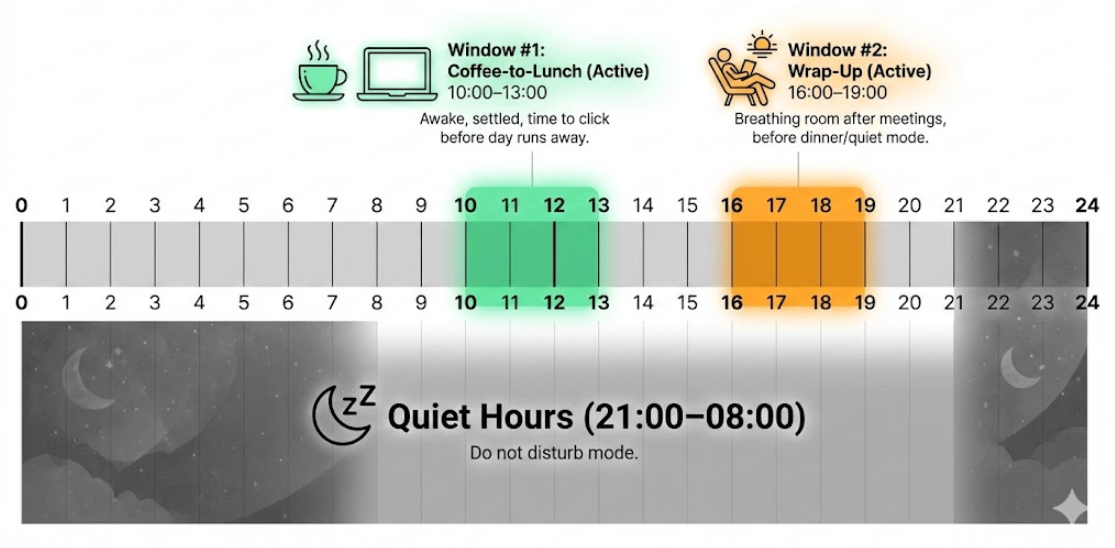
Start with two windows, not a single “best time.” People don’t live on a stopwatch. They live in rhythms.
Window #1: coffee-to-lunch (10:00–13:00, local time). It’s often a decent starting point because people are awake, settled, and still have time to click before the day runs away.
Window #2: wrap-up (16:00–19:00, local time). Many customers have a little breathing room here—after meetings, before dinner, before the phone goes into “do not talk to me” mode.
And then there’s the tempting window that often backfires: late night. Even if the click looks good once, it can raise opt-outs and complaints. A common rule of thumb in SMS marketing is to avoid promotional texts too early or too late (you’ll often hear “not before late morning, not after evening”). Your brand only gets so many interruptions before people hit STOP.
Pre-Test Worksheet: The One-Page Timing Self-Check
Copy this into a note or spreadsheet:
Timing Worksheet (fill in before you hit send)
- Campaign type: (promo / win-back / cart reminder / launch)
- Audience: (new subscribers / repeat buyers / VIP / lapsed)
- Offer: (what’s the value in 6 words?)
- Action: (what should they do in one tap?)
- Window A (local time): ___ to ___
- Window B (local time): ___ to ___
- Quiet hours guardrail: ___ to ___
- Frequency cap this week: ___ texts max
- Success metric: (click/conversion/opt-out) = ___
If you can’t fill this in cleanly, don’t send yet. Fix the basics first.
Time Zones: Stop Scheduling in Your Own Clock
If you market across regions, the fastest way to sabotage timing is simple: scheduling in your own time zone. Your 4 p.m. send might be someone else’s midnight.
Default to recipient-local time whenever you can. Even a rough time-zone grouping (West / Central / East, or by country) is better than blasting the whole list at once.
Quiet-hours guardrails reduce opt-outs. Pick a conservative block—many teams start with something like no promo texts between ~21:00–08:00 local time unless the message is truly time-sensitive. (Also: check local laws and carrier policies for your markets. Don’t guess.)
Watch out for DST and holidays. Daylight Saving Time can shift your schedule by an hour without warning. Holidays can flip the “normal rhythm” entirely. Your timing test should be ongoing, not a one-and-done.
The 7-Day Timing Test (Without Changing Everything Else)
Most “timing tests” fail because they’re not timing tests. We see this mistake constantly: teams think they’re testing timing, but they’re really testing chaos. Timing tests are everything-at-once tests: new copy, new offer, new link, new landing page… and also a different send time. Then you learn nothing.
Here’s the one-variable rule: keep the message, offer, audience, and link the same—change only the send window. Boring. Effective.
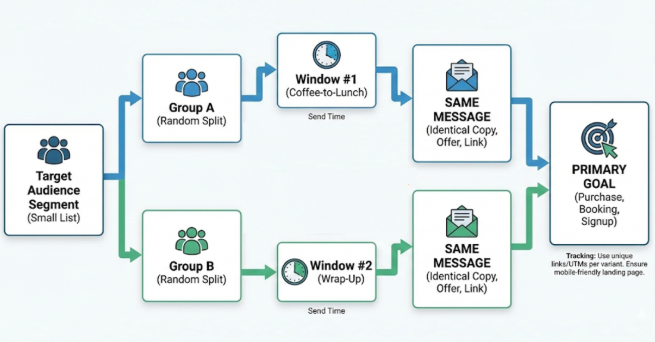
A tiny A/B setup that works even with a small list:
- Split one segment into two comparable groups (random is fine).
- Send the same message in Window #1 to Group A and Window #2 to Group B.
- Repeat the pattern across the week (or alternate which group gets which window) so you’re not accidentally testing “Monday vs Thursday” instead of “time vs time.”
Tracking you can’t skip (seriously):
- Use one short link per variant (or the same link with different UTM parameters).
- Decide one primary goal (purchase, booking, signup). One.
- Make sure the landing page works on mobile. If the page is slow, your “best time” won’t matter.
Send Frequency: When a “Good Time” Turns Into a Bad Experience
Even the best time to send SMS marketing fails fast if you text too often. Frequency creates fatigue, and fatigue creates opt-outs. So set a cap before you optimize.
A beginner-friendly starting cap: 1–2 marketing texts per week, unless your audience has clearly signaled they want more. You can always earn the right to increase frequency later. You can’t un-burn trust.
Follow-ups should feel like help, not chasing. If you do follow-ups, make them purposeful:
- Follow up only when the offer is still relevant.
- Change the angle, not just the timestamp.
- Stop after one follow-up unless the customer engaged.
Reply-first messages (two-way) are powerful—when the timing is respectful. Asking a question at an inconvenient hour is worse than sending a link at an inconvenient hour. If you want replies, aim for times when people can respond without being annoyed. That usually means daytime.
Reading Results Like a Grown-Up (Without a Data Team)
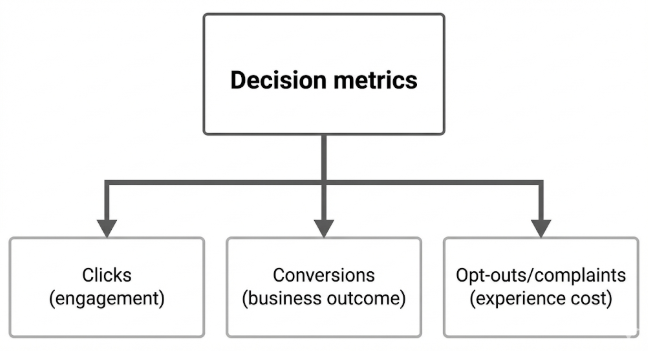
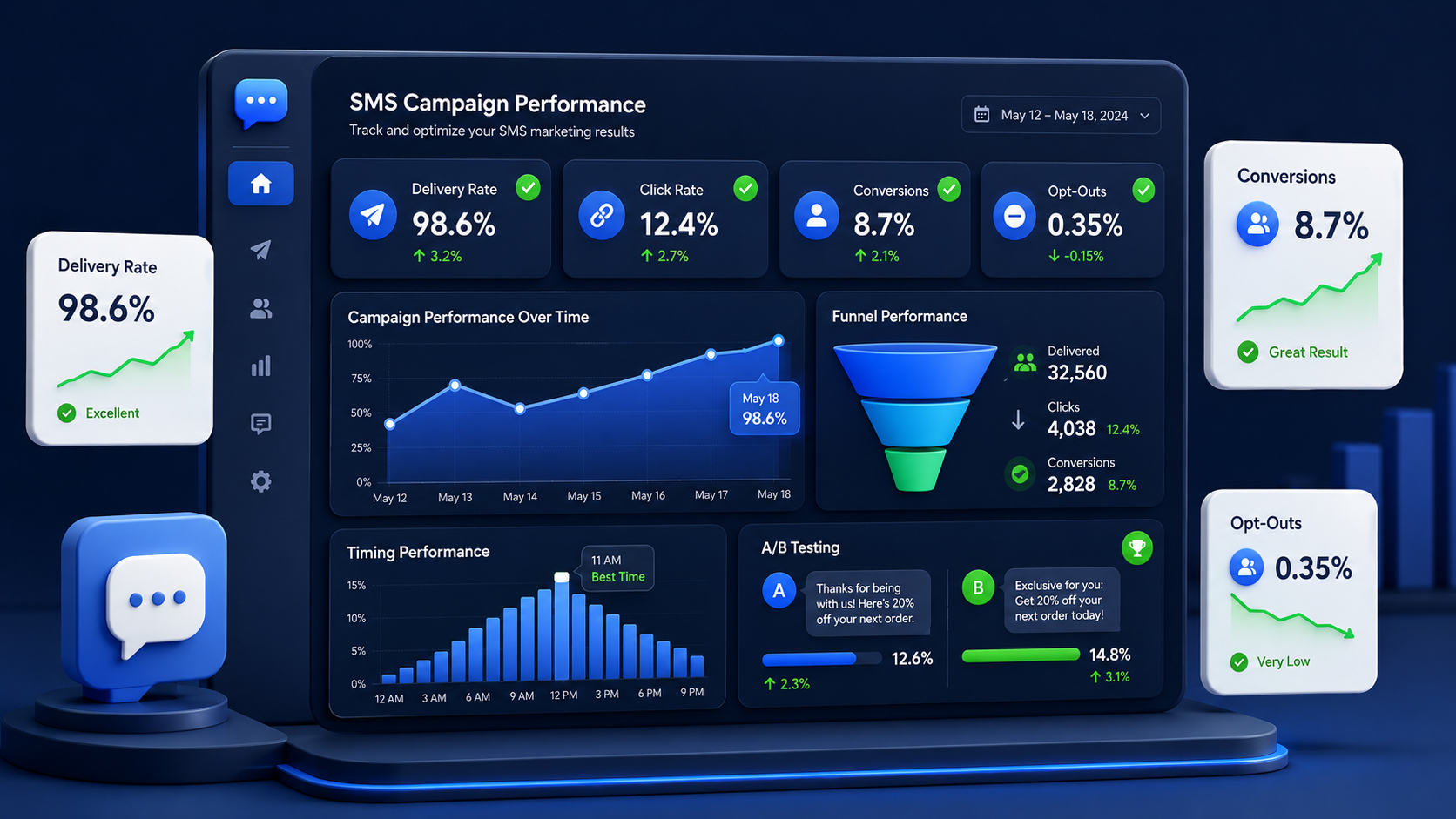
Don’t drown yourself in metrics. For timing, the trio that matters is (For timing decisions, focus on three signals that actually matter:)
- Clicks (engagement)
- Conversions (business outcome)
- Opt-outs/complaints (experience cost)
Industry sources often cite extremely high SMS open rates (you’ll see figures like ~98% repeated across SMS provider benchmarks), but opens don’t pay your bills—and they don’t tell you if the timing worked. Focus on what changes _after_ the click.
Build a simple day×hour heatmap in one spreadsheet tab:
- Rows: day of week
- Columns: hour blocks (or your two windows)
- Cells: click rate, conversion rate, opt-out rate
You’re not looking for perfection. You’re looking for a pattern you can repeat without annoying your list.
What to change next week (and what to leave alone):
- Change next: send window, segment definition, frequency cap
- Leave alone (for now): copy tone, offer type, landing page layou. Because if you change everything, you’ll always be “busy,” and never be sure.
If Nothing Moves, Timing Isn’t Your Villain
Sometimes the schedule isn’t the problem. It’s the foundation.
List-quality red flags you can spot fast:
- High bounce/undelivered rate
- Lots of numbers that never click anything
- Opt-outs spiking regardless of send time
Deliverability bottlenecks can distort your “best time.” If messages queue, throttle, or get filtered, the text may arrive later than you think—wrecking your test. If your delivery reports are messy or inconsistent, fix that before declaring a winner.
And yes: sometimes the offer is the problem, not the timing. If your message isn’t worth the interruption, no hour will save it. One line to keep you honest: send fewer texts—make each one worth the interruption.
Endgame: Pressure-Test Your Schedule Before You Scale
Before you scale up, collect a tiny “review packet” so your next decision is real:
- Your two tested windows (and what each one did to clicks, conversions, opt-outs)
- Your segment definitions (who got what)
- Your frequency cap
- Your top markets/time zones
- Any delivery issues you noticed (queues, delays, filtering)
Now close the loop: keep the better window, run the next 7-day test, and slowly widen to more segments. This is how “best time to send SMS marketing” becomes a measurable advantage—not a guess.
Final Thoughts
Timing isn’t about finding a universal “best hour.” It’s about building a schedule your audience actually tolerates—and responds to—week after week. When you treat send time as a testable system instead of a guess, you protect your list, reduce opt-outs, and make every message earn its place.
If you want a second set of eyes on your timing plan—especially across time zones, delivery routes, and real cost assumptions—SMS Boostingworks with teams to think through send timing, cadence, and deliverability trade-offs before they scale. The goal is simple: avoid guesswork, protect your list, and make sure timing decisions are backed by real signals, not assumptions.
FAQs
What’s the best day of the week to send SMS marketing?
For most beginners, Tuesday to Thursday is the safest starting bet because people are in “normal routine” mode. Use that as your baseline, then test your audience—some lists respond surprisingly well on Mondays or Sundays depending on what you sell.
Should I send SMS promotions on weekends?
You can—but don’t assume weekends are “free attention.” Weekend timing works best when your offer matches weekend behavior (shopping, dining, events). If you’re unsure, test one weekend window against your best weekday window and let opt-outs be your guardrail.
Is morning or evening better for promotional SMS?
Neither is “always better.” Start with two windows: late morning (10:00–13:00) and late afternoon (16:00–19:00) in the recipient’s local time. Avoid late-night promos; even if clicks look fine, fatigue and opt-outs can rise.
How do I handle time zones for international lists?
Default to recipient-local time. If you can’t fully automate it yet, group subscribers by country or major time zone blocks and schedule separately. A rough local-time send is still better than one global blast.
What are “quiet hours,” and do I need them?
Quiet hours are your “don’t be that brand” rule—usually no promos late at night or very early morning. They help reduce complaints and opt-outs. Also: rules vary by market, so check local regulations and carrier guidance instead of guessing.
How many marketing texts per week is too many?
If you’re new, start with 1–2 marketing texts per week. Increase only when engagement stays healthy and opt-outs stay flat. Your schedule isn’t just about response—it’s about protecting long-term list quality.
How soon should I follow up after a promo text?
If you follow up, do it once, and only if the offer is still relevant. A common approach is a second message the next day (not an hour later), with a different angle (e.g., reminder vs benefit), then stop.
My list is small—can I still test send times?
Yes. With smaller lists, test over a longer period: keep the same message type and alternate windows across two weeks, not two hours. You’re looking for a consistent direction, not statistical perfection.