SMS campaign examples are useful when they show more than polished copy. A workable example also defines the audience, the reason for sending now, the next action, and the metric used to judge the result.
This guide gives you 12 ideas across acquisition, conversion, retention, and reactivation. Each one can become a scheduled campaign or an automated message, depending on the customer signal behind it. Adapt every example to your brand, offer, local messaging rules, and approved subscriber list.
Which SMS Campaign Example Fits Your Goal?
Start with the business goal, then choose the message. This keeps SMS from becoming a filler channel that sends another discount whenever the calendar looks empty.
|
Goal |
Best Starting Campaign |
Audience Signal |
Primary Metric |
|
Acquire subscribers |
Keyword sign-up or event follow-up |
The person requests SMS updates |
Confirmed opt-ins |
|
Convert interest |
Launch, restock, or cart reminder |
The person shows product intent |
Completed purchases |
|
Retain customers |
Loyalty, education, or replenishment |
The person has already bought |
Repeat purchases |
|
Reactivate customers |
Win-back or preference reset |
The person has become inactive |
Reactivated customers |
Use this table as a filter, not a promise. A product launch and a replenishment reminder may use similar copy, but they belong to different audiences and measurement plans. For broader planning, build the idea into a complete SMS marketing campaign brief before writing the final message.
Acquisition SMS Campaign Examples
Acquisition messages should deliver the value promised during sign-up. They should not use a vague consent request as permission for every future promotion.
1. Welcome Offer After a Clear Opt-In
Use this campaign immediately after someone joins a promotional text list. The first message should identify the brand, confirm what the subscriber requested, and deliver the promised benefit.
North & Pine: You’re in. Use WELCOME15 for 15% off your first order through Aug 31: [link]. Reply STOP to opt out.
The campaign goal is first purchase, but the first quality check is simpler: did the message match the sign-up promise? Track confirmed opt-ins, code redemptions, and opt-outs. Suppress anyone who already used the offer through another channel.
2. Text-to-Join Keyword Campaign
A keyword campaign connects offline attention to a permission-based SMS list. Promote a phrase such as “Text TASTING to [number]” on a store sign, event booth, package insert, or printed receipt.
Cedar Coffee: Thanks for texting TASTING. Show this message for a free sample flight on Sat, Aug 16, 10 AM–2 PM at 8 King St. Reply STOP to opt out.
The keyword must map to one program and one expectation. Record the sign-up source, date, message shown to the customer, and confirmation status. Measure confirmed opt-ins and offer claims rather than total inbound texts.
3. Event or Webinar Follow-Up
Send this message only to attendees who asked for text updates. SMS fits when the next action is time-sensitive, such as collecting slides, booking a follow-up session, or joining a limited workshop.
FieldOps Summit: Your route-planning slides are ready: [link]. Want a 15-minute workflow review? Reply REVIEW. Reply STOP to opt out.
This example gives recipients two clear paths: open the resource or request a conversation. Route replies to a named team, then track resource visits and qualified replies. Do not leave responses in an unmonitored inbox.
Conversion SMS Campaign Examples
Conversion messages work best when the customer has a current reason to care. Purchase history, a waitlist request, cart activity, or product interest is stronger than a broad demographic label.
4. Product Launch for a Waitlist
Waitlist subscribers have already asked to hear about a release, so the message can lead with availability instead of a discount.
Aurelia Run: The Trail 2 is live in the colors you selected. Waitlist access ends at 8 PM: [link]. Reply STOP to opt out.
Use the product or category preference collected at sign-up. Send the customer to the exact product page, not the home page. Track product-page sessions and orders from the waitlist segment.
5. Flash Sale for a Relevant Segment
A flash sale needs a specific offer, deadline, and audience. “Everything is on sale” may be easy to write, but a category offer often gives the customer a clearer reason to open the link.
Harbor Home: Dining chairs are 20% off for SMS members until 9 PM. Shop the collection: [link]. Terms apply. Reply STOP to opt out.
Check time zones, inventory, exclusions, and the landing page before sending. Track purchases and revenue from the selected segment. Also watch opt-outs; a sale can generate revenue while still weakening the list.
6. Browse or Cart Reminder
This is usually an automated message, not a calendar campaign. Send it after a consented subscriber views or adds an item and leaves without purchasing.
Morrow Goods: Still considering the Weekender Bag? Your saved item is here: [link]. Questions about size? Reply to this text. Reply STOP to opt out.
The example avoids an automatic discount. A helpful reminder may be enough when product intent is strong. Cancel the message after purchase, stock loss, or an expired session. Measure recovered orders and assisted replies.
7. Back-in-Stock Alert
Back-in-stock SMS should follow an explicit availability request or a relevant preference. Confirm inventory shortly before send time, especially when several locations share stock.
Oak Street Books: The illustrated Atlas is back at our West End store. Reserve a copy by 6 PM: [link]. Reply STOP to opt out.
The action can be a reservation, online order, or store visit. Choose one. Track reservations or purchases rather than link clicks alone, and pause the campaign when available stock falls below the promised quantity.
Retention SMS Campaign Examples
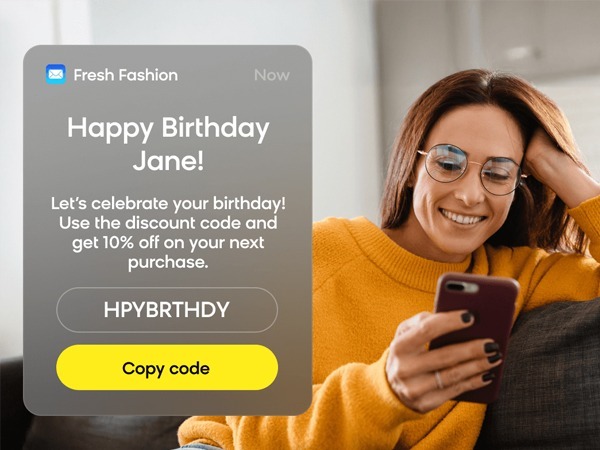
Retention messages should make an existing customer’s relationship with the brand more useful. A constant stream of coupons may train customers to wait for discounts and ignore every other message.
8. Loyalty Status Update
A loyalty update works when it contains usable information. State the current reward, the action required, and any deadline.
Luma Club: You have a $12 reward available through Sep 15. Apply it to your next order here: [link]. Reply STOP to opt out.
Keep the balance synchronized with the loyalty system. A customer who sees the wrong reward may lose trust faster than a customer who receives no message. Measure reward use and repeat purchases.
9. Post-Purchase Education
Not every retention message should sell. A short setup, care, or usage tip can reduce confusion and help the customer get more from the purchase.
Form & Field: Your linen care guide is ready: [link]. Wash cool and air-dry for the best fit. Need help? Reply here.
This message may be classified differently from a promotion depending on its content and location. Do not add a discount and assume the original service consent still covers the new marketing purpose. Track guide visits, replies, and support outcomes.
10. Replenishment Reminder
Use an estimated purchase cycle only when it fits the product and the customer’s actual order history. Give the customer an easy way to delay or decline.
Kinship Pet: Running low on River Blend? Reorder your usual 4-lb bag here: [link], or reply LATER for a reminder next week. Reply STOP to opt out.
The “LATER” option makes the message more useful and supplies preference data. Measure repeat orders, delayed reminders, and opt-outs. Avoid sending after a recent reorder or subscription renewal.
Reactivation SMS Campaign Examples
Reactivation campaigns address customers whose engagement has faded. Set an inactivity rule before writing the offer, and exclude recent purchasers or active support cases.
11. Win-Back Offer
Use a win-back message when the discount is economically justified and tied to a defined inactive segment.
Juniper Table: We haven’t seen you in a while. Take $10 off a $50 order through Aug 24 with BACK10: [link]. Reply STOP to opt out.
Track reactivated customers, net revenue after the discount, and later repeat behavior. A one-time discounted order is not the same as a recovered customer relationship.
12. Preference Reset
A preference reset is a useful alternative to another sales message. Ask whether the subscriber still wants the program and let them select a more relevant category or cadence.
Vela Market: Want fewer texts or different offers? Update your SMS preferences here: [link]. Reply STOP to opt out.
This message may reduce list size, which is healthy when inactive subscribers no longer want the program. Track preference updates, confirmed opt-outs, and later engagement among retained subscribers.
How to Adapt an Example as a Campaign

Templates save writing time, but the campaign still needs a decision trail. Use this five-part review before launch.
- Define the Audience: State the behavior, consent source, location, and exclusions that place a subscriber in the send group.
- Choose One Action: Ask the customer to buy, reserve, reply, register, or update a preference, but do not combine several competing requests.
- Adapt the Copy: Replace every variable, confirm the sender identity, and use the same terms on the message and landing page. This marketing SMS writing guide can help refine the hook and CTA.
- Run Message QA: Test links, tracking, opt-out handling, time zones, suppression, personalization fallbacks, GSM-7 or Unicode encoding, and message segments.
- Select One Primary Metric: Use the outcome closest to the goal, such as confirmed opt-ins, completed purchases, reservations, qualified replies, or reactivated customers.
Consent and opt-out expectations vary by market. In the United States, CTIA’s Messaging Principles and Best Practices call for consent before non-consumer messaging and a way to opt out. Check the rules, carrier program requirements, and sending-hour restrictions for every destination before launch.
Frequently Asked Questions
How many SMS campaign examples should I test at once?
Start with one use case, one audience, and one primary metric. Test a single copy, offer, timing, or landing-page variable at a time. Several simultaneous changes make the result hard to explain.
Is an SMS campaign different from an automated SMS flow?
Yes. A campaign is usually a planned send to a segment at a chosen time. An automated flow starts after a customer event, such as sign-up, cart activity, purchase, or a replenishment date.
Start With One Measurable Campaign
Choose the example that matches your current goal, define the audience and suppression rules, then run a small pilot. SMSBoosting’s Marketing SMS service supports scheduled and API-based sending for teams ready to test a campaign across approved destinations.