
Every April, brands start searching for Earth Day campaign ideas that feel timely, credible, and conversion-friendly. For eco-conscious brands, the challenge is not just joining the conversation, but standing out from a sea of green-washed social posts and generic “go green” messaging. The answer might already be in your customers’ pockets: SMS.
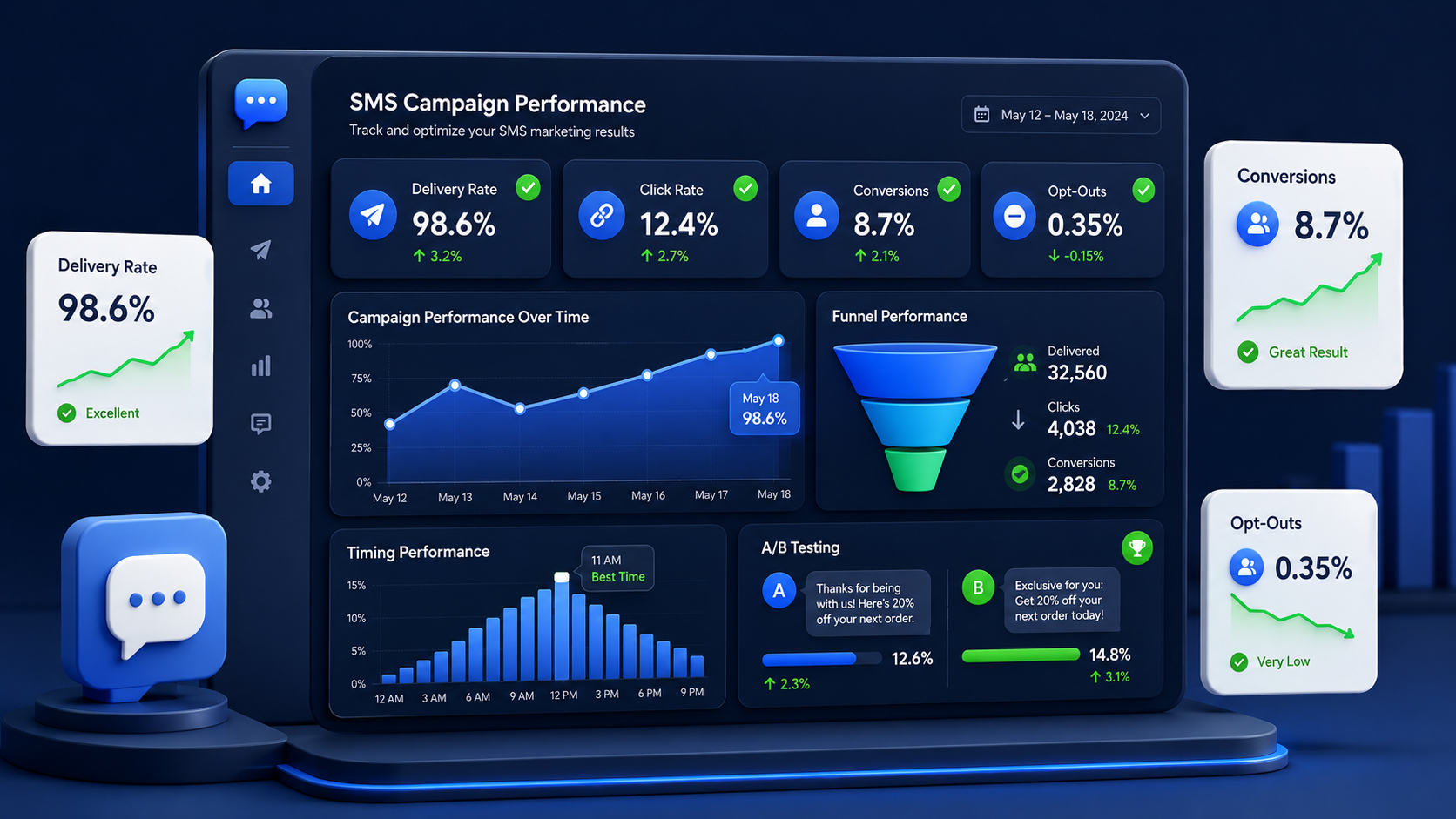
Here’s a number that should change your marketing playbook: 98% of text messages are opened, and 90% are read within three minutes (SimpleTexting, 2025). Compare that to email open rates hovering around 20%, and it’s clear that SMS is your most underutilized Earth Day channel.
This guide gives you 10 actionable Earth Day campaign ideas built specifically for SMS—complete with copy templates, timing suggestions, and KPI recommendations—so you can turn April 22 into a meaningful engagement and revenue opportunity.
Why SMS Is Your Most Underrated Channel for Earth Day Campaign Ideas
Most sustainability-focused brands pour their Earth Day budgets into Instagram posts, blog articles, and email newsletters. These channels matter, but they share a fundamental limitation: low guaranteed visibility. Your Earth Day email lands in a crowded inbox. Your Instagram post competes with thousands of others using the same hashtags.
SMS operates differently. With a 98% open rate and click-through rates between 19–35% (DMText, 2025), text messages cut through the noise with near-certainty. That’s not speculative—it’s the most consistently high-performing digital channel available to marketers today.
The environmental case for SMS is equally compelling. A single SMS generates approximately 0.014g CO2e, compared to 4g CO2e for an average email (ADEME). If your brand is committed to reducing its carbon footprint, switching campaign weight from email to SMS isn’t just strategic—it’s aligned with your values.
Consumer behavior data reinforces the opportunity. According to PwC’s 2024 Global Consumer Survey, consumers are willing to pay a 9.7% premium for sustainable products. And 84% of consumers say they would stop buying from a brand with a poor environmental record (ElectroIQ, 2025). The demand is real. The question is whether your Earth Day message actually reaches your audience.
SMS also delivers measurable ROI. Retail brands using SMS report an average return of $71 for every $1 spent (Sakari, 2025). When you combine that with the seasonal urgency of Earth Day, the case for SMS-first campaign planning becomes difficult to ignore.
The 10 ideas below are designed for marketing teams at eco-conscious brands who want to move beyond awareness posts and create campaigns that drive real engagement, real conversions, and real environmental impact.
10 Earth Day Campaign Ideas for Eco-Conscious Brands
1. The Eco-Pledge Countdown: Build Anticipation Before April 22
Start seven days before Earth Day with a daily countdown series. Each message contains one simple, achievable eco-action—bring a reusable bag, skip single-use plastic, take a shorter shower—and invites subscribers to reply and commit.
Why it works: Countdown campaigns build anticipation and create a daily touchpoint with your audience over a full week. By asking subscribers to reply with their pledge, you transform passive readers into active participants. This two-way engagement increases reply rates and strengthens the emotional connection between your brand and its community.
🌍 7 days to Earth Day! Pledge one green act today. Reply EARTH to join our countdown. Small steps, big impact! [link]
♻️ Day 3: Skip the plastic straw today. Reply DONE when you’ve made the swap! [link]
KPI to track: Reply rate (target: 15%+), daily opt-out rate (keep under 0.5%).
2. Exclusive Earth Day Offer: Reward Sustainable Choices
Send a subscriber-exclusive discount on Earth Day that rewards eco-conscious purchasing. Tie the offer to specific sustainable product lines or collections rather than generic sitewide discounts.
Why it works: Exclusivity drives urgency. When subscribers feel they’re receiving something not available to the general public, conversion rates increase. By linking the discount to sustainable products specifically, you reinforce your brand’s environmental commitment rather than appearing to capitalize on the holiday.
🌱 Happy Earth Day! Subscribers get 15% off all sustainable styles—today only. Code: EARTH15. Shop responsibly: [link]
Earth Day deal just for you! 🎁 Free eco-shipping on orders $50+. Expires midnight: [link]
KPI to track: Conversion rate (target: 10–15%), average order value vs. non-SMS campaigns.
3. Plant-a-Tree with Every Purchase: Mission-Driven Conversion
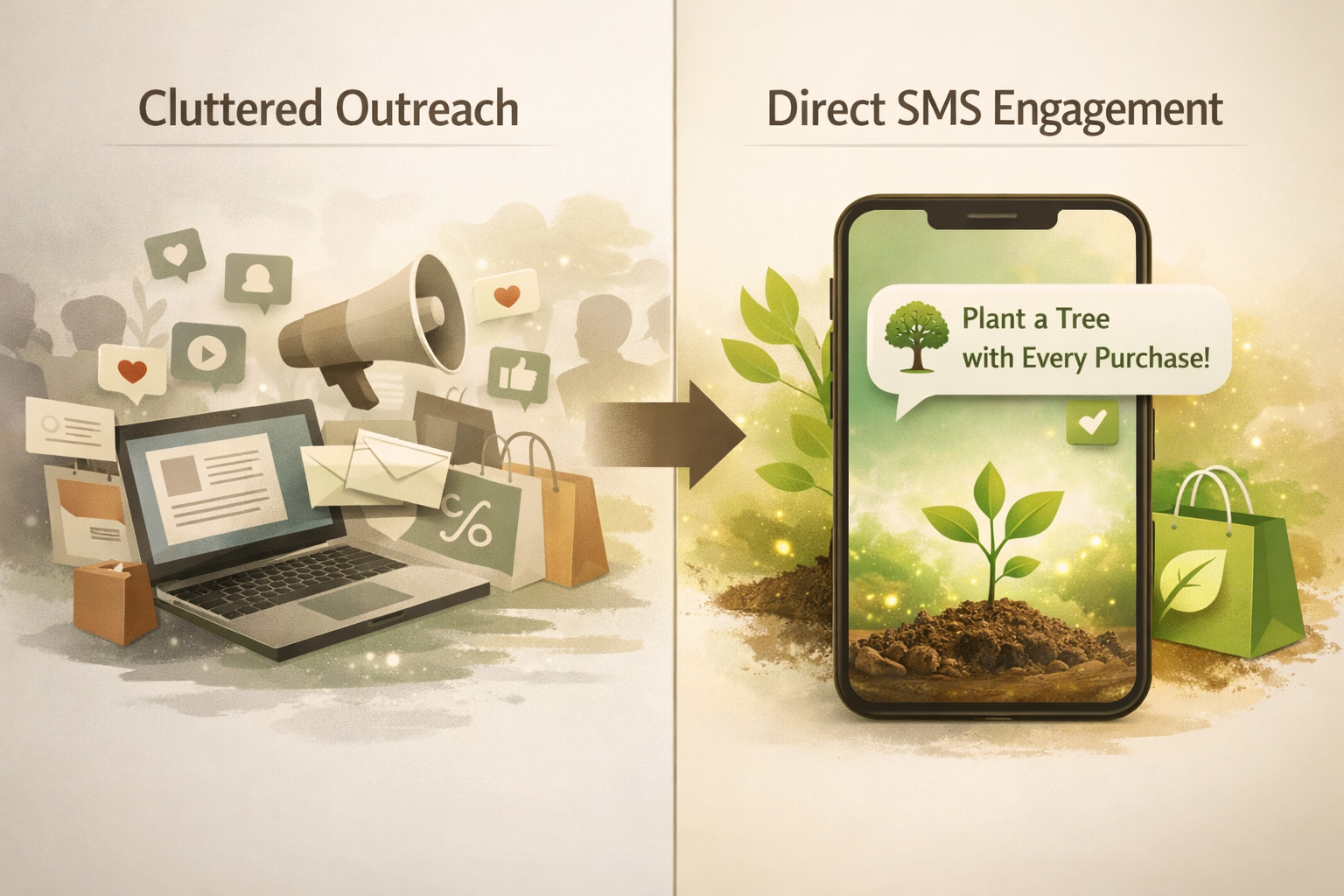
Partner with a reforestation organization (One Tree Planted, Eden Reforestation) and commit to planting one tree for every purchase made during Earth Week. Communicate this through SMS with a real-time tree counter.
Why it works: This campaign converts purchase intent into tangible environmental impact. Customers can see exactly how their individual action contributes to a collective goal. Brands like Cariuma have used this model successfully, pairing limited-edition products with a “buy one, plant ten trees” message that drove both urgency and purpose.
🌳 This Earth Day, your purchase plants a tree! Shop our eco collection & we plant 1 tree per order. Track our forest: [link]
Update: You’ve helped us plant 2,340 trees this week! 🎉 Keep the momentum going: [link]
KPI to track: Total trees pledged, conversion rate, post-campaign social shares of the tree counter.
4. Customer Voice Campaign: Share Your Eco Story
Invite subscribers to share their personal eco habits or sustainability stories by replying to your text. Select the best responses and feature them on social media or in a follow-up campaign.
Why it works: User-generated content builds authenticity in ways that brand-created content cannot. When your customers become your advocates, trust increases. This campaign also generates content you can repurpose across channels, extending the value of a single SMS touchpoint into weeks of social media material.
What’s YOUR eco habit? 🌎 Reply with one green thing you do daily. We’ll feature the best ones! #MyEcoHabit [link]
Loved your replies! 🌿 This week’s top eco habit: “I bring my own containers to restaurants.” See more: [link]
KPI to track: Reply rate, UGC pieces generated, social media engagement on featured stories.
5. Sustainability Quiz: Segment Your Audience via SMS
Send a short sustainability quiz—two to three questions max—with respondents texting back A, B, or C. Use the results to segment your audience and follow up with personalized product recommendations.
Why it works: Quizzes are inherently engaging, and SMS-native quizzes have the advantage of zero friction—no links to click, no forms to fill. The segmentation data you collect allows you to send more relevant follow-up messages, which directly improves conversion rates. Segmented SMS campaigns consistently outperform mass blasts by 20%+ (Omnisend, 2025).
🧠 Quick quiz! Which eco-hero are you? Reply A, B, or C to find out & get personalized green tips! [link]
You’re “The Waste Warrior”! ♻️ Based on your answers, try our zero-waste starter kit: [link]
KPI to track: Quiz completion rate (target: 25%+), follow-up CTR by segment.
6. Zero-Waste Tip Series: Value-First Engagement
Send a series of three to five practical zero-waste tips over the week leading up to Earth Day. No sales pitch—just genuinely useful content. On the final message, naturally transition to a product recommendation.
Why it works: This campaign builds trust through generosity. When a brand provides value before asking for anything in return, reciprocity kicks in. The gradual transition from tips to a soft product recommendation feels natural rather than pushy, which is critical for eco-conscious consumers who are sensitive to inauthentic marketing.
♻️ Eco Tip #1: Switch to reusable water bottles. The avg person uses 156 plastic bottles/year. Tip #2 tomorrow!
🌱 Final tip! Ready to go further? Our sustainable starter kit has everything you need: [link]
KPI to track: Read-through rate across the series, CTR on the final recommendation message.
7. Referral Loop: Spread the Green Message
Encourage subscribers to forward your Earth Day message to a friend. When the friend signs up, both the referrer and the new subscriber receive a reward—discount, bonus loyalty points, or a free eco-friendly gift.
Why it works: Referral campaigns tap into social proof and shared values simultaneously. When someone recommends your brand to a friend, it carries more weight than any advertisement. SMS referral links have higher forward rates than email because texting feels more personal and immediate. This campaign turns your existing subscriber base into an acquisition channel.
🌍 Share the green love! Forward this to a friend—you both get 20% off. They join, you earn, the planet wins: [link]
🎉 Your friend Sarah just joined! Here’s your 20% off code: GREEN20. Welcome to the movement! [link]
KPI to track: Forward rate, new subscriber acquisition cost, referral conversion rate.
8. Flash Donation Match: Double Your Impact
Commit to donating a fixed amount, such as $1, to an environmental organization for every subscriber who replies with a keyword during Earth Day. Set a maximum cap to create urgency as you approach the limit.
Why it works: This campaign requires almost no effort from participants—a single keyword reply is all it takes—yet delivers a powerful sense of collective impact. The donation match format has been proven effective by brands like Ibex and Girlfriend Collective, who combined Earth Day discounts with charitable contributions. The rising reply counter creates social momentum that drives further participation.
💚 Reply EARTH today & we’ll donate $1 to One Tree Planted. Zero cost to you, real impact for the planet. Max 10K replies! [link]
📣 We’ve hit 6,000 replies! Only 4,000 left before we reach our $10K donation goal. Keep going! [link]
KPI to track: Total replies vs. cap, cost per engagement, post-campaign sentiment survey.
9. Post-Earth Day Impact Report: Close the Loop
Within 48 hours after Earth Day, send a follow-up message summarizing what your community accomplished together—trees planted, pounds of plastic avoided, donations matched. Include a teaser for your next sustainability initiative.
Why it works: Most brands go silent after Earth Day. The brands that follow up with tangible results create a lasting impression and demonstrate accountability. This message serves a dual purpose: it rewards participants with a sense of accomplishment and keeps your brand top-of-mind for future engagement. Brands like Cerebelly have successfully used impact reporting to deepen customer loyalty.
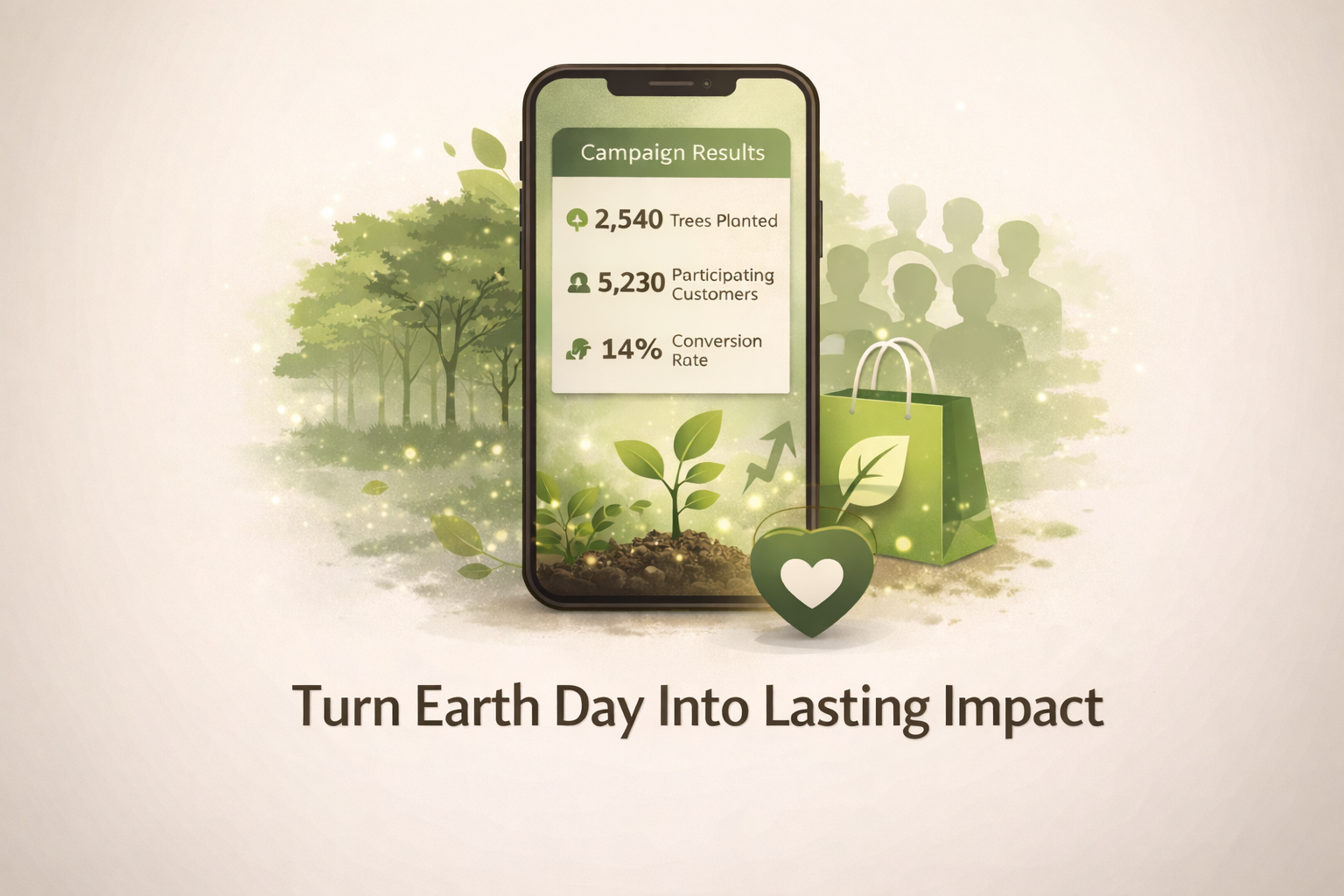
📊 Earth Day Results! Together we planted 2,500 trees & avoided 8K plastic bottles. You did this! Full report: [link]
🌿 Want to keep the momentum? Our summer sustainability challenge starts June 1. Early access: [link]
KPI to track: Message engagement rate, click-through to impact report, opt-out rate (should decrease if the report is well-received).
10. Loyalty Program Launch: Turn One-Day Hype into Ongoing Engagement
Use Earth Day as the launchpad for a sustainability-focused loyalty program. Subscribers earn points not just for purchases, but for eco-actions—recycling packaging, choosing slower shipping, referring friends. Promote the program via SMS with a sign-up incentive.
Why it works: The biggest risk of any holiday campaign is that it creates a spike in engagement that immediately flattens. A loyalty program converts one-day participants into long-term community members. By rewarding sustainable behaviors beyond purchases, you align your loyalty mechanics with your brand values, which resonates strongly with eco-conscious consumers.
🌿 Love the planet? Join our Green Rewards! Earn points for every eco-purchase & redeem for sustainable perks. Join free: [link]
Welcome to Green Rewards! 🎉 Your first mission: choose eco-shipping on your next order & earn 50 bonus points. [link]
KPI to track: Sign-up rate from SMS, 30-day program engagement, repeat purchase rate among members.
How to Turn These Earth Day Campaign Ideas Into a Full-Funnel SMS Strategy
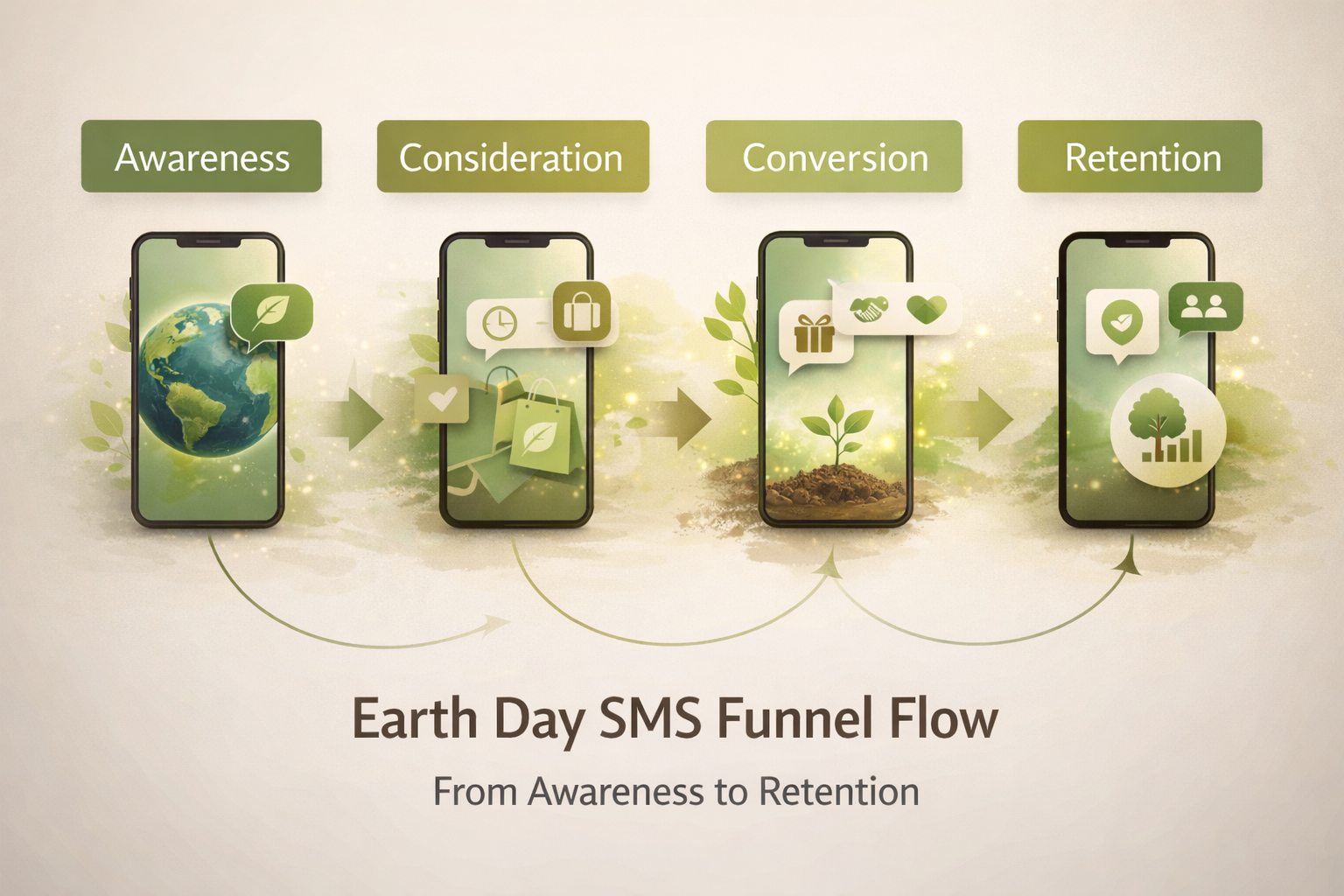
The 10 ideas above aren’t random tactics—they map to a complete customer journey. Here’s how to organize them into a cohesive full-funnel strategy using the AIDA framework.
Awareness (April 15–18): Use Ideas 1, 5, and 6 to build familiarity. The Eco-Pledge Countdown creates daily touchpoints. The Sustainability Quiz segments your audience. The Zero-Waste Tip Series delivers upfront value. Goal: maximize reach and list engagement before Earth Day.
Consideration (April 19–21): Shift to Ideas 2, 3, and 4. The Exclusive Offer creates urgency. The Plant-a-Tree campaign connects purchases to purpose. The Customer Voice campaign builds social proof. Goal: move subscribers from awareness to purchase intent.
Conversion (April 22–23): Deploy Ideas 7, 8, and 10 on Earth Day itself and the day after. The Referral Loop turns customers into advocates. The Flash Donation Match drives mass participation. The Loyalty Program Launch converts one-time buyers into recurring customers. Goal: maximize revenue and community growth.
Retention (April 24–25): Close with Idea 9. The Post-Earth Day Impact Report demonstrates accountability and tees up the next engagement cycle. Goal: reduce churn and maintain the relationship beyond the holiday.
This timeline covers April 15–25, giving you an 11-day campaign window. Adjust dates based on your brand’s calendar and audience geography.
Getting Started With Earth Day Campaign Ideas in 3 Steps
Step 1: Choose your ideas. You don’t need all 10. Pick two to three that align with your brand’s product, audience, and capacity. A smaller, well-executed campaign outperforms an ambitious one that falls flat. If you’re new to SMS marketing, start with Ideas 6 and 9—they require the least infrastructure and deliver strong engagement.
Step 2: Prepare your contact list and ensure compliance. Audit your subscriber list to confirm opt-in status. Segment by engagement level—your most active subscribers should receive the highest-priority messages. Familiarize yourself with SMS marketing regulations in your target regions, such as TCPA in the US, GDPR in the EU, and PECR in the UK. Always include an opt-out mechanism such as “reply STOP to unsubscribe.”
Step 3: Choose your SMS platform and schedule. Look for a platform with global reach, developer-friendly APIs, and robust analytics. Platforms like SMSBoosting offer coverage across 200+ countries with delivery rates above 98%. Schedule your messages in advance, set up automated follow-ups, and prepare real-time tracking dashboards so you can monitor performance as the campaign runs.
If you are comparing Earth Day campaign ideas across channels, it also helps to understand what operational support sits behind your SMS program. For a broader foundation, see what an SMS platform is and how SMS platforms connect to mobile networks.
FAQ
How far in advance should I start planning Earth Day campaign ideas for SMS?
Ideally, begin planning 4–6 weeks before April 22. This gives you time to build your subscriber list, design creative assets, coordinate with any nonprofit partners, and test your message sequences.
What’s the best time of day to send Earth Day SMS messages?
Mid-morning (10 AM–12 PM local time) and early evening (5 PM–7 PM) tend to generate the highest engagement. Avoid early mornings and late nights. Always respect time zone differences if your audience is global.
How do I avoid greenwashing accusations in my SMS campaigns?
Be specific and measurable. Instead of vague claims like “we care about the planet,” cite concrete actions—trees planted, emissions reduced, packaging eliminated—and share verifiable results. Partner with recognized third-party organizations for added credibility.
What’s a good opt-out rate for an Earth Day SMS campaign?
A healthy opt-out rate is below 0.5% per message. If you’re seeing higher rates, review your send frequency, message relevance, and value proposition. The Zero-Waste Tip Series and Impact Report typically generate the lowest opt-out rates because they prioritize value over promotion.
Can I combine multiple campaign ideas?
Absolutely. In fact, combining ideas often produces the strongest results. For example, pair the Eco-Pledge Countdown with the Post-Earth Day Impact Report to create a complete narrative arc from anticipation to results.
Conclusion: Make This Earth Day Your Most Impactful One
Earth Day is a moment when consumers are actively looking for brands that align with their values. SMS gives you the most direct line to those consumers—a channel with 98% open rates, measurable ROI, and a carbon footprint that’s 285x lighter than email.
But the real advantage isn’t just reach. It’s the ability to create genuine, two-way conversations that turn passive followers into active participants. When someone replies EARTH to your countdown or forwards your message to a friend, they’re not just engaging with a campaign—they’re joining a movement.
Start with two or three ideas. Execute them well. Measure the results. And build on what works.
This Earth Day, don’t just post about sustainability—text about it. Your customers are already holding their phones.
References
- SimpleTexting. “2025 SMS Marketing Statistics.” simpletexting.com/blog/2025-texting-and-sms-marketing-statistics
- DMText. “2025 SMS Marketing Benchmarks.” dmtext.com/resources/benchmarks
- Sakari. “SMS Marketing Benchmarks: 2025 Performance Metrics and Industry Insights.” sakari.io/blog/sms-marketing-benchmarks-2025
- ElectroIQ. “Environmentally Conscious Consumers Statistics and Facts (2025).” electroiq.com/stats/environmentally-conscious-consumers-statistics
- PwC. “Global Consumer Insights Survey 2024.” pwc.com/gx/en/news-room/press-releases/2024/pwc-2024-voice-of-consumer-survey.html
- ADEME. “Digital Carbon Footprint Analysis.” ademe.fr
- Omnisend. “2025 SMS Marketing Data: Stats, Trends, and Benchmarks.” omnisend.com/blog/sms-marketing-statistics
- Sendfolio. “21 Earth Day SMS Marketing Examples.” sendfolio.com/holidays/earth-day
- Deloitte. “Sustainable Consumption Trends.” deloitte.com/us/en/insights/topics/environmental-social-governance/sustainable-consumption-trends.html