
Why World Book Day Is a Strong Moment for SMS Book Promotion
World Book Day gives book businesses a strong moment to test book promotion ideas that are timely, relevant, and easy for readers to act on. Readers are more open to discovering new titles, trying a new format, visiting a bookstore, or responding to a limited-time offer tied to reading. For publishers, bookstores, and reading apps, that makes it a useful SMS campaign window if the message matches the audience and the next step is clear.
SMS can work well in this context because it is direct and fast. A text message is especially useful when the next step is simple: claim early access, redeem a code, RSVP to a discussion, reply for a recommendation, or return to an app session. It is less useful when the campaign depends on long storytelling, heavy education, or a complicated decision path. In those cases, email, landing pages, or in-app content may need to do more of the work first.
That distinction matters. World Book Day does not automatically make every book promotion more effective. A strong campaign still depends on list quality, title relevance, timing, and whether the offer matches the audience. A mystery reader, a bookstore member, and a lapsed reading-app user may all respond to World Book Day, but they will not respond to the same message for the same reason.
This guide covers five practical SMS campaign ideas for World Book Day. Each one includes where it works best, where it can fall short, and what to watch before you send it.
Book Promotion Ideas for Early Access and Pre-Order Campaigns
Why this idea can work
Early access works when the title already has some momentum. If readers are waiting for a sequel, a signed edition, a collector’s release, or a high-profile debut, SMS can be a strong channel because speed matters. A short message that reaches subscribers before general availability can convert attention into immediate action.
This is especially useful for publishers with upcoming releases, independent bookstores with limited signed stock, and reading platforms launching featured content tied to a known author or trend. In those cases, the value of the message is not just the information. It is the timing.
Best fit
This approach is a stronger fit for:
- anticipated titles with clear reader demand
- segmented subscriber lists with known genre interest
- limited inventory offers that benefit from urgency
It is a weaker fit for:
- midlist titles with no visible anticipation
- broad lists with little audience segmentation
- campaigns built only on “be first” language without a meaningful reason to act
What to include in the SMS
A pre-order or early-access text should stay focused. Include:
- the book title
- the release or access timing
- a direct link
- one concrete reason to act now
That reason could be a signed edition, exclusive bonus content, a limited hardcover run, or earlier access than the public release.
Example SMS:
Early access starts now: pre-order The Glass Harbor before public launch and get the bonus chapter + signed bookplate. Tap here: [link]
You’re on the priority list: reserve your copy of Night Library 48 hours before general release. Limited signed stock. [link]
What to watch
This tactic depends on credibility. If the “exclusive” access is vague, widely available elsewhere, or disconnected from real demand, the campaign loses force quickly. It is also worth checking whether the landing page finishes the promise. If the text says “early access,” the page should not make the customer hunt for the title.
Primary KPI
Track click-to-pre-order rate first. For this kind of campaign, open-rate narratives matter less than whether the audience actually moves into reservation or purchase behavior.
Book Promotion Ideas for Personalized Reading Recommendations
Why this idea can work
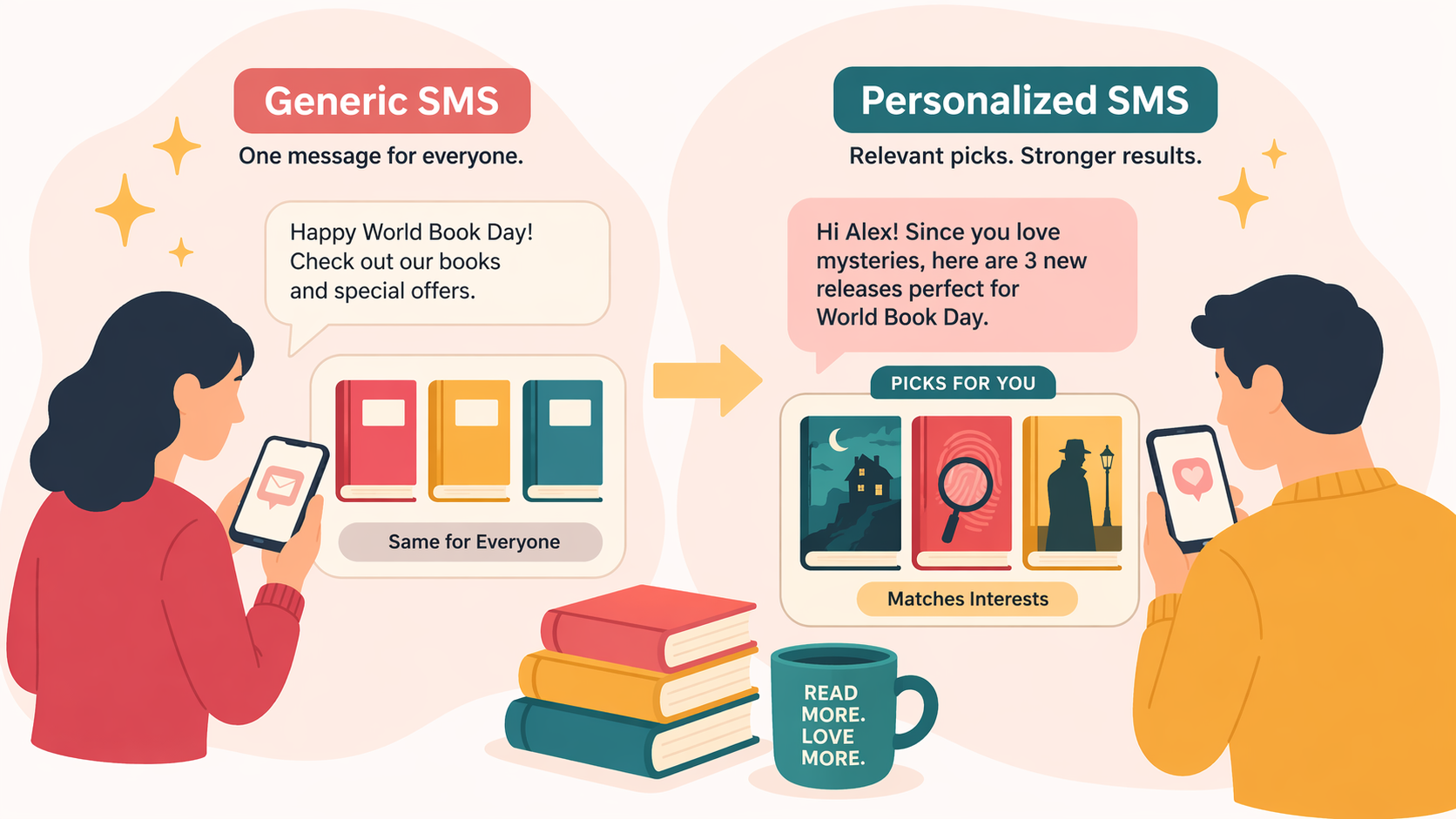
World Book Day is not only a buying moment. It is also a discovery moment. That makes recommendation-based SMS useful, but only when the recommendations feel earned. Readers do not want a generic “books you might like” list that could have gone to anyone. They respond better when the recommendation reflects something real: prior purchases, reading history, preferred genre, favorite authors, or format preference.
This does not require one-to-one personalization for every subscriber. In many cases, segmentation is enough. A bookstore can group readers by genre. A reading app can group by completion behavior or series preference. A publisher can group by author affinity or recent purchase category.
Best fit
This works best when:
- you have reasonably clean behavioral data
- the recommendation is narrow enough to feel specific
- the follow-up page or reply flow matches the segment
It works less well when:
- your data is outdated or incomplete
- you are calling something “personalized” when it is only loosely targeted
- the recommendation points to a broad category page with no clear relevance
How to make it stronger
Instead of pushing a single title to everyone, build a message around a reader pattern:
- “If you liked atmospheric historical fiction…”
- “If you’ve been finishing short thrillers…”
- “If you usually buy children’s books before school breaks…”
That framing makes the recommendation feel more grounded and more useful.
Example SMS:
If you’ve been reading cozy mysteries lately, here are 3 World Book Day picks worth your weekend. Explore the list here: [link]
Based on your recent fantasy reads, we pulled together a short list of new releases for World Book Day. Start here: [link]
Where it can fall short
The risk here is trust erosion. A bad recommendation is worse than no recommendation, because it signals that the brand either does not understand the reader or is pretending to personalize without enough evidence.
If your data quality is uneven, keep the promise smaller. “Readers who liked recent literary fiction are loving these titles” is safer than “picked just for you” unless you can genuinely support that claim.
Primary KPI
Track recommendation click quality, not just clicks. Are readers viewing the suggested books, saving them, adding them to cart, or returning to browse later? Those downstream signals matter more than raw engagement.
Book Promotion Ideas Using Limited-Time World Book Day Discounts
Why this idea can work
A discount code can perform well on World Book Day because the buying mindset is already active. Readers expect promotion around the occasion, and a time-bound code gives them a reason to act now rather than later.
But not every discount creates the same behavior. The structure of the offer matters. Percentage-off codes can feel simple and attractive, but may pull in lower-intent bargain hunters. Amount-off codes with a threshold can support higher basket size. Free shipping can remove hesitation for physical books. App-based offers might work better when they unlock subscription trials, credits, or bundle pricing rather than simple markdowns.
Best fit
This approach is strongest when:
- the offer is easy to understand
- the timing is clear
- the product set is relevant to the audience receiving it
It is weaker when:
- the discount is too broad and feels generic
- the code is sent too often and trains the audience to wait for promotions
- the message tries to do too much at once
How to choose the offer type
Use the campaign goal to decide the structure:
- Need fast conversion? Use a clear, short-lived discount.
- Need higher order value? Use a threshold-based offer.
- Need less price pressure? Use free shipping or a bundle incentive.
- Need app reactivation? Use credits, bonus content, or limited premium access.
Example SMS:
World Book Day deal: use READ20 for 20% off select new releases through midnight. Shop here: [link]
Today only: free shipping on orders over $30 for World Book Day. No code needed. Browse picks: [link]
What to watch
Do not treat every World Book Day customer as discount-driven. For some segments, especially loyal readers or active members, early access or exclusivity may outperform a basic code. A promotion that feels too generic can flatten the occasion into a routine sale.
Primary KPI
Track redemption rate and revenue per message. If possible, compare performance against your usual SMS offers to see whether World Book Day created incremental value or simply shifted existing demand.
Book Promotion Ideas for Book Clubs and Author Events
Why this idea can work
Not every World Book Day message needs to push a sale. Some of the strongest book-related SMS campaigns focus on participation. A book club invitation, author Q&A, virtual discussion, or in-store reading event can build community and deepen retention, especially for bookstores and reading apps.
SMS is useful here because it supports fast response. Readers can RSVP, reply with interest, or confirm availability without leaving the channel. That creates a lower-friction interaction than email for time-sensitive coordination.
Best fit
This is a stronger fit for:
- bookstores with repeat local foot traffic
- publishers with author events or launch discussions
- reading apps with a community layer or group-reading features
It is less suitable when:
- there is no real community offer behind the invite
- the event logistics are unclear
- the audience has no reason to participate beyond the event title itself
Different ways to run it
- For bookstores: invite members to a themed in-store reading night or a local-author event.
- For publishers: use SMS to collect advance questions for a live Q&A or launch discussion.
- For reading apps: invite users into a short challenge, live discussion, or coordinated reading sprint.
Example SMS:
Join our World Book Day book club this Thursday at 7 PM. Reply YES for the RSVP link and event details.
We’re hosting a live Q&A with the author of Paper Windows for World Book Day. Reply ASK if you want to submit a question.
What matters here
The value is not immediate sales attribution. It is ongoing engagement. If you run a campaign like this, measure whether participants come back, buy again, refer others, or interact more often afterward.
Primary KPI
Track RSVP rate first, then compare retention or repeat engagement among participants versus non-participants. That gives you a better picture than trying to force a direct-sales metric onto a community-building campaign.
Book Promotion Ideas for Reading Challenges and UGC Campaigns
Why this idea can work
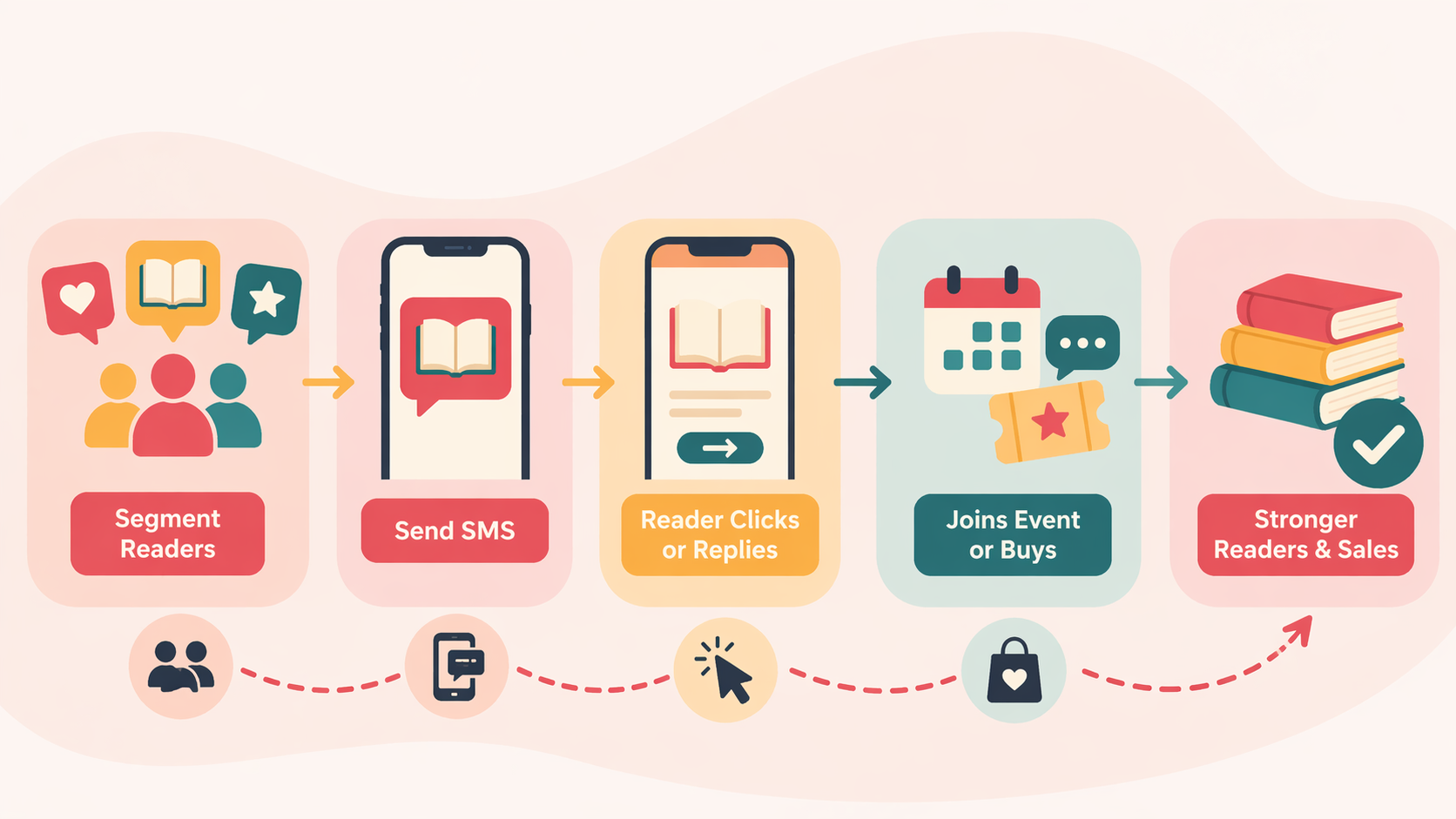
World Book Day naturally encourages sharing. Readers already post shelf photos, reviews, reading updates, and favorite quotes. A UGC or challenge-based SMS campaign can turn that existing behavior into structured participation that supports visibility and community at the same time.
This can work especially well when the ask is simple and specific:
- share a reading setup
- submit a short review
- reply with a reading goal
- join a one-week challenge
- post around a bookish prompt tied to World Book Day
Best fit
This works better when:
- your audience is already somewhat active socially or conversationally
- the campaign has a clear participation mechanic
- you have a moderation and permission process in place
It is weaker when:
- you do not have the team to review and reuse submissions
- the reward is unclear
- the audience is unlikely to participate publicly
Practical campaign angles
Review request: ask recent buyers to leave a short review tied to World Book Day.
Photo challenge: invite readers to submit a reading-space photo or bookstack image.
Reading goal prompt: ask subscribers to reply with how many pages or books they plan to finish that week.
Example SMS:
World Book Day challenge: reply with your reading goal for this week and we may feature it in our reader roundup. 📚
Show us your World Book Day reading corner for a chance to win a $25 gift card. Submit here: [link]
What to watch
UGC is not free content. It requires moderation, permission handling, and clear expectations. If you want to republish customer submissions, make that explicit. Also think carefully about the audience. Younger readers may respond more readily to visual challenges, while older readers may prefer text replies or review prompts.
Primary KPI
Track participation rate and usable submission quality. A high response volume is less valuable if most submissions cannot be reused or do not fit the brand context.
A Practical World Book Day Timing Plan for SMS
The timing of your SMS campaign matters as much as the creative. A good message sent too early can be ignored. The same message sent too late can miss the moment entirely.
A practical structure looks like this:
T-14 to T-10: Build Awareness and Opt-Ins
Use this window to capture late SMS subscribers, tease what is coming, and identify which offers or titles deserve the most attention. This is a good time for light-value messages, waitlist prompts, or sign-up incentives.
T-7 to T-4: Launch Your Primary Campaigns
This is when early-access messages, segmented recommendations, and the first offer-driven texts usually work best. Readers who like planning ahead often act in this window.
T-3 to T-1: Use Urgency Carefully
As the day gets closer, reminder messages, event invites, and “last chance” promotions become more effective, but also easier to overdo. Do not increase frequency unless each message adds something new.
T-0: Send One Focused World Book Day Message
On the day itself, keep the campaign simple. A single well-timed message with one strong CTA will usually outperform multiple overlapping messages.
Frequency Guidance
Across the full campaign window, most brands are better off with fewer, stronger sends. If your SMS list is not used to frequent contact, 3 to 5 well-spaced messages are often safer than an aggressive sequence. If you are also reviewing list quality and consent readiness before launch, our guide to SMS compliance and deliverability basics is a useful companion read.
What Your SMS Setup Needs Before You Launch
Before sending any World Book Day campaign, make sure the basics are in place.
1. A Clean, Permission-Based List
SMS is not forgiving of weak consent or poor list hygiene. If your audience did not clearly opt in, the campaign risk rises quickly.
2. Useful Segmentation
Even basic segmentation, such as genre interest, purchase history, subscriber status, app activity, or bookstore membership, can make a large difference in message relevance.
3. A Landing Experience That Matches the Text
If the message promises a signed copy, recommendation list, or event RSVP, the page should reflect that immediately. SMS loses force when the click leads to friction or confusion.
4. A Clear Measurement Plan
Decide what success means before launch. It might be pre-orders, redemption, RSVPs, app return sessions, review submissions, or repeat engagement. Not every campaign should be judged on direct sales alone. If deliverability quality is part of the plan, it also helps to review how to improve SMS deliverability before the campaign window begins.
Conclusion: Choose the Few World Book Day SMS Campaigns That Fit Your Audience Best
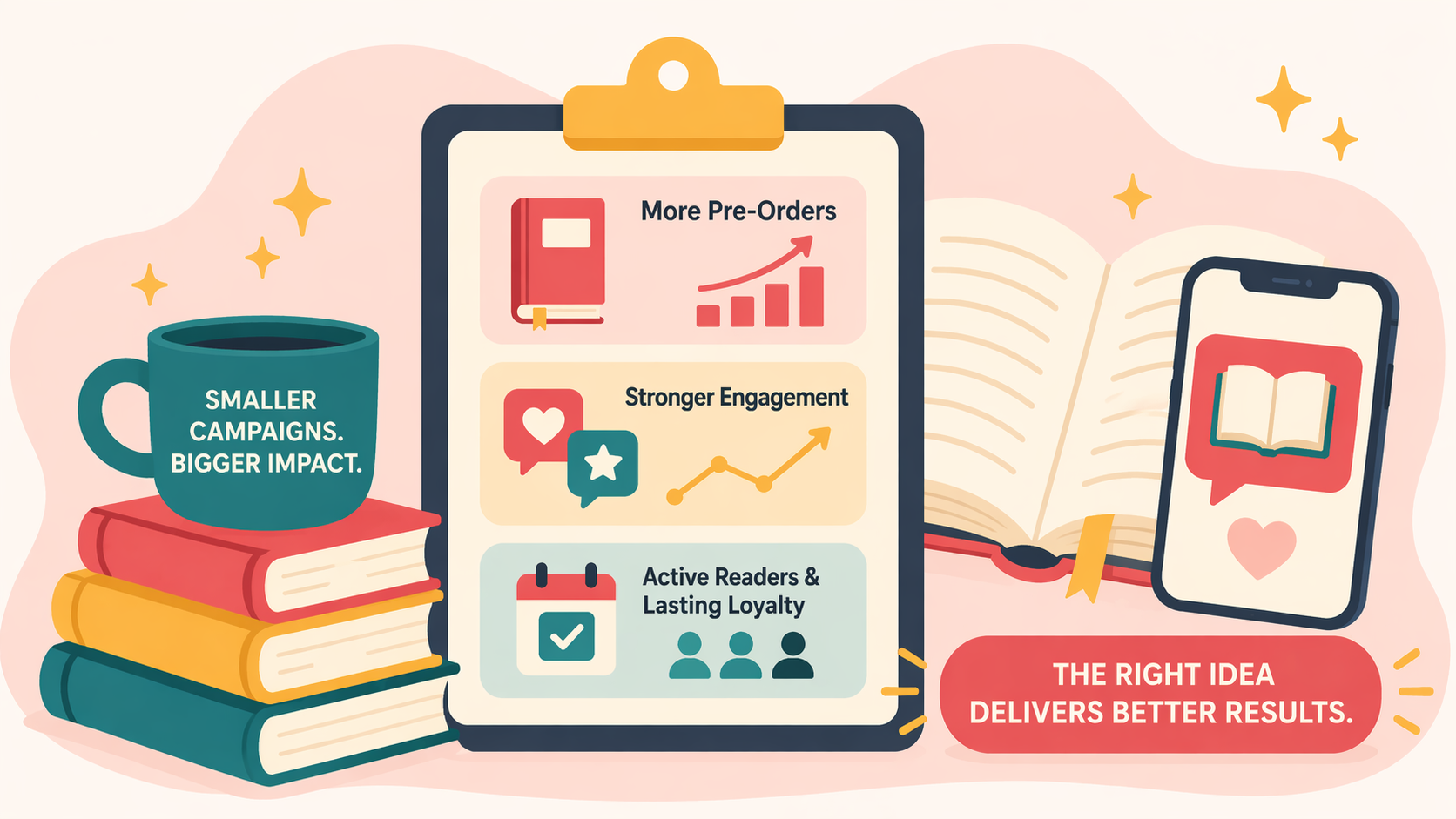
World Book Day creates a real opportunity for book businesses, but the opportunity is not automatic. SMS works best when the audience is opted in, the message is relevant, and the next action is easy to complete.
- For publishers, that may mean early access or pre-order alerts for anticipated releases.
- For bookstores, it may mean event invitations, timed offers, or local community engagement.
- For reading apps, it may mean segmented recommendations or participation mechanics that reactivate readers without overwhelming them.
The strongest strategy is usually not to run every possible tactic. It is to choose the few that match your catalog, your audience behavior, and your operational capacity. A narrower campaign with a clear mechanic will usually outperform a crowded campaign built on generic urgency.
If you are building your first World Book Day SMS strategy, start with one strong campaign type, measure what happens, and use those results to shape the next one.
References
- McKinsey & Company. “The State of Marketing & Sales.”
- Mobile Marketing Association. “Consumer Engagement Metrics.”
- Bookshop.org. “World Book Day Sales Analysis.”
- Gartner. “Marketing Technology Survey.”
- Twilio. “State of Customer Engagement Report.”
- Salesforce. “Connected Shopper Report.”
- Statista. “Email Marketing Benchmarks by Industry.”