
SMS API pricing looks simple at first. A provider quotes $0.005 per message. You send 100,000 messages. Your bill should be $500. Right?
Not exactly. The per-message rate is just the starting point. The country you are sending to, the route quality you choose, your monthly volume commitment, and a handful of hidden fees all change the final number. A bill that looks like $500 on paper can easily become $700 or more in practice.
If you are evaluating SMS API providers, you need to understand how pricing actually works. Not just the headline rate, but the mechanics behind it. This article explains every factor that drives SMS API cost — from country-specific carrier fees and route quality to volume discounts, hidden charges, and how to calculate true total cost of ownership. By the end, you will be able to evaluate any provider’s quote and know where the real costs hide.
How SMS API Pricing Actually Works
Every SMS API provider uses a variation of the same base formula. Understanding the building blocks helps you read any quote.
The Basic Formula
At its simplest:
Total cost = Messages sent × Per-message rate + Fees
The per-message rate is what providers advertise. The fees are what they often bury in terms of service. Both matter.
Messages sent includes every API call that results in an SMS dispatch. This includes original sends, retries, test messages, and failed deliveries (if your provider charges for failures).
The per-message rate varies by destination country, route quality tier, and your volume commitment. A message to India might cost $0.003. A message to Germany might cost $0.085. Same API call, different price.
Three Pricing Models
Providers typically offer one of three models:
Pay-as-you-go: No monthly commitment. You pay the published per-message rate for every send. Rates are highest in this tier, but there is no penalty for low volume. Best for startups, testing, or variable traffic.
Committed volume: You commit to a monthly message volume (e.g., 100,000 messages) and get a lower per-message rate. If you send less than your commitment, you still pay for the committed volume. If you exceed it, overage rates apply — sometimes 50% higher than the committed rate. Best for teams with predictable volume.
Enterprise / wholesale: Custom rates negotiated based on volume, destination mix, and SLA requirements. These agreements include dedicated account management, custom routing, and volume-based discounts that can reach 40–60% off retail rates. Best for high-volume senders (1M+ messages monthly) or businesses with specific routing needs.
How Providers Calculate Per-Message Rates
Providers set rates based on:
- Carrier termination fees: What the receiving carrier charges to deliver the message
- Route type: Direct carrier agreements cost more than grey routes
- Market competition: Crowded markets (India, US) have lower margins
- Currency and regulation: Some markets add taxes or regulatory fees
For detailed API documentation on how SMSBoosting structures pricing, see our developer docs.
Why SMS Prices Vary by Country
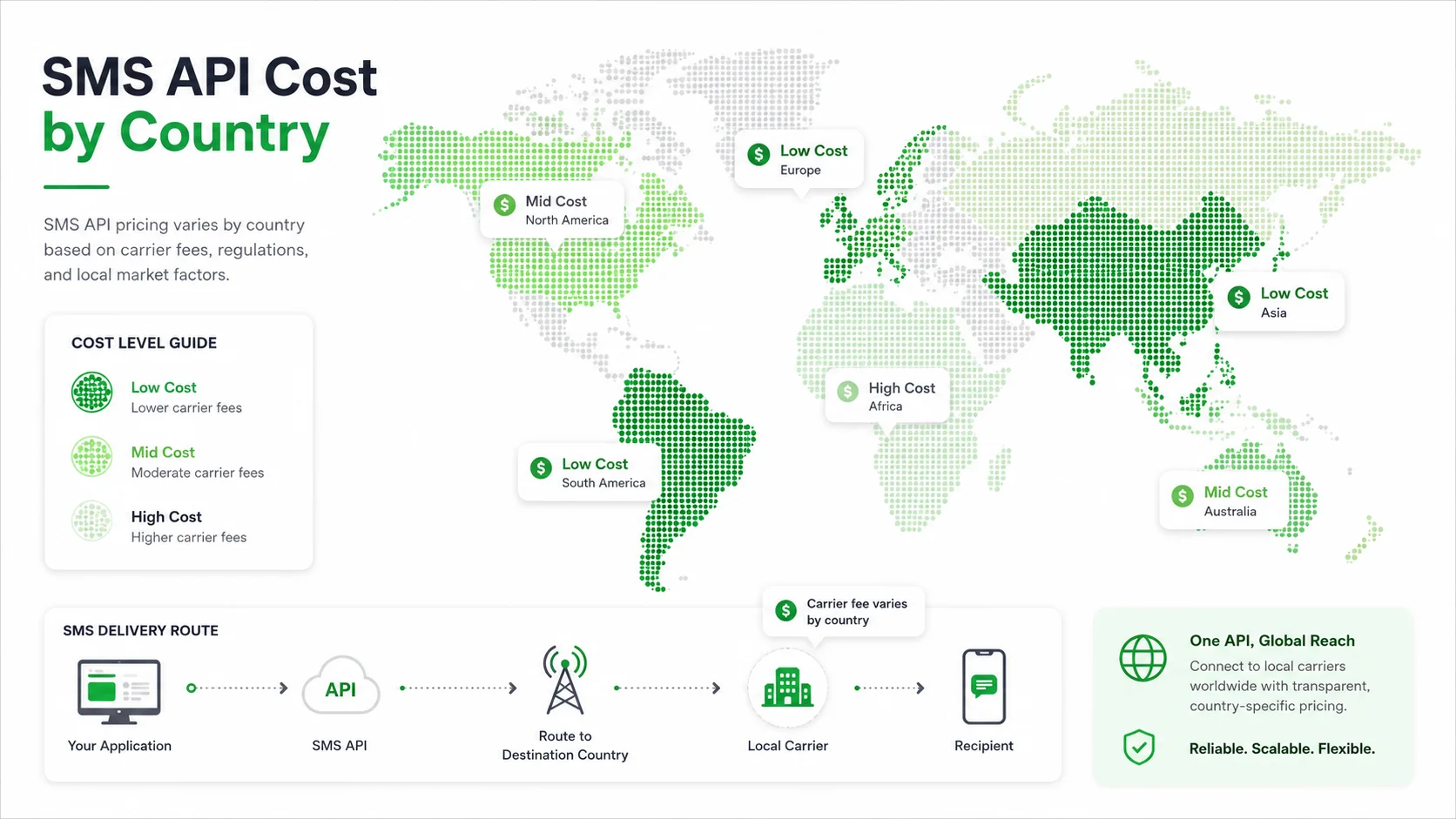
The biggest factor in SMS API pricing is destination. A message to the US costs a fraction of a message to Switzerland. Here is why.
Carrier Termination Fees
Every SMS passes through the recipient’s mobile carrier. That carrier charges a termination fee to deliver the message to the handset. These fees vary by country and carrier.
- High-fee markets: Scandinavia, Switzerland, and some Middle Eastern countries have high termination fees due to limited carrier competition and regulated pricing.
- Low-fee markets: India, Pakistan, and Bangladesh have extremely low termination fees because of intense carrier competition and high message volume.
- Variable markets: Africa and Latin America have wide fee ranges depending on whether the provider uses direct carrier agreements or third-party aggregators.
Regulatory Costs
Some countries add regulatory fees on top of carrier charges:
- India: TRAI-mandated DLT registration costs and template scrubbing fees
- UAE and Saudi Arabia: Government messaging taxes and sender ID registration fees
- EU: GDPR compliance overhead (not a per-message fee, but a cost providers factor in)
Market Competition
In markets with many SMS providers competing for volume, prices drop. India and the US have dozens of competing aggregators. Smaller European markets may have only a handful, keeping prices higher.
Currency and Exchange Rate Risk
If your provider prices in USD but pays carriers in local currency, exchange rate swings affect their margins — and your rates. Some providers hedge this risk; others adjust rates quarterly.
Price Comparison by Market
| Country/Region | Typical API Rate (per SMS) | Cost Driver |
|---|---|---|
| United States | $0.004–0.008 | High volume, competitive market |
| United Kingdom | $0.035–0.050 | Moderate termination fees |
| Germany | $0.070–0.090 | High termination fees, strict regulations |
| India | $0.001–0.003 | Very low termination fees, high competition |
| Nigeria | $0.015–0.030 | Variable infrastructure, grey route dependency |
| Brazil | $0.015–0.025 | Consolidated carriers, number portability complexity |
| Indonesia | $0.010–0.020 | Registration requirements, filtering |
| Philippines | $0.010–0.018 | Strong competition, spam filter costs |
Rates are approximate and reflect retail API pricing. Wholesale and enterprise rates are typically 30–50% lower.
The key insight: Your “average” cost per message is meaningless if 60% of your traffic goes to high-fee markets. Calculate blended cost by destination mix, not by a single headline rate.
Route Quality: Why Cheap Routes Often Cost More
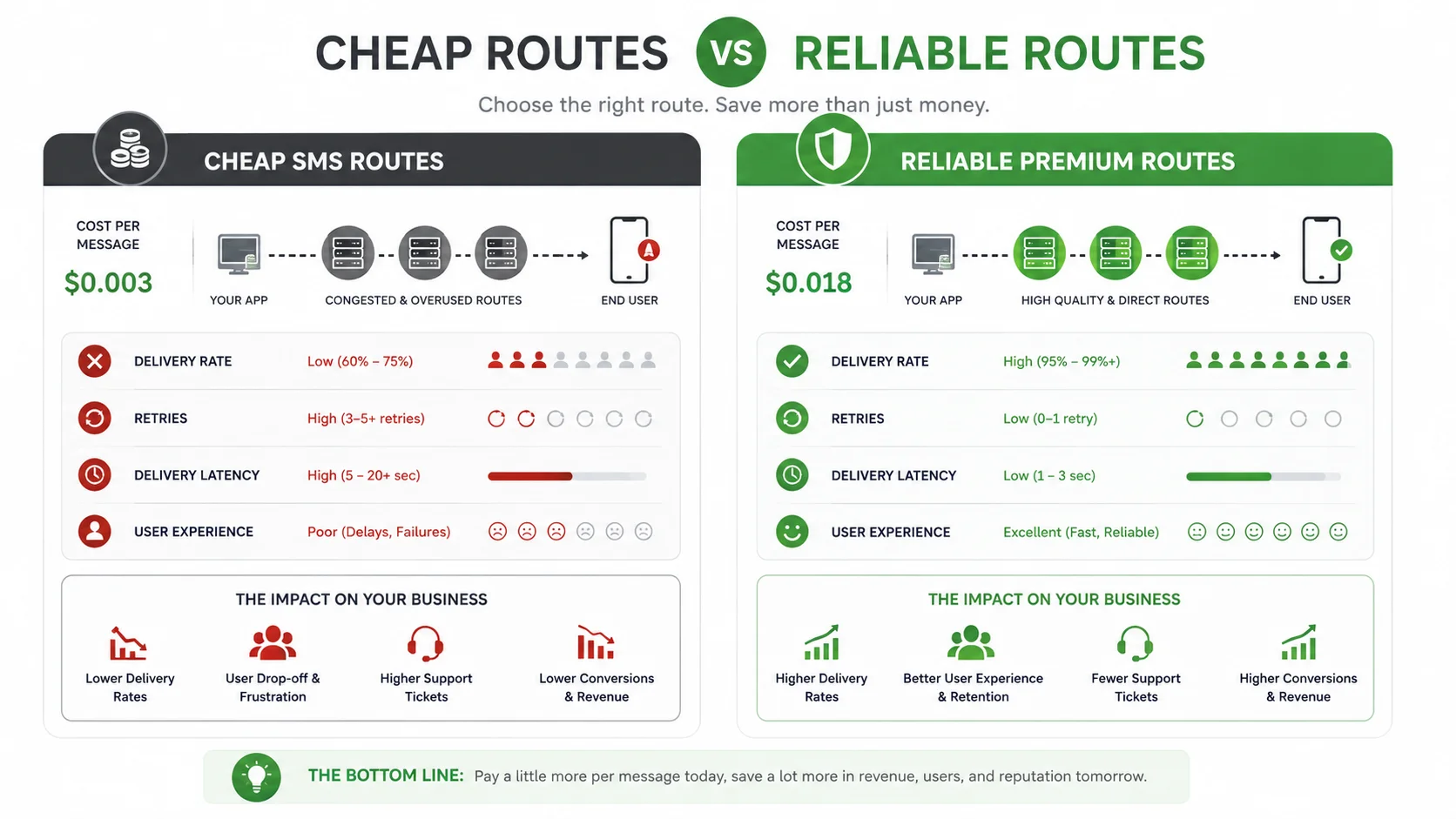
Not all SMS routes are equal. The route your provider uses to reach a handset directly affects both price and delivery success. Choosing the cheapest route often increases total cost.
Three Route Types
SMS routes fall into three categories: direct carrier agreements (most reliable, highest cost), grey routes (cheaper, less reliable), and aggregator networks that mix both. For a full breakdown of how each routing model works, see our direct carrier vs grey route guide. The pricing impact is what matters here.
The Hidden Cost of Cheap Routes
A grey route at $0.002 per message sounds like a bargain compared to a direct route at $0.005. But delivery rate determines whether you are paying for messages or paying for results.
Here is the math for 100,000 messages:
- Direct route: 100,000 messages × $0.005 = $500. 98% delivery = 98,000 successful deliveries.
- Grey route (first attempt): 100,000 messages × $0.002 = $200. 70% delivery = 70,000 successful deliveries. 30,000 failures.
- Grey route (one retry): 30,000 retries × $0.002 = $60. 70% of retries deliver = 21,000 additional successful deliveries.
Grey route total: $260 spent, 91,000 successful deliveries, 9,000 still failing.
To match the direct route’s 98,000 deliveries, the grey route needs 140,000 attempts. Total SMS cost: $280. The “cheap” route still saves $220 in pure SMS spend.
But that $220 savings ignores what happens on the other side of the API call. 40% more attempts mean:
- Higher latency variance: Retry delays stretch verification windows past user patience.
- User dropoff: A percentage of the 9,000–30,000 failed recipients abandon signup or checkout.
- Support load: Undelivered OTPs generate support tickets that cost $5–15 each to resolve.
- Engineering distraction: Time spent debugging delivery issues is time not spent on product.
For transactional messaging where a failed delivery means a lost conversion, the SMS cost difference is rarely the real cost.
When Premium Routes Pay for Themselves
Premium direct routes are worth the cost when:
- Transactional Messages: You send transactional messages (OTP, alerts) where delivery failure means user dropoff.
- Aggressive Filtering Markets: Your audience is in markets with aggressive carrier filtering (India, UAE, Singapore).
- Brand Reputation: Your brand reputation depends on reliable message delivery.
- Compliance Reporting: You need accurate delivery reports for compliance or auditing.
For bulk SMS campaigns where perfect delivery is less critical, grey routes or hybrid models may be acceptable. For OTP SMS, direct routes or redundant aggregator networks are the safer choice.
How Volume Discounts Work
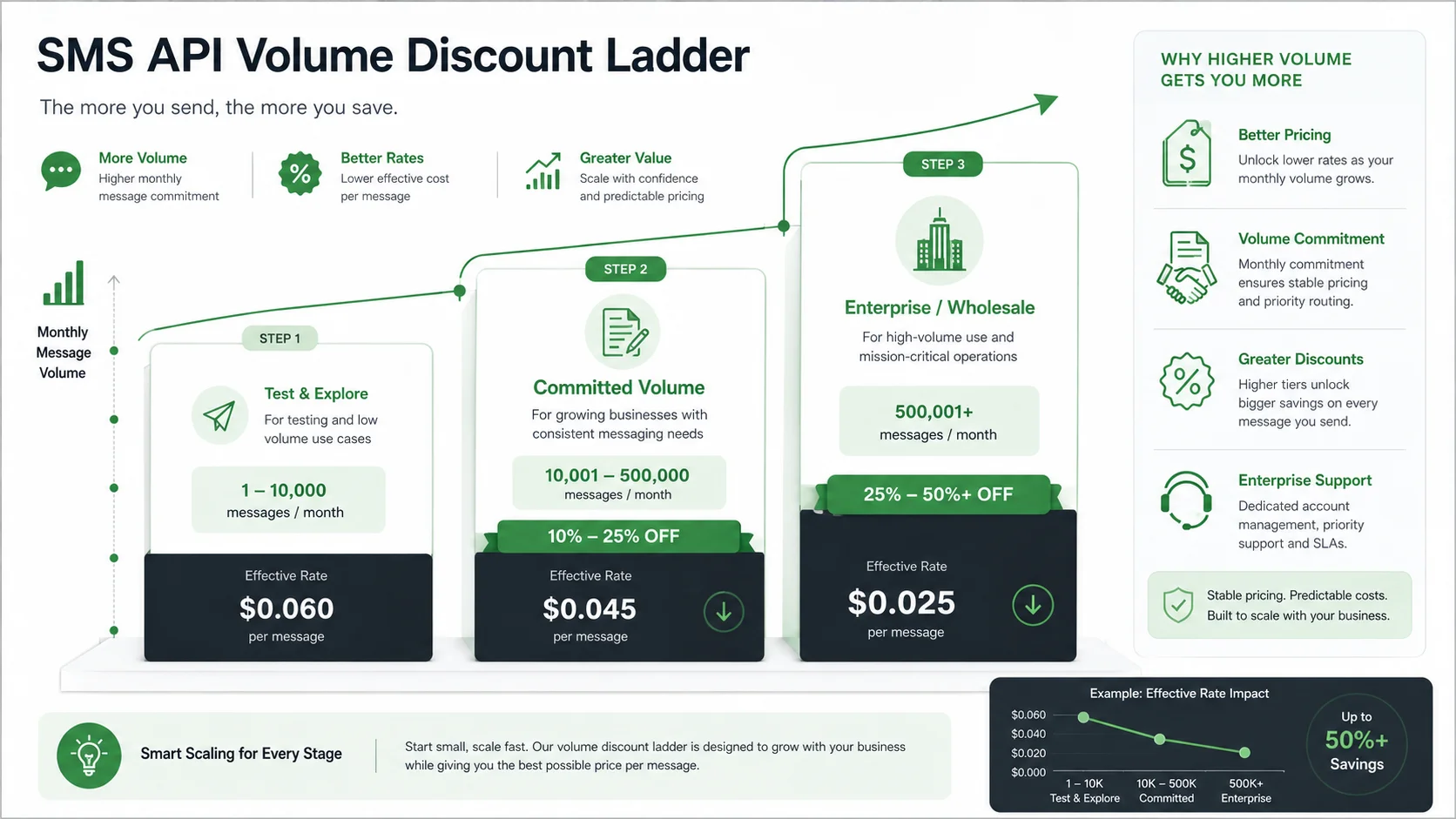
Volume is your primary leverage in SMS API pricing. The more messages you send, the lower your per-message rate. But discount structures vary widely between providers.
Typical Volume Tiers
Most providers use tiered pricing that looks something like this:
| Monthly Volume | Discount vs. Retail | Effective Rate (US) |
|---|---|---|
| 0–10,000 | 0% (retail) | $0.0079 |
| 10,000–50,000 | 5–10% | $0.0071–0.0075 |
| 50,000–100,000 | 10–15% | $0.0067–0.0071 |
| 100,000–500,000 | 15–25% | $0.0059–0.0067 |
| 500,000–1,000,000 | 25–35% | $0.0051–0.0059 |
Example based on US SMS rates. International rates follow similar tier structures but start from different base prices.
Committed Volume vs. Actual Volume
There is an important distinction between committed and actual volume:
Committed volume plans require you to pay for a set number of messages each month, regardless of whether you send them. If you commit to 100,000 messages at $0.006 each, your monthly bill is $600 minimum. Send 80,000 messages, you still pay $600. Send 120,000 messages, the extra 20,000 may be billed at overage rates (often 1.5x the committed rate).
Actual volume plans charge only for messages sent, but at higher per-message rates. You pay more per message but face no penalty for underuse. Best for teams with unpredictable or seasonal traffic.
Negotiation Leverage
At volumes above 500,000 messages monthly, most providers enter custom negotiation. Your leverage increases with:
- Higher volume
- Longer contract term (annual vs. monthly)
- Exclusive or primary provider status
- Willingness to prepay
At 1M+ messages, enterprise agreements typically include dedicated support, custom SLAs, and rates that are not published on any pricing page.
Hidden Costs That Inflate Your SMS Bill
The per-message rate is only part of the bill. Here are the charges that catch teams off guard.
Failed Delivery Charges
Not every provider charges only for delivered messages. Some bill for failed, blocked, expired, and retried SMS as well. Ask your provider for a clear “no” before you sign.
Retry Costs: A Hidden Multiplier
Every retry is another message. A three-attempt retry policy can multiply your volume by 5–15% depending on your base failure rate. If retries go to fallback channels (voice, WhatsApp), those have separate pricing.
Here is what retries add to a 500,000-message month at a 2% base failure rate:
- First retry: 10,000 messages × $0.005 = $50
- Second retry: 2,000 messages × $0.005 = $10
- Fallback to voice: 500 messages × $0.03 = $15
Total retry cost: $75 monthly — on top of your base message spend.
Verification Fees
Providers like Twilio charge a per-verification fee on top of SMS costs. Twilio Verify charges approximately $0.05 per verification plus the SMS cost. For 100,000 verifications, that is $5,000 in verification fees alone. Providers that charge only for SMS (no per-verification fee) eliminate this cost entirely.
Support Tiers and Overage Fees
Free support often means email tickets with 24-hour response times. For production SMS systems, you need faster response. Paid support plans can add $500–2,000 monthly depending on the provider.
Exceed your committed volume and rates jump. A plan with a $0.005 committed rate may charge $0.0075 for overages — a 50% increase.
One-Time Setup and Validation Costs
Some enterprise providers charge setup fees, integration consulting fees, or onboarding costs. These range from a few hundred to several thousand dollars.
HLR lookups and number validation APIs cost $0.001–0.003 per lookup. At scale, this adds up but typically saves money by preventing sends to invalid numbers.
Currency Conversion Fees
If your provider bills in a different currency than your accounting system, bank conversion fees (1–3%) apply to every transaction.
Calculating Total Cost of Ownership
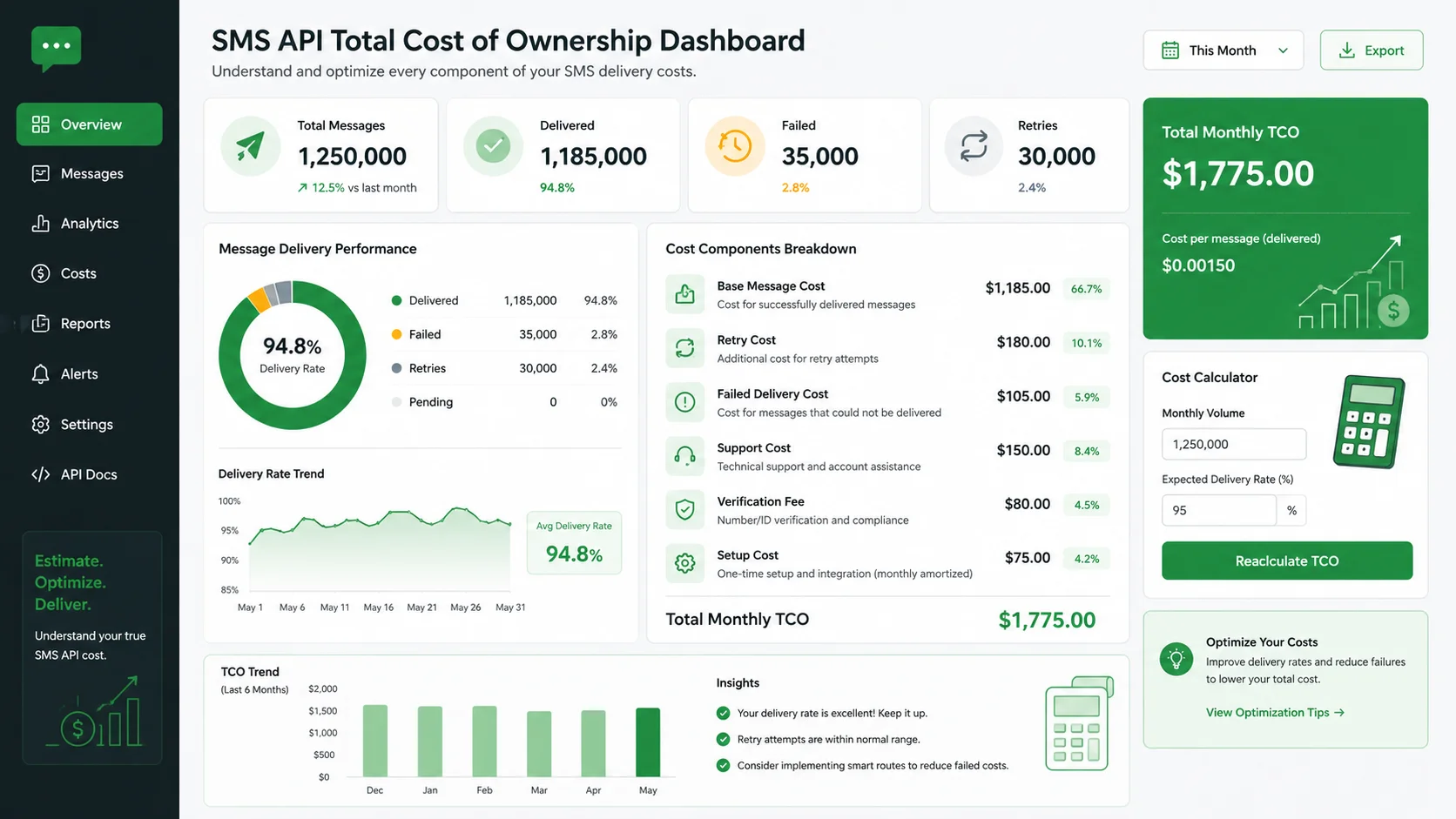
To compare providers fairly, calculate TCO — not just the per-message rate.
The TCO Formula
TCO = Base message cost + Retry cost + Failed delivery cost + Support cost + Fraud cost + Setup cost
Example: 500,000 Messages Monthly
| Cost Component | Calculation | Amount |
|---|---|---|
| Base messages | 500,000 × $0.005 | $2,500 |
| Failed deliveries (2%) | 10,000 × $0.005 | $50 |
| Retries (1 per failure) | 10,000 × $0.005 | $50 |
| Verification fees | 500,000 × $0.00 | $0 |
| Support plan | Fixed monthly | $0 |
| Setup/onboarding | Amortized over 12 months | $0 |
| Monthly TCO | $2,600 |
Assumes a provider that does not charge for failed deliveries or verifications. With a provider that charges for both, add $50 for failures + $25,000 for verification fees = $27,600 monthly.
Choosing the Right Pricing Model
| Your Situation | Best Model | Main Risk |
|---|---|---|
| Under 50,000 messages, unpredictable or seasonal traffic | Pay-as-you-go | Higher per-message rate |
| Predictable volume above 100,000, can forecast within 10% | Committed volume | Overcommitment penalty + overage fees |
| Above 500,000 messages, need custom SLAs or routing | Enterprise / wholesale | Minimum volume lock-in, setup fees |
Conclusion
SMS API pricing is more than a per-message rate. Country, route quality, volume, and hidden fees all determine what you actually pay. Understanding these factors lets you compare providers accurately and avoid budget surprises.
Want to see how these pricing factors affect your actual bill? Start a free trial to test SMSBoosting’s rates in your target markets.
Frequently Asked Questions
What is the average cost per SMS via API?
US domestic SMS typically costs $0.004–0.008 per message via API. International rates range from $0.001 (India, Pakistan) to $0.090 (Germany, Switzerland). Enterprise volumes see 30–50% discounts off retail rates.
Do volume discounts apply to all countries?
Usually yes, but the discount percentage applies to the base rate for each country. A 20% discount on US messages and a 20% discount on German messages yield very different absolute savings because the base rates differ.
Why are international SMS rates higher than domestic?
International SMS involves cross-border carrier agreements, currency conversion, and regulatory compliance. The recipient’s carrier charges a termination fee that is often higher for international traffic than for domestic traffic from local aggregators.
Can I negotiate SMS API pricing?
Yes, at volumes above 100,000 messages monthly. Above 500,000 messages, most providers offer custom rates. Above 1 million messages, you should expect dedicated account management and negotiated SLAs.
What is the cheapest way to send bulk SMS?
The cheapest per-message option is usually grey routes or low-cost aggregators in competitive markets like India. However, the cheapest reliable option for transactional SMS is direct carrier routes or aggregator networks with redundancy. Factor delivery rate into cost calculations.