


Gaming teams can use SMS marketing for gaming when a message needs a direct, timely path to an eligible player. The planning challenge is choosing the right moment, audience, and expectation before a message is sent. This article covers launch campaigns, promotions, inactive player reactivation, and the delivery decisions that become more visible when audiences span regions.
A useful campaign plan treats SMS as one part of a player communication system. It should make the next action clear, respect permission and opt-out expectations, and account for sender identity and routing before frequency is increased. The sections below move from campaign purpose to message moments, audience decisions, regional delivery, and a practical review checklist.
What SMS Marketing for Gaming Should Achieve
SMS marketing for gaming should give a player a relevant reason to act, check, return, or learn more at a moment where a short message is appropriate. It is most useful when the team can name the audience, the message purpose, and the destination of the action. It is less suitable when the information requires a long explanation, rich interaction, or context that the SMS cannot carry.
The first planning decision is channel fit. A launch invitation, a time-bounded reward, or a carefully scoped reactivation prompt may work as a campaign message. A complex support conversation may need in-product help, email, or a two-way support path instead. A real-time operational alert is a separate concern and should not be treated as the default model for promotional campaigns. Teams can keep that boundary clear with the configured notification SMS context while this article stays focused on campaigns and reactivation. General A2P documentation distinguishes common messaging use cases and explains that sender identity, interaction design, and filtering affect how a message reaches a recipient [1].
That distinction also protects the player experience. A team should define what the recipient is expected to do, how the player can recognize the sender, and where a reply or support request goes. If those answers are missing, adding more messages will not solve the underlying communication problem. For a broader view of sending, routing, tracking, and reply handling, see the configured SMS platform overview.
Campaign Moments: New Games, Versions, Seasons, and Limited-Time Events
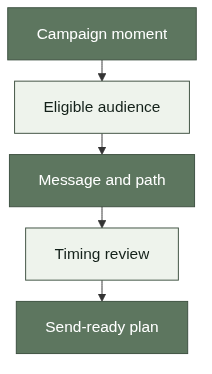
The campaign moment determines how SMS marketing for gaming should express urgency, audience logic, and acceptable repetition. A team should start with the product or event calendar, then map each moment to players who have a reason to receive it. That sequence prevents a generic broadcast from being used as a substitute for campaign planning.
New Game Launches
New game launches need a clear invitation rather than a vague announcement. The team can identify players who have opted into relevant marketing communication, explain what is becoming available, and point to one useful next step. The message should match the recipient’s relationship to the brand: a prospect, an existing player, or someone who has shown interest in a particular title may require different framing.
Launch SMS is a poor fit when eligibility is uncertain or the destination is not ready. Sending before the game page, consent record, or player-facing explanation is prepared can create confusion that a short message cannot repair. A smaller, well-defined audience is a practical starting point for teams still learning which launch context is meaningful; broader sending should depend on evidence from that first audience and on suppression rules for people already contacted.
Version and Season Launches
Version launches and season launches usually need more context than a single new-game announcement. A version message can focus on what changed for an existing player, while a season message can focus on a new time-bound context, content theme, or participation window. The distinction matters because an inactive player may need a concise reason to return, whereas an active player may already see the update in-product.
Timing should follow the player’s likely ability to understand and use the update, not simply the internal release timestamp. Coordinate the SMS with the in-product destination so the recipient does not arrive at an unavailable or unexplained experience. If a team cannot describe the update without several caveats, SMS can serve as a prompt to a fuller channel rather than carrying the complete explanation.
Limited-Time Events
Limited-time events need an explicit end point, eligibility logic, and action path. A reminder can be helpful when it tells an eligible player what is happening and where to find the details. It becomes noise when the same reminder reaches players who cannot participate, have already completed the action, or have been contacted through overlapping campaigns.
Event messages should be suppressed when the event is no longer relevant, even if a scheduled send remains in the calendar. Teams with limited campaign tooling can begin with a simple eligibility export and a review owner; teams with more automation can connect event state, audience state, and suppression state before sending. Neither method proves participation or retention. It only creates a clearer test of whether the message was relevant to the intended audience.
Promotions and Rewards: Make the Offer Specific
For SMS marketing for gaming, promotions and rewards should be specific enough for a player to understand the value, eligibility, and next action without guessing. A campaign brief should state which players qualify, what the reward or offer involves, when it ends, and where the full conditions are available. Clear wording is more useful than adding urgency that the team cannot substantiate.
The offer also needs a frequency decision. A promotion sent to every available contact may overlap with a launch or event audience, making it difficult to understand which message drove a response and increasing the chance of fatigue. Start with the narrowest audience that has a legitimate reason to receive the offer, then suppress players who have already converted, declined, or received a conflicting message.
Permission, opt-out handling, sender identity, timing, and list governance are general SMS campaign planning factors documented in the configured best-practice source [3]. Teams can use the configured marketing SMS guidance to connect this campaign work with broader permission-based marketing and segmentation context. That page is an internal navigation destination, not evidence of a specific promotion result.
A promotion is also not automatically a retention strategy. If the reward is the only reason to return, the team should say so in its internal hypothesis and monitor whether the message remains useful after the offer ends. Avoid promising a player outcome, a response rate, or a durable engagement effect that the available evidence cannot support.
Inactive Player Reactivation: Use Context Before Frequency
Inactive player reactivation is a setting where SMS marketing for gaming should begin with context, not volume. An inactivity window can be one input to an audience definition, but it does not explain why a player stopped engaging or whether a new message is welcome. Combine inactivity with prior game, season, event, or permission context where that information is available and appropriate to use.
A useful reactivation message answers a simple question: why is this player receiving this invitation now? The reason might be a relevant update, a new season, or an event connected to the player’s prior interest. The message should lead to a destination that confirms the promise made in the SMS. If the destination has no meaningful change, a generic “come back” prompt is difficult to distinguish from routine pressure.
Reactivation is not the same as repeating every retention tactic. Keep the scope on campaign audience, message relevance, timing, and the next action. A team testing this use case should compare the message against its own defined baseline and inspect delivery, engagement, suppression, and complaint signals together; none of those signals alone establishes a causal player outcome.
Frequency should remain a control rather than the primary lever. If an inactive audience does not respond, first inspect eligibility, message relevance, destination readiness, sender recognition, and delivery conditions. Increasing sends before checking those dependencies can make the result harder to interpret and can create avoidable fatigue.
Segmentation, Timing, and Campaign Frequency
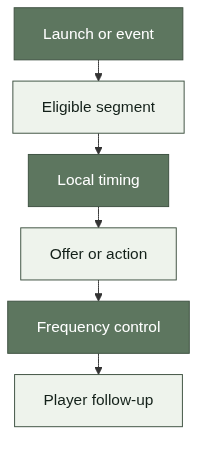
Before a team expands SMS marketing for gaming, segmentation and timing should be decided in a deliberate order: confirm consent and eligibility, define the player segment, choose local timing, state the campaign purpose, and then apply frequency controls. This order gives teams a reason for every send. Reversing it by selecting a send window first often produces an audience assembled merely to fill that window.
Useful segments can reflect player relationship to the game, interaction with a launch or event, prior permission, or the difference between active and inactive status. The segment should be narrow enough to make the message relevant and broad enough to support a meaningful internal comparison. Do not infer motivation from inactivity alone, and do not turn an internal segment label into a claim about player behavior.
Local timing needs a region-aware rule. A single clock setting can send during unsuitable hours for part of a global audience, while a local-time rule may require more scheduling and review. If the team lacks reliable local-time or regional data, it should reduce the audience, choose a safer channel, or hold the send until the missing decision can be resolved.
Campaign frequency is best managed through suppression and overlap rules rather than an unexamined universal quota. Suppress recipients who have opted out, are no longer eligible, have completed the relevant action, or recently received a conflicting campaign. When a launch, promotion, and event overlap, rank their purposes and send the message with the clearest immediate value; the other messages can wait or use another channel.
Monitor response signals against an appropriate internal baseline, and interpret them with delivery and suppression context. A weak click signal may indicate a weak offer, a mismatched destination, or a delivery issue; it does not by itself identify the cause. Teams can use the configured deliverability guidance when reviewing consent, sender identity, content risk, monitoring, and route quality.
Cross-Region Sending Considerations
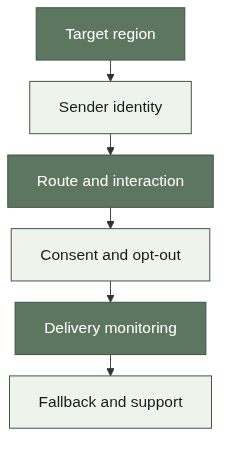
Cross-region sending adds decisions about sender identity, route selection, timing, filtering risk, and reply behavior. The message concept may be shared, but the sending configuration cannot be assumed to behave the same way in every destination. Regional sender ID, long-code, short-code, and one-way or two-way choices are general planning considerations described in the configured AWS documentation [2].
Begin with the recipient’s region and the campaign’s interaction requirement. A one-way reminder may have different setup needs from a message that expects a reply. A sender identity that is recognizable in one market may need a different treatment elsewhere, and local delivery timing can change how an event message is perceived. These are design questions to resolve before creative is finalized.
Routing quality and delivery timing should be monitored as operational inputs, not converted into an unsupported promise of universal reach. The configured SMS routing guidance provides a relevant internal path for considering route quality, delay, filtering risk, and deliverability. For consent, opt-out, sender identity, and content-risk review, use the same configured deliverability guidance rather than inventing regional rules in the article.
The application-to-recipient path also matters when teams interpret delivery receipts or campaign records. General SMS documentation describes messaging as a path from an application through routing and carrier infrastructure to a device, with delivery status providing a delivery signal rather than proof that a player read, understood, or acted on the message [4]. A regional campaign review should therefore separate send status, delivery status, engagement, and player outcome.
A Practical Planning Checklist for Gaming SMS Campaigns
Before approving a campaign, review the following questions in order:
- Purpose: Is this a new game launch, version launch, season launch, limited-time event, promotion, reward, or inactive player reactivation message?
- Audience: Who is eligible, who has permission, and which players should be suppressed because they already acted or received a conflicting message?
- Message: Can the player understand the reason for contact, the offer or event context, the expiry condition, and the next action?
- Timing: Does the send use an appropriate local-time rule, and is the destination ready when the message arrives?
- Frequency: What other campaigns overlap, which purpose has priority, and what is the holdout or suppression decision?
- Region: Is sender identity appropriate, is one-way or two-way interaction required, and has routing and filtering risk been reviewed?
- Fallback: Where should a player go for fuller context or support if SMS cannot carry the explanation?
- Ownership: Who reviews the audience, sender setup, destination, delivery signals, and follow-up action?
The checklist is intentionally operational at the planning level; it does not require a claim about a universal gaming playbook. Teams can start with the purpose, audience, timing, and suppression decisions, then add automation, reporting, templates, and two-way handling as their workflow requires. SMS marketing for gaming is ready for the next step when the message has a legitimate audience, a clear reason, a suitable route, and a measurable internal question.
For a broader content path, explore the configured Gaming SMS pillar or review SMS campaign capabilities through SMSBoosting’s SMS platform overview. The invitation is to evaluate fit and planning needs, not to assume a delivery or player result.
FAQ
References
Twilio, SMS Foundations: general A2P SMS use cases, sender identity, interaction patterns, and delivery-filter considerations. https://www.twilio.com/docs/messaging/onboarding/sms-foundations
AWS, Phone number types: general regional sender ID, long code, short code, and one-way or two-way capability considerations. https://docs.aws.amazon.com/sms-voice/latest/userguide/phone-number-types.html
AWS, SMS best practices: general permission, opt-out, sender identity, timing, and list-governance considerations. https://docs.aws.amazon.com/sms-voice/latest/userguide/best-practices.html
AWS, What is SMS?: general application-to-recipient delivery path and delivery-receipt context. https://docs.aws.amazon.com/sms-voice/latest/userguide/what-is-sms.html