

Player engagement SMS helps a gaming team support a relevant player step after onboarding, during a return journey, or around an event or milestone. The useful question is not whether messaging can create engagement on its own. It is whether the player has a clear context, a legitimate reason to receive the message, and a next action that is more useful than another generic promotion.
This article treats SMS as one part of lifecycle operations. It covers post-onboarding follow-up, inactive player re-engagement, event follow-up, reward and milestone reminders, preferences, two-way responses, and segmentation. Marketing campaigns, discount-led persuasion, and complete OTP flows remain separate workflows, even when they use the same messaging infrastructure.
What Player Engagement SMS Should Do
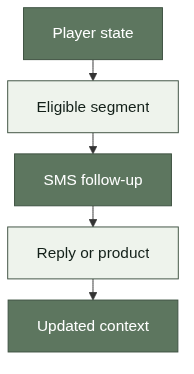
Player engagement SMS should help a player continue, understand, or return to a relevant product experience. A good message has a specific trigger, a defined player context, and a destination that is ready when the message arrives. It may remind a player about a useful next step, invite a simple response, or point to a product surface where the player can continue.
Start with the player’s lifecycle state rather than the message template. A newly onboarded player, an active player who reached a milestone, and an inactive player with prior product context should not automatically receive the same message. The team should record why the message is appropriate now, what should be suppressed, and which owner can update or stop the communication if the player state changes.
The boundary with marketing matters. A campaign is generally built to persuade a player toward an offer, reward, purchase, or return action. Engagement support can include a reminder or update, but its primary job is to make an existing player journey more understandable or timely. If the message’s main purpose is conversion, route it to campaign planning rather than relabelling it as lifecycle support.
General A2P SMS documentation distinguishes use cases, sender identity, one-way and two-way interaction, and filtering considerations [1]. These concepts help a team choose a suitable message path, but they do not establish a guaranteed engagement result. The configured SMS platform overview provides related context for sending, routing, tracking, and reply handling. SMSBoosting can support delivery infrastructure within a workflow; the gaming product still owns lifecycle logic, audience decisions, and player experience.
Post-Onboarding Follow-Up: Support the Next Player Step
In a player engagement SMS workflow, post-onboarding follow-up should answer the player’s next practical question. After a player creates an account or completes an initial setup, a message may point to a product feature, explain where to continue, or remind the player about an unfinished step. It should not repeat a welcome slogan when there is no useful action behind it.
Timing depends on player state and destination readiness. A follow-up sent before the player can access the relevant product surface may create confusion, while a message sent after the context has disappeared may feel irrelevant. The team should define the onboarding event, the permitted follow-up window, the destination, and the condition that suppresses the message once the player has completed the step.
Orientation and promotion should remain visibly different. Setup guidance can support engagement without offering a discount or claiming that the player will stay active. If a team wants to promote a new feature, sale, or reward, that is a campaign decision with its own audience and frequency rules. Mixing the two makes it harder to know whether a message helped a player continue or merely exposed them to another offer.
A small team can manage this with a clear event record and a human owner for exceptions. A more automated workflow can connect the SMS API, webhook events, product state, and suppression rules. Neither approach proves a retention outcome. It simply gives the player a more coherent next step.
Inactive Player Re-Engagement: Use Context Before Pressure
For player engagement SMS, inactive player re-engagement should begin with context, not message volume. An inactivity signal may identify a player who has not recently used a product, but it does not explain why the player stopped, whether the original interest remains, or whether another message is welcome. Combine inactivity with prior product context, relevant updates, permission, and a destination that has a reason to be visited.
A useful re-engagement message makes the reason for contact understandable. It might refer to a relevant product change, a player-specific unfinished step, or an event connected to a prior interaction. Avoid a vague request to return when the product offers no meaningful context. A player who receives repeated general reminders may learn only that the sender is not distinguishing interest from absence.
Suppression is as important as inclusion. Exclude players who opted out, already completed the relevant action, are in an active support process, or recently received a conflicting lifecycle message. If the team cannot define those exclusions, it should narrow the audience or delay automation. Broadening the send before clarifying the audience makes the result harder to interpret and can create unnecessary fatigue.
Do not promise retention or reactivation outcomes. A team can evaluate whether an eligible player received, responded to, or acted after a message, but those signals are not interchangeable and do not prove causation. Keep the scope on relevance, timing, preference, and the next product action rather than duplicating Marketing SMS campaign content.
Event Follow-Up and Player Updates
Player engagement SMS can make event follow-up useful after an event, update, or participation moment. A post-event message may point to an outcome available inside the product, explain what the player can do next, or acknowledge a completed step without turning the communication into an offer. The message should match the player’s actual relationship to the event.
Eligibility and event state need to be current. A player who did not participate should not receive a message written as if they did. A player who completed the relevant action may need a different update from someone who stopped before completion. The event owner should define the source of truth, the destination, and the condition that suppresses a follow-up once it is no longer useful.
Event follow-up is not automatically event marketing. A marketing message asks a player to choose, buy, claim, or return in response to persuasion. A player update explains a current or completed product context. If the copy leads with a reward or promotion, it belongs in campaign planning even when it is sent after an event.
The configured Notification SMS content provides a relevant internal path for time-sensitive account and player updates. It does not prove a particular event outcome or replace the team’s event-state logic. Keep the follow-up concise, make the next destination clear, and give support ownership to cases the product cannot resolve automatically.
Reward and Milestone Reminders Without Making Engagement Discount-Led
Player engagement SMS can support reward and milestone reminders when they explain progress or a completed product condition in context. A milestone message might tell a player that a status has changed, a reward is available within the product, or a completion step needs attention. The reminder should not assume that every player values the same reward or that a reminder will produce a lasting behavior change.
Context should come before incentive language. State what the player did or reached, why the reminder is being sent, and where the player can inspect the relevant details. If the message is mainly trying to persuade the player to claim an offer, it may be a promotional campaign rather than engagement support. A reward can be one part of a lifecycle experience without defining the lifecycle as discount-led.
Teams should also consider overlap. A player may receive an event update, a milestone reminder, and a campaign offer around the same product moment. Rank the messages by immediate usefulness, suppress duplicates, and give the player one clear next step. Sending every eligible message may maximize activity in a queue while weakening the player’s understanding of why each message arrived.
Use internal baselines carefully. A delivery record can show a transport event, while a product record can show whether the player opened or completed the related step. Neither demonstrates a universal reward preference or retention effect. When a reminder performs differently from expectation, inspect the trigger, eligibility, destination, wording, preference state, and delivery conditions before changing frequency.
Player Preferences and Lifecycle Segmentation
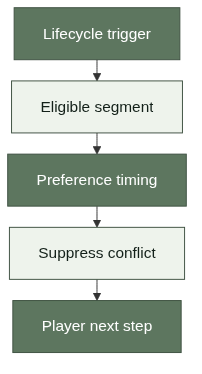
Player preferences and lifecycle segmentation should determine relevance before player engagement SMS frequency. The team needs a clear record of which communication the player permitted, which channel choices apply, and which messages should be suppressed. Preferences should not be inferred from one click, one inactive period, or one reply without a defined interpretation rule.
Useful lifecycle segments can include post-onboarding players, active players with a current product context, players who stopped before a meaningful step, and players who have entered a support or preference-change path. These labels are planning tools, not claims about motivation. A segment should have an inclusion reason, an exclusion rule, a message purpose, and an owner who can revise it.
Permission, sender identity, timing, opt-out handling, and list governance are general messaging planning considerations in the configured best-practices source [2]. The team should apply its own policy and compliance review, especially where lifecycle communication and promotional communication have different rules. SMSBoosting’s configured SMS deliverability guidance provides internal context for consent, sender identity, content risk, monitoring, and delivery conditions.
Segmentation also protects the player from automation that outlives the original context. Suppress a follow-up after the player completes the action, changes preference, enters support, or receives a newer message that replaces the old one. If the lifecycle data is incomplete, simplify the flow and use a safer channel rather than pretending the segment is precise.
Two-Way Responses: Give the Player a Clear Path
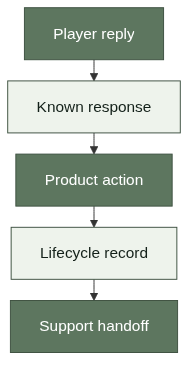
Two-way responses make player engagement SMS useful when the player can complete a simple, well-defined interaction by replying. The message should explain what kind of response is expected, how the response will be handled, and what happens if the player needs support outside the reply path. A two-way option is not automatically a substitute for in-product support or a full conversation system.
Set ownership before enabling replies. A response may require an automated acknowledgement, a routing rule, a support handoff, or a product-state update. The team should define which replies are recognized, which are ignored or escalated, and how a player can stop or change a communication preference. Ambiguous reply handling can make an apparently helpful message feel like a dead end.
Regional sender and interaction choices can vary. General documentation covers sender ID, long code, short code, and one-way or two-way capability considerations [3]. These are inputs to planning, not proof that the same reply experience works in every region. The team should document its selected route and fallback, then monitor actual send, delivery, reply, and support states separately.
The configured SMS routing guidance provides context for route quality, delay, filtering risk, and regional delivery. Together with the SMS platform overview, it can help teams map where replies enter the lifecycle workflow. SMSBoosting should not be described as a full CRM or engagement platform; the product team remains responsible for response logic and player support.
Measuring Engagement Support Without Reusing Campaign KPIs
Player engagement SMS support should be measured through a set of separate signals rather than one campaign conversion metric. Delivery status can show what happened in the messaging path. Reply status can show whether a player responded. Product or support records can show whether the next step was completed or resolved. These signals answer different questions and should not be collapsed into a claim about retention.
Start with the workflow question. For post-onboarding follow-up, ask whether the destination was ready and whether the player continued the relevant setup. For inactive re-engagement, inspect relevance, suppression, preference, and product context before interpreting a response. For two-way SMS, review reply classification, handoff time, and unresolved cases rather than treating every reply as success.
General SMS documentation describes the application-to-recipient path and delivery-receipt context [4]. That helps explain why a send record is not the same as a player action. When an outcome changes, inspect the trigger, segment, timing, sender identity, route, destination, and support handoff in sequence. Avoid inventing a universal response rate, retention threshold, or causal result.
The comparison with marketing KPIs is deliberate. A campaign may prioritize clicks, purchases, or offer responses; engagement support may prioritize continuity, clarity, preference compliance, and resolution of a player need. The measures can coexist in a broader operating system, but one should not be used as a shortcut for the other.
A Practical Player Engagement SMS Planning Checklist
Before approving a player engagement SMS lifecycle message, review these questions in order:
- Player context: What has the player done, not done, or recently encountered?
- Trigger: What event, milestone, preference state, or lifecycle transition creates the message?
- Purpose: Is the message supporting a player step rather than persuading the player toward a campaign offer?
- Permission: Which consent, opt-out, and sender-recognition rules apply?
- Segment: Why is this player included, and who should be suppressed?
- Preference: Does the player’s channel or frequency preference change the path?
- Timing: Will the destination, event state, and support owner be ready when the message arrives?
- Reply path: Is a response expected, and who handles it?
- Fallback: What should happen if the message is delayed, ignored, or answered outside the expected format?
- Monitoring: Which application, delivery, reply, product, and support signals will be reviewed separately?
- Ownership: Who can update, suppress, or stop the lifecycle message?
Start with context, purpose, permission, and suppression because those decisions protect the player experience before automation is added. Add API integration, webhooks, reporting, templates, routing controls, and two-way handling as the workflow needs them. SMSBoosting’s configured capabilities support SMS API, sender identity, routing, webhooks, reporting, and templates, but this article does not claim a particular retention or reactivation result.
For the next step, teams can evaluate a lifecycle workflow and review the configured SMS platform context, deliverability guidance, or notification context. The invitation is to assess fit and response ownership, not to turn engagement support into a campaign or promise a player outcome.
FAQ
References
Twilio SMS Foundations: general A2P SMS use-case categories, sender identity, one-way and two-way interaction, and filtering considerations. https://www.twilio.com/docs/messaging/onboarding/sms-foundations
AWS SMS Best Practices: general permission, sender identity, timing, opt-out, list governance, and messaging planning considerations. https://docs.aws.amazon.com/sms-voice/latest/userguide/best-practices.html
AWS Phone Number Types: general regional sender ID, long code, short code, and one-way or two-way capability considerations. https://docs.aws.amazon.com/sms-voice/latest/userguide/phone-number-types.html
AWS What is SMS?: general application-to-recipient SMS delivery path and delivery-receipt context. https://docs.aws.amazon.com/sms-voice/latest/userguide/what-is-sms.html