

Every gaming marketer has hit the same wall: a player who uninstalled the app two weeks ago, disabled push notifications, or lives in a time zone where your “urgent” event reminder lands while they are asleep. In-game push only works while a player is online. Email sits unopened in a crowded inbox. When you need a message to actually reach a player — not just be sent — gaming SMS is often the only channel that reliably lands in the phone’s notification tray.
This guide explains why gaming companies build SMS into their player communication stack, what makes player reach unique, the four main scenarios where SMS earns its place, and what cross-region delivery and routing demand when your players are spread across the globe.
When Your Players Go Offline, What Reaches Them?
The offline blind spot
Most player messaging is built around channels that assume the player is present. For gaming SMS, that assumption is a risk: the messages that matter — a time-sensitive offer, an outage notice, a verification code — are exactly the ones that must still arrive after the player has gone quiet. In-game push notifications fire while the app is open or running in the background — the moment a player closes the app, that channel goes dark. Email is more persistent but carries a well-documented weakness: open rates are low and messages are easy to ignore among promotions, newsletters, and spam filters. For a lapsed or dormant player, both channels effectively disappear.
SMS as the reliable floor
SMS works differently. It needs no app install, no active session, and no login. As long as the phone number is valid, the message reaches the notification tray of the device. Industry data routinely cited across the messaging space puts SMS open rates in the 90% range, with a large share of messages read within minutes of delivery — far ahead of email’s typical single-digit-to-20% open rates [1]. That combination of reach and immediacy is why SMS is treated as the high-assurance floor for player messaging: when a message must land, SMS is the channel that lands it.
The core question
So the practical question for any gaming team is not “should we use SMS?” but “which messages in our player communication stack genuinely need the assurance that SMS provides?” The rest of this guide walks through the scenarios where that answer is clearly yes, and the delivery realities you need to manage to make it work.
What Makes Player Reach Unique (and Why SMS Fits)
Players are mobile-first, fragmented, and spread across time zones
Gaming audiences are rarely a single, predictable cohort. Players are mobile-first, play in short fragmented sessions, and are spread across countries and time zones. Their online status is never guaranteed — a player in one region may be active while a player in another is asleep, at work, or simply away from the game for weeks. Any channel that depends on the player being present at the moment you send will miss a meaningful share of your audience.
SMS needs no install and reaches the system tray directly
SMS sidesteps all of those prerequisites. It does not depend on the player opening the app, checking email, or being online. It arrives directly in the phone’s notification tray and is read quickly. For a gaming company, this makes SMS the channel that can touch the players other channels cannot reach: the lapsed, the dormant, the push-disabled, and the ones who live in a different time zone.
SMS is a complement, not a replacement
It is worth being precise about positioning. SMS does not replace push or email — it is a high-assurance, high-immediacy complement reserved for messages that must arrive. Push remains the low-cost, instant channel for players who are online. Email remains the right home for long-form content like patch notes and monthly recaps. SMS carries the messages where delivery is not optional: a verification code, a security alert, a time-sensitive event reminder.
The Four Main Gaming SMS Scenarios at a Glance
Gaming companies lean on SMS across four broad scenarios. Each one has a different goal, different delivery expectations, and different compliance considerations.
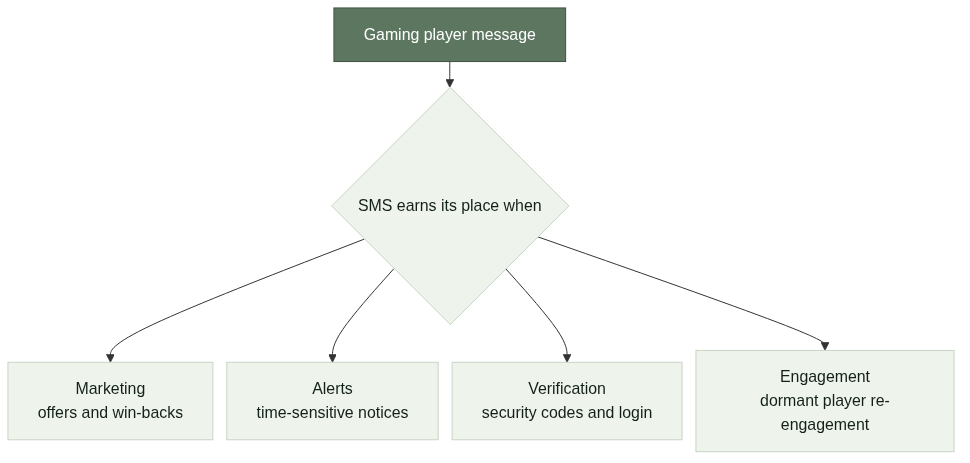
Marketing
The marketing scenario covers campaigns, limited-time promotions, and win-back rewards. Because SMS open rates are high and read latency is short, it is well suited to time-boxed offers where you need the player to act quickly. The trade-off is that marketing messages carry the heaviest compliance load: opt-in consent, time-zone rules, and frequency caps all apply.
Alerts
Alerts cover maintenance notices, outage warnings, unusual-login flags, and match or event reminders. These messages lean on SMS’s immediacy — the value comes from the player seeing the notice before, or as, it matters. Alerts generally face lighter content filtering than marketing, but they still need reliable delivery confirmation.
Verification
Verification is the trust baseline. Login one-time passwords, account recovery, and transaction or top-up security confirmations are the most important non-marketing use of SMS in gaming. Verification codes are widely treated as a primary component of gaming SMS traffic, and they carry the strictest delivery expectations — a code that arrives late or not at all is a direct hit on the player experience and on account security.
Engagement
Engagement messages re-engage dormant players, invite them to surveys, or nudge community interaction. The goal is to extend the player lifecycle by pulling people back into the game. Engagement sits close to marketing in its compliance posture — it still needs consent and frequency discipline to avoid over-reaching.
Where SMS Sits in the Player Communication Stack
A layered system
The most useful way to see SMS is as part of a layered stack, not a single channel. In-game push handles online, instant, low-cost interactions. Email handles long-form, low-cost content. SMS handles the high-priority messages that need high assurance and immediacy, and it works regardless of terminal or session state.
The three high-priority classes SMS carries
Within that stack, SMS is the natural home for three high-priority classes of message: verification, critical alerts, and high-value marketing. These are the messages where a missed delivery has a real cost — a failed login, an unanswered security warning, a promotion that never reached the player.
Channel comparison at a glance
| Channel | Reach prerequisite | Open rate / latency | Cost | Best-fit message types | Role in the stack |
|---|---|---|---|---|---|
| In-game push | Player online / app open | Instant but depends on session | Low | Real-time events, rewards, reminders | Daily operations workhorse |
| Player checks inbox | Low open rate, high latency | Low | Patch notes, recaps, long-form content | Content and retention | |
| SMS | Valid phone number | High open rate, short latency | Medium | Verification, critical alerts, high-value marketing | “Must-deliver” assurance layer |
| In-app inbox | Player returns voluntarily | Depends on return visits | Low | Announcements, activity hubs | Supplemental reach |
Cross-Region Delivery and Routing That Holds Up
Cross-region delivery is not a nice-to-have for gaming — it is the default. When your players span many countries, the mechanics of getting a message delivered change in ways that matter.
Delivery realities
Deliverability is shaped by factors outside your control. Different carriers have different strategies for accepting and forwarding traffic. Application-to-person (A2P) messaging is increasingly regulated — in the US, for example, 10DLC registration and compliance shape how business messaging is handled [2]. Content filtering can catch messages that look promotional or spammy, and time-zone compliance means you need to avoid sending at hours that feel like harassment to a player on the other side of the world. A message that is technically sent is not the same as a message that is delivered.
Routing capabilities that matter
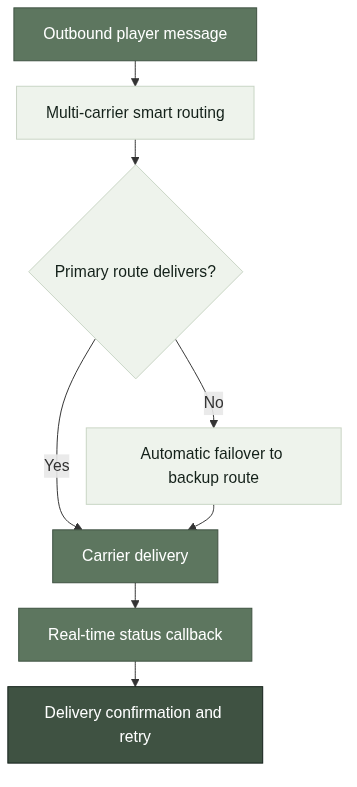
Under the hood, stable cross-region delivery depends on routing. Multi-carrier smart routing lets a message be directed through the most reliable path, and automatic failover reroutes when one path fails. Real-time status callbacks give you visibility into whether each message was actually delivered, rather than just sent. Batch sending handles volume, and Unicode support plus long-short message concatenation covers multilingual players who need characters beyond basic ASCII.
Why coverage, availability, and retry underpin it all
Two more factors round out the picture. Coverage determines whether your provider can reach the countries your players actually live in — a provider with broad international reach is a practical requirement, not a differentiator. Availability and retry mechanisms determine whether the system stays up and recovers gracefully when a delivery attempt fails. Together, coverage, availability, and retry are what make cross-region delivery reliable enough to depend on for verification and critical alerts.
Applying the Framework to Your Player Messaging
The “which channel should this message take” pre-send checklist
Before you send, run the message through a short decision:
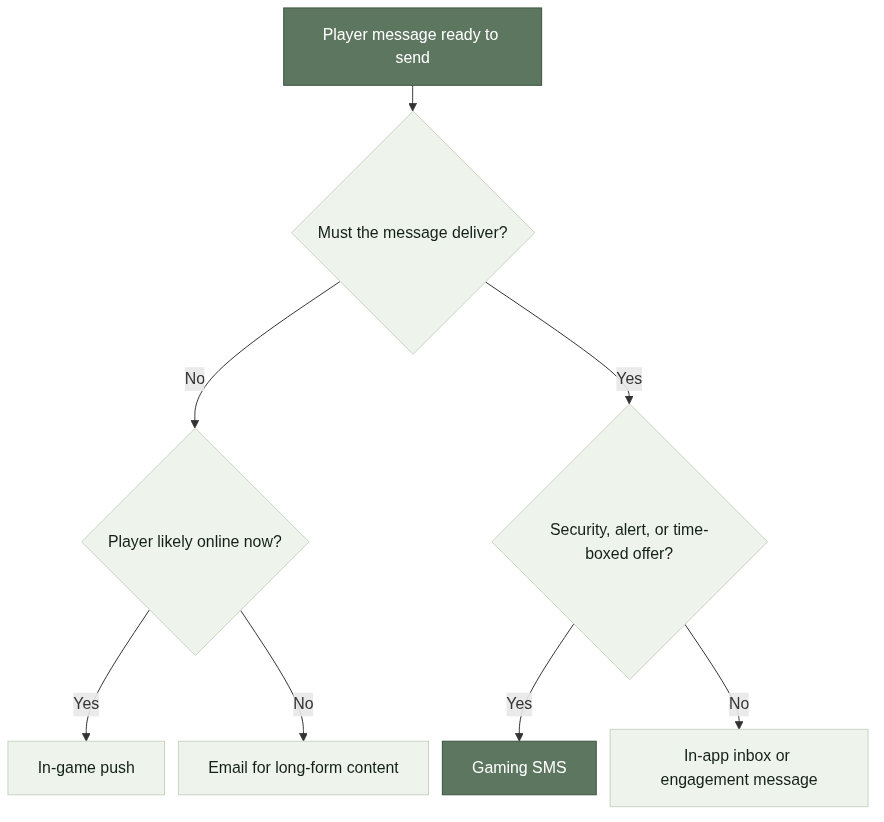
- Is this message must-deliver? (verification codes, security alerts → SMS)
- Is the player likely online right now? (online real-time reminder → in-game push)
- Is this long-form, non-urgent content? (patch notes, monthly recap → email)
- Do I need high open rate and immediacy? (limited-time offer, win-back reward → SMS)
- Are the targets cross-time-zone or offline? (yes → prioritize SMS)
The cross-region delivery evaluation checklist
When you are choosing how to send across regions, evaluate on these dimensions:
- Coverage — does the provider reach the countries your players live in?
- Routing — does it support multi-carrier smart routing and automatic failover?
- Delivery visibility — are there real-time status callbacks and detailed send reports?
- Compliance readiness — does it adapt to each market’s A2P and content-filtering rules, including time-zone compliance?
- Multilingual support — does it handle Unicode and long-short message concatenation?
- Stability — what service availability does it offer, and does it retry failed deliveries?
How the four scenarios differ in routing and compliance
| Scenario | Primary goal | Delivery expectation | Typical compliance / routing focus |
|---|---|---|---|
| Marketing | Conversion / win-back | High open rate, slightly lower tolerance | Opt-in, time-zone, frequency rules; heavier content filtering |
| Alerts | Notification / warning | Timely delivery required | Lighter filtering; needs delivery confirmation |
| Verification | Security | Must deliver, low latency | Highest deliverability bar; fraud protection and number routing |
| Engagement | Re-engagement / interaction | High open rate | Marketing-like compliance; frequency discipline |
Key Takeaways and Next Steps
The core takeaway
SMS earns its place in a gaming company’s stack not because it replaces push or email, but because it is the high-assurance, always-reachable complement. When a player is offline, dormant, or in another time zone, SMS is the channel that can still reach them — which is exactly why it is reserved for verification, critical alerts, and high-value marketing.
The four scenarios in one line each
Marketing drives conversion on high open rates. Alerts deliver time-sensitive notices with immediacy. Verification secures accounts and transactions as the trust baseline. Engagement pulls players back to extend the lifecycle. And because your players are global, every one of these scenarios sits on top of cross-region delivery and routing that has to hold up — coverage, routing, delivery visibility, compliance, multilingual support, and stability.
A soft next step
If you are mapping out how SMS should fit your player communication strategy — or evaluating whether your current cross-region setup can handle verification, alerts, and high-value marketing reliably — it is worth a conversation with someone who works on this daily. Our team can help you think through the channel mix and the delivery mechanics. You can also read more about how our SMS API handles global coverage and routing for high-assurance messaging.
FAQ
References
SMS — Wikipedia — Provides the background on SMS as a channel, including the widely cited industry convention that SMS open rates are around 90% with short read latency, which underpins the reach argument for high-assurance messaging.
Application-to-person (A2P) messaging — Wikipedia_messaging) — Provides the background on application-to-person messaging regulation, including how US 10DLC registration and carrier content filtering shape business messaging deliverability.
SMS API — SMSBoosting — Provides the background on multi-carrier routing, global coverage, and delivery visibility for high-assurance business messaging.