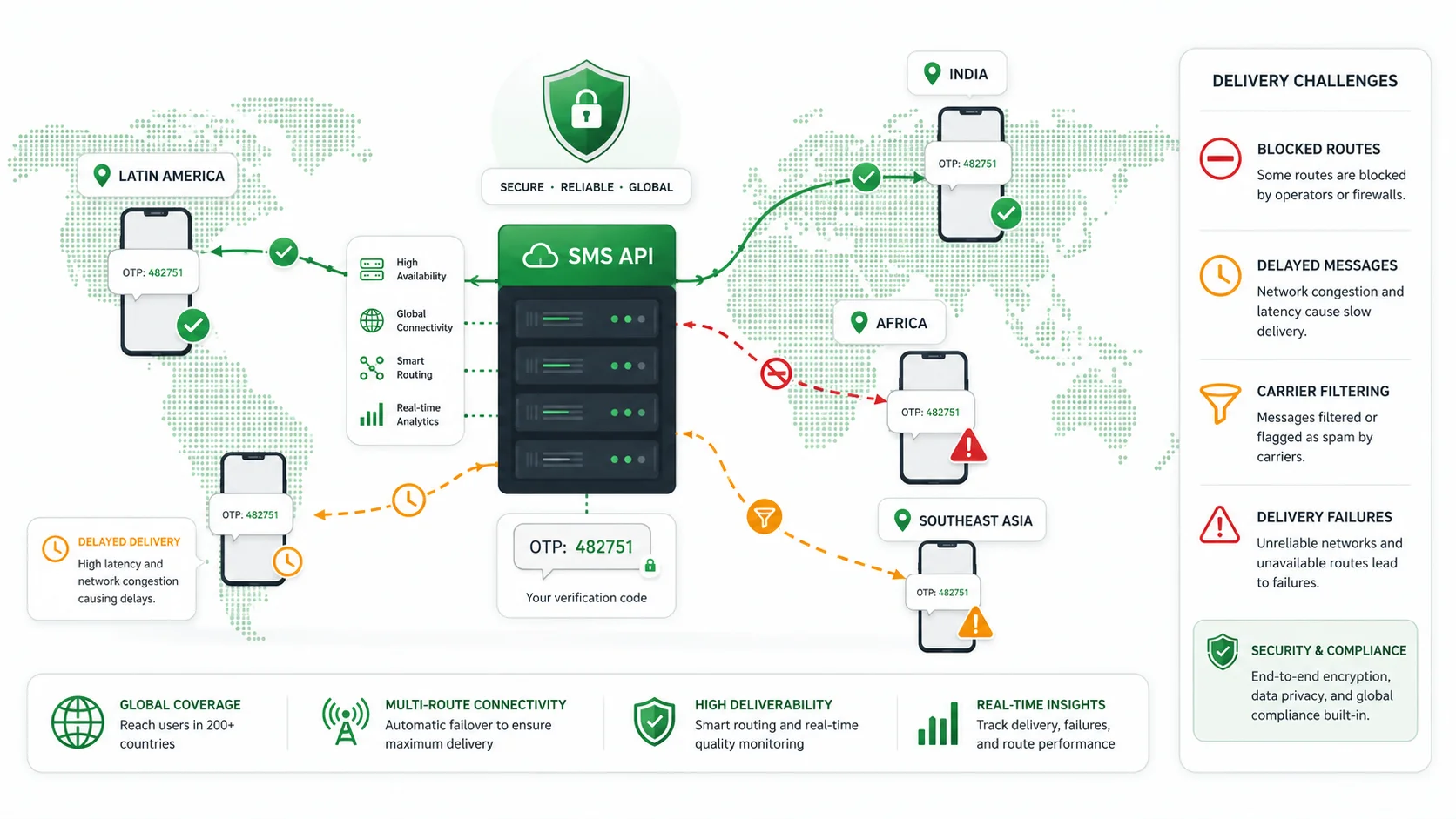
Your OTPs deliver fine in the US and Europe. But in India, Africa, or Southeast Asia, users report codes that never arrive. Support tickets pile up. Conversion rates drop in your biggest growth markets.
This is not random bad luck. OTP delivery failures in emerging markets follow predictable patterns. Grey routes get blocked by carriers. Regulatory requirements like India’s DLT registration reject unapproved messages. Number format issues send codes to inactive SIMs. And network congestion during peak hours delays delivery past the code’s expiration window.
The good news: most of these failures are fixable. You do not need to accept delivery rates as low as 60–70% in Mumbai or Lagos as normal — these figures have been reported in markets relying on grey routes.
This article breaks down the five root causes behind most emerging market OTP failures — and gives you region-specific fixes you can start on today, from India’s DLT compliance to grey route alternatives in Africa.
Why OTPs Fail in Emerging Markets: 5 Root Causes
Before you fix the problem, you need to know what is actually breaking. Here are the five root causes behind most emerging market OTP failures.
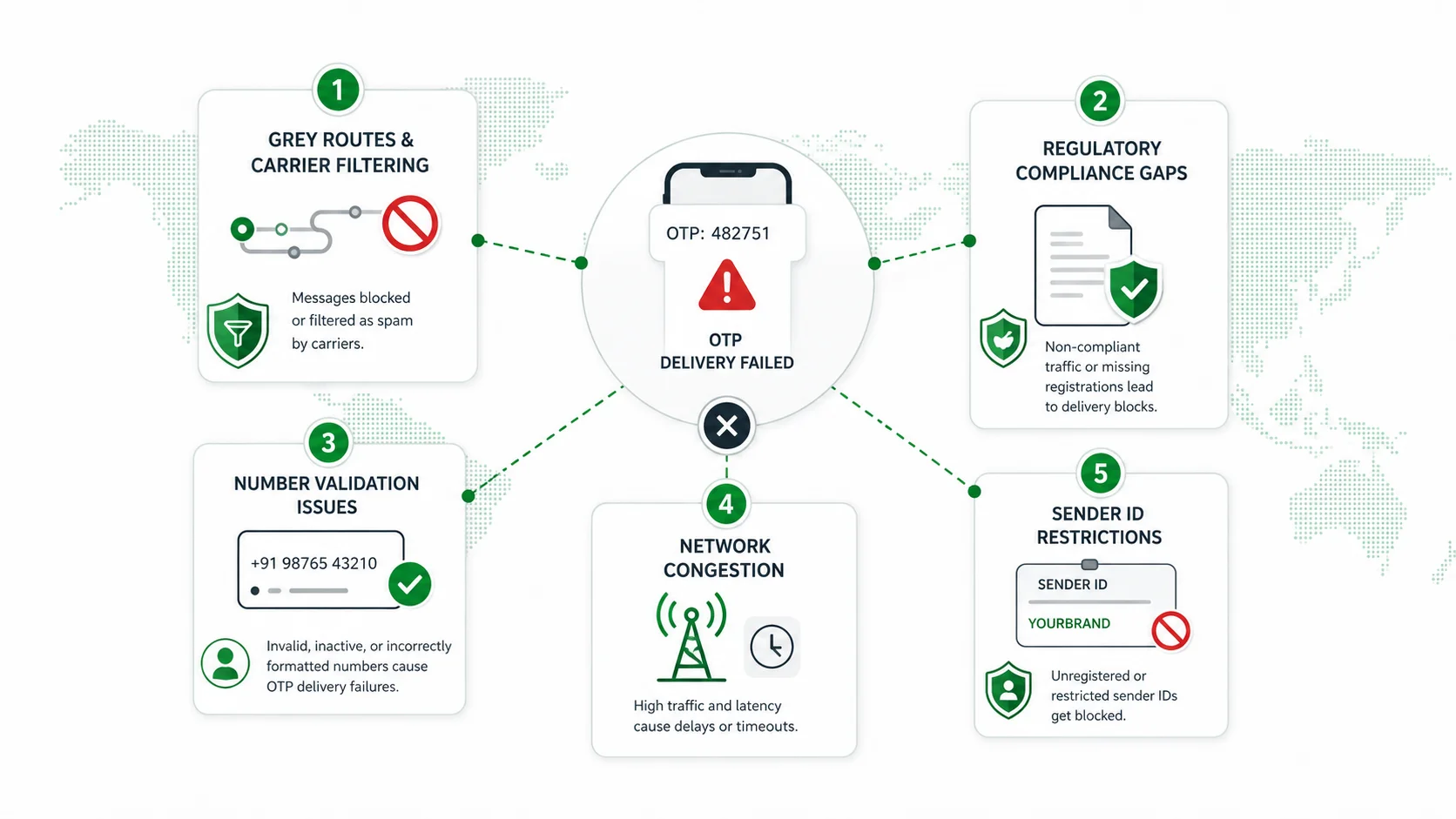
Grey Routes and Carrier Filtering
Grey routes are unofficial connections between SMS aggregators and carriers. They cost less than direct carrier agreements, but carriers can block them at any time without warning. One day your OTPs deliver. The next day, nothing.
Carriers in emerging markets filter aggressively. Messages from unknown sender IDs, international routes, or unregistered templates get blocked silently. You see a “sent” status in your API. Your user sees nothing.
Regulatory Compliance Gaps
India requires DLT (Distributed Ledger Technology) registration for all business SMS. Without it, carriers block your messages at the network level. No error code tells you why. The message just disappears.
Other markets have similar rules. Indonesia requires sender ID registration. Nigeria mandates NCC approval for bulk SMS. Delivery fails before the message even reaches the carrier if you skip these steps.
Number Validation Issues
Users change carriers but keep their numbers. A phone number that worked last month may now route to a different carrier with different filtering rules. Invalid or disconnected numbers waste money and create false failure data. This is one of those issues that is easy to miss because your API still shows a “sent” status — but the message went nowhere. A quick HLR lookup before sending catches most of these before they become a problem.
Network Infrastructure Limitations
Rural areas in Africa and India rely on 2G networks with limited capacity. During peak hours, SMS queues back up for hours. A verification code that arrives three hours late is useless.
Sender ID Restrictions
Many emerging markets require pre-approved sender IDs. Sending from a generic name like “VERIFY” or “CODE” gets blocked in countries that only allow registered alphanumeric IDs. We have seen teams waste weeks debugging delivery failures when the only problem was an unregistered sender ID — a fix that takes hours, not days, once you know where to look.
OTP Delivery Issues by Region
Each emerging market has its own failure patterns. What works in Mumbai does not work in Nairobi.
India: DLT Compliance and Template Approval
India has the most structured SMS regulatory environment. TRAI mandates DLT registration for all business messaging. The registration process sounds simple, but a lot of companies skip step one — and that is where everything falls apart. Here is the full checklist:
1. Register as a principal entity on all three DLT platforms (VIL, Airtel, Jio)
2. Submit message templates for approval before sending
3. Use a registered sender ID tied to your business
4. Include opt-out language in promotional messages
Failure at any step means carrier-level blocking under TRAI regulations. We have seen teams miss the principal entity registration and watch every message disappear without an error code. Delivery rates for unregistered traffic often fall below 30%, with some providers reporting drops as low as 20% in heavily filtered markets.
Realistic delivery benchmarks: Under 5 seconds in Mumbai/Delhi. 5–10 seconds in Tier-2 cities. 10–30 seconds in rural areas — assuming full DLT compliance.
Africa: Grey Routes and Sender ID Blocks
Africa’s SMS market runs heavily on grey routes. Direct carrier agreements are limited outside South Africa, Nigeria, and Kenya. Grey route providers offer cheap rates but cannot guarantee delivery — a route that works on Monday may be blocked by Tuesday if the carrier detects unauthorized traffic. We have seen clients watch delivery rates drop from 90% to 20% overnight because their provider lost a single grey route.
Use providers with direct carrier partnerships in your target countries. Pre-register sender IDs in Nigeria and South Africa. Avoid generic sender names.
Realistic delivery benchmarks: 90–95% in South Africa and Nigeria. 75–85% in East and West Africa outside major cities. Delivery times range from 5 seconds to 2 minutes depending on infrastructure.
Southeast Asia: Registration Requirements and Filtering
Indonesia requires sender ID registration through the Ministry of Communication. Without it, messages from international routes face heavy filtering. Singapore blocks most unregistered alphanumeric sender IDs.
The Philippines has strong delivery infrastructure but aggressive spam filters. Using a local sender ID commonly improves delivery rates by 10–20% compared to international numeric IDs.
Latin America: Number Portability and Carrier Variability
Brazil’s number portability system (Anatel) creates routing confusion. A message routed to the wrong carrier gets delayed or dropped. Mexico has consolidated carriers but inconsistent rural coverage.
For reliable delivery rates across Latin America, use providers with local carrier agreements rather than international hub routing.
How to Fix OTP Delivery: A Technical Playbook
Once you understand the root causes, implement these fixes in order of impact.
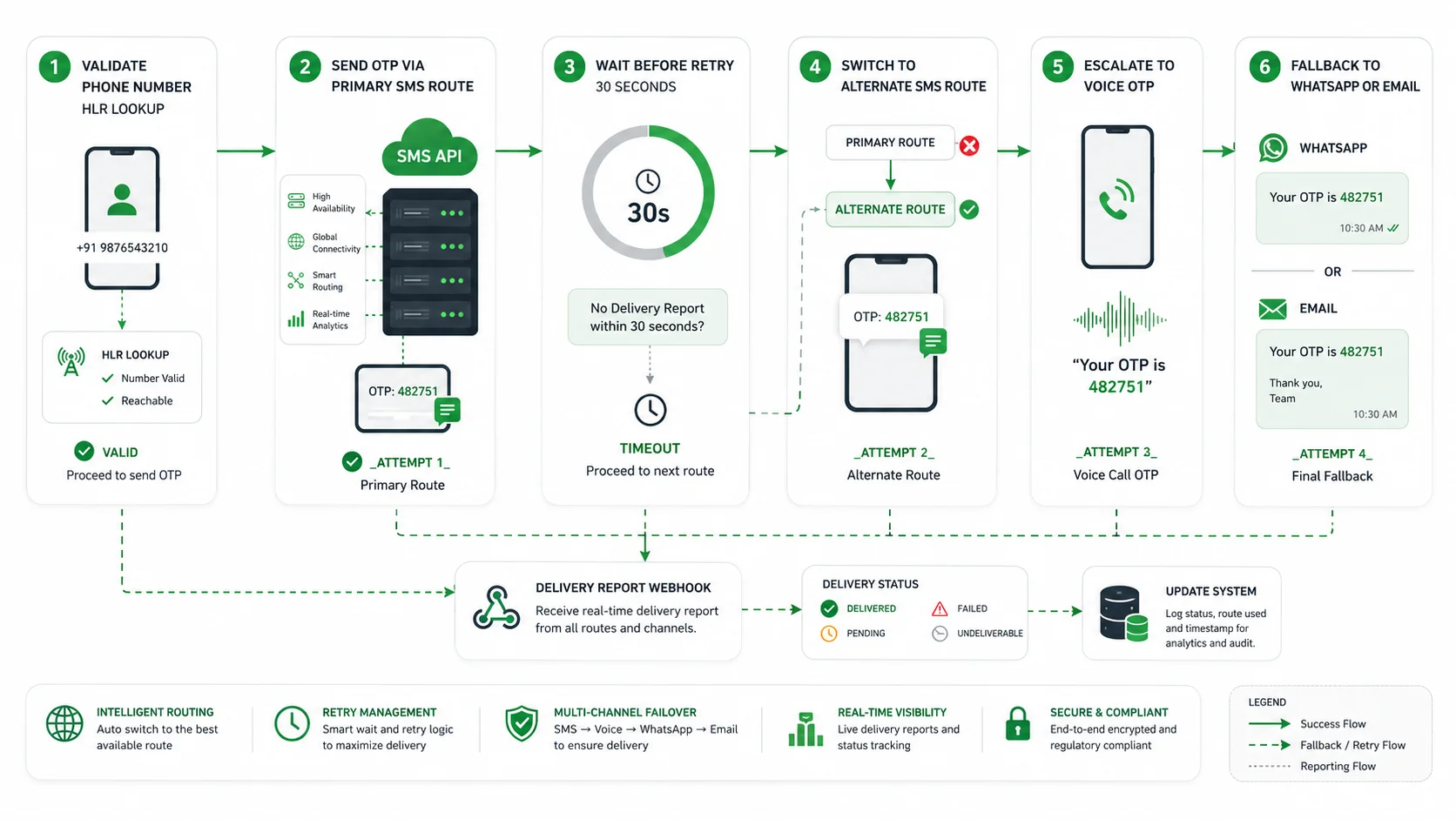
Implement Reliable Retry Logic
Do not retry immediately. A message blocked by carrier filtering will not get through 10 seconds later.
Recommended retry strategy:
- First Retry: Wait 30 seconds before trying again, and switch to a different route this time.
- Second Retry: Give it 2 minutes, then escalate to a voice OTP if you have that option set up.
- Third Retry: Wait 5 minutes before the final attempt. After this, offer an email fallback.
- Max Retries: Cap it at 3 total attempts — going beyond that risks getting flagged as spam.
Track retry success rates by country. Your routes are the problem — not your logic — if retries rarely succeed.
Validate Numbers Before Sending
Use an HLR (Home Location Register) lookup or number validation API before sending. This catches:
- Disconnected Numbers: These are numbers that are no longer active — sending to them wastes money and skews your failure data.
- Invalid Country Codes: Malformed numbers that will never reach a real device.
- Premium-Rate Numbers: Often used in fraud schemes to rack up charges on your account.
- Recently Ported Numbers: A number that just switched carriers may temporarily route incorrectly.
Validation costs a fraction of a failed SMS send. At scale, it pays for itself.
Configure Fallback Channels
When SMS fails, you need alternatives. Set up this fallback hierarchy:
1. SMS (primary)
2. Voice OTP (read aloud by automated call)
3. WhatsApp (where available and user-opted-in)
4. Email (last resort for account recovery only)
For SMS API integration, configure webhooks to activate fallback automatically when delivery reports show failure.
Monitor Delivery by Region and Carrier
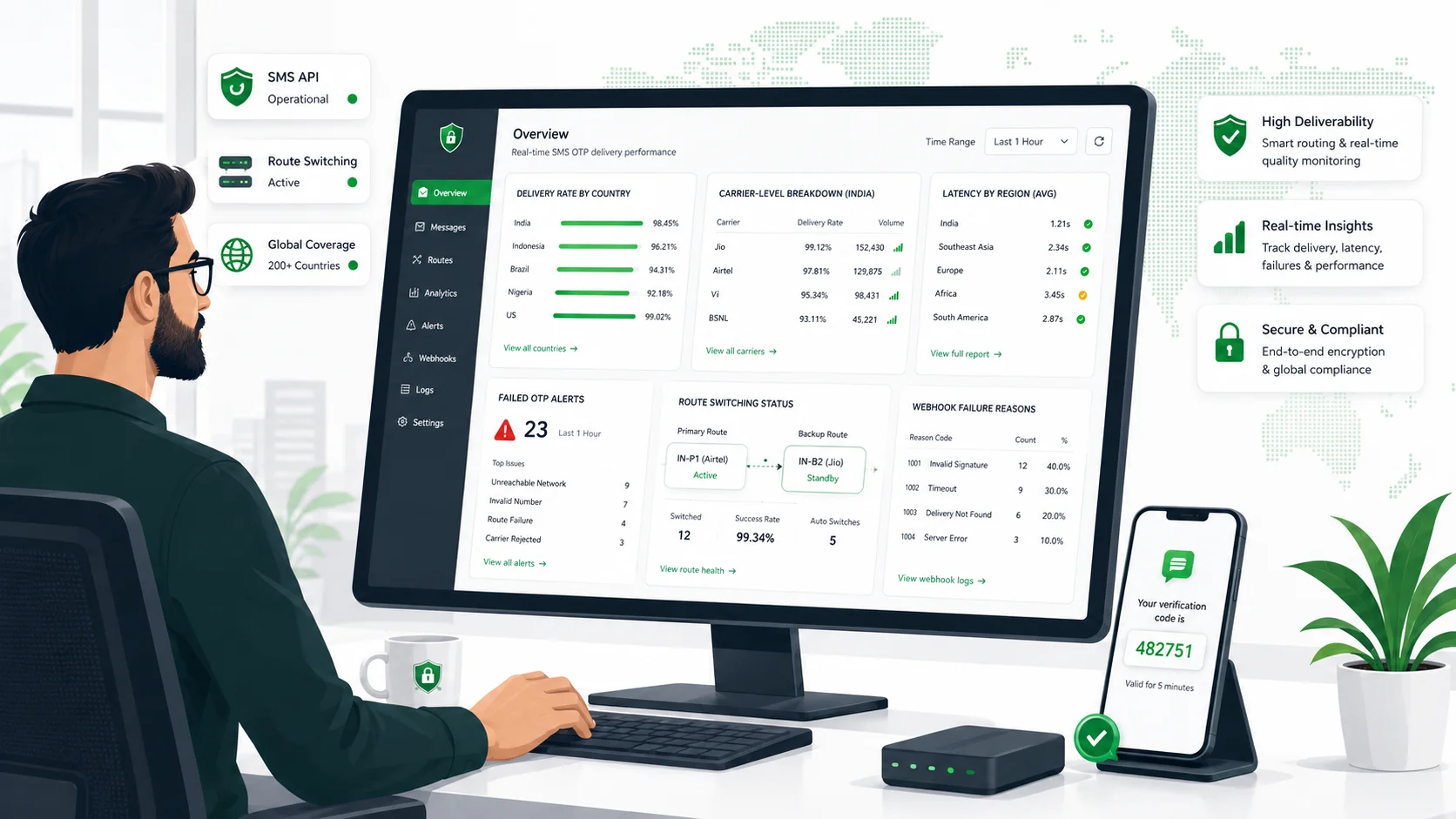
Set up dashboards that track:
- Delivery Rate by Country: Set an alert for anything that drops below 90% — that is your early warning signal.
- Delivery Rate by Carrier: One carrier at 40% while another hits 95% means you have a routing problem, not a volume problem.
- Average Delivery Time by Region: Rural areas will always be slower, but anything over 30 seconds in a major city needs investigation.
- Failure Reason Codes: Your provider should be surfacing these. If they are not, that is a red flag on its own.
When to Switch Providers
Fix your configuration first. If you have done everything above and still see:
- Delivery Rates Below 85%: Anything under this threshold in your target markets means your routing or configuration needs serious work.
- No Direct Carrier Routes: If your provider cannot name specific carrier partners in your target countries, you do not have real redundancy.
- No DLT Support for India: Without this, you are effectively blocked from the Indian market.
- No 24/7 Support: OTP delivery issues do not wait for business hours. You need incident response at any time.
Then your provider is the bottleneck. Look for one with direct carrier partnerships, route redundancy, and regional compliance expertise.
Preventing OTP Failures Before They Happen
The cheapest fix is preventing the failure. Most teams we see launch in a new market first and debug later — which means weeks of failed deliveries before they fix the basics. Here is a checklist to run through before you go live:
- Test in Target Markets: Send 1,000+ messages to real numbers in each country before launch. Do not rely on sandbox testing alone.
- Register Sender IDs Early: Some approvals take 2–4 weeks. Do not wait until launch day to find out your sender ID is blocked.
- Set Up Monitoring Dashboards: You cannot fix what you do not measure. Track delivery rates by country and carrier from day one.
- Build Failover Into Your Architecture: Based on typical market conditions, assume SMS will fail 5–10% of the time and design fallback channels accordingly.
- Review Compliance Requirements: Check sender ID rules, DLT registration, and content restrictions for each new country before adding it to your supported list.
Run through this list once and you will avoid most of the problems that drain engineering time after launch.
Conclusion
OTP failures in emerging markets are solvable for any industry — from e-commerce to financial services. Most issues trace back to grey routes, compliance gaps, or missing retry logic. Fix the root cause and your delivery rates jump.
Need reliable routes in India, Africa, or Southeast Asia? Test SMSBoosting’s OTP SMS with direct carrier partnerships and built-in route failover. Start a free trial to measure delivery in your target markets.
Frequently Asked Questions
What is a good OTP delivery rate in emerging markets?
In major emerging markets with proper routing and compliance, typical benchmarks are: 90–95% in India (with DLT), 90–95% in South Africa and Nigeria, 85–90% in Southeast Asia. Below 85% typically means your routing or configuration needs work.
How long should I wait before retrying a failed OTP?
Wait 30 seconds for the first retry, then 2 minutes, then 5 minutes. Immediate retries usually fail for the same reason. Escalate to voice or WhatsApp after the second SMS failure.
Does using a local sender ID improve delivery?
Yes, significantly. In India, Indonesia, and Nigeria, registered local sender IDs commonly improve delivery rates by 10–20% compared to international or generic IDs.
Can I fix OTP delivery without changing my SMS provider?
Sometimes. If your provider offers direct routes, DLT support, and webhook reporting, the fix is usually a configuration. If they only offer grey routes and ticket-based support, the provider is the limiting factor.