
The difference between an SMS platform and an SMS gateway comes down to scope.
An SMS gateway is the basic pipe that hands your text message off to carrier routes. An SMS platform is the system around that pipe—routing choices, send controls, reporting, and operational support—so business texting stays reliable as you scale.
This distinction matters more than most teams expect. Both products often look like “an SMS API” at first glance, which is why many companies don’t realize what they’re missing until delivery rates drop, campaigns stall, or a country blocks traffic at launch.
In this guide, we’ll break down SMS platform vs SMS gateway in plain terms—what each one actually does, where the overlap causes confusion, and how to choose the right option based on scale, geography, and messaging risk.
SMS Platform vs SMS Gateway in 2 Minutes
What an SMS Gateway does in plain English
An SMS gateway connects your software to mobile carrier networks and passes messages to the next hop. Think of an SMS gateway as the connection layer between your software and mobile networks. You send a request (often via HTTP API), and the gateway’s job is to accept the message and pass it onward to the next hop toward the carrier.
At a basic level, a gateway helps you:
- Submit messages to routes that reach carriers
- Receive delivery receipts (DLRs) when available
- Do simple formatting and basic retries (varies by provider)
A gateway is about handoff.
What an SMS Platform does in plain English
An SMS platform includes gateway connectivity, but adds the capabilities that make business messaging operationally stable.
A platform typically helps you:
- Choose and manage routes (or at least provide route strategy and controls)
- Control send behavior (rate limits, pacing, scheduling, quiet hours, segmentation)
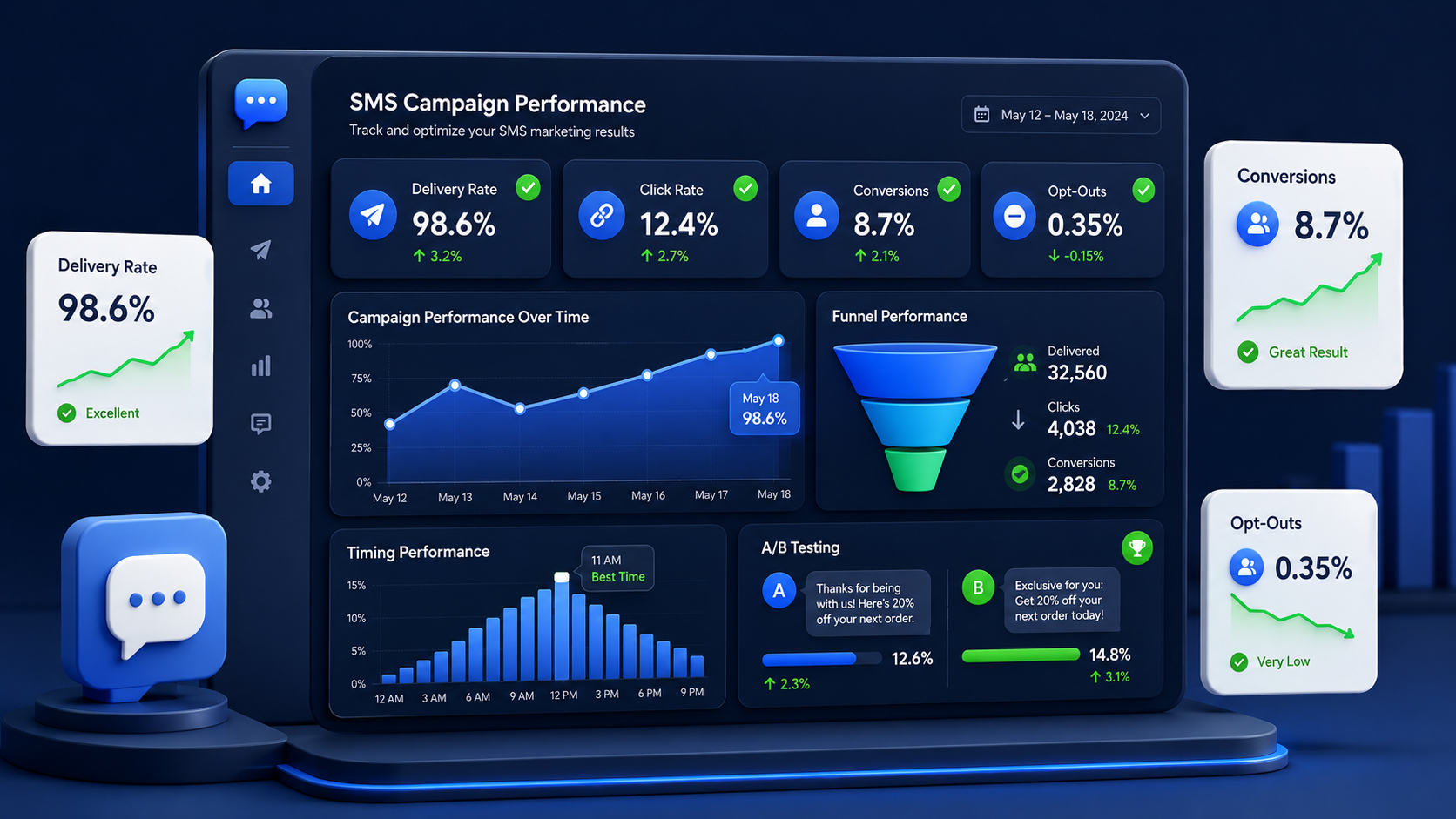
- Track outcomes with usable reporting (beyond “sent/delivered”)
- Handle sender identity and compliance workflows across regions
- Troubleshoot with better visibility—and support that can escalate issues when needed
A platform is about running messaging as a system, not just sending requests.
The fastest way to tell them apart when you’re buying
If your main question is “Can I send a text?” you’re thinking gateway.
If your main question is “Can I keep results stable across countries, campaigns, and carrier rules?” you’re thinking platform.
The Overlap That Confuses Everyone
Both can look like “an SMS API”
“SMS API” describes how you send (the interface), not what you’re buying (the product).
That’s why:
- Many gateways market themselves as “SMS API providers”
- Many platforms also expose the same kind of API endpoint
Same shape. Different depth.
Why “API success” is not the same as “message outcomes”
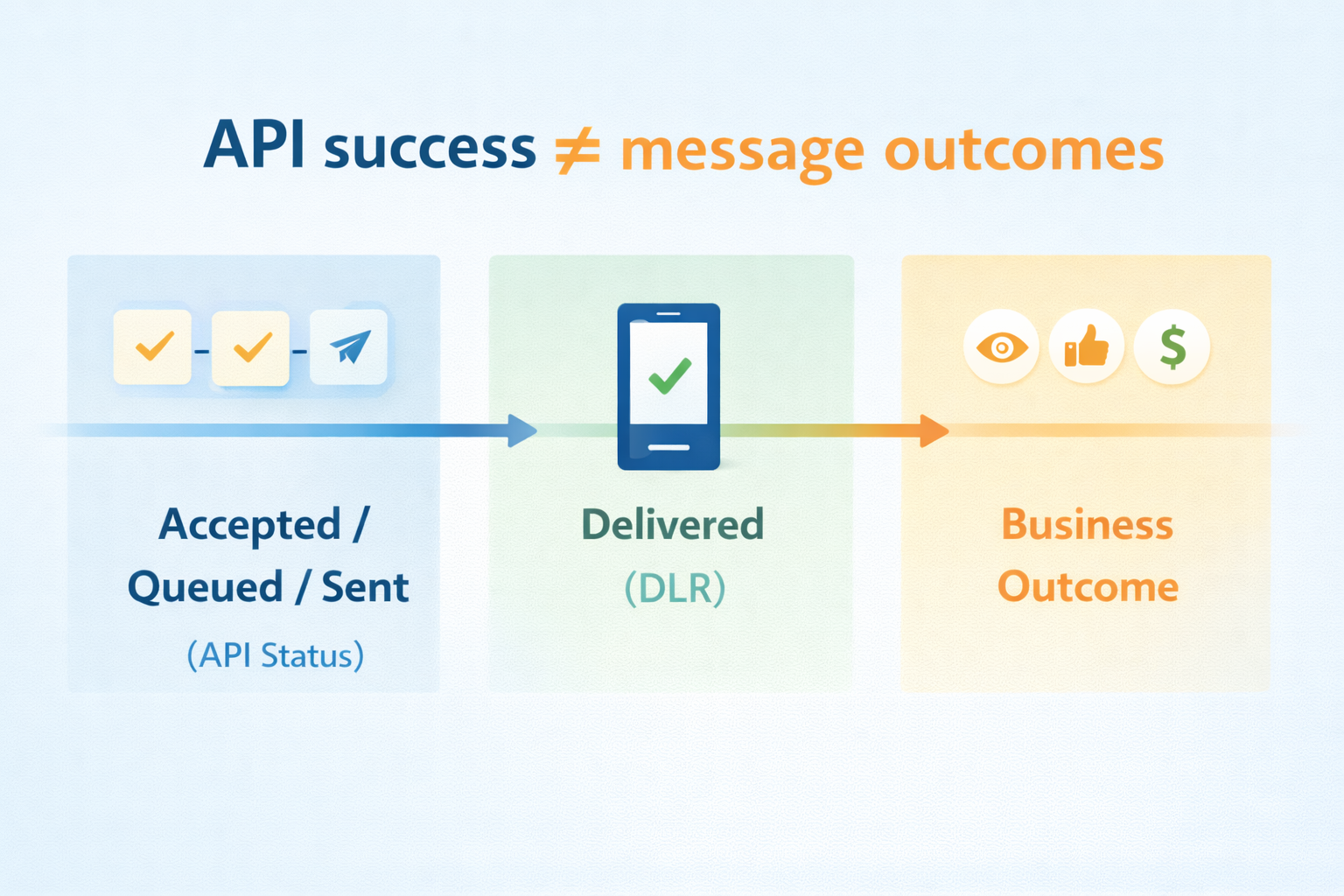
Most APIs will return a success response when your provider accepted the request—not when the recipient’s phone received the SMS. This is where many teams get misled the first time they scale. Everything looks fine in the logs. Then performance drops, and no one knows why.
For beginners, this is the key mental model:
- Accepted/queued/sent (API status) = your provider took responsibility for processing it
- Delivered (DLR) = a downstream network confirmed delivery to the handset (when that signal exists)
- Business outcome = the customer saw it, trusted it, and acted—without triggering complaints or blocks
You can do everything “right” at the API layer and still see performance vary—because routing, filtering, identity rules, and pacing happen after your request is accepted.
SMS Platform vs SMS Gateway Side by Side
| Dimension | SMS Gateway | SMS Platform |
| Core Role | Passes messages to carrier routes | Operates messaging as a managed system |
| Primary Focus | Connectivity and handoff | Stability, control, and outcomes at scale |
| Routing Control | Limited or opaque | Managed routes and strategy guidance |
| Sender Identity | Basic support | Country-specific guidance and guardrails |
| Send Controls | Minimal or optional | Pacing, scheduling, suppression, segmentation |
| Reporting Depth | Sent/delivered statuses | Actionable insights by region, sender, or route |
| Best Fit | Simple, low-volume use cases | Multi-country or high-volume business messaging, including OTP SMS traffic |
Connectivity and routing control
Connectivity differs between a gateway and a platform in how routing is managed and controlled. A gateway gives you a path. A platform helps you manage the fact that there are multiple possible paths, and not all routes behave the same.
At small scale, “a route” feels like a commodity. At scale, route differences become visible:
- Some routes are more tolerant; others are stricter
- Filtering can be harsher in certain regions, industries, or sender types
- Performance can shift when downstream paths change
Platform-style value shows up when you need consistency: visibility into where traffic is going, options for routing strategy, and guardrails that reduce surprise.
Sender identity and country requirements
Sender identity rules vary by country and carrier, and incorrect setup often leads to blocked traffic. It is one of the fastest ways to get confused—and blocked.
Depending on country and use case, your “sender” might need to be:
- A long code (regular phone number)
- A short code (special 5–6 digit number in some countries, often for high-volume A2P)
- An alphanumeric sender ID (brand name) in many markets
- A toll-free number (commonly used in North America for certain business messaging)

The tricky part: what’s allowed and what’s required changes by country and carrier. And it rarely changes in a way that’s obvious. You usually discover it when a campaign stalls or traffic gets blocked at launch.
This is where a platform typically helps more than a bare gateway:
- Guidance on what sender type fits your use case and region
- Support for registration steps where they apply (requirements vary widely)
- Guardrails that prevent you from launching on a sender setup that will predictably fail
Trust and identity are not optional in messaging ecosystems. Once sender reputation drops, recovery can take weeks—not hours. Google’s Verified SMS rollout (initially across nine countries) is a reminder that messaging is moving toward clearer sender verification.
Send controls you’ll miss at scale
Send controls determine whether high-volume messaging remains stable or starts triggering filtering and complaints. Beginners often assume “sending faster” is always better. In reality, messaging systems punish abrupt spikes.
Common platform controls include:
- Rate limiting and pacing (smooth out bursts)
- Scheduling and time windows (respect local time and customer experience)
- Segmentation (don’t blast everyone the same way)
- Suppression rules (avoid repeated sends to the same recipient)
- Template and content guardrails (reduce risky patterns that trigger filtering)
A gateway may offer some of these. A platform usually treats them as first-class features—because they directly affect deliverability and complaints.
Delivery reporting you can actually debug with
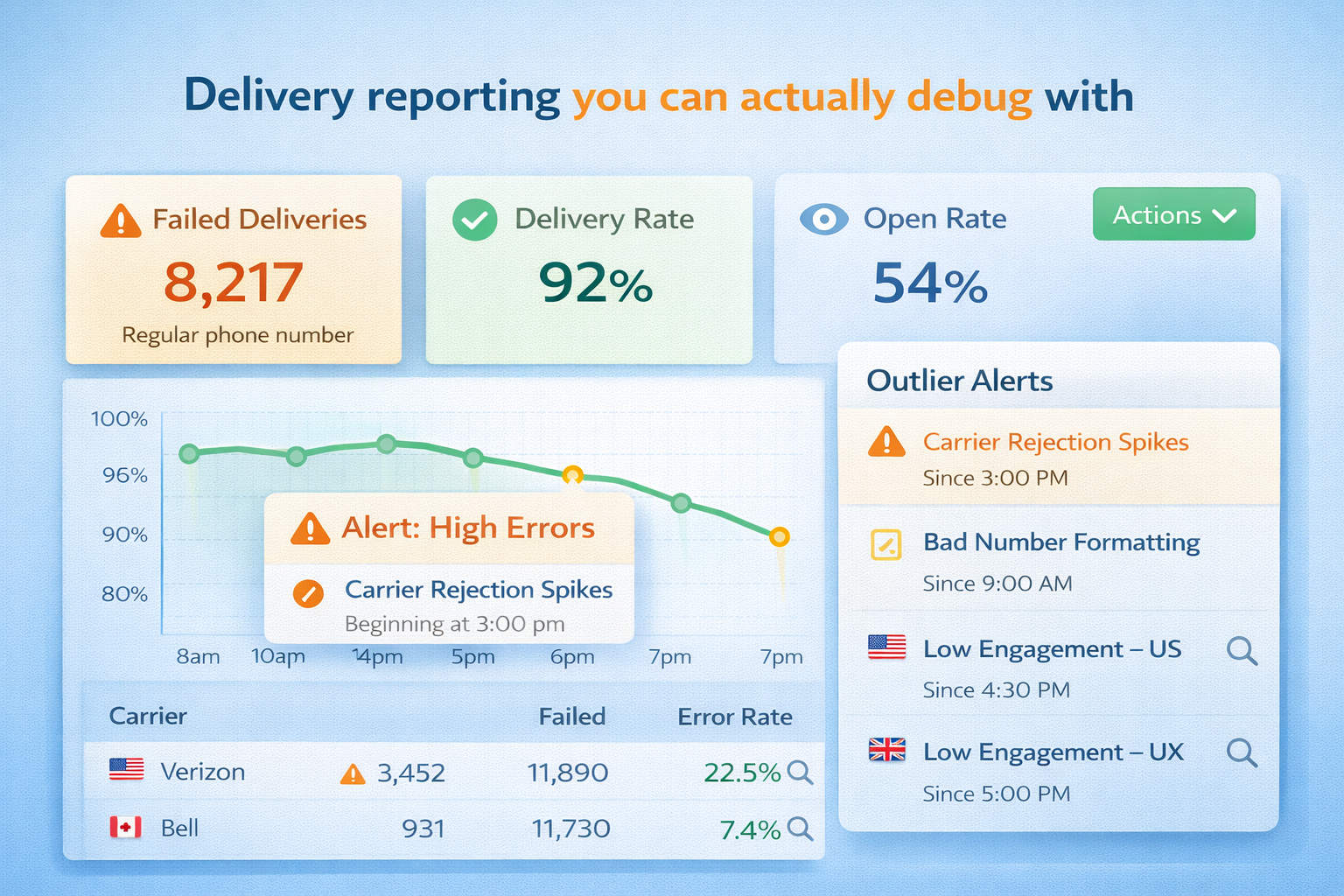
Delivery reporting determines whether you can diagnose performance drops or only see surface-level status updates. If your reporting is limited to “sent” and “delivered,” you’ll hit a wall quickly.
When things go wrong, you want answers like:
- Which countries or carriers changed?
- Is the problem isolated to one sender type?
- Did failure rates spike at a specific hour?
- Are messages being rejected, throttled, or filtered?
DLRs and error signals vary by route and carrier. Sometimes you’ll get detailed reason codes; sometimes you won’t. A platform’s job is to make the available signals actionable:
- More granular status categories
- Better analytics by country/carrier/route (where available)
- Dashboards that highlight anomalies rather than bury them
This is the difference between “we can send” and “we can operate.”
If you’re comparing SMS API providers, don’t stop at price-per-SMS. Use the checklist below to sanity-check routing, identity requirements, and reporting—those are the usual sources of expensive surprises.
Support, SLAs, and what escalation looks like
Support differs between gateways and platforms in how issues are escalated and resolved during live campaigns. A gateway can be a tool you use. A platform is often closer to a service you rely on.
When messaging becomes revenue-critical, you care about:
- Response times and escalation paths
- Help interpreting failures (not just forwarding logs back to you)
- Proactive guidance on country-specific constraints
- Clear expectations around throughput and deliverability realities
No provider can “force” carriers to deliver everything. But the difference between weak and strong support is whether you can diagnose and adapt fast when the network behaves differently than yesterday.
When an SMS Gateway Is Enough
Low volume and simple alerts
A gateway can be enough if you’re sending:
- Low-volume transactional messages
- Internal notifications
- Simple customer alerts or an internal SMS notification service with predictable patterns
In these cases, your main needs are basic connectivity and a clean API.
Single-region sending with predictable rules
If you’re sending mostly within one country—and using a sender type that’s already proven to work for your use case—your operational surface area is smaller.
You still need to care about consent and content rules, but you’re less likely to run into complex cross-border identity and routing issues immediately.
The operational work you still own
Even with a gateway, someone has to own:
- Consent handling and opt-out logic
- Campaign pacing and send-time choices
- Monitoring and alerting
- Interpreting failures and adapting
A gateway doesn’t remove this work. It just gives you a pipe.
When You’ll Want an SMS Platform
Multi-country messaging and carrier variability
An SMS platform becomes necessary when you operate across multiple countries, send high-volume traffic, or need delivery consistency. The moment you go cross-border, you’ll discover that “SMS” is not one consistent product. It’s many local rule sets riding on global infrastructure. What works perfectly in one country can quietly fail in another—even with the same copy, sender, and send time.
A platform becomes valuable when you need:
- Country-specific identity guidance
- Route strategy that matches your traffic type
- Reporting that helps you spot regional drift
Marketing at scale without hurting deliverability
High-volume SMS marketing traffic is where complaints, filtering, and pacing problems show up.
A platform helps by putting structure around:
- Frequency control
- Time window management
- Segmentation and suppression
- Observability (so you notice issues before your unsubscribe rate tells you)
When you need visibility, not just “delivered”
Many teams only upgrade after they experience this exact pain:
“We didn’t change copy or code, but performance dropped anyway.”
That often happens because something changed underneath—route behavior, filtering sensitivity, sender reputation signals, or carrier policy enforcement. You can’t fix what you can’t see.
The Decision Checklist Before You Commit
Questions about routing and deliverability
1. How does traffic get routed in each target country?
You’re not asking for trade secrets—you’re asking whether route quality and regional differences are actively managed.
2. What happens when delivery rates drop in one country?
Do you get a diagnosis path, or just a shrug and a log export?
Questions about identity, registration, and consent
3. Which sender type should you use per country (long code/short code/alphanumeric/toll-free)?
Wrong sender choice is a common “blocked at launch” mistake.
4. What registrations are required for your use case—and who helps you complete them?
Requirements vary widely; you want clarity before you build workflows.
5. What’s the default handling for opt-out/STOP and compliance keywords (where applicable)?
This is non-negotiable for customer experience and policy enforcement.
Questions about throughput, pacing, and controls
6. What throughput can you actually sustain (not just theoretical limits)?
You need realistic expectations, especially during peaks.
7. Do you have send controls (rate limiting, scheduling, quiet hours, suppression)?
Controls prevent self-inflicted deliverability problems.
Questions about reporting and troubleshooting
8. How detailed are delivery receipts and failure reasons by region?
Some carriers provide better feedback than others—your tools should adapt to that reality.
9. Can you break down performance by country/carrier/sender (where available)?
If you can’t segment, you can’t diagnose.
Questions about support, SLAs, and real costs
10. What does escalation look like when something breaks during a campaign?
Support quality is part of your deliverability strategy.
And one bonus question that saves pain later:
What “extra fees” exist beyond per-message price (registrations, numbers, compliance programs, dedicated routes, support tiers)?
Conclusion
If you only need a pipe to submit messages, an SMS gateway can work. If you need consistent results across scale, regions, and changing carrier behavior, you want an SMS platform.
Before you commit, validate three things:
- Sender identity requirements for your target countries
- Throughput/pacing expectations for your traffic type
- Reporting depth (so you can debug, not guess)
If you’re launching in multiple countries or scaling marketing + transactional traffic, it can be worth doing a short messaging readiness review—routing, identity requirements, and reporting expectations—before you build everything around the wrong assumptions.