

SMS marketing for retail is a permission-based way for retailers to use text messages to improve customer engagement, repeat visits, and timely customer communication. It works best when consent, message relevance, timing, opt-out clarity, and trust protection come before sending more promotions.
For retail growth, marketing, and CRM teams, that distinction matters. A text message can bring someone back to a store, remind them about a reward, confirm a pickup, or alert them that a product is back in stock. But the same channel can also create fatigue quickly if customers receive messages they did not expect, cannot easily stop, or no longer find useful.
The goal is not to send more. The goal is to send retail SMS messages that customers understand, recognize, and still want to receive.
What SMS Marketing for Retail Means for Customer Engagement and Repeat Visits
SMS marketing for retail means using permission-based text messages to support useful customer actions across the retail journey. Those actions can include checking a restock alert, redeeming a loyalty reward, visiting a store, completing a pickup, or returning for a replenishment purchase.
This article treats retail broadly, not as ecommerce-only. U.S. Census retail data separates total retail sales from e-commerce sales, which is a useful reminder that retail SMS should support both online and store-linked customer journeys, not just website campaigns [4].
Definition block
| Term | Working definition for this article |
|---|---|
| SMS marketing for retail | Permission-based text messaging used by retailers to support engagement, repeat visits, timely updates, loyalty activity, and relevant offers. |
| Retail SMS customer engagement | Customer actions created or supported by SMS, such as clicks, replies, reward redemptions, restock interest, store visits, or pickup completion. |
| Repeat-visit value | The practical reason a customer has to come back, such as a reward reminder, replenishment prompt, product availability alert, or local store update. |
| Trust risk | The risk that SMS feels unexpected, excessive, unclear, or hard to stop, which can lead to opt-outs, complaints, or lower engagement. |
How Retail SMS Marketing Differs From Generic SMS Marketing
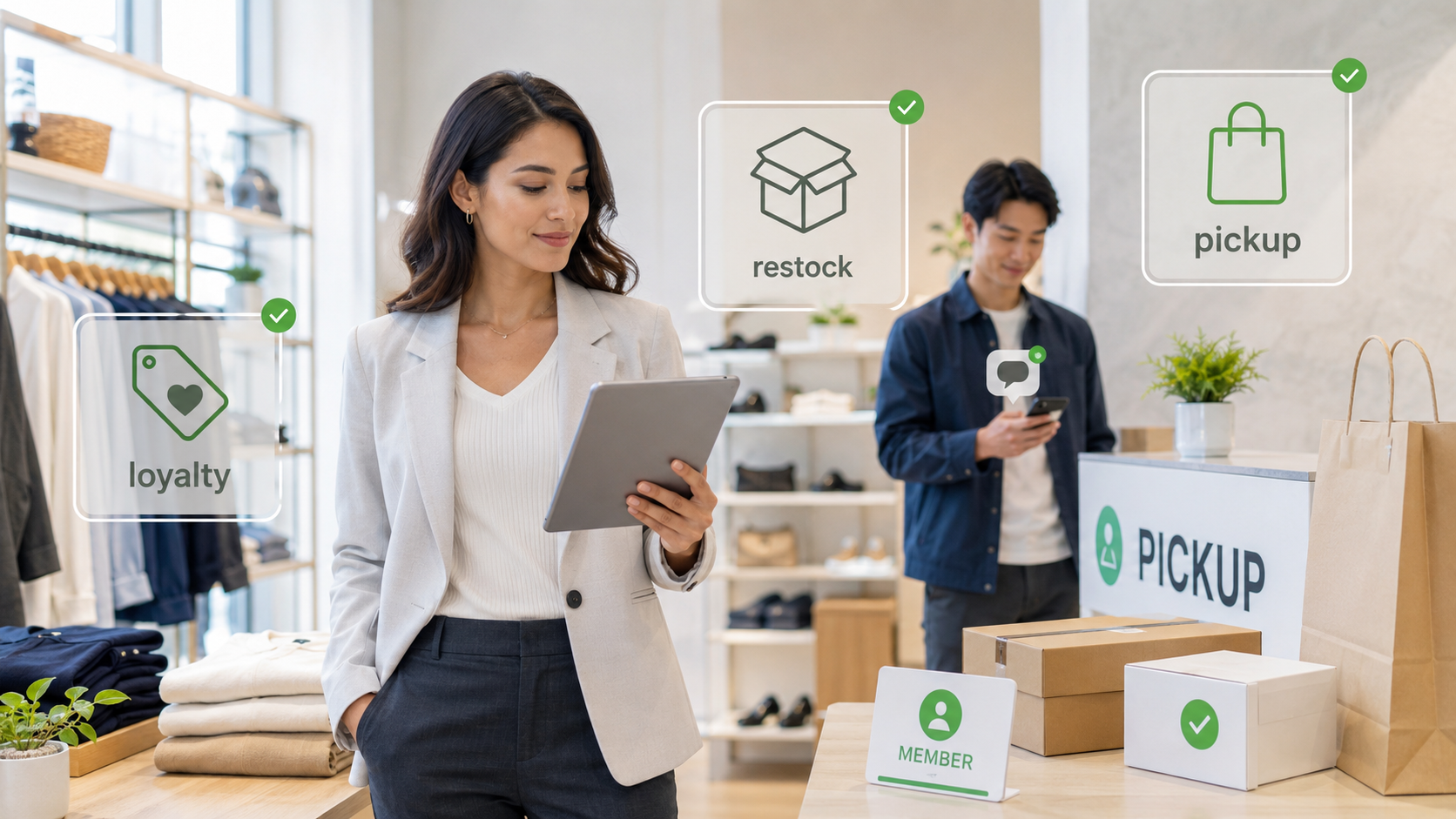
Retail SMS marketing differs from generic SMS marketing because the message often connects to a specific shopping moment. A customer may be waiting for a restock, checking a loyalty balance, picking up an order, comparing local availability, or deciding whether to return before a promotion ends.
That makes context important. A message about “20% off today” is not the same as a message saying an item the customer asked about is back in stock. Both are retail SMS messages, but they carry different expectations.
Where SMS Fits in a Retail Customer Journey
SMS fits best where timing and usefulness matter. It can support discovery, purchase, pickup, loyalty, reactivation, and post-purchase follow-up, but it should not replace every other customer communication.
A useful retail SMS journey usually looks like this:
- Capture permission through a clear opt-in at checkout, online signup, in-store enrollment, or loyalty registration.
- Confirm what the customer joined and how often messages may arrive.
- Send messages tied to customer value, such as rewards, updates, availability, or relevant offers.
- Measure engagement, opt-outs, repeat actions, and list quality.
- Review routing, sender recognition, and campaign setup before scaling volume.
Why More Retail SMS Promotions Are Not a Better Growth Strategy
More retail SMS promotions do not automatically create more growth because frequency without consent, relevance, and timing can increase fatigue and opt-outs. Retail SMS growth works when the customer has a reason to welcome the next message.
That is the common mistake. A team sees SMS drive a few fast responses, then turns the channel into a discount pipe. At first, it may look efficient. Over time, customers stop clicking, unsubscribe, or ignore the sender.
The Risk of Treating Every Retail Text Message as a Promotion
Promotional SMS has a place in retail. The problem is treating every customer moment as a sales moment.
| Wrong assumption | Better retail SMS principle |
|---|---|
| “If one campaign works, send more.” | Increase usefulness before increasing frequency. |
| “A discount makes every message valuable.” | Some messages are valuable because they solve a customer problem, such as pickup timing or product availability. |
| “All subscribers want the same offers.” | Segment by context, such as loyalty status, store location, past purchase category, or stated preference. |
| “Opt-outs are only a compliance issue.” | Opt-outs are also a list-quality and trust signal. |
| “SMS should push urgency every time.” | Urgency works only when it is real, relevant, and expected. |
When SMS Marketing for Retail Creates Value Instead of Pressure
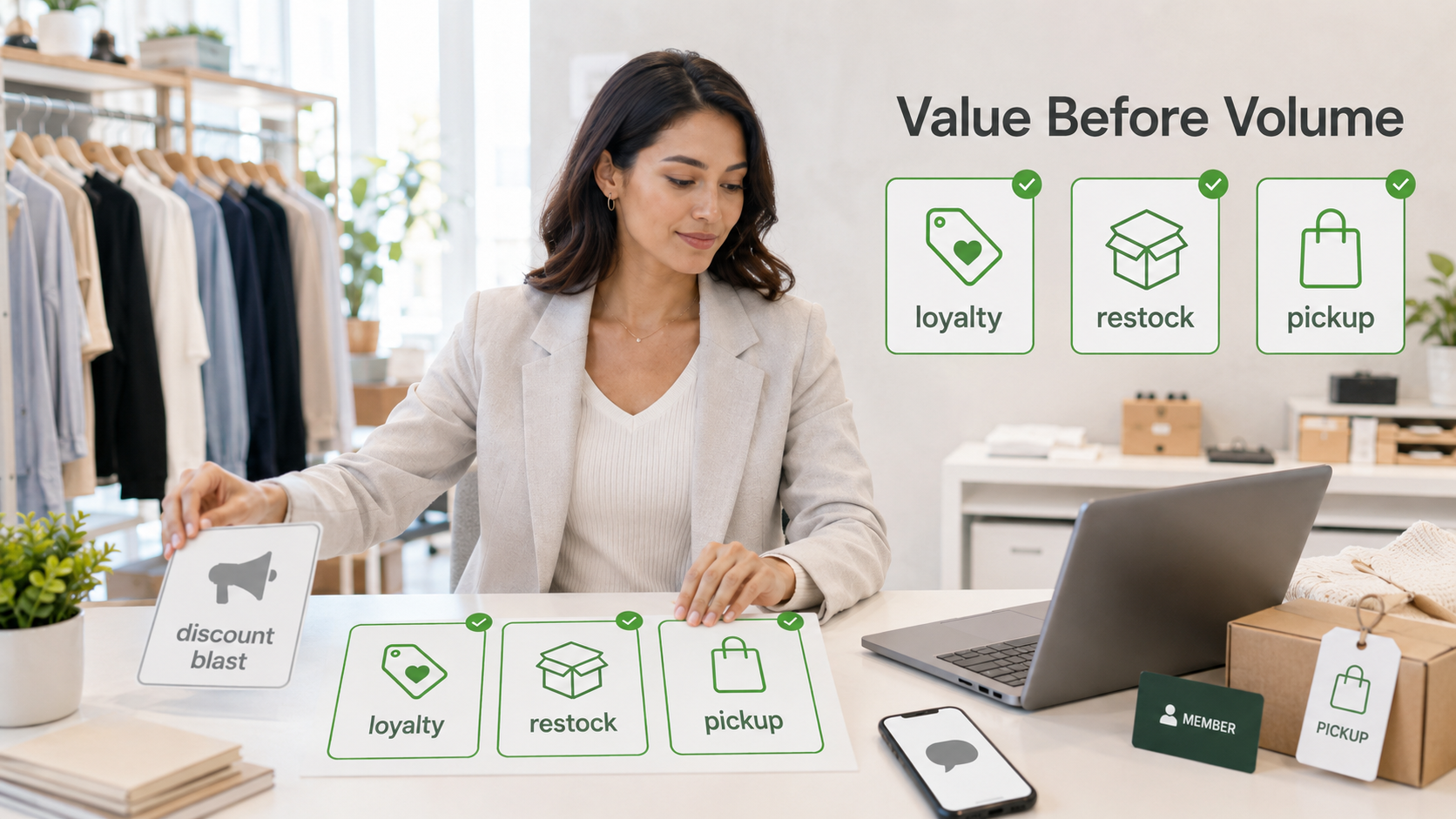
SMS creates value when the message matches the customer’s reason for joining. A loyalty member may expect reward reminders. A shopper who requested a back-in-stock alert expects availability updates. A customer who chose pickup expects practical order communication.
Not every useful retail SMS is promotional. In many cases, the best message is simply the one that helps the customer do what they already wanted to do.
Consent and Opt-Out Guardrails for Retail SMS Marketing
Consent and opt-out guardrails protect retail SMS marketing by making customer permission, message expectations, and unsubscribe paths clear before campaigns scale. This is where trust starts.
The FCC has emphasized consumer ability to revoke consent and set a reasonable processing expectation for revocation requests, with a backstop of no more than 10 business days for covered robocall and robotext consent-revocation requests [1]. CTIA best practices also emphasize opt-in mechanisms, documentation of consent, clear recurring-message confirmation, and opt-out handling [2].
This is not legal advice. It is an operating principle: retail SMS should be built so customers understand what they joined and can leave without friction.
Clear Opt-In Expectations Before Retail SMS Campaigns Start
A clear opt-in should answer four customer questions before the first recurring campaign begins:
| Guardrail | Retail meaning | Example |
|---|---|---|
| Message purpose | What will the customer receive? | “Loyalty rewards and product updates” instead of a vague “marketing messages.” |
| Sender identity | Who is sending the message? | Store brand name, recognized program name, or clear sender reference. |
| Frequency expectation | How often might messages arrive? | “Up to 4 messages per month” or campaign-specific language. |
| Consent record | How was permission captured? | Website form, POS signup, SMS keyword, loyalty enrollment, or mobile button. |
CTIA guidance lists several opt-in mechanisms, including website entry, mobile webpage button, SMS keyword, point-of-sale signup, and IVR opt-in, and also recommends retaining consent details such as timestamp, acquisition medium, campaign, and phone number [2].
Easy Opt-Out Handling That Protects Customer Trust
Easy opt-out handling is not just a compliance detail. It is a trust signal.
Retail teams should make unsubscribe instructions easy to find, easy to use, and easy to respect. CTIA guidance says message senders should support consumer opt-out at any time and recognize standard STOP wording as well as normal-language requests such as “unsubscribe,” “cancel,” “quit,” or “please opt me out,” where applicable [2].
A customer who cannot leave easily will not trust the next message. A clean opt-out path protects the list that remains.
Sender Identity and Message Purpose in Retail Text Message Marketing
Retail text message marketing works better when customers recognize the sender and understand the message purpose. If the sender identity is unclear, even a useful offer can look suspicious.
That matters because consumer protection is part of trust. The FTC describes its mission as protecting the public from deceptive or unfair business practices [3]. In retail SMS, that should push teams toward plain language, accurate offers, recognizable sender identity, and message purpose that matches the opt-in.
Retail SMS Marketing Use Cases That Support Repeat Visits
Retail SMS marketing supports repeat visits best when messages are tied to useful customer moments such as loyalty rewards, restock alerts, pickup updates, and replenishment reminders. These use cases can support engagement without turning every message into a discount blast.
| Retail SMS use case | Customer value | Repeat-visit role | Trust risk to avoid |
|---|---|---|---|
| Loyalty reminder | Helps customers use points, rewards, or member perks | Brings members back before rewards expire | Sending rewards messages to people who never joined the loyalty program |
| Restock alert | Tells customers a requested item is available again | Brings back high-intent shoppers | Sending generic product pushes disguised as alerts |
| Pickup update | Helps customers complete an order or store visit | Supports store traffic and service experience | Mixing operational updates with unrelated promotions |
| Replenishment reminder | Reminds customers to reorder consumable or repeat-use products | Builds repeat purchase behavior | Guessing too aggressively without customer context |
| Limited-time offer | Gives a relevant reason to act now | Drives campaign response and store visits | Overusing urgency or sending too frequently |
| Feedback request | Asks about purchase, pickup, or store experience | Improves future targeting and customer experience | Asking too often or after low-value interactions |
Loyalty Reminders and Rewards Updates for Returning Customers
Loyalty SMS works when it reminds customers of value they already earned. A reward balance, birthday perk, early member access, or points expiration reminder can create a reason to return without relying only on a new discount.
The key is expectation. If the customer joined a loyalty program, loyalty updates make sense. If they only opted in for order alerts, loyalty promotions may feel like a surprise.
Restock Alerts, Pickup Updates, and Replenishment Reminders
Restock alerts and pickup updates are strong retail SMS use cases because they are tied to customer intent. Someone asked for an item, placed an order, or showed interest in a product category.
Replenishment reminders can also work, but only when the logic is reasonable. A skincare refill reminder after a normal usage cycle feels helpful. A random “buy again” message two days after purchase does not.
Limited-Time Retail Offers That Match Customer Expectations
Limited-time offers are still part of SMS marketing for retail. They just need boundaries.
A good retail SMS offer should match the customer’s opt-in, purchase context, or preference. For example, a local store event reminder for nearby loyalty members is different from sending the same flash-sale text to the entire list.
Feedback Requests That Improve Future Retail SMS Campaigns
Feedback requests can support engagement without pushing another purchase. A short post-pickup survey, fit feedback request, or preference prompt can help retail teams improve segmentation and message relevance.
Keep it light. If every feedback request feels like another campaign, customers will treat it like one.
Timing, Frequency, and Personalization Rules for Retail SMS Marketing

Retail SMS timing, frequency, and personalization should make each message feel expected and useful instead of constant or intrusive. This is where SMS marketing best practices become practical.
Use this checklist before scaling a campaign:
- Match the message to the customer’s last meaningful action, such as signup, purchase, pickup, restock interest, or loyalty activity.
- Limit frequency based on message value, not only campaign calendar pressure.
- Separate service updates from promotional texts so customers know why they are receiving each message.
- Personalize with useful context, such as store location, reward status, product category, or stated preference.
- Avoid overusing urgency unless the deadline, stock condition, or event timing is real.
- Review opt-outs and complaints after each campaign, not only revenue.
- Pause low-performing segments before sending another promotion.
How Often Retail Brands Should Send SMS Without Creating Fatigue
There is no universal retail SMS frequency that works for every brand. A grocery loyalty program, fashion retailer, pharmacy chain, and specialty store may all have different customer expectations.
The better question is: does each message have a clear reason to arrive now? If not, frequency is probably too high.
Best Timing Signals for Retail SMS Customer Engagement
Good timing signals usually come from customer behavior or retail context. A back-in-stock alert should arrive when inventory returns. A pickup reminder should arrive when action is needed. A loyalty reminder should arrive before value expires.
Weak timing comes from internal pressure only: “We need one more campaign this week.” Customers can feel that.
Personalized Retail SMS That Uses Customer Data Responsibly
Personalized retail SMS should use customer data to reduce noise, not to prove how much the brand knows. Helpful personalization might include a store location, preferred product category, reward status, or replenishment window.
Avoid personalization that feels too sensitive, too surprising, or disconnected from consent. A customer may welcome a restock alert for a saved item. They may not welcome a message that makes unclear assumptions about their behavior.
How to Measure SMS Marketing for Retail Beyond Short-Term Sales
SMS marketing for retail should be measured through engagement, opt-out behavior, redemption, repeat-visit signals, and list quality rather than sales alone. Revenue matters, but it is not the only signal.
A campaign can produce short-term sales and still weaken the list. Another campaign may produce fewer immediate purchases but stronger repeat engagement, lower opt-outs, and better customer preference data.
SMS Engagement Metrics Retail Teams Should Track
Retail teams should track metrics that show whether customers still want the SMS relationship.
| Metric | What it shows | Example signal |
|---|---|---|
| Opt-in source quality | Which signup paths create better subscribers | Loyalty signup vs one-time discount popup |
| Click behavior | Whether customers act on messages | Product link clicks, store page clicks, reward clicks |
| Redemption | Whether SMS drives action | Coupon redemption, loyalty reward use, local event redemption |
| Replies or preference responses | Whether customers interact | “YES” confirmations, keyword replies, preference prompts |
| Repeat action | Whether SMS supports returning behavior | Second purchase, store revisit, replenishment order |
| Segment performance | Which audiences still find value | VIP members, local store shoppers, category buyers |
Opt-Out and Complaint Signals That Reveal Trust Risk
Opt-outs and complaints should be reviewed as performance signals. A spike after a campaign may mean the message was too frequent, too broad, unclear, or poorly timed.
List quality matters because consent is not a one-time checkbox. It has to be maintained through message relevance and customer control. CTIA guidance also advises maintaining opt-in and opt-out records to ensure consumer consent is honored and unwanted messages are minimized [2].
Repeat-Visit Signals That Show Retail SMS Is Working
Repeat-visit signals depend on the retail model. For a store, they may include local event attendance, pickup completion, or loyalty redemption. For online retail, they may include repeat orders, replenishment purchases, or restock-driven return visits.
The important point: measure what the SMS was meant to do. A pickup reminder should not be judged like a flash-sale text.
Operational Reliability Behind Retail SMS Marketing Performance
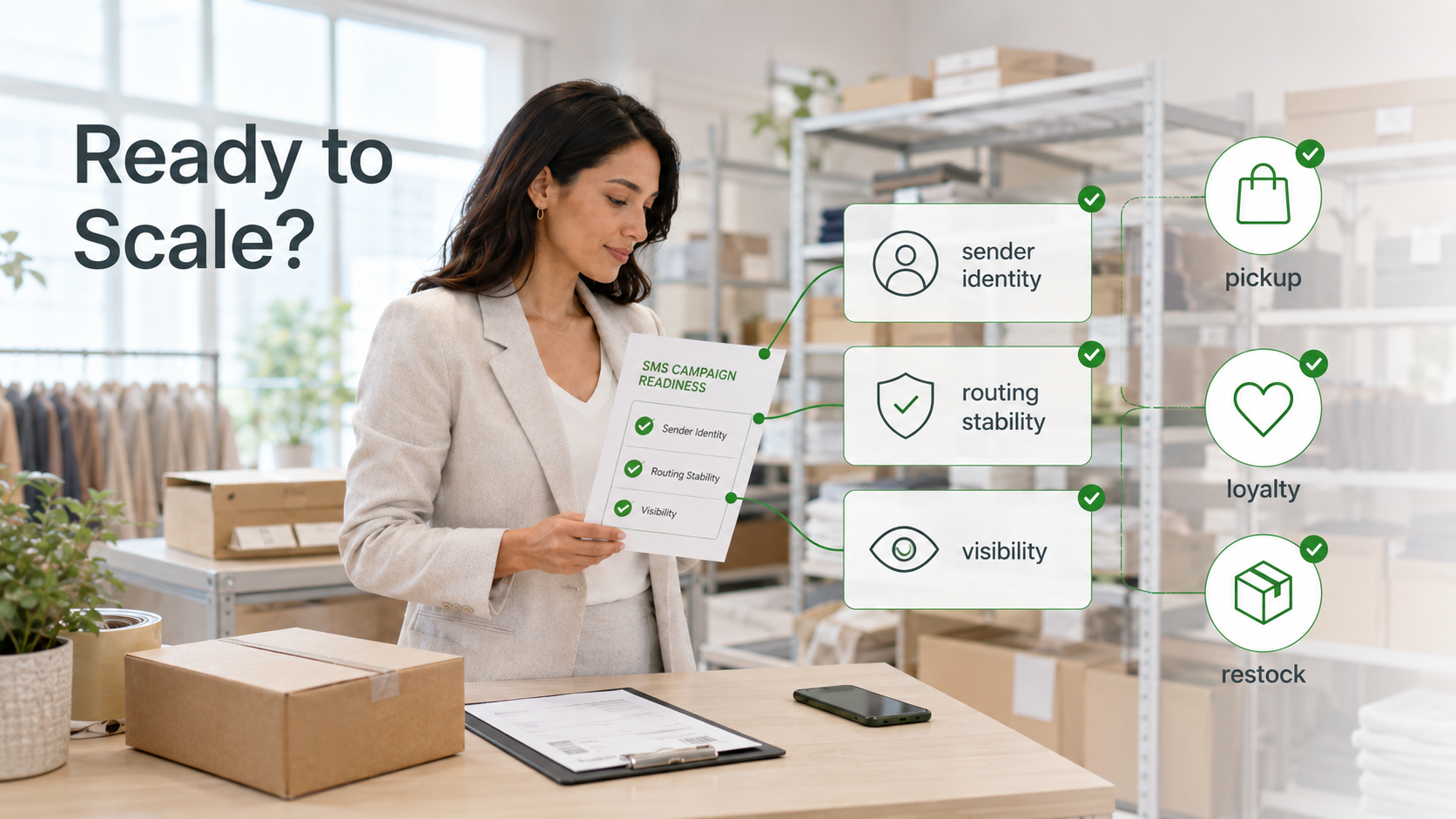
Retail SMS performance depends on reliable routing, recognizable sender identity, and enough delivery visibility to understand what happened after messages were sent. Even a strong campaign plan can underperform if the operational setup is weak.
This is especially true for time-sensitive retail messages. A restock alert sent too late loses value. A local event reminder that arrives after the event is not just ineffective; it can hurt trust.
Why Routing Stability Matters for Time-Sensitive Retail SMS Campaigns
Routing stability matters because many retail messages have a short useful life. Pickup reminders, limited-time offers, loyalty deadlines, and restock alerts need predictable execution.
When retail teams review SMS campaign setup, they should look beyond copy and audience. They should also review routing behavior, sender setup, delivery visibility, and whether the campaign depends on one market, multiple regions, or cross-border A2P messaging.
Why Sender Recognition Supports Retail SMS Trust
Sender recognition supports retail SMS trust because customers need to know who is texting them. Recognition can come from the brand name, sender setup, campaign consistency, or message language that matches the opt-in.
This is not only a design issue. It affects whether a customer opens, clicks, ignores, or opts out.
When Retail Teams Should Review Their SMS Campaign Setup
Retail teams should review their SMS campaign setup before increasing volume, entering a peak season, expanding to new markets, or changing message types. The review should include consent capture, opt-out handling, sender recognition, routing stability, and performance visibility.
One light checkpoint here can prevent bigger problems later. More volume should not be the first fix.
FAQ About SMS Marketing for Retail
Is SMS Marketing for Retail Mainly for Promotions?
SMS marketing for retail is not mainly for promotions; it should support useful customer actions across the retail journey. Promotions can work when they are expected, relevant, and time-sensitive, but retail SMS can also include loyalty reminders, restock alerts, pickup updates, and feedback requests. A good test is whether the message gives the customer a clear reason to act now.
How Can Retail Brands Get Consent for SMS Marketing?
Retail brands can get consent for SMS marketing through clear opt-in methods such as website forms, checkout signup, point-of-sale enrollment, mobile buttons, or SMS keyword opt-ins. The customer should understand the program, sender, message purpose, frequency expectation, and opt-out path before receiving recurring texts [2]. For example, a loyalty signup should clearly say whether the customer is joining reward alerts, promotional messages, or both.
What Retail SMS Messages Help Bring Customers Back?
Retail SMS messages that help bring customers back usually connect to a timely reason to return. Examples include loyalty reward reminders, restock alerts, replenishment prompts, pickup updates, local store event reminders, and relevant limited-time offers. The strongest messages are not always the loudest promotions; they are the ones tied to customer intent.
How Often Should Retail Brands Send SMS Messages?
Retail brands should send SMS messages only as often as they can provide clear customer value. There is no single safe frequency for every retailer, because a grocery chain, fashion brand, and specialty retailer may have different buying cycles. A practical rule is to review opt-outs, clicks, redemptions, and repeat actions after each campaign before increasing frequency.
What Metrics Show Whether Retail SMS Marketing Is Working?
SMS marketing for retail is working when engagement, list quality, and repeat actions improve together. Useful metrics include click rate, reward redemption, repeat purchase behavior, store visit signals, opt-out rate, complaint rate, and segment-level response. Revenue alone can hide early trust problems if a campaign drives sales but also causes a sharp unsubscribe spike.
How Should Retailers Handle SMS Opt-Outs?
Retailers should make SMS opt-outs easy, visible, and respected. Customers should be able to stop messages without friction, and common opt-out language should be recognized where applicable [2]. If opt-outs rise after a campaign, the team should treat that as a signal to review message relevance, timing, and frequency.
Can Retail SMS Marketing Work for Both Stores and Ecommerce?
Retail SMS marketing can work for both stores and ecommerce when the message matches the customer journey. Store-focused messages might include pickup reminders, local event alerts, or in-store loyalty rewards. Ecommerce-focused messages might include cart reminders, restock alerts, replenishment prompts, or order-related updates. The retail context matters more than the sales channel alone.
References
FCC — TCPA Consent Revocation Rules and Robotext Consent Handling. Used for consent revocation and opt-out handling principles.
CTIA — Messaging Principles and Best Practices. Used for opt-in, opt-out, sender identity, campaign consent, and unwanted-message prevention principles.
FTC — Consumer Protection Mission. Used for consumer protection, deceptive or unfair practice framing, and trust-risk boundaries.
U.S. Census Bureau — Quarterly Retail E-Commerce Sales Report. Used for retail context and the distinction between total retail and e-commerce activity.
Review Retail SMS Marketing Before Scaling More Campaigns
Before scaling more retail SMS campaigns, review consent quality, message purpose, opt-out handling, sender recognition, routing reliability, and list-quality signals. That review helps retail teams decide whether SMS is ready for more volume—or whether the next improvement should be better targeting, clearer permissions, or a more reliable campaign setup.
For teams that want a practical second look, SMSBoosting can support a trust-aware review of retail SMS campaign setup, routing stability, and A2P messaging performance before campaigns scale further.
Talk to an SMS expert


