An SMS gateway in the Philippines connects your application to local networks like Globe, Smart, and DITO. It lets you send bulk SMS, OTP codes, and transactional alerts to Philippine mobile numbers through a single API.
This guide shows you how to choose a bulk SMS and OTP provider for the Philippines. You will learn what to look for in operator coverage, sender ID support, pricing, API reliability, and delivery quality.
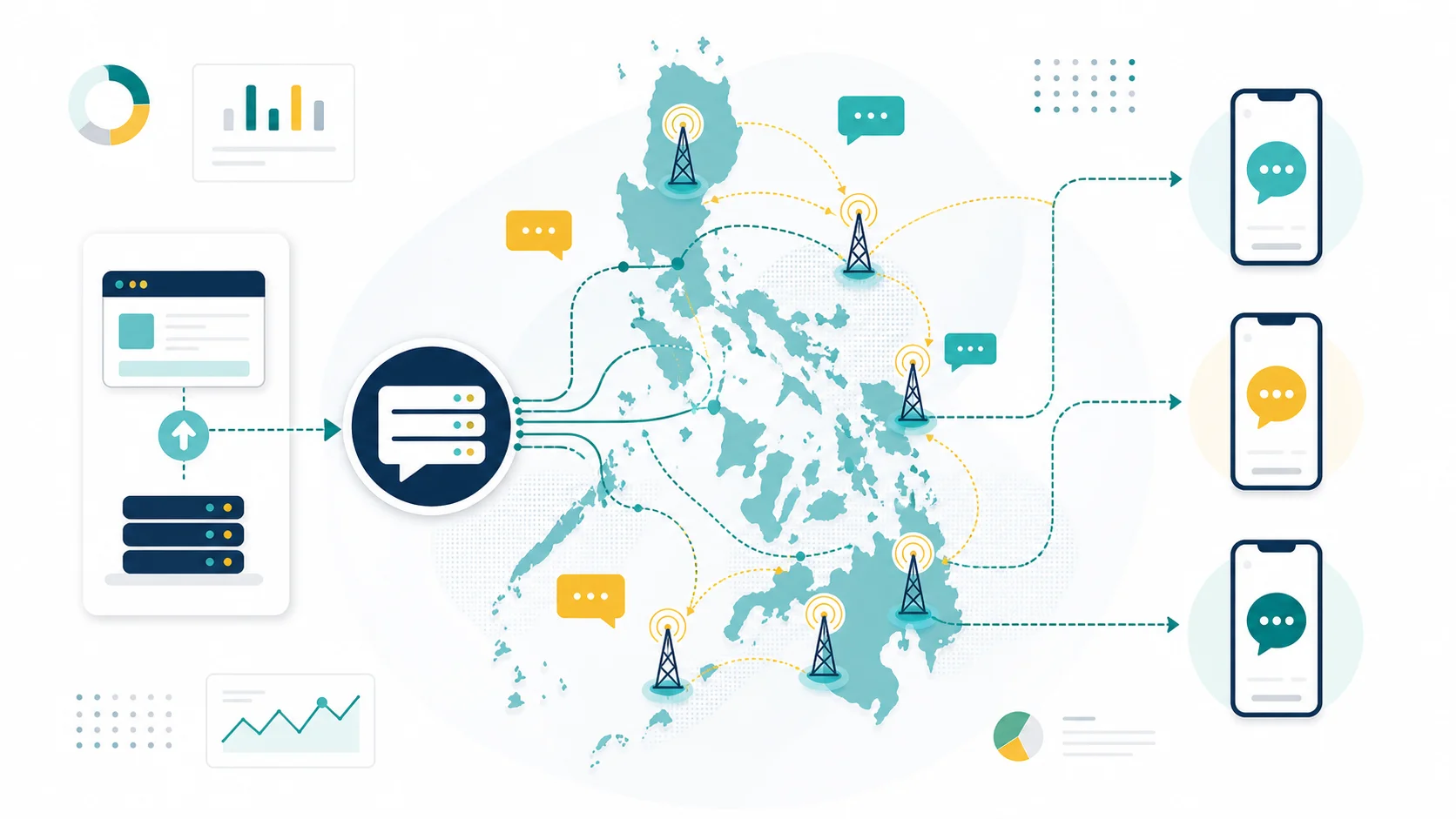
Quick answer: Choose a Philippine SMS gateway based on five criteria: direct connections to Globe, Smart, and DITO; clear handling for legacy Sun number ranges now managed through Smart; transparent pricing without hidden fees; reliable API with delivery reporting; and experience with OTP traffic.
Philippines Mobile Market and Regulatory Context
The Philippines has one of the highest mobile adoption rates in Southeast Asia, with prepaid and postpaid subscriptions spread across a large mobile-first population. Most Filipinos rely on mobile data and SMS, making text messaging a reliable channel for OTPs, alerts, and promotions.
The market is led by Globe Telecom and Smart Communications, while DITO Telecommunity is the third mobile operator and continues to expand coverage. Some older databases may still show Sun Cellular branding, but Sun service has been folded into Smart’s network and should not be treated as a separate operator for routing checks.
The NTC (National Telecommunications Commission) regulates telecommunications and messaging. While A2P SMS rules are less centralized than in some neighboring markets, providers still must follow operator policies on sender ID, content, and opt-in consent for promotional messages.
| Operator | Approx. Market Position | Why It Matters |
|---|---|---|
| Globe Telecom | Leading operator | Strong prepaid and mobile data base |
| Smart Communications | Leading operator | Broad rural and urban coverage |
| DITO Telecommunity | Third operator | Growing coverage, price-competitive |
How to Evaluate a Bulk SMS and OTP Provider

Use these five criteria to compare Philippine SMS gateway providers before signing a contract.
Operator coverage: Confirm direct connections to Globe, Smart, and DITO, then ask how the provider handles legacy Sun number ranges through Smart. A provider that routes only through one operator will leave part of your audience unreachable.
Route quality: Ask whether the provider uses direct operator routes or grey routes. Direct routes give better delivery rates and faster OTP arrival. For fintech and banking apps, grey routes are usually too risky for authentication traffic.
Sender ID support: Verify whether the provider supports branded sender IDs and how long approval takes. Some Philippine providers allow same-day approval; others take several business days.
Pricing transparency: Look for a rate card split by operator and volume tier. Watch for setup fees, monthly minimums, and API access charges.
API and reporting: A usable SMS API should support batch sending, delivery receipts, and webhook callbacks. Test the API with a small batch before committing.
These key factors are the same ones enterprise teams use when selecting a messaging platform. Apply them in the Philippine context and you will avoid most common provider mistakes.
For broader market planning, see our country-by-country bulk SMS guide to compare the Philippines with other international SMS destinations.
SMS Types You Can Send in the Philippines
Philippine businesses rely on SMS for three main use cases. Each one has different routing and content requirements.
OTP and verification: Apps like GCash, Maya, and major banks send OTP SMS for login, fund transfers, and payments. These messages require the lowest latency and the most reliable route because a delayed code directly affects conversion.
Transactional SMS: Order confirmations, delivery updates, and payment receipts work best as automated SMS notification messages. These are usually allowed around the clock when tied to a customer transaction.
Marketing SMS: Promotional blasts, sale announcements, and loyalty offers fall under marketing SMS. Philippine operators and the NTC expect explicit opt-in consent and clear opt-out instructions. Confirm promotional sending windows with the gateway provider before launch, especially for campaigns aimed at prepaid users.
Keep transactional and marketing content separate. Mixing promotional language into a transactional template can trigger filtering or reclassification.
Sender ID Registration in the Philippines
Sender ID branding is one of the first things Philippine recipients notice. A registered sender ID builds trust and helps your message stand out among generic short-code traffic.
Supported sender ID types:
- Alphanumeric: Brand names like YOURBRAND are common for OTP and marketing messages.
- Numeric/short code: Used by large enterprises and banks for high-volume messaging.
- Generic numbers: Often overwritten by operators if no branded ID is registered.
Registration process:
- Choose a sender ID that matches your business name or trademark.
- Submit the request through your gateway provider, who forwards it to Globe, Smart, and DITO.
- Wait for operator approval. Alphanumeric IDs often take several business days, but timing varies by provider, operator queue, and document completeness.
- Test delivery across all networks before launching.
Best practices: Avoid generic words like “INFO” or “VERIFY.” Operators may reject IDs that resemble other brands or look like spam labels. Make sure your message templates match the approved use case, especially for OTP traffic where consistency improves delivery.
Philippines SMS Pricing Factors
Philippine SMS pricing depends on route quality, operator destination, message type, and volume. The cheapest rate is not always the best deal if it sacrifices delivery reliability.
Route quality: Direct routes to Globe and Smart cost more but deliver faster and more consistently. Grey routes may look cheaper, yet they often produce delayed or failed OTP messages.
Operator split: Some providers charge different rates depending on whether the message terminates on Globe, Smart, or DITO. Ask for an operator-level rate card if your users cluster on one network.
Volume: Higher monthly volumes unlock lower per-SMS pricing. Enterprise senders with hundreds of thousands of messages per month can negotiate custom rates.
SMSBoosting offers rates starting from approximately €0.006 per SMS for the Philippines. Local providers may quote in PHP, with entry points around ₱0.30–₱0.50 per SMS depending on volume.
For a fuller view of SMS marketing cost at scale, request a tailored quote that includes routing details and any platform fees.
API Integration Example for the Philippines
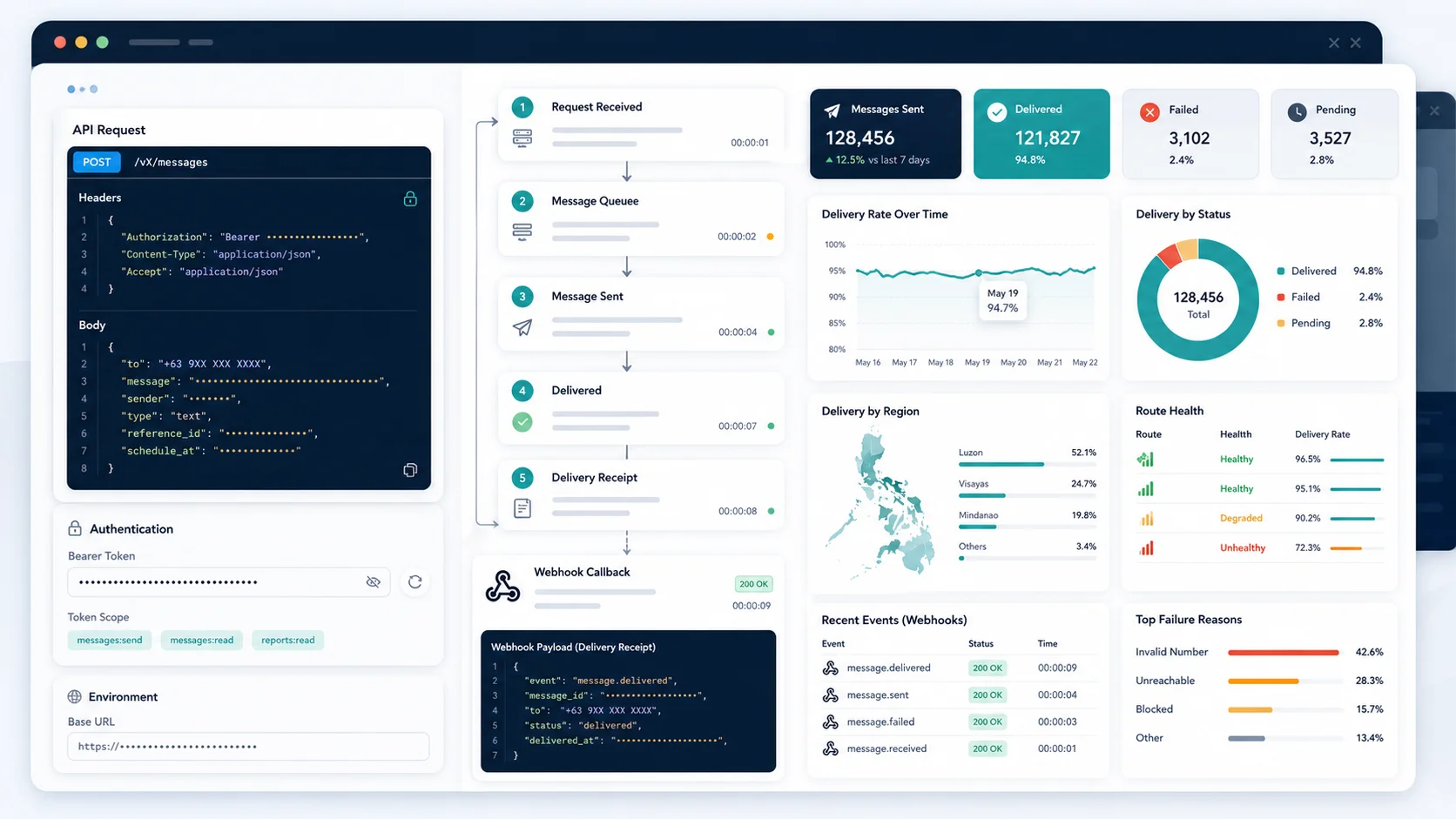
A Philippine SMS gateway API accepts the recipient number, message content, sender ID, and message type. It returns a message ID you can later use to check delivery status.
Here is a cURL example for sending an SMS to a Philippine number. Replace the credentials, sender ID, and content with your own values.
curl -X POST “https://api.smsprovider.com/send” \
-H “Content-Type: application/json” \
-d ‘{
“account”: “your_account”,
“password”: “your_password_or_md5_hash”,
“numbers”: “639123456789”,
“content”: “Your verification code is 123456.”,
“sender”: “YOURBRAND”,
“smstype”: 0
}’
Use the international format 63 followed by the mobile number without the leading zero. For example, 639123456789 instead of 09123456789. URL-encode the message content and confirm Unicode support if you send messages in Filipino or with special characters.
Look for an SMS API that supports batch sending, delivery reports, scheduled messages, and webhook callbacks. Test these features with a small batch before production traffic.
Delivery Quality and Common Failures
Delivery quality in the Philippines is generally stronger on direct routes to Globe, Smart, and DITO than on grey routes. Ask each provider for recent test results by network and message type before you move OTP or banking traffic into production.
Factors that affect delivery:
- Route type: Direct routes hand off messages straight to the operator network. Grey routes add intermediaries, which increases delay and failure risk.
- Sender ID registration: Unregistered traffic may be overwritten or filtered by Globe or Smart.
- Network load: Holiday sales, payday weekends, and typhoon-related traffic can cause temporary congestion.
- Content filtering: Operators scan for prohibited keywords and promotional content in transactional templates.
Common failures to watch for:
- Number format errors: Using the domestic 09xx format instead of the international 63 format.
- Duplicate sends: Weak idempotency logic can trigger repeated OTP messages during retries.
- Grey route fallback: Some providers quietly move traffic to cheaper routes when direct routes are busy.
If delivery drops, review your delivery failure logs for number formatting, sender ID status, and route changes.

Conclusion
Choosing a bulk SMS and OTP provider in the Philippines comes down to operator coverage, route quality, sender ID support, transparent pricing, and API reliability. OTP and banking traffic should always run on direct routes, while marketing traffic needs strong sender ID branding and opt-in compliance.
Test delivery across Globe, Smart, and DITO before committing. Confirm sender ID timelines and compare pricing at your real volume. If you are evaluating a Philippine SMS gateway, start with a free trial or request a tailored quote to see local route performance firsthand.
FAQ
Do I need a Philippine company to send SMS there?
No. Foreign businesses can send A2P SMS to the Philippines through a gateway provider. Sender ID registration may still require business documents that prove your right to the brand name.
Can I send SMS in Filipino or Tagalog?
Yes, but Unicode messages are limited to 70 characters per SMS part. Longer Filipino messages split into multiple parts and cost more than plain ASCII messages.
What number format should I use for the Philippines?
Use the international format starting with 63, for example, 639123456789. Do not use the domestic 09xx format.