Choosing the right SMS API provider for global OTP delivery is not about finding the most popular name. It is about finding a service that delivers your verification codes fast, reliably, and cost-effectively across every region your users live in.
Most comparison articles list providers and call it a day. That helps no one. You need to know what actually matters for OTP delivery, why some providers fail in certain regions, and how to test a service before you bet your user experience on it.
Here is the reality most teams learn the hard way: a provider that delivers flawlessly in the US can fail consistently in Southeast Asia or Africa. The marketing page will not tell you that. You only find out when your users start complaining.
This guide covers seven specific criteria for evaluating OTP SMS providers, explains how route architecture affects delivery rates, and compares the top providers honestly. If you are building a fintech app that needs sub-5-second OTP delivery, or scaling an e-commerce platform into new markets, you will leave with a clear decision framework.
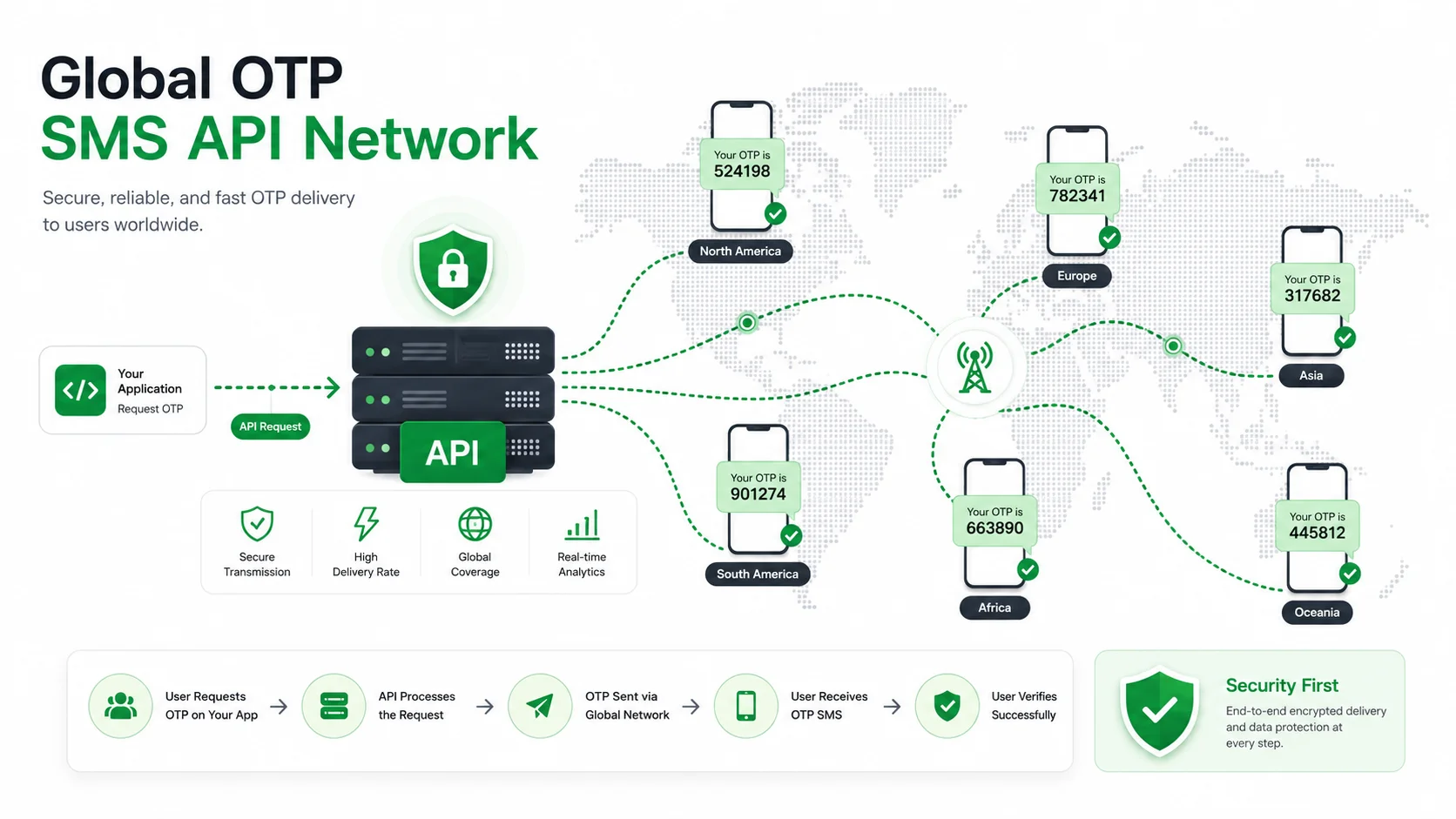
Here is what this guide covers:
- Eight evaluation criteria that separate reliable OTP providers from the rest
- Route architecture explained — why direct carrier APIs and aggregator models deliver different results
- Honest provider comparison of Twilio, Vonage, MessageBird, Telnyx, and SMSBoosting
- Technical evaluation criteria for API stability, SDK quality, and security
- Real cost modeling beyond per-message pricing
- Failover and redundancy — what happens when primary routes fail
- Testing checklist to validate a provider before production
If you are a developer, CTO, or product manager evaluating SMS APIs for OTP, this guide is written for you. No marketing fluff. Just the information you need to choose confidently.
Quick Answer: Best Provider by Use Case
If you need a fast answer, here is how the top providers map to common situations:
- Enterprise with multi-channel needs: Twilio
- European-focused applications: Vonage
- Omnichannel (SMS + WhatsApp + Voice): MessageBird
- Cost-conscious startups: Telnyx
- Global OTP with automatic route backup per market: SMSBoosting
For the full reasoning, read on.
What to Look For in an OTP SMS API Provider
Use these criteria to score providers. OTP delivery is not the same as marketing SMS.
| Criterion | What to Check |
| Coverage | Delivery data by region and carrier, not total country count |
| Speed | Latency benchmarks (aim under 5s), SLA penalties for missing them |
| API & SDK | REST/JSON consistency, SDKs in your stack, sandbox, webhooks |
| OTP Features | Templates, expiry controls, retry logic, idempotency keys |
| Pricing | Total cost incl. retries, failed deliveries, support tiers |
| Visibility | Granular error codes, real-time delivery callbacks |
| Support | Human technical contact, response SLA, routing expertise |
| Security | Fraud detection (SMS pumping, AIT), rate limiting, number validation |
Route Architecture: Why It Matters for OTP
The way your provider connects to mobile networks directly affects OTP delivery. Two models dominate.
Direct Carrier Connections — Providers like Twilio negotiate directly with carriers. This gives control and consistent quality, but limited fallback if a route fails. Direct routes cost more.
Aggregator Networks — Providers like SMSBoosting partner with thousands of local suppliers. If Route A fails, traffic shifts to Route B automatically. This redundancy matters for OTP, where every failed message costs a user. The tradeoff is complexity — not every aggregator manages routes well.
| Factor | Direct Carrier | Aggregator |
| Route redundancy | Limited to backup agreements | Multiple automatic fallbacks |
| Coverage speed | Slower in new markets | Faster via existing partnerships |
| Pricing | Higher per-message | Lower via wholesale rates |
| Best for | Stable markets with high volume | Global reach with variable demand |
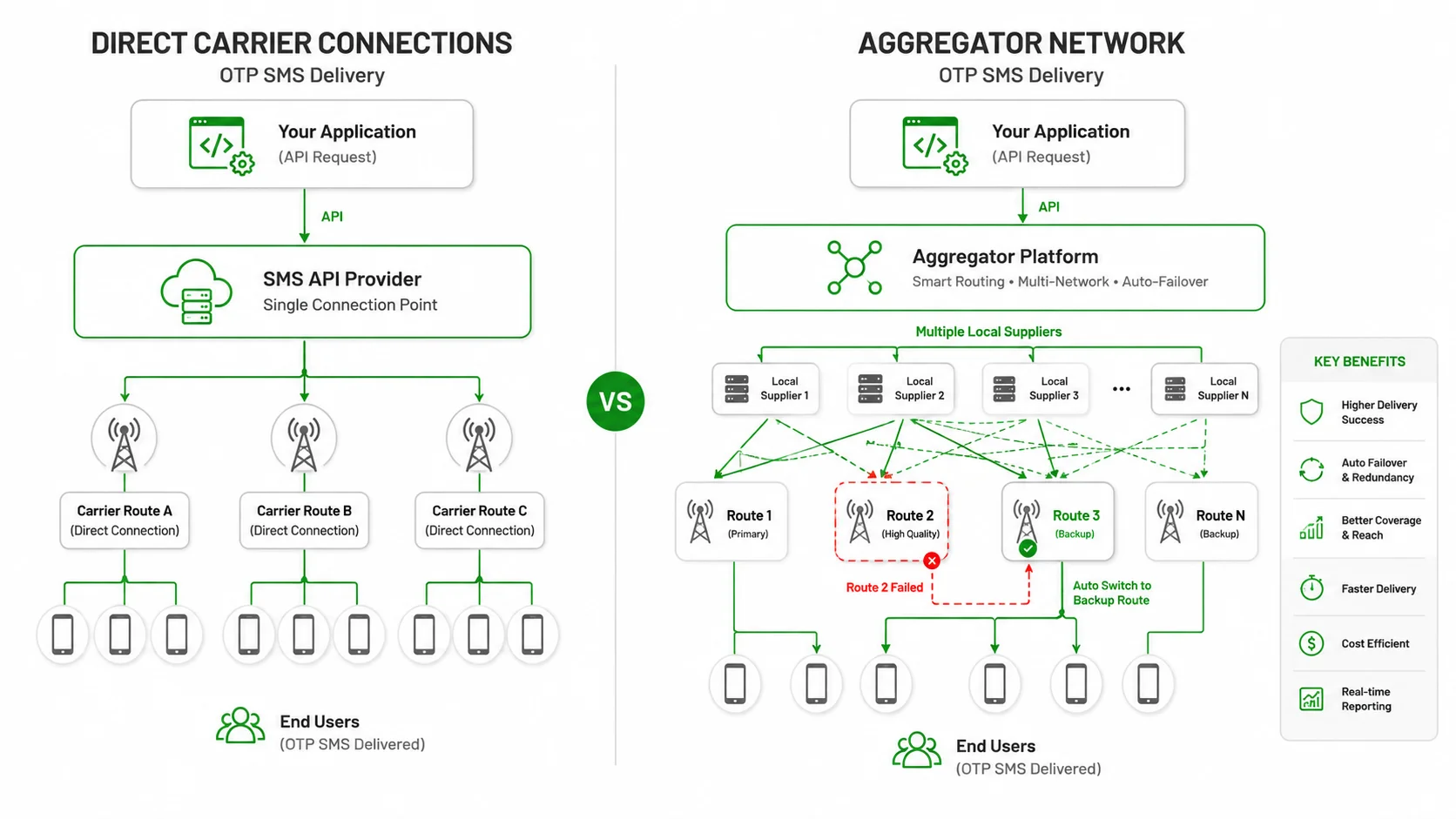
For OTP, route redundancy beats raw speed. A 5-second delivery on a stable route beats a 2-second delivery on a route that fails 3% of the time. At scale, 3% failure means thousands of frustrated users daily.
Ask providers: How many routes per country? What is failover time? Do you charge for failed deliveries? A provider that cannot answer with specific data is not ready for your OTP traffic.
Top SMS API Providers for Global OTP Delivery Compared
Here is how the leading providers stack up for global OTP delivery. Every provider on this list supports OTP via SMS. The differences show up in coverage depth, pricing, API design, and support quality.
Comparison at a Glance
| Provider | Model | Coverage | Latency | API Quality | OTP Features | Pricing | Best For |
| Twilio | Direct carrier | 180+ countries | Under 5s (major markets) | Excellent | Strong | Higher | Enterprise multi-channel teams |
| Vonage | Direct carrier | 190+ countries | Under 5s (EU strong) | Good | Good | Mid-range | European-focused apps |
| MessageBird | Direct + some aggregation | 200+ countries | Under 5s | Good | Good | Higher | Teams wanting omnichannel |
| Telnyx | Direct carrier | 150+ countries | Under 5s | Good | Basic | Lower | Cost-conscious developers |
| SMSBoosting | Aggregator (1,000+ suppliers) | 200+ countries | Under 5s | Good | Good | Competitive | Teams serving markets with variable carrier quality |
Twilio
Twilio is the largest name in SMS APIs. Their coverage is broad, their documentation is thorough, and their ecosystem includes voice, email, and WhatsApp APIs alongside SMS.
Strengths: Mature platform with extensive SDKs across major languages, strong uptime SLAs with financial penalties, detailed delivery reporting, and built-in Fraud Guard for AIT detection. Documentation includes OpenAPI specs and step-by-step guides.
Limitations: Pricing runs higher than competitors, especially at scale. The platform can feel complex if you only need SMS OTP.
Best for: Teams that need SMS OTP alongside other communication channels and have the budget for a premium platform.
Vonage (formerly Nexmo)
Vonage offers solid European coverage and competitive pricing in that region. Their API is easy to work with for basic OTP flows.
Strengths: Strong European carrier relationships, competitive EU pricing, good voice OTP fallback, and Fraud Defender for real-time fraud alerting. SDKs cover major languages with solid type definitions.
Limitations: API documentation is less consistent than Twilio. The platform has changed ownership and branding multiple times, which creates some integration confusion. Status page and latency benchmarks are less transparent.
Best for: Applications with a heavy European user base that also want voice OTP as a fallback.
MessageBird
MessageBird positions itself as an omnichannel platform. You get SMS, WhatsApp, voice, and email in one interface.
Strengths: Clean dashboard, good omnichannel orchestration, strong European and Asian coverage. Unified API simplifies multi-channel integration. Documentation is well-organized with clear webhook examples.
Limitations: Pricing escalates quickly with volume. The omnichannel focus means SMS-specific features sometimes feel secondary. Fraud protection features are less prominent than competitors.
Best for: Teams that want to manage SMS OTP, WhatsApp, and voice notifications from one platform.
Telnyx
Telnyx focuses on developer experience and competitive pricing. They have built a strong following among startups and mid-size companies.
Strengths: Lower pricing than Twilio, good API documentation with OpenAPI specs, programmable voice alongside SMS. Clean REST API with consistent error codes and sandbox environment.
Limitations: Smaller ecosystem means fewer community resources and third-party integrations. Fraud protection features are basic compared to enterprise-focused providers.
Best for: Cost-conscious developers who want a clean API and do not need the broadest global coverage.
SMSBoosting
SMSBoosting uses an aggregator model with 1,000+ supplier partnerships. Instead of relying on single-carrier contracts, they route messages through multiple paths per country.
Strengths: 99.99% delivery rate for transactional SMS (based on internal delivery reports across all routes), route redundancy through multiple suppliers per market, competitive wholesale pricing, 24/7 technical support with direct access to routing engineers. Built-in rate limiting and fraud monitoring help prevent SMS pumping attacks. The HTTP GET/POST JSON API is simple to integrate.
Limitations: Coverage excludes a small number of regulated markets. The API ecosystem is smaller than Twilio’s, with fewer pre-built integrations and SDKs.
Best for: Teams that need reliable global OTP delivery at scale with competitive wholesale pricing. The route diversity is valuable if you serve users in regions with inconsistent carrier quality.
Other Notable Providers
- Plivo: Solid alternative with competitive pricing, strong in Asian markets.
- Sinch: Enterprise-focused with good voice fallback options.
- Arkesel: Strong African coverage with local currency billing, good for region-specific needs.
Cost Comparison: Per-Message Price vs. Total Cost
Per-message pricing gets attention. Total cost of ownership determines your budget. Here is how to think about OTP SMS costs realistically.
Per-Message Pricing Overview
| Provider | US Price (per SMS) | EU Price (per SMS) | Asia Price (per SMS) | Notes |
| Twilio | ~$0.0079 | ~$0.085 | ~$0.05 | Volume discounts at enterprise tier |
| Vonage | ~$0.0058 | ~$0.045 | ~$0.04 | Lower EU rates |
| MessageBird | ~$0.005 | ~$0.065 | ~$0.055 | Minimum monthly spend applies |
| Telnyx | ~$0.004 | ~$0.04 | ~$0.035 | Competitive across regions |
| SMSBoosting | ~$0.003 (est.) | ~$0.035 (est.) | ~$0.03 (est.) | Wholesale aggregation; contact for current rates |
Prices vary by volume, destination, and contract terms. Contact providers directly for quotes above 100,000 messages monthly.
Prices are approximate and drawn from public rate cards. Contact providers directly for current quotes.
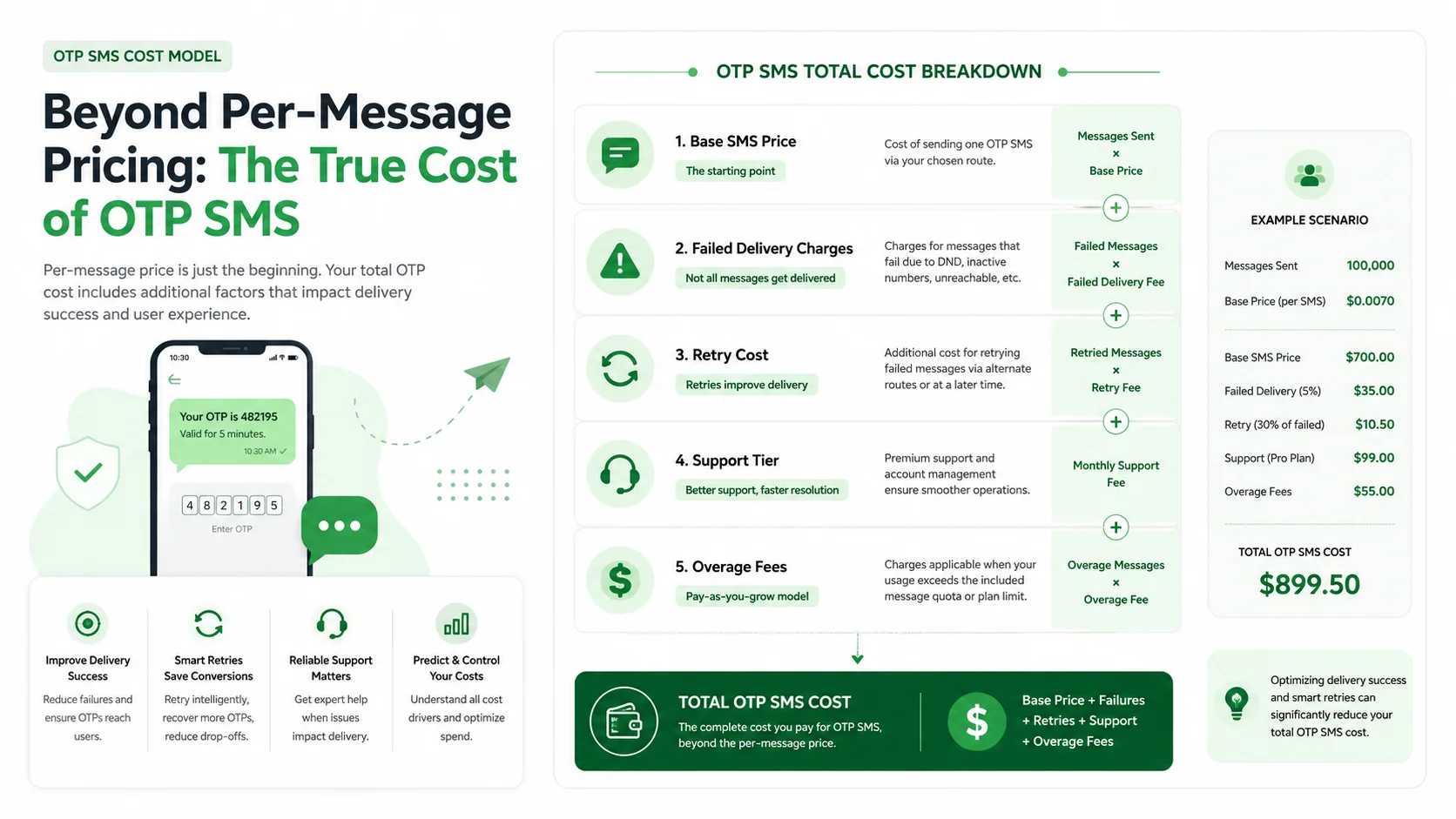
Hidden Costs to Factor In
Failed delivery charges: Some providers bill for messages that never reach the user. At a 2% failure rate on 1 million messages, that is 20,000 wasted sends.
Retry costs: Every retry is another message. Aggressive retry logic multiplies costs fast.
Support tiers: Free support often means ticket queues. For OTP-critical systems, you might need a paid plan.
Overage fees: Exceed your committed volume and per-message rates can jump 50% or more.
Volume Discounts
Most providers offer discounts starting at 100,000 messages monthly. Enterprise contracts (1M+) typically include dedicated account management, custom SLAs with financial penalties, and volume-based rate reductions.
A practical cost model: If you send 500,000 OTP messages monthly with a 1.5% failure rate and one retry per failure, your actual volume is 507,500 messages. Factor that into your budget.
Failover and Redundancy
When a user is trying to log in or confirm a payment, a failed SMS means a failed conversion.
A provider with one route per country has no backup when outages or regulatory blocks happen. Providers with multiple routes can shift traffic automatically — the shift should happen in seconds, not minutes. If a provider cannot give you a failover time, they do not have true redundancy.

Build redundancy at the application level:
- Primary + backup provider: Switch automatically if your main provider has a global outage
- SMS + voice fallback: Offer a voice call when SMS fails
- Health checks: Monitor delivery rates per provider. If rates drop below 95%, kick off failover
- Test before you need it: Run failure simulations quarterly
Before You Commit: Testing Checklist
Send 1,000+ OTP messages to your top markets in under 5 minutes. Measure delivery rate, latency, and error rate. Open a support ticket during trial to test response quality.
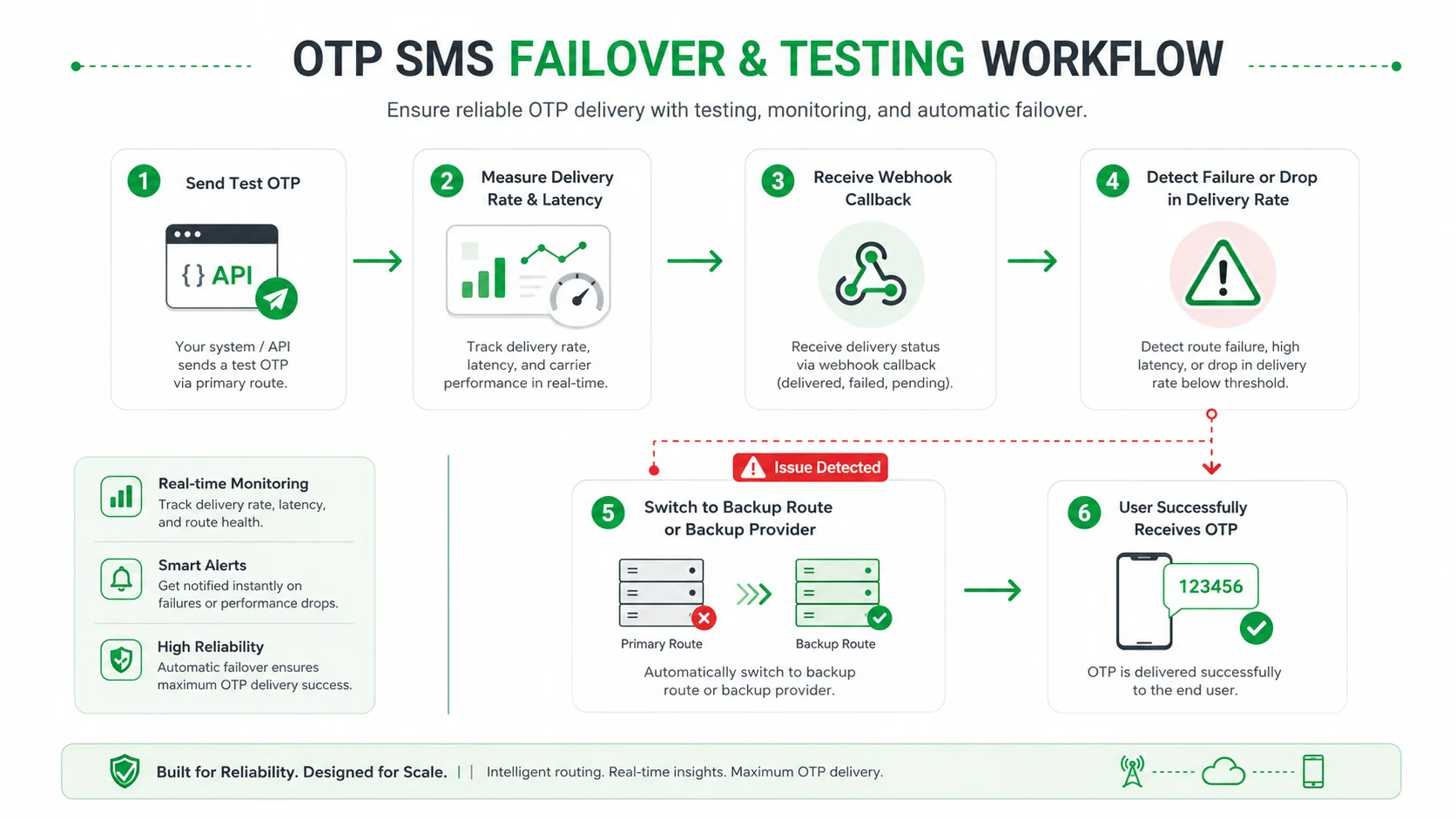
- Send 1,000+ messages and measure delivery rate and latency
- Test in your top 5 markets with real numbers
- Verify webhook delivery and error codes
- Evaluate support response time
- Confirm pricing matches quoted rates
Run this with your top 2-3 candidates.
Conclusion: Choosing the Right Provider for Your Needs
The best SMS API provider for global OTP depends on your situation. Twilio leads for enterprise multi-channel needs. Vonage excels in Europe. MessageBird suits omnichannel teams. Telnyx delivers value for cost-conscious developers. SMSBoosting offers route redundancy and competitive wholesale pricing for global OTP at scale.
Your next step is simple: pick two providers and test them head-to-head in your target markets. Measure delivery rates, latency, and support quality.
Start your evaluation with SMSBoosting. Our free trial gives you full API access to test real OTP delivery across your regions. Most teams see the difference within the first 1,000 messages.
FAQ
What is the average OTP SMS delivery time?
In major markets like the US, UK, and Germany, OTP delivery typically takes 2-5 seconds. In emerging markets or during peak traffic, delivery can extend to 10-30 seconds. Your provider’s route quality and carrier relationships directly affect these numbers. Always test delivery times in your specific target markets before launch.
Can I use the same provider for OTP and marketing SMS?
Yes, but verify that your provider supports both message types. Some carriers and regulators treat promotional and transactional SMS differently. Using the same provider simplifies integration, but you might want separate sender IDs and routing profiles for OTP vs. marketing traffic. This prevents promotional delivery issues from affecting your verification messages.
Do I need user opt-in for OTP messages?
Generally no. OTP messages are transactional, not promotional. Most regulations exempt verification messages from explicit opt-in requirements. However, you must identify your brand clearly in the message and honor opt-out requests if users ask to stop receiving SMS. Regulations vary by country, so confirm local rules for your target markets.
What is the difference between SMS OTP and authenticator apps?
Aim for 99%+ in your primary markets. Below 95% means one in twenty users is not receiving their code, which directly impacts conversion and support costs. In emerging markets with weaker carrier infrastructure, 97-98% is realistic. Always measure success rate by country and carrier, not as a global average. A provider showing 99.5% overall might deliver 99.9% in the US and 92% in parts of Africa.