An SMS gateway in Indonesia connects your application to local mobile networks such as Telkomsel, Indosat, and XLSMART’s XL, AXIS, and Smartfren brands. It turns API requests into text messages that reach customer phones for OTPs, delivery alerts, and marketing campaigns.
This guide explains how an Indonesian SMS gateway works in practice. You will learn which message types are allowed, how sender ID checks under Komdigi (formerly Kominfo) affect delivery, what pricing to expect, and how to integrate an SMS API for Indonesian numbers.
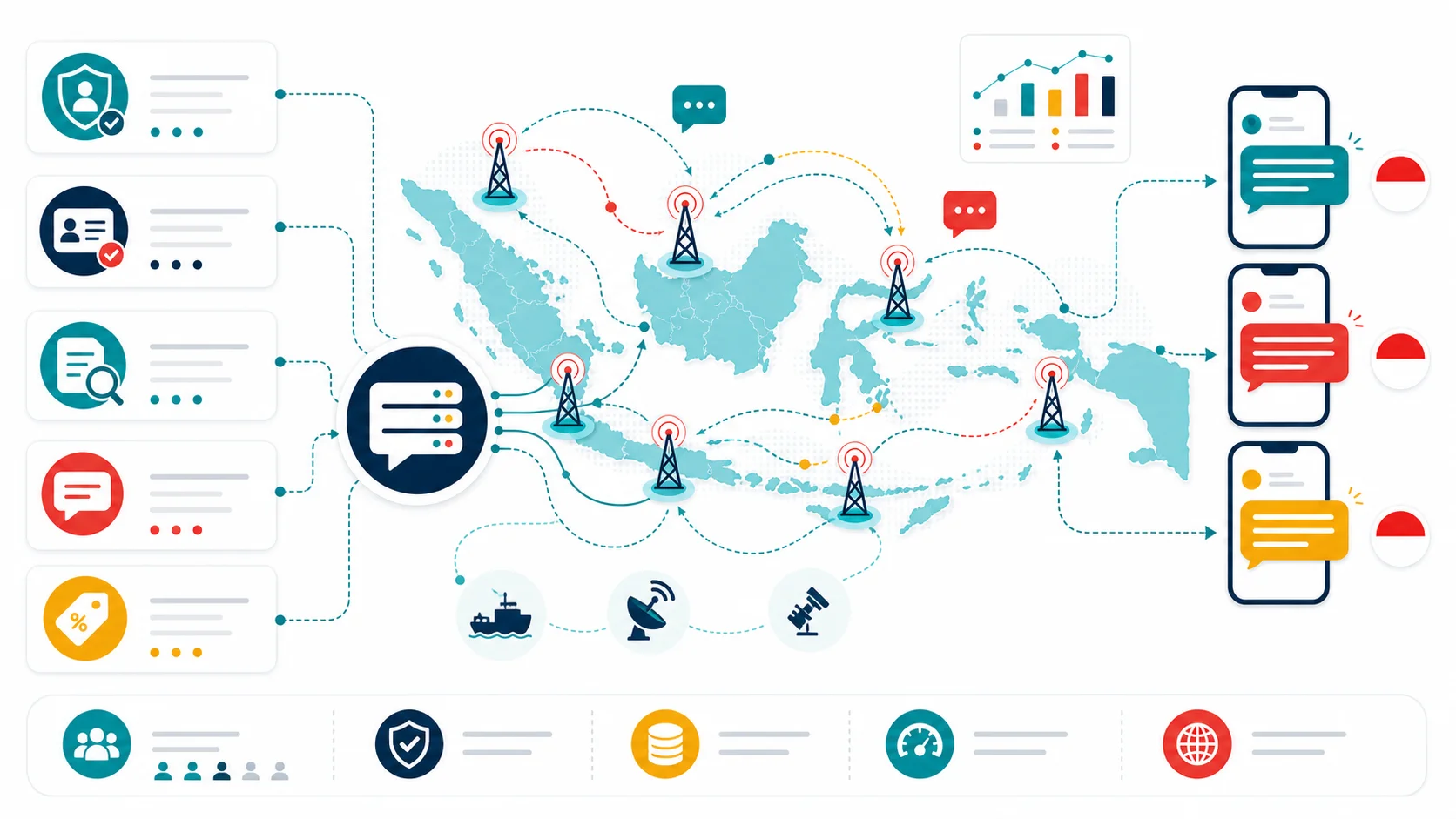
Quick answer: A reliable Indonesian SMS gateway needs four things: broad coverage across Telkomsel, Indosat Ooredoo Hutchison, and XLSMART brands; a sender ID approved by local operators; direct carrier routing for time-sensitive messages; and transparent per-SMS pricing.
Indonesia Mobile Market and Regulatory Context
Indonesia is the largest mobile market in Southeast Asia, with more mobile connections than people in a country of roughly 280 million residents. Many users carry multiple SIMs, so reaching the right operator group still matters even when national coverage looks broad on paper.
The market is concentrated around three major operator groups. Telkomsel remains the largest mobile network, Indosat Ooredoo Hutchison operates the Indosat and Tri brands, and XLSMART now brings XL, AXIS, and Smartfren under one merged telecom group after the 2025 XL Axiata-Smartfren merger. A gateway that cannot reach these groups will miss a meaningful share of Indonesian users.
SMS policy sits within the Komdigi (Kementerian Komunikasi dan Digital) environment, formerly known as Kominfo. A2P (application-to-person) SMS senders should expect local operator checks for sender ID, content category, and message templates. Unregistered or mismatched traffic is more likely to be filtered, delayed, or rejected by carriers.
| Operator Group | Key Brands | Why It Matters |
|---|---|---|
| Telkomsel | Telkomsel, by U | Largest national reach and a core network for OTP traffic |
| Indosat Ooredoo Hutchison | Indosat, Tri | Important for urban, youth, and data-heavy audiences |
| XLSMART | XL, AXIS, Smartfren | Merged XL-Smartfren group with multiple retained consumer brands |
SMS Types You Can Send in Indonesia
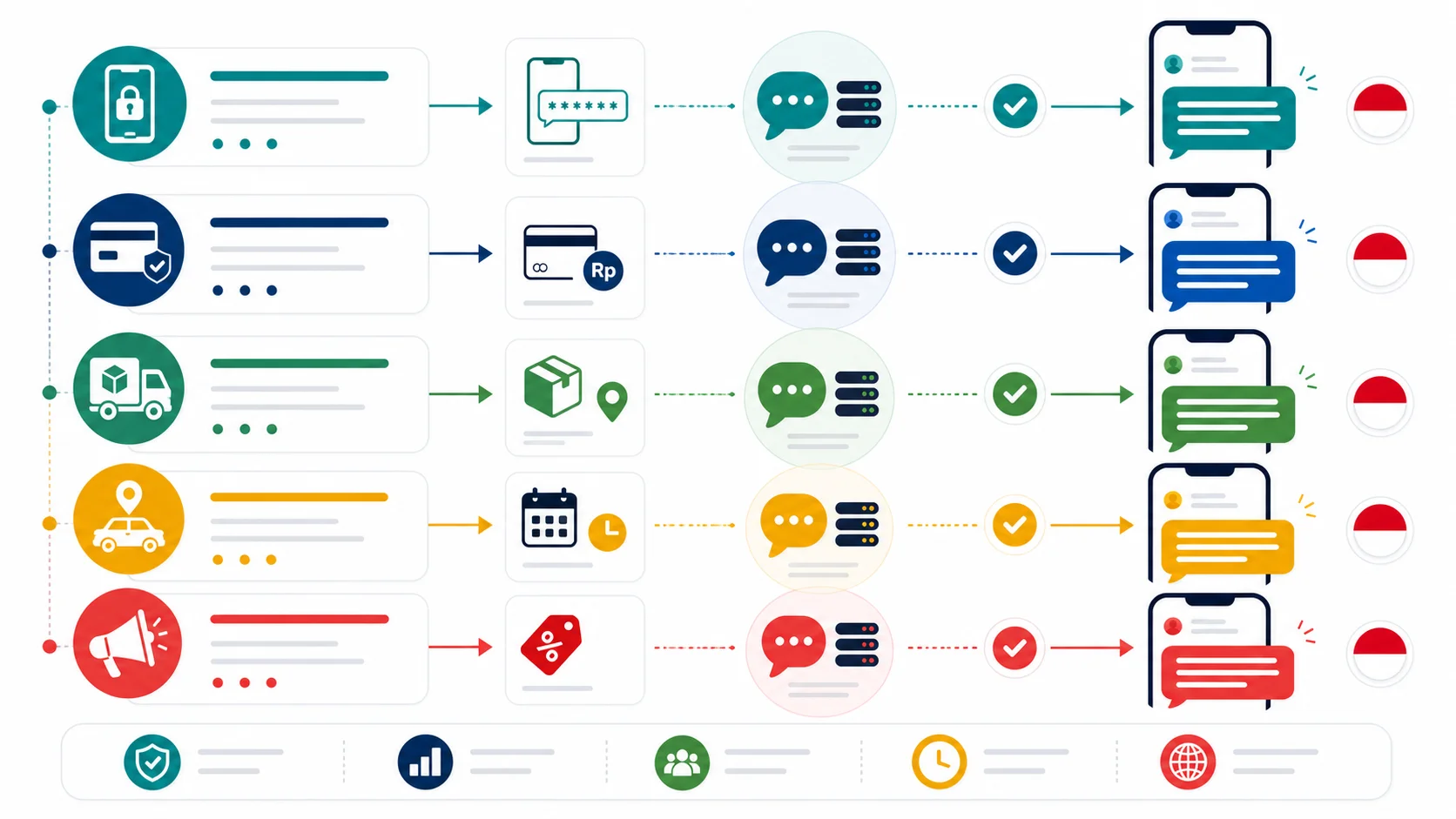
Indonesian businesses use SMS gateways for three primary message types. Each type has different routing, timing, and sender ID requirements.
OTP and Verification SMS: Banks, e-wallets, and e-commerce platforms send OTP SMS for logins, payments, and account changes. These messages need the fastest delivery and the highest delivery rate. In Indonesia, OTP traffic to Telkomsel and Indosat typically arrives within seconds on direct routes.
Transactional SMS: Order confirmations, shipping updates, and payment alerts fall into this category. An SMS notification service works best when it triggers automatically from your system and returns delivery status.
Marketing SMS: Promotional messages, flash-sale alerts, and loyalty offers require explicit opt-in consent under local operator policies. Marketing SMS in Indonesia should use approved sender IDs, clear brand identification, and daytime sending windows confirmed with the gateway provider.
Content restrictions: Gambling, adult content, political campaigning, and loan solicitation without proper licensing are generally prohibited. Transactional templates must stay free of promotional language to avoid reclassification.
Sender ID Registration in Indonesia
Sender ID is the name or number that appears as the message sender. In Indonesia, operator-approved sender IDs are essential for branded messaging and often improve delivery rates.
Supported sender ID types: Alphanumeric sender IDs (such as YOURBRAND) are widely used for transactional and marketing SMS. Numeric sender IDs and short codes are available but usually require longer approval and higher-volume commitments. Generic IDs like “INFO” or “SMS” are typically rejected.
Registration process:
- Prepare business documents, including company registration (NPWP) and a copy of your trademark or brand authorization.
- Submit the sender ID request through your SMS gateway provider, which routes it to the operators.
- Wait for operator approval, which typically takes 3–7 business days for alphanumeric IDs.
- Test the approved sender ID with a small batch before launching full campaigns.
Approval tips: Match the sender ID exactly to your brand name. Operators in Indonesia often reject IDs that look like generic words, other companies’ trademarks, or abbreviations that could confuse recipients. Keep templates consistent with the registered use case to avoid blocking during live sends.
Indonesia SMS Pricing Factors
SMS pricing in Indonesia depends on route quality, operator destination, message type, and monthly volume. Understanding these factors helps you compare quotes without fixating on the lowest per-SMS rate.
Route quality: Direct operator connections cost more than grey routes but deliver better uptime, faster arrival, and more reliable delivery receipts. For OTP and transactional traffic, direct routes are usually worth the premium.
Operator destination: Some gateways charge different rates based on whether the message terminates on Telkomsel, Indosat, or XLSMART-managed brands. Ask your provider for a rate card split by operator group if your audience is concentrated on one network.
Message type: OTP and transactional SMS often use priority routing. Marketing SMS may use lower-cost routes, though delivery consistency matters there too.
Volume commitments: Higher monthly volumes unlock lower per-SMS rates. SMSBoosting offers rates starting from approximately €0.006 per SMS for the Indonesia market, with custom pricing for very large senders. For local budgeting, ask for both EUR and IDR quotes; this benchmark is roughly in the low-hundreds of rupiah per SMS before exchange-rate movement, taxes, and route premiums.
If you want a clearer picture of SMS marketing cost at your volume, request a tailored quote that includes setup, sender ID registration, and any API access fees.
If Indonesia is one market in a broader rollout, use our country-by-country bulk SMS guide to compare international route coverage, pricing factors, and sender ID requirements.
API Integration Example for Indonesia
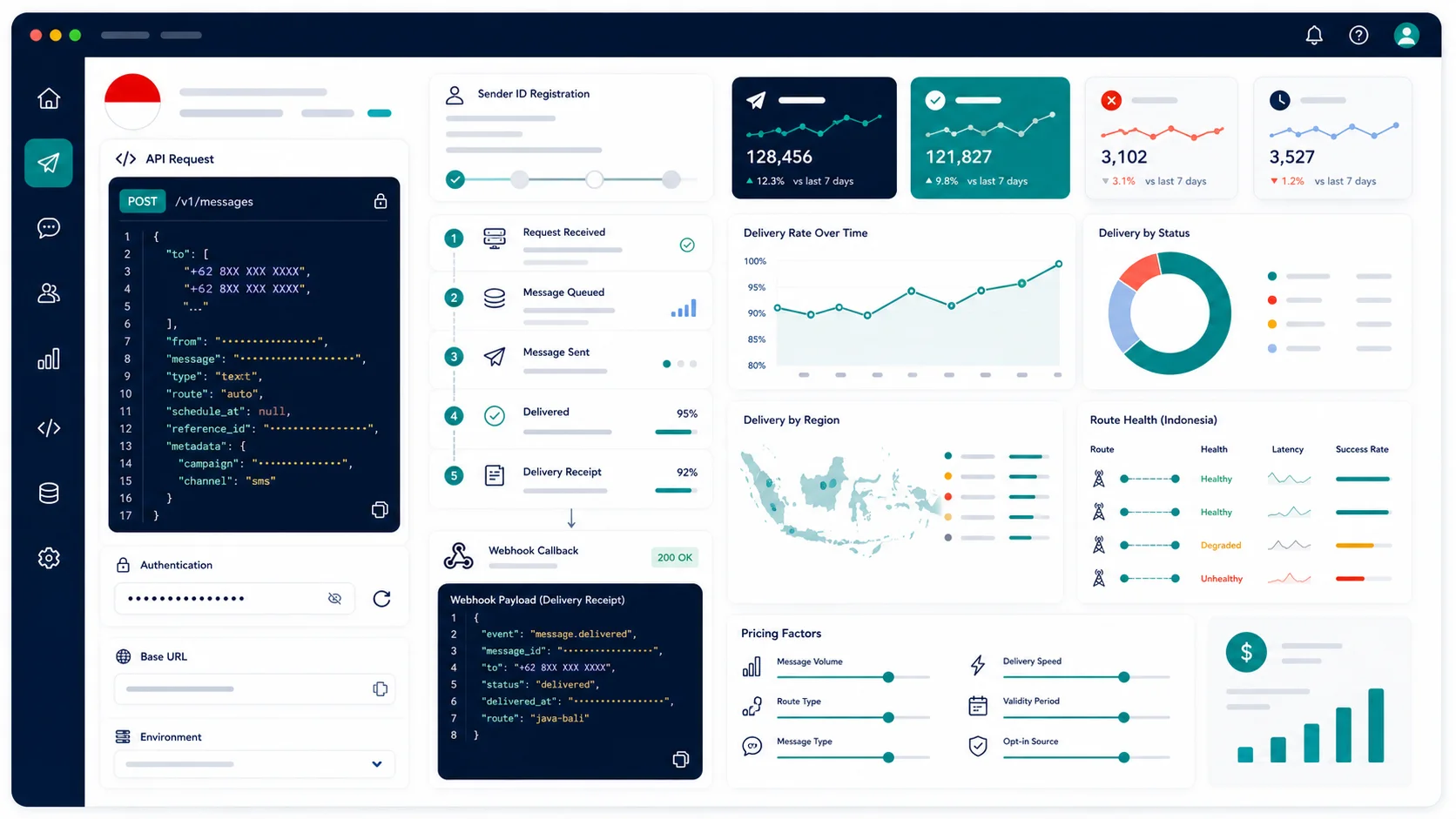
A good Indonesia SMS gateway exposes a simple HTTP API that accepts destination numbers, message content, sender ID, and message type. Most providers return a message ID you can use to query delivery status later.
Below is a cURL example for sending an SMS to an Indonesian number. Replace the account, password, sender ID, and content with your own values.
curl -X POST “https://api.smsprovider.com/send” \
-H “Content-Type: application/json” \
-d ‘{
“account”: “your_account”,
“password”: “your_password_or_md5_hash”,
“numbers”: “6281234567890”,
“content”: “Your verification code is 123456.”,
“sender”: “YOURBRAND”,
“smstype”: 0
}’
Use the international format 62 followed by the mobile number without the leading zero. For example, 6281234567890 instead of 081234567890. Always URL-encode message content and confirm that your SMS API provider supports Unicode if you send messages in Bahasa Indonesia with special characters.
Most APIs also support batch sending, delivery reports, and scheduled messages. Test these features in staging before going live with customer traffic.
Delivery Quality and Common Failures
Delivery quality in Indonesia varies by operator group, route, and time of day. Direct routes to Telkomsel, Indosat, and XLSMART-managed brands usually provide more stable delivery receipts and faster OTP arrival than grey routes. Ask providers for recent test results by network instead of relying on a single blanket delivery-rate claim.
Factors that affect delivery:
- Route type: Direct connections hand messages straight to the operator. Grey routes pass through intermediate aggregators, adding delay and failure points.
- Sender ID status: Unregistered sender IDs are more likely to be filtered or overwritten with a generic number.
- Network congestion: Major sales events (such as Black Friday) and national holidays can cause delays on all routes.
- Content filtering: Operators scan for prohibited keywords and mismatched templates.
Common failures to watch for:
- Number format errors: Using the domestic 08xx format instead of the international 62 format.
- Template mismatch: Transactional messages that include promotional wording may be reclassified or blocked.
- Grey route fallback: Some providers silently move traffic to cheaper routes when direct routes are busy.
If delivery rates drop suddenly, check your delivery failure logs first. The cause is usually number formatting, sender ID, or route quality.

Conclusion
A reliable SMS gateway in Indonesia starts with broad operator-group coverage, a registered sender ID, and direct routing. Get those three right, and OTP, transactional, and marketing messages reach customers consistently.
Before choosing a provider, test delivery to Telkomsel, Indosat, and XLSMART-managed brands, confirm sender ID approval timelines, and compare pricing at your expected monthly volume. If you are evaluating an Indonesian SMS gateway, start with a free trial or request a tailored quote to see how your messages perform on local routes.
FAQ
Do I need a local company to send SMS in Indonesia?
No. International businesses can send A2P SMS to Indonesia through a gateway provider. However, sender ID registration usually requires business documents that prove your right to use the brand name.
How long does sender ID approval take in Indonesia?
Alphanumeric sender IDs typically take 3–7 business days. Numeric sender IDs and short codes can take longer and may require higher-volume commitments.
Can I send SMS in Bahasa Indonesia?
Yes, but Unicode messages are limited to 70 characters per SMS part. Longer Bahasa Indonesia messages cost more than English messages because they are split into multiple parts.
What number format should I use for Indonesia?
Use the international format starting with 62, for example, 6281234567890. Do not use the domestic 08xx format.