Nepal’s bulk SMS market centers on Nepal Telecom and Ncell, with legacy SmartCell or Smart Telecom references still appearing in some provider materials. Most organizations struggle to choose the right option because official channels, partner channels, and private gateways all use different pricing, approval, and API models

This guide covers every procurement path in Nepal. From NTA compliance requirements and the NTC application process to private provider comparison and use-case recommendations, the goal is to help you make an informed decision based on your volume, timeline, and technical needs.
Quick answer: For most organizations in Nepal, private SMS providers offer the fastest setup and more flexible APIs, while NTC Group SMS is usually the lowest-cost path for high, predictable volumes. Treat old online rate tables as starting points only. Ask each provider for a current NPR quote, sender ID requirements, network coverage, Unicode pricing, and delivery-report support before you commit.
What Do You Need to Get Bulk SMS Service in Nepal?
A few preparations streamline the application process regardless of which provider you choose.
Valid Company Registration: Both NTC and most private providers require a registered company. Sole proprietorships may work with some private providers but face limitations. For NTC, a formal company registration certificate is mandatory.
Tax Registration (PAN/VAT): NTC explicitly requires tax registration documents. Private providers typically ask for PAN at minimum. Have these ready before starting any application.
Clear Use Case Definition: Know whether you need promotional SMS (marketing, offers) or transactional SMS (OTPs, alerts, notifications). This determines sender ID requirements, timing restrictions, and in some cases, which providers can serve you.
Estimated Monthly Volume: NTC pricing is tiered by volume. Private providers often offer volume discounts. Having an estimate helps you choose the right tier and negotiate rates.
Contact List with Opt-In Consent: For promotional SMS, NTA regulations require documented opt-in consent. Prepare your list in Excel or CSV format, and ensure you have consent records before sending
Step-by-Step Guide to Getting Bulk SMS in Nepal
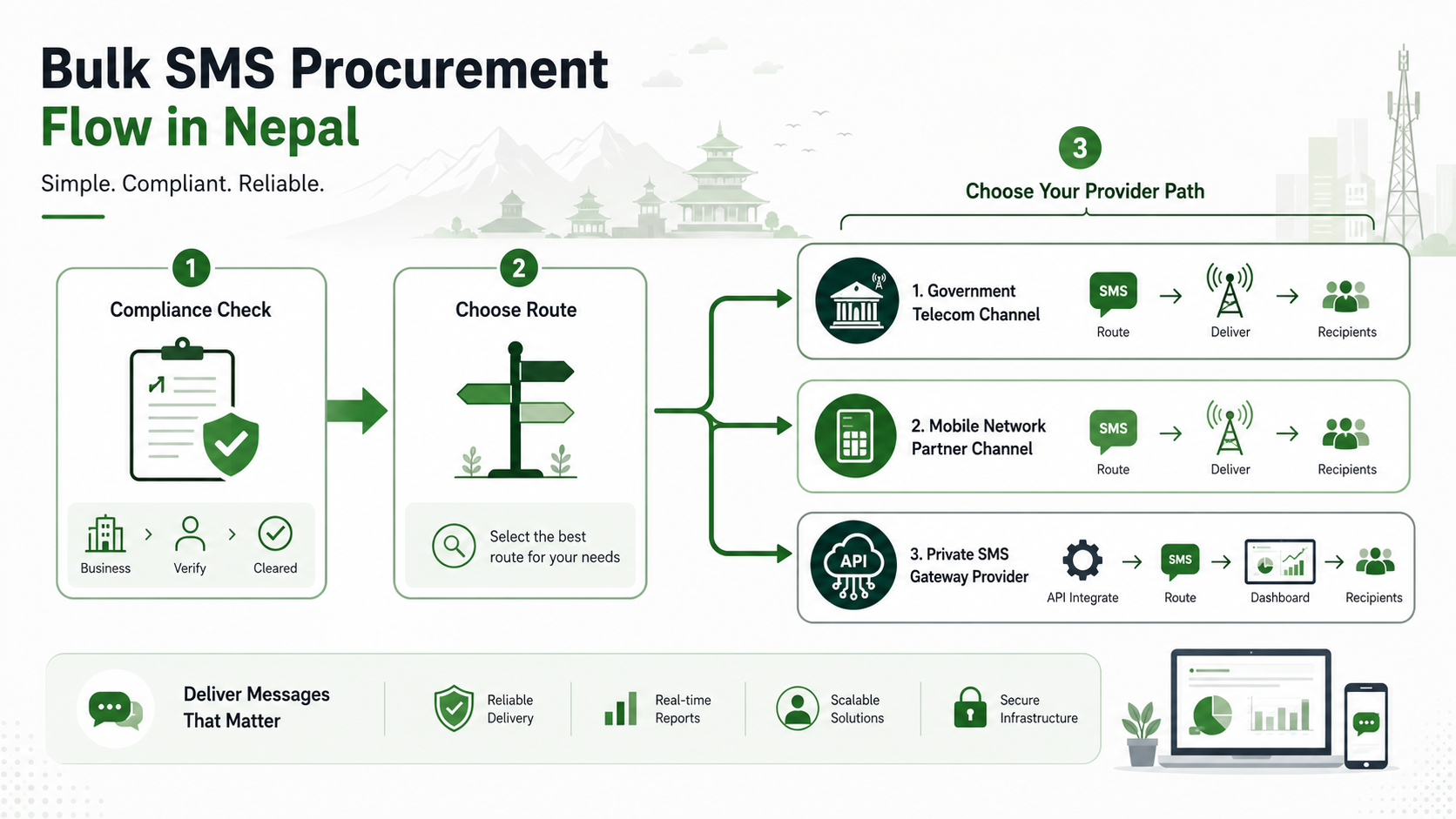
Step 1 — Understand NTA Regulatory Requirements
The Nepal Telecommunications Authority (NTA) regulates all commercial SMS. Understanding these rules before applying prevents rejected applications and compliance violations.
Key Compliance Checks:
Before launch, verify these points with your provider or the Nepal Telecommunications Authority. The exact enforcement process can change, and commercial SMS rules may differ by message type.
| Compliance Area | What to Verify |
|---|---|
| Sender ID | Confirm whether your brand name needs operator or provider approval before live sending. |
| Consent | Keep documented opt-in records for promotional campaigns and avoid purchased lists. |
| Opt-out | Add HELP/STOP or another provider-approved unsubscribe path for promotional traffic. |
| Content category | Keep OTP and transactional templates separate from sales language. |
| International traffic | Confirm whether the route is approved for Nepal-bound A2P SMS before sending at scale. |
Do not treat old penalty summaries or reseller rate sheets as legal advice. If the campaign is promotional, political, financial, or public-sector related, ask the provider for current NTA guidance before sending.
Step 2 — Apply for NTC Group SMS
Nepal Telecom’s Group SMS service is the official government-backed channel. It is the most cost-effective option for high-volume senders who can tolerate a longer setup process.
Who NTC Group SMS Is Best For:
- High-Volume Senders: Organizations sending 10,000+ SMS per month can spread the application effort across a larger message budget.
- Formal Buyers: Government offices and NGOs with procurement requirements often prefer the official Nepal Telecom channel.
- Cost-Focused Teams: Businesses that can wait for setup may choose NTC when the current rate card is lower than private-provider quotes.
- Simple Message Programs: Senders without complex API needs can use NTC for alerts, notices, and scheduled campaigns.
Required Documents:
- Request Letter: Prepare a formal request on company letterhead that states your bulk SMS purpose and target customer base.
- Company Profile: Include a short profile that explains the organization, industry, and use case.
- Registration Certificate: Provide the company registration certificate required for formal onboarding.
- Tax Registration: Attach PAN or VAT copies if Nepal Telecom requests tax documentation.
- Authorized Signatory ID: Include identification for the person allowed to sign the agreement.
Application Process:
- Prepare Documents: Gather all required documents. Ensure the request letter clearly states your use case, estimated volume, and target audience.
- Submit Application: Send the complete application packet to the Chief Commercial Officer (CCO), Strategy Implementation & VAS Division, Nepal Telecom Head Office, Bhadrakali, Kathmandu.
- Wait for Review: NTC reviews applications for completeness and compliance. Incomplete applications are returned without processing. The review typically takes 7–14 business days.
- Sign Contract: Upon approval, sign the bulk SMS service agreement with Nepal Telecom.
- Make Payment: Deposit the required amount based on your SMS volume quota to Nepal Investment Mega Bank. NTC provides specific payment instructions upon approval.
- Receive Login Credentials: NTC sends dashboard login credentials via email within 2–3 business days of payment confirmation.
NTC Pricing to Verify Before Purchase:
| SMS Volume | Rate (Excl. Tax) | Validity |
|---|---|---|
| 2,000 – 100,000 | NPR 0.50/SMS | 3 Months |
| 100,001 – 500,000 | NPR 0.40/SMS | 6 Months |
| 500,001 – 1,000,000 | NPR 0.30/SMS | 9 Months |
| 1,000,000+ | NPR 0.20/SMS | 1 Year |
Note: Treat this as a working rate-card example unless Nepal Telecom confirms the current pricing in writing. Tax, validity, and rollover rules can change, so ask for an updated quote before budgeting.
Contact Information to Verify:
- Email: Check Nepal Telecom’s current VAS or enterprise contact before submitting documents.
- Phone: Confirm the latest service desk number on the Nepal Telecom website or through a branch office.
- Portal: Use the Group SMS portal only after Nepal Telecom confirms account access.
One university in Pokhara applied for NTC Group SMS to send exam notifications to 25,000 students. The application took 12 days to approve, but the NPR 0.40 rate saved them approximately NPR 25,000 per month compared to their previous private provider. For institutions with predictable, high-volume needs, the bureaucratic overhead pays for itself.
Step 3 — Apply for Ncell Bulk SMS
Ncell offers bulk SMS through authorized partners rather than direct application. This channel is ideal for businesses needing alphanumeric sender IDs and faster setup than NTC.
Who Ncell Bulk SMS Is Best For:
- Branded Senders: Businesses that need alphanumeric sender IDs may prefer an Ncell partner if approval is faster than the NTC path.
- Faster Launches: Organizations that cannot wait for a longer government-channel process can compare partner onboarding timelines.
- Transactional Teams: Senders with alerts, OTPs, and notification traffic should ask partners about route priority and delivery reports.
- API Buyers: Companies needing integration support should request API documentation before signing.
Authorized Partner Check:
Ncell partner lists can change, and individual contact details go stale quickly. Before publishing or purchasing, ask Ncell or the provider to confirm current authorization.
- Authorization Proof: Request a current document or official email showing the partner can sell Ncell bulk SMS.
- Sender ID Process: Ask who submits the sender ID request, who approves it, and how long review usually takes.
- Network Scope: Confirm whether the partner can deliver to Ncell only, route to NTC as well, or support any legacy SmartCell number ranges.
- Commercial Terms: Compare per-SMS pricing, setup fees, minimum deposits, and delivery-report access.
Application Process:
- Contact an Authorized Partner: Reach out to 2–3 partners to compare pricing and services. Not all partners offer the same rates or support levels.
- Submit Company Documents: Provide company registration, PAN/VAT, and a letter stating your intended use case.
- Choose Sender ID: Select an alphanumeric sender ID (6 characters maximum). The partner submits this for Ncell approval.
- Sign Agreement: Review and sign the service agreement with the partner. Clarify: per-SMS rate, minimum monthly volume, API access fees, and delivery reporting capabilities.
- Make Payment: Most partners accept bank transfer, Khalti, or eSewa. Some require an initial deposit or setup fee.
- Receive Access: Dashboard login and API credentials are typically provided within 2–3 business days of payment.
Approval Timeline to Confirm:
- Partner Onboarding: Ask whether onboarding takes hours, days, or longer once documents are complete.
- Sender ID Approval: Confirm the current review window for alphanumeric IDs before planning a campaign launch.
- Total Setup Time: Build a buffer into your timeline because document issues and template reviews can delay access.
Ncell’s partner model adds a layer of complexity but delivers faster setup than NTC. The key is choosing the right partner — rates and service quality vary significantly. A fintech startup in Lalitpur compared three partners and found a 40% price difference for the same volume tier.
Step 4 — Evaluate Private SMS Providers
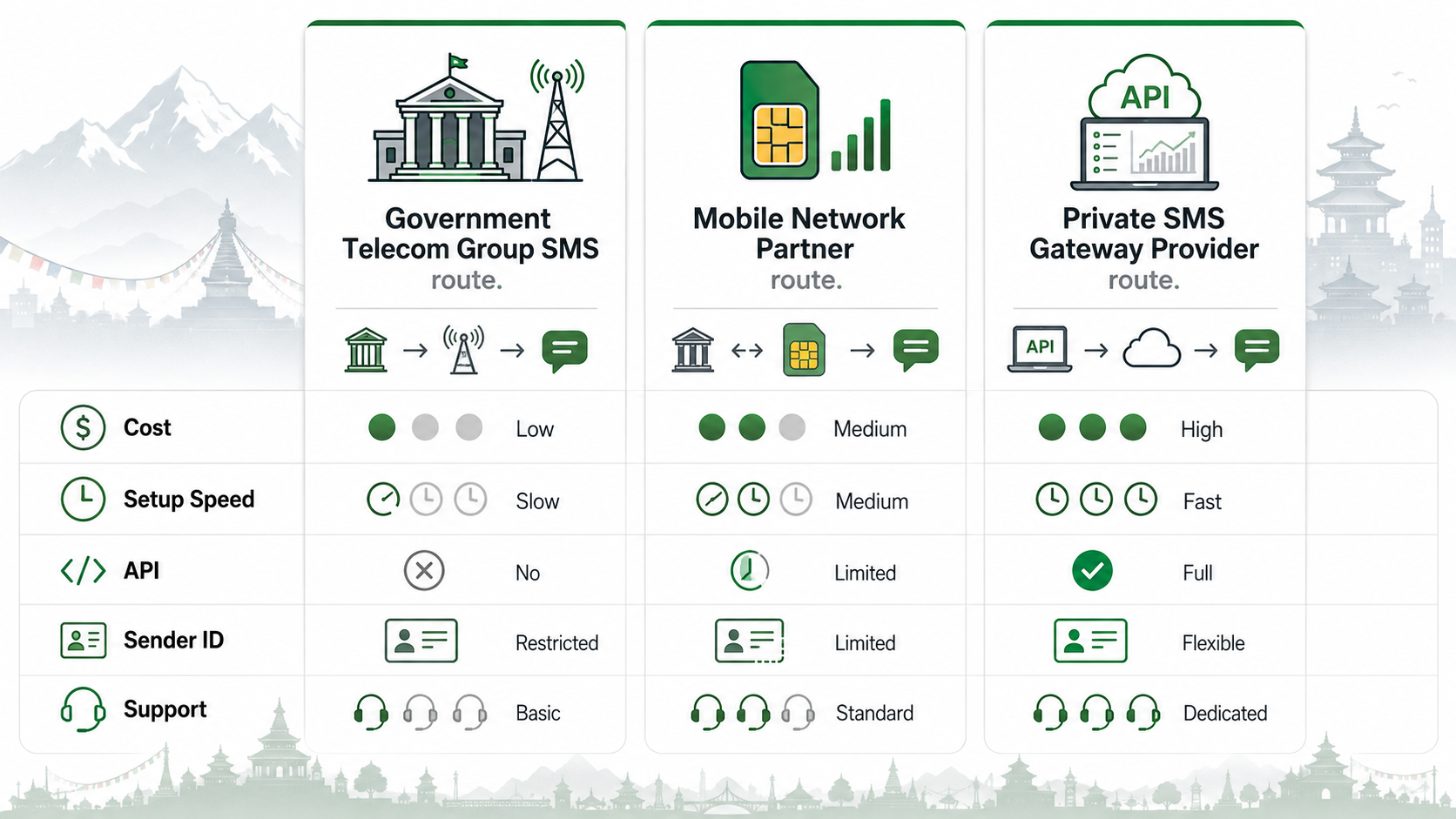
Private providers offer the fastest setup, best APIs, and most flexible terms. They are ideal for organizations that need to start sending within 24–48 hours.
Major Private Providers (2025–2026):
| Provider | Starting Rate | NTC | Ncell | Legacy SmartCell | API | Unicode | Payment Methods |
|---|---|---|---|---|---|---|---|
| SparrowSMS | Custom | Yes | Yes | Verify | Yes | Yes | Bank, Khalti, eSewa |
| AakashSMS | NPR 1.40/SMS | Yes | Yes | Verify | Yes | Yes | Bank, Khalti |
| SMS Pasal | Competitive | Yes | Yes | Verify | Yes | Yes | Bank, eSewa |
| Bulk SMS Nepal | Verify current quote | Yes | Yes | Verify | Yes | Yes | Khalti |
| Nitya SMS | NPR 1.10/SMS (Express) | Yes | Yes | Verify | Yes | Yes | Bank, eSewa |
| Swift Technology | Custom | Yes | Yes | Verify | Yes | Yes | Bank |
Rates are approximate and subject to volume discounts. Always request a current quote before committing. SMSBoosting offers rates starting from approximately €0.035 per SMS for Nepal, with customized pricing available for high-volume or multi-network requirements. For a detailed cost breakdown across markets, see how much SMS marketing costs.
Evaluation Framework:
When comparing private providers, assess these factors in order of priority:
- Network Coverage: Does the provider route through both NTC and Ncell, and can it explain any legacy SmartCell handling? Single-network providers limit your reach. For organizations targeting rural areas, NTC coverage is especially important because Ncell’s rural reach can vary by district.
- API Quality: If you need system integration, request API documentation before signing. Look for REST API, webhook support for delivery reports, and SDK availability for common platforms. If documentation is incomplete or no webhook support is available, integration will take longer and cost more in developer hours.
- Unicode Support: For Nepali-language messages, confirm the provider supports Unicode encoding. Not all providers handle Nepali script correctly. Ask the provider to send a test message in Nepali to multiple devices. If rendering is inconsistent, your recipients will see garbled text.
- Payment Flexibility: Khalti and eSewa integration matters for businesses without easy bank transfer access. Some providers only accept bank deposits. Providers that restrict payment to bank transfers only add friction for smaller businesses without corporate banking relationships.
- Delivery Reporting: Real-time delivery reports are essential for troubleshooting. Ask to see a sample report before signing. If they cannot show a sample report with status codes for delivered, failed, and pending messages, you will have no way to verify whether your campaigns actually reached recipients. Review SMS deliverability benchmarks before committing to a provider.
- Support Responsiveness: Send a test inquiry before committing. Response time within 24 hours indicates acceptable support. Response delays beyond 48 hours suggest you will struggle when urgent routing or delivery issues arise.
When to Choose Private Over Government:
| Factor | Choose NTC | Choose Private |
|---|---|---|
| Volume | 100,000+ SMS/month | <100,000 SMS/month |
| Setup Speed | Can wait 2+ weeks | Need to start within 48 hours |
| API Integration | Not needed | Required |
| Sender ID | Numeric acceptable | Alphanumeric preferred |
| Support | Self-service acceptable | Need dedicated support |
| Budget | Cost is primary concern | Willing to pay for convenience |
Step 5 — Choose by Use Case
The best provider depends on what you are sending, to whom, and how often.
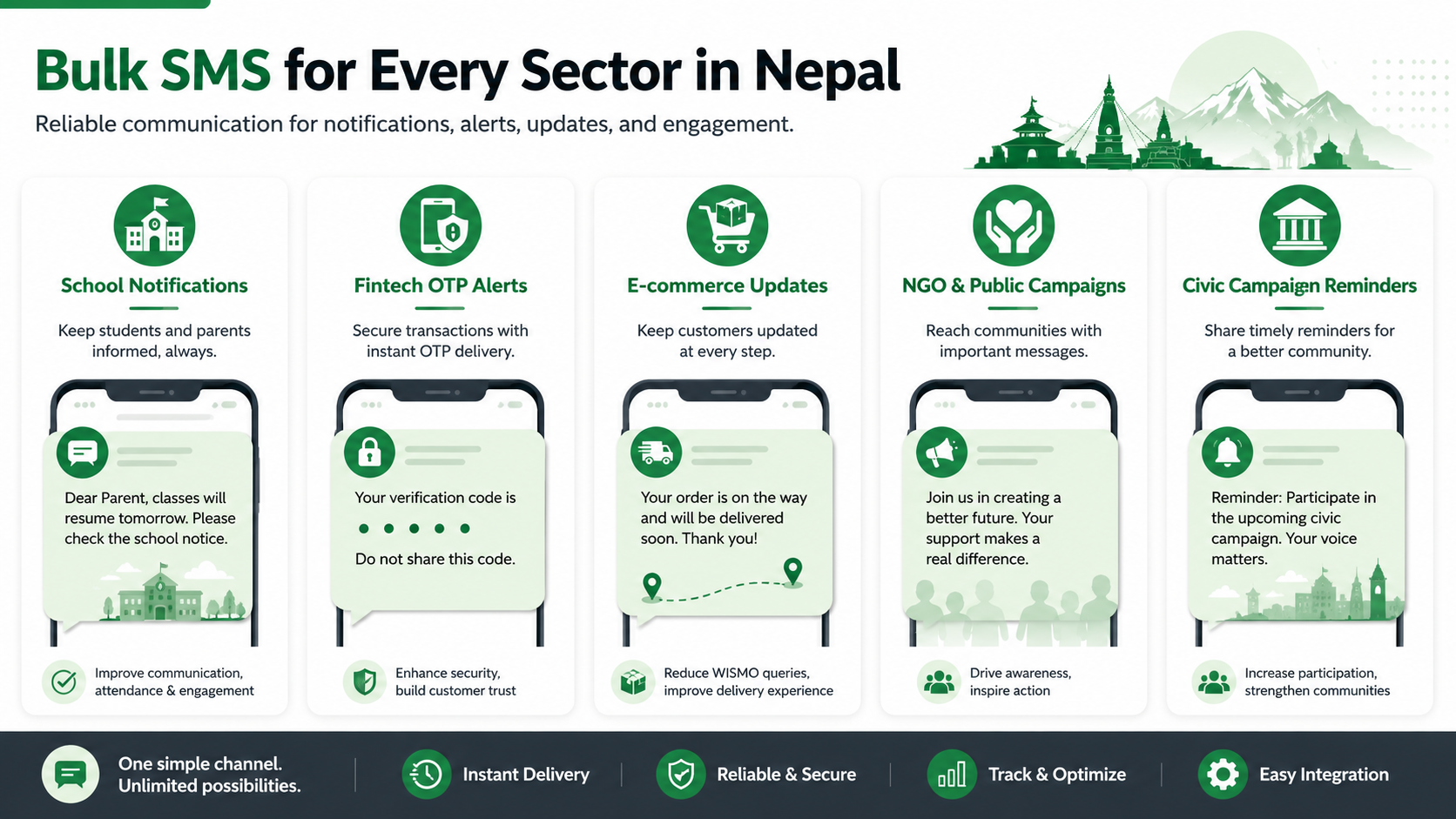
Schools and Colleges:
- Primary Need: Exam notifications, fee reminders, emergency alerts
- Recommended: NTC Group SMS for high-volume institutions; private providers for smaller schools
- Key Feature: Scheduling capability and Nepali Unicode support
- Volume Estimate: 5,000–50,000 SMS per month during exam seasons
Banks and Fintech:
- Primary Need: Banks and fintech teams usually need OTP SMS, transaction alerts, and loan reminders.
- Recommended: Ncell through an authorized partner or a private provider with strong API support can work if delivery reports are reliable.
- Key Feature: API integration, delivery speed, and support response time matter more than the lowest quote.
- Volume Estimate: A fintech program may send 10,000–500,000 SMS per month depending on login, payment, and loan activity.
A microfinance team in Birgunj would not choose a provider the same way a school would. For OTP traffic, test delivery speed, retry behavior, and delivery reports before you trust the route with payment or login flows.
E-commerce:
- Primary Need: E-commerce teams usually need order confirmations, delivery updates, and promotional SMS campaigns.
- Recommended: A private provider with strong API support and campaign analytics is usually the easiest fit.
- Key Feature: Promotional and transactional routing should stay separate so order alerts are not filtered like campaigns.
- Volume Estimate: A growing online store may send 20,000–200,000 SMS per month during active sales periods.
NGOs and Government:
- Primary Need: Awareness campaigns, event notifications, survey distribution
- Recommended: NTC Group SMS (cost-effective for high volume)
- Key Feature: Wide coverage, low per-SMS cost
- Volume Estimate: 10,000–100,000 SMS per campaign
Civic or Political Campaigns:
- Primary Need: Campaign teams may need supporter updates, event reminders, and time-sensitive notices.
- Recommended: Use a provider with clear consent handling, fast throughput, and written guidance on regulated content.
- Key Feature: Scheduling, opt-out handling, and audit records are more important than raw sending speed.
- Volume Estimate: Large campaigns can reach 100,000–1,000,000 SMS in short windows, so testing matters before launch.
Political campaigns in Nepal often need to send hundreds of thousands of SMS within 48 hours of an event. Private providers with redundant routing are better equipped for these spikes than government channels with fixed quotas.
Step 6 — Set Up and Send Your First Campaign
Once you have chosen a provider and received access, the setup process is routine.
Uploading Contacts and Composing Messages:
Upload your contact list in Excel or CSV format. Ensure numbers are in international format (+977XXXXXXXXXX) and remove duplicates — many providers charge for duplicate sends.
- English SMS: 160 characters per SMS. Longer messages split into concatenated SMS (2–6 parts), with each part charged separately.
- Nepali Unicode SMS: 70 characters per SMS. Unicode encoding uses more bytes per character, reducing the limit significantly. A 140-character Nepali message costs twice as much as the same length in English.
Character Count Reference:
| Language | Characters per SMS | Concatenated SMS |
|---|---|---|
| English (GSM-7) | 160 | 153 per part |
| Nepali Unicode (UTF-16) | 70 | 67 per part |
Scheduling and Delivery Reports:
Schedule messages for optimal timing — promotional SMS performs best between 10 AM and 6 PM. Always review delivery reports within 24 hours. Look for patterns: if delivery rates to Ncell numbers are significantly lower than NTC, contact your provider — routing issues may exist.
What Mistakes Should You Avoid When Buying Bulk SMS in Nepal?
Mistake 1 — Choosing on Price Alone:
The cheapest provider often lacks direct routing to both main networks. Messages may travel through multiple intermediaries, causing delays and delivery failures. The fix: Verify routing quality before committing. Request a test send to NTC and Ncell numbers, plus any legacy SmartCell ranges if your list includes them.
Mistake 2 — Ignoring Sender ID Registration:
Without a registered sender ID, your messages display a generic alphanumeric code. Recipients ignore or block messages from unknown senders. The fix: Register your sender ID before your first campaign. Factor the 3–5 day approval timeline into your launch schedule.
Mistake 3 — Underestimating Unicode Costs:
A 200-character Nepali message splits into 3 Unicode SMS, costing 3× the price of a single English message. Many organizations budget for English rates and face surprise bills. The fix: Test your Nepali messages in the provider’s dashboard before sending. The character counter shows exact SMS count.
Mistake 4 — No Delivery Tracking:
Sending without reviewing delivery reports is like mailing letters without confirming the address. You have no way to know if messages reached recipients. The fix: Review delivery reports after every campaign. Investigate delivery rates below 90%.
Mistake 5 — Skipping Opt-In Compliance:
Unsolicited promotional SMS can lead to account suspension, complaints, investigation, or penalties depending on the current rule and enforcement process. The fix: Maintain documented opt-in consent for every promotional contact. Implement double opt-in for online signups.
Mistake 6 — Wrong Volume Commitment:
NTC quotas expire at the end of the validity period. Private provider credits may have expiry dates. Buying more than you use wastes budget. The fix: Start with a conservative estimate and scale up. Most providers allow mid-contract upgrades.
FAQ
Can individuals get bulk SMS service in Nepal?
NTC Group SMS requires company registration and is not available to individuals. Some private providers may serve individuals for personal or small-scale use, but most require business registration for accounts above 1,000 SMS per month.
How long does NTC approval take?
NTC bulk SMS applications typically take 7–14 business days to approve, assuming all documents are complete and correct. Incomplete applications are returned without processing, which adds to the timeline.
Can I send SMS in Nepali language?
Yes, most private providers and NTC support Nepali Unicode SMS. However, Nepali messages are limited to 70 characters per SMS (compared to 160 for English), which increases costs for longer messages. Always test Nepali messages in your provider’s dashboard to verify character count and rendering.
What is the cheapest bulk SMS option in Nepal?
For high volumes, NTC Group SMS is usually the lowest-cost option if the current rate card matches your volume. For lower volumes, compare private-provider quotes on a per-SMS basis and verify any online package table before using it in a budget. The cheapest option depends on your monthly volume, setup timeline, API needs, and Unicode message length.
Conclusion
Getting bulk SMS service in Nepal is not difficult, but it requires choosing the right channel for your specific needs. Government channels through NTC often offer the lowest per-SMS rates for high-volume senders willing to work through the application process. Ncell can support branded sender IDs through partners. Private providers offer the best combination of speed, API access, and support for organizations that need to start quickly.
The key principle is to match the provider to your use case, not just the price. A school sending 50,000 exam notifications has fundamentally different needs than a fintech startup sending 10,000 OTPs per day.
Start by estimating your monthly volume, defining your use case, and determining whether you need API integration. Then compare providers across coverage, pricing, and support. For organizations evaluating multiple providers, SMSBoosting delivers bulk SMS to Nepal with coverage across NTC, Ncell, and provider-confirmed legacy number ranges. Contact the team for volume-based pricing and a test account to compare delivery rates before committing.
For teams comparing Nepal with other destination markets, our international bulk SMS service guide shows how country coverage, routing quality, and sender requirements differ across regions.