
To choose a bulk SMS provider, B2B teams should evaluate market coverage, routing quality, compliance support, pricing transparency, API readiness, delivery reporting, scalability, and support before comparing headline rates. The lowest price, largest coverage map, or longest feature list does not prove that a provider can deliver reliable business messaging in the markets you actually use.
A reliable bulk SMS provider is not the one with the loudest claim. It is the one that can prove how messages move, how failures are reported, how opt-outs are handled, and how costs change when your volume grows.
Why the Cheapest Bulk SMS Provider Can Still Be the Wrong Choice
The cheapest bulk SMS provider can still be the wrong choice when low rates hide weak routing, poor reporting, limited support, or country-level delivery issues. Price matters, but it is only one part of provider evaluation. A low per-message rate can become expensive when campaigns fail, retries increase, support tickets rise, or your team cannot explain what happened after a send.
Lowest Price Can Hide Routing, Support, and Failed-Message Costs
A low unit rate is useful only when the route, reporting, and support model are also clear. If a provider cannot explain whether pricing changes by destination, carrier, message segment, or origination identity, the quote is not complete enough for a B2B decision.
Public pricing pages from major messaging platforms show why this matters. SMS prices can vary by country, region, carrier, message segment, and carrier fee; some providers also note charges tied to failed messages or registration-related costs [4]. So the buying question should not be, “Who is cheapest?” It should be, “Which provider can explain the real cost of sending at our expected volume?”
Global Coverage Maps Need Country-Level Proof
A global coverage map is a starting point, not proof. B2B teams should ask whether their priority countries support the sender type, message type, registration path, and two-way capability they need.
For example, official provider documentation often separates country availability from sender ID support, two-way messaging support, registration rules, and local restrictions [6]. That is the level of evidence your team needs. “We cover 200+ countries” is not enough when your business depends on five specific markets.
Long Feature Lists Do Not Replace Delivery Evidence
A provider can list API access, dashboards, templates, sender IDs, analytics, and integrations. Useful, yes. But features do not prove routing quality.
For provider evaluation, delivery evidence matters more than feature volume. You want to know whether the provider can show message status, failure reasons, delivery logs, escalation paths, and testing results. Without that, your team may have a polished dashboard and still lack operational control. For a broader foundation on what shapes message reach, see this guide to SMS deliverability.

What a Bulk SMS Provider Should Prove Before You Buy
A bulk SMS provider should prove that it can support your target markets, message types, compliance needs, reporting expectations, and volume before you commit. The best evaluation starts by defining what the provider is responsible for — and what it is not.
What a Bulk SMS Provider Does in B2B Messaging
A bulk SMS provider helps businesses send SMS messages at scale. In a B2B setting, that may include promotional campaigns, customer updates, service notices, account alerts, or basic two-way interactions.
A provider should usually support:
| Evaluation area | What it means for B2B teams |
|---|---|
| Market reach | Can you send to the countries and carriers that matter? |
| Routing | How are messages routed and monitored? |
| Compliance support | Can the provider support opt-out, consent records, and sender identity needs? |
| Reporting | Can your team see message status and failure reasons? |
| Cost control | Can you forecast price by country, segment, and volume? |
| Support | Can you escalate delivery or setup issues quickly? |
This is the practical definition that matters for provider selection. Not a broad messaging vision. Not a marketing slogan. A provider has to support the operational job.
Where Provider Evaluation Ends and Campaign Strategy Begins
Provider evaluation is not the same as campaign strategy. A provider can support delivery, routing, reporting, compliance workflows, and technical integration. It cannot fix weak audience consent, poor segmentation, irrelevant offers, or confusing copy by itself.
That boundary is important because it keeps the buying process fair. When comparing providers, judge them on infrastructure, evidence, documentation, and support. Judge your internal team on audience quality, campaign design, offer relevance, and lifecycle logic.
Why Proof Matters More Than Claimed Reach
Proof matters because bulk SMS performance depends on details. Country rules, sender identity, route behavior, opt-out handling, throughput, and delivery reporting can all affect business outcomes.
For example, 10DLC in the United States is an A2P messaging channel where brands and campaign service providers are verified before sending [2]. That does not mean every business needs the same setup everywhere. It means a provider should be able to explain what sender identity, registration, or campaign requirements apply to your target market.

How to Evaluate a Bulk SMS Provider Before Comparing Prices
B2B teams should evaluate a bulk SMS provider by market fit, route quality, compliance support, reporting visibility, scalability, and support before comparing price. Once those criteria are clear, pricing becomes easier to judge.
Match Provider Criteria to Markets, Message Types, and Monthly Volume
Start with your actual use case. A SaaS company sending login alerts to two countries has different needs from an ecommerce brand sending promotional campaigns across ten markets. A platform business with both customer updates and marketing campaigns has another set of tradeoffs. If your use case is mainly business-critical service messaging, this guide on how to choose a transactional SMS provider can help you evaluate the narrower reliability requirements.
Before contacting vendors, define:
| Planning input | Example |
|---|---|
| Priority countries | United States, United Kingdom, Singapore |
| Message types | Promotions, customer updates, basic alerts |
| Monthly volume | 50,000 / 500,000 / 5 million messages |
| Sender needs | Sender ID, toll-free number, long code, short code |
| Reporting needs | Delivery status, failure reason, exportable logs |
| Internal owner | Marketing, operations, product, engineering |
This avoids vague vendor calls. It also helps your team compare providers using the same criteria.
Check Evidence for Coverage, Compliance, Cost, and Reporting
The strongest providers are usually specific. They can explain how coverage works by country, what compliance support is available, what pricing variables affect your campaign, and what reporting data your team can access.
Compliance is one area where vague answers are risky. FCC rules and industry guidelines emphasize that consumers must be able to revoke consent through reasonable methods, and CTIA guidance says message senders should support opt-out mechanisms and honor opt-out requests [1]. If a provider cannot explain opt-out handling, suppression, or sender identity setup, that is a buying risk.
Use a Pilot Test Before Scaling Business Messaging Volume
Do not scale from a sales call. Run a pilot.
A useful pilot should test at least two priority countries, one real campaign type, message status reporting, opt-out handling, support response, and cost tracking. Even a small test can reveal gaps that a feature list will not show: delayed messages, unclear failures, missing logs, unstable sender identity, or slow escalation.
A pilot is not a formality. It is how you turn provider claims into operating evidence.

10 Factors to Check Before Choosing a Bulk SMS Provider
The 10 most useful provider selection factors cover coverage, routing, compliance, pricing, API readiness, reporting, scale, support, testing, and red flags. Use them as a checklist, not as isolated features.
| # | Factor | What to verify |
|---|---|---|
| 1 | Target-market coverage | Priority countries, sender types, two-way support |
| 2 | Routing quality | Regional route stability and monitoring |
| 3 | Compliance support | Consent, opt-out, sender identity |
| 4 | Pricing transparency | Segments, carrier fees, destination costs |
| 5 | API readiness | Documentation, authentication, webhooks |
| 6 | DLR / reporting | Status changes, failure reasons, logs |
| 7 | Scalability | Throughput, queues, peak campaigns |
| 8 | Support SLA | Escalation, onboarding, response expectations |
| 9 | Testing process | Pilot design before contract expansion |
| 10 | Vendor red flags | Claims without evidence |
1. Target-Market Coverage for Your Priority Countries
Check coverage by country, not by map size. A provider may support SMS sending to a country but have different rules for sender IDs, two-way messaging, dedicated numbers, or registration [6].
Ask for proof by market. If your top markets are the United States, Singapore, and the United Kingdom, your evaluation should focus there first. Do not let a long country list distract from the few markets that carry most of your revenue.
2. Routing Quality and Regional Route Stability
Routing quality affects whether messages move through reliable paths and whether performance stays stable by region. You may see acceptable results in one market and weaker results in another without changing copy, timing, or audience.
Ask how the provider monitors routes, detects degradation, and escalates route issues. You do not need every carrier-level detail, but you do need enough operational proof to trust the route strategy.
3. Compliance Support for Consent, Opt-Out, and Sender Identity
A provider should help you support compliant messaging workflows. That includes opt-out handling, suppression lists, sender identity setup, and documentation for local requirements.
Industry guidance says opt-out should be available at any time and should support multiple mechanisms, including text; it also notes that senders should retain opt-in and opt-out records [1]. In practice, this means your provider evaluation should include both product capability and support process. Can the provider explain what happens when someone replies STOP? Can your team export or audit opt-out status?
4. Pricing Transparency Beyond the Per-Message Rate
Compare total cost, not just the per-message rate. SMS cost may depend on country, carrier, segment count, origination identity, registration fees, and failed-message handling [4].
Ask for pricing examples using your actual markets and expected message length. A 160-character message and a longer message split into multiple segments may not cost the same. A provider that explains this clearly is easier to budget with than one that only shows a low headline rate.
5. API Readiness Without Turning Provider Selection Into an API Project
Even if your team is not building a complex messaging product, API readiness still matters. It affects automation, CRM connection, campaign triggers, delivery callbacks, and future integration work.
You do not need to turn this article into an SMS API tutorial. For provider selection, check whether the API docs are clear, whether authentication is manageable, whether sandbox or test options exist, and whether your technical team can review webhook behavior before launch. For a deeper technical layer after provider screening, read this guide to building a reliable transactional SMS API workflow.
6. Delivery Reports, DLRs, and Failure-Code Visibility
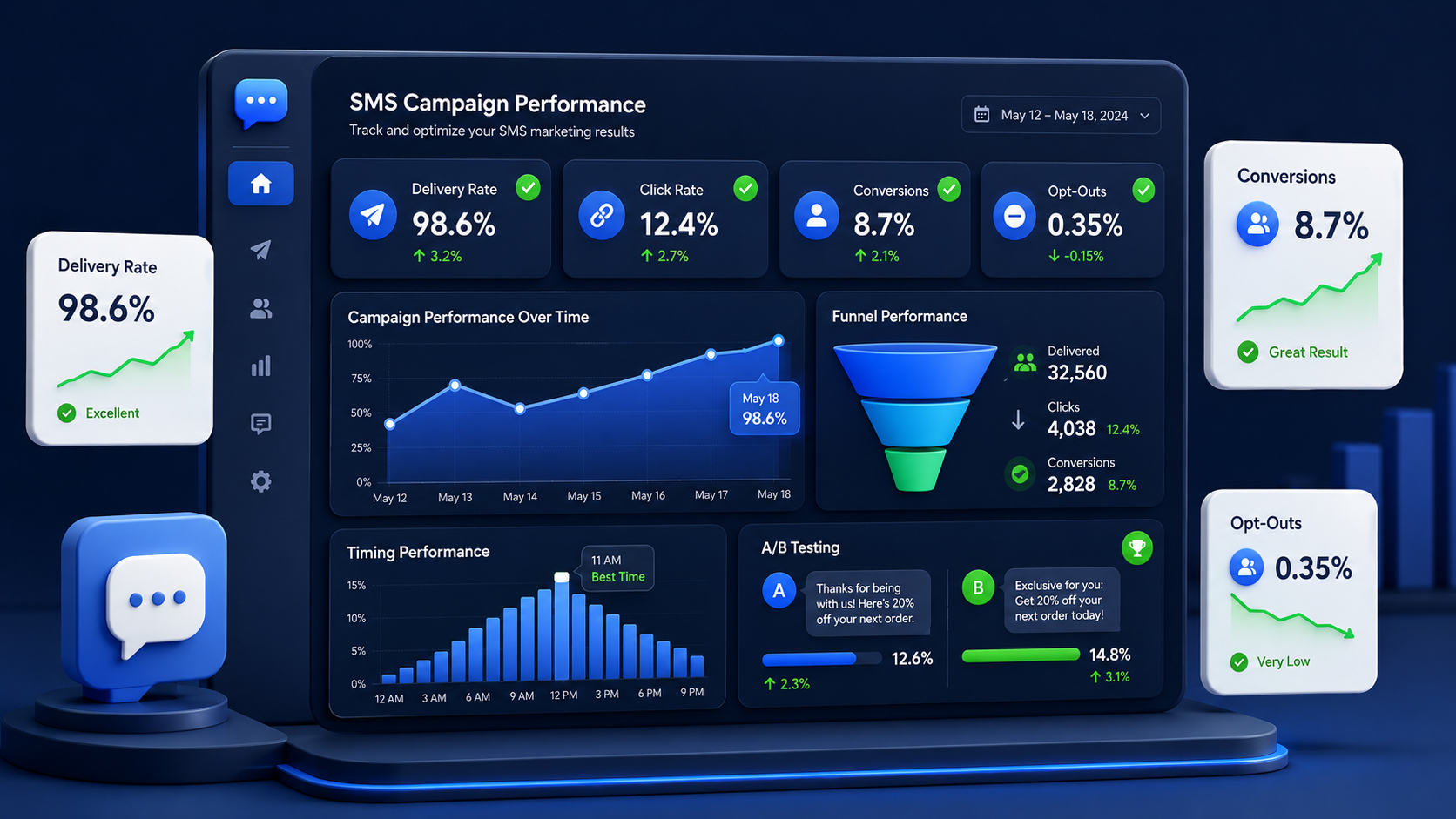
Delivery reporting is one of the clearest signs of operational maturity. Your team should be able to see message status changes, delivery outcomes, and failure reasons when available.
Official technical documentation from messaging platforms shows how status callbacks, delivery logs, and monitoring tools can help teams track message status, successful and unsuccessful deliveries, price, failure reason, and dwell time [3]. You may not need every field on day one. But if a provider cannot explain what you will see after a campaign, your operations team will be guessing. If your team needs a diagnostic frame for failed sends, this article on why SMS messages are not delivered can help separate sender, route, filtering, and destination issues.
7. Scalability for Higher Volume, Peak Campaigns, and New Markets
Scalability is not only about monthly volume. It is also about peak timing, queue behavior, throughput, sender type, and market expansion.
For example, official documentation on messaging throughput explains that messages may queue when requests exceed the available messages-per-second capacity, and that planning MPS matters for time-sensitive sends [5]. So ask how the provider handles a campaign spike, a product launch, or a new country rollout. “We can scale” is not enough. You need the capacity model.
8. Support SLA, Escalation Path, and Onboarding Quality
Support quality often becomes visible only when something breaks. That is too late.
Before signing, ask who handles onboarding, who monitors early sends, how delivery issues are escalated, and whether support hours match your sending windows. If your campaigns run across time zones, support coverage matters. A strong provider should be able to explain the escalation path before you need it.
9. Testing Process Before a Long-Term Contract
A good provider should support testing before long-term commitment. The test does not need to be huge, but it should be realistic.
Test your priority markets, normal message templates, sender setup, opt-out handling, reporting exports, and support response. If possible, include one business-as-usual send and one higher-volume send. The goal is not perfection. It is evidence.
10. Vendor Red Flags That Signal Weak Operational Proof
Watch for signs that a provider is selling reach without proof. Red flags include vague coverage claims, unclear route explanations, no sample reporting, no opt-out workflow, no country-specific guidance, unclear pricing, and no escalation process.
One red flag may not disqualify a vendor. Several together should slow the decision. Better to pause before a contract than rebuild under pressure after a campaign fails.
Bulk SMS Provider Comparison Table for B2B Teams
A bulk SMS provider comparison table should compare evidence-based criteria rather than vendor claims alone. The goal is not to crown a universal winner. It is to find the provider that fits your markets, message types, team capacity, and risk tolerance.
Compare Providers by Evidence, Not by Marketing Claims
Use this table during vendor calls or internal evaluation:
| Evaluation criterion | Provider A | Provider B | Provider C | Evidence to request |
|---|---|---|---|---|
| Priority-country coverage | Country list with sender support | |||
| Route quality explanation | Routing model, monitoring process | |||
| Opt-out support | STOP handling, suppression process | |||
| Sender identity support | Registration path, sender ID rules | |||
| Pricing clarity | Segment, carrier fee, country pricing | |||
| API readiness | Docs, webhook behavior, test access | |||
| DLR / reporting | Sample logs, failure reasons | |||
| Scalability | Throughput, queues, peak planning | |||
| Support SLA | Escalation path, onboarding owner | |||
| Pilot testing | Test plan, success criteria |
Use Weighted Criteria for Business, Technical, and Operational Needs
Not every criterion carries the same weight. A marketing-led ecommerce team may weight pricing, segmentation fit, and reporting highly. A product-led SaaS team may weight API readiness, delivery callbacks, and support response more heavily.
Set weights before vendor calls. For example: coverage 20%, routing 15%, compliance 15%, reporting 15%, pricing 15%, support 10%, scalability 10%. The numbers can change, but the discipline helps. It keeps the loudest sales claim from becoming the buying logic.
Red-Flag Questions to Ask Before Signing With an SMS Provider
Red-flag questions help reveal whether an SMS provider can support real delivery, compliance, reporting, and escalation needs after launch. Ask them before procurement finalizes the contract.
Questions About Coverage and Route Quality
Ask:
- Which of our priority countries require sender registration or special sender setup?
- Which sender types are supported in each market?
- How do you monitor route degradation?
- Can we run a pilot in our top 2–3 markets?
- What happens when one route becomes unstable?
Questions About Compliance and Opt-Out Handling
Ask:
- How do you support opt-out keywords such as STOP?
- Can we maintain suppression lists across campaigns?
- What records can we access for opt-in and opt-out status?
- How do you support A2P registration where required?
- What content or sender risks can lead to filtering?
Questions About Pricing, Reporting, and Support
Ask:
- Does pricing change by country, carrier, segment, or sender type?
- Are carrier fees, registration fees, or failed-message fees separate?
- What delivery statuses and failure reasons can we see?
- Can reports be exported or connected through API?
- Who handles escalation if delivery drops during a campaign?
The answers should be concrete. If a provider cannot answer these questions before a contract, it may not be ready to answer them during an incident.

FAQ About Choosing a Bulk SMS Provider
What Is the Most Important Factor When Choosing a Bulk SMS Provider?
The most important factor when choosing a bulk SMS provider is evidence that the provider can support your target markets reliably. That evidence should include country-level coverage, routing explanation, compliance support, delivery reporting, and support process. Price matters, but it should be judged after those basics are clear. For example, a provider that is cheaper in one country but cannot show delivery status or opt-out handling may create more operational cost than it saves.
How Do I Compare Bulk SMS Provider Pricing?
To compare bulk SMS provider pricing, ask for a cost estimate based on your real destination countries, expected message length, sender type, and monthly volume. Do not compare only one per-message rate. SMS pricing can vary by country, carrier, segment count, carrier fee, and registration-related cost [4]. A useful pricing review should include at least one normal campaign scenario and one higher-volume scenario.
Why Does Route Quality Matter for Bulk SMS?
Route quality matters for bulk SMS because business messaging performance can vary by country, carrier, sender type, and routing path. A route that works for one market may not be the best option for another. In practical terms, route quality affects delivery stability, failure patterns, and how quickly issues can be diagnosed. Ask the provider how it monitors route performance and what evidence it can show during a pilot.
Should a B2B Team Choose a Bulk SMS Platform or an SMS API Provider?
A B2B team should choose a bulk SMS platform when campaign management, dashboards, reporting, and non-technical operation are the main needs. It should choose an SMS API provider when product workflows, system triggers, delivery callbacks, and technical integration are central. Some providers support both, but your evaluation should not assume that a dashboard and an API are equally mature. For example, a marketing team may need easy campaign scheduling, while a product team may need webhook-based delivery status.
How Can I Test a Bulk SMS Provider Before Committing?
You can test a bulk SMS provider by running a pilot in 2–3 priority markets using real message types, realistic volume, and agreed success criteria. The test should check sender setup, opt-out handling, delivery reporting, failure visibility, support response, and final cost. Include at least one export or API check so operations can see whether reporting is usable. The goal is to identify operational gaps before a long-term contract.
What Questions Should I Ask an SMS Provider Before Signing?
Before signing with an SMS provider, ask questions about coverage, routing, compliance, pricing, reporting, scalability, and support. For example, ask which markets require sender registration, what delivery statuses you will see, whether pricing includes carrier fees, and who handles escalation during campaign issues. Ask for sample reports, not only verbal assurances. If the provider cannot show evidence before purchase, your team may lack evidence after launch.
References for Bulk SMS Provider Evaluation
FCC and CTIA guidance. Consent revocation, opt-out handling, and consumer messaging expectations.
The Campaign Registry. Description of 10DLC as an A2P channel with brand and campaign service provider verification.
Twilio and AWS technical documentation. Status callbacks, delivery logging, monitoring fields, failure reasons, dwell time, and message visibility.
AWS SNS and Twilio pricing guidance. SMS pricing variables such as destination, message segments, carrier fees, registration fees, and failed-message fees.
Twilio throughput documentation. MPS planning, queueing behavior, and capacity considerations for scale.
AWS country and region support documentation. SMS country support, sender IDs, two-way messaging, and country-specific requirements.
Next Step for Bulk SMS Provider Evaluation
If your team is comparing providers now, the next step is to turn the 10 factors into a short evaluation worksheet for your top 2–3 markets. SMSBoosting can support a low-pressure discussion around routing, regional coverage, cost control, and evidence-based provider evaluation, especially when your team needs to compare options before scaling business SMS volume.
Talk to an SMS expert