
A transactional SMS provider should be chosen by how reliably it can deliver business-critical messages, not by price or headline delivery-rate claims alone. The strongest provider is the one that can prove route quality, delivery visibility, consent readiness, sender identity support, message classification discipline, and support accountability before failures affect users.
For teams comparing providers, this is a vendor evaluation problem. You are not trying to relearn what transactional SMS is. You are trying to reduce the risk that verification codes, account alerts, order updates, payment notices, or service messages arrive late, get filtered, or become impossible to diagnose when something goes wrong.
If you need the broader category context first, start with our guide to transactional SMS. This article focuses specifically on how to evaluate a provider once you already know transactional SMS is the right channel.
Choosing a Transactional SMS Provider Is Not Just a Price Decision
Choosing a transactional SMS provider by price alone is risky because transactional messages often fail through delay, filtering, weak visibility, or poor support accountability rather than simple sending cost. A cheaper SMS rate does not help if users cannot complete login, confirm a payment, or receive a time-sensitive alert.
The first useful filter is simple: can this provider explain how reliability is protected before traffic goes live? If the answer is only “we have high delivery rates,” keep asking.
Why Claimed Delivery Rates Do Not Tell the Full Reliability Story
A claimed delivery rate tells you very little unless you know how that number is measured, across which countries, under what traffic conditions, and with what failure categories included. “Delivered” can also mean different things depending on the reporting layer, carrier feedback, and available delivery receipt data.
A reliable transactional SMS provider should be able to explain at least three things:
- Define what its delivery metrics actually measure.
- Separate accepted, sent, delivered, failed, expired, and unknown statuses.
- Show how latency and failure patterns change by route, region, sender type, or traffic spike.
This matters because transactional SMS is usually tied to a user action. A code that arrives 10 minutes late may be technically delivered, but it is operationally useless. For provider evaluation, speed, visibility, and failure explanation matter alongside delivery rate.
When Low Pricing Creates Hidden Delivery and Support Costs
Low pricing becomes a problem when it hides weak routing, poor support, or limited troubleshooting. The SMS fee is only one part of the cost. Failed messages can create abandoned logins, failed checkout flows, support tickets, fraud-review delays, and customer frustration.
We’ve seen teams treat a delayed verification code as a minor routing issue until support tickets, failed logins, and checkout drop-offs made the real cost visible.
A better pricing question is: what does this route cost when it fails? That question changes the evaluation. It pushes you to compare delivery quality, support response, monitoring, and failure resolution together.
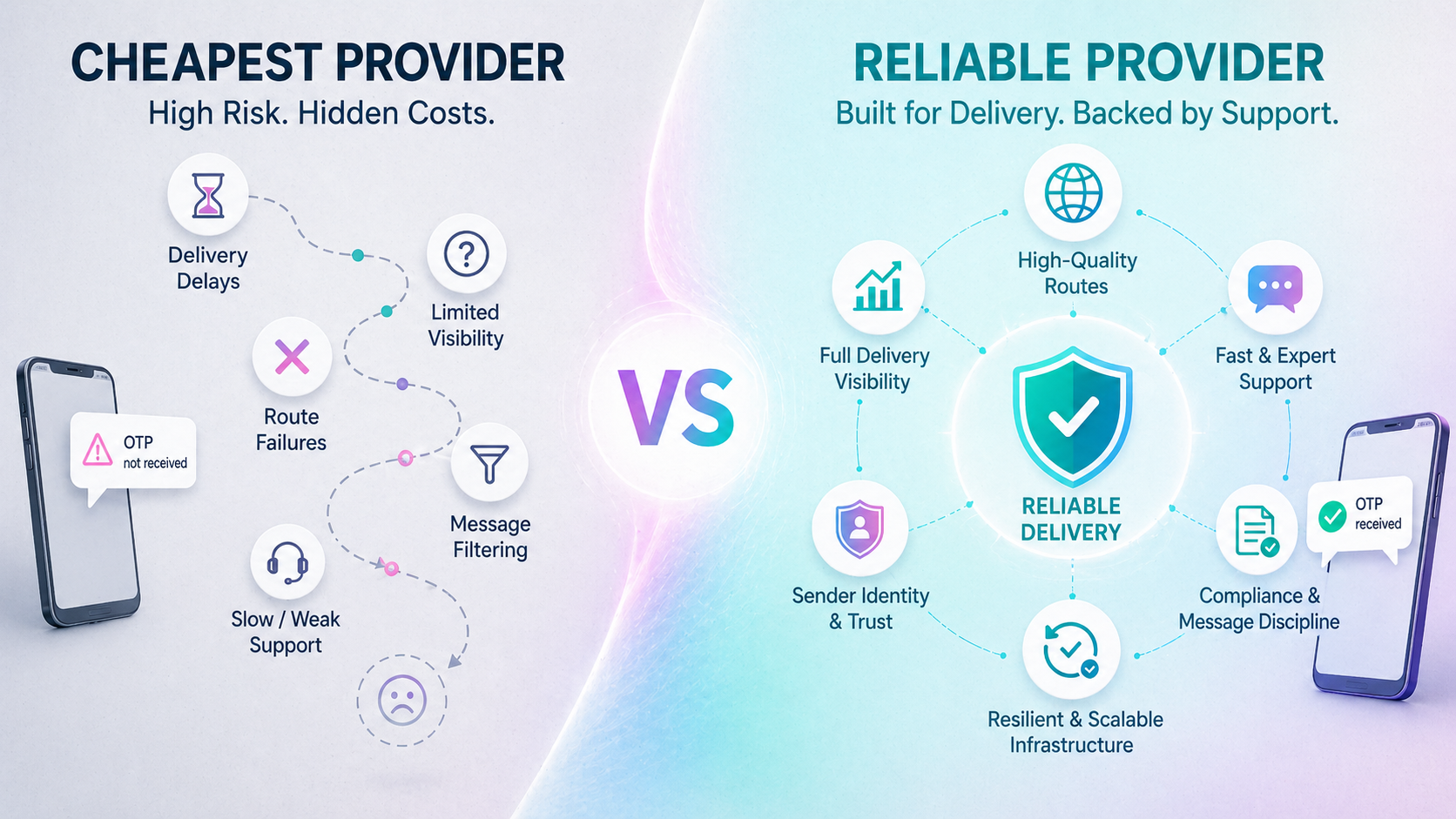
How a Transactional SMS Provider Handles Routing Reliability
A reliable transactional SMS provider should be able to explain how messages are routed, how routes perform across regions, and how delivery is protected when traffic or carrier conditions change. Routing reliability is the foundation of reliable transactional SMS delivery.
This does not mean every business needs a complex telecom architecture review. It means the provider should be able to discuss route quality in practical terms. Which markets are sensitive? Which sender types are supported? What happens when traffic spikes? What changes when a carrier route underperforms?
Check Whether the Provider Can Explain Route Quality by Region
Transactional SMS delivery is local in practice. A route that performs well in one country may behave differently in another because of carrier rules, sender ID expectations, local filtering, or registration requirements.
A serious provider should explain regional differences instead of hiding behind broad coverage claims. For example, a fintech company sending login codes in one market may need different sender identity handling than an ecommerce company sending delivery updates in another.
For reliable transactional SMS delivery, ask the provider to:
- Explain which routes are used for your priority regions.
- Identify markets where sender ID registration or templates may be required.
- Describe how route quality is monitored over time.
- Clarify what happens when a route starts showing delay or failure patterns.
The point is not to demand every technical detail. The point is to see whether the provider understands delivery as an operating system, not a static coverage map.
Look for Route Resilience During Peak Traffic or Carrier Changes
Reliable routing is also about resilience. Transactional traffic is often uneven. Login surges, payment windows, order events, account-security incidents, and seasonal traffic spikes can expose weak routes quickly.
A provider should be able to explain how it handles route changes, carrier congestion, and unexpected delivery slowdowns. MEF notes that the A2P SMS delivery chain includes multiple stakeholders and risk points, and it recommends a “Know Your Supply Chain” approach for brands and enterprises using business messaging [1].
That idea matters for vendor evaluation. If the provider cannot explain its own routing chain, route quality controls, or escalation process, your team may have limited options when a business-critical flow starts failing.
Ask How the Provider Tests Delivery Before Live Business Traffic
Before choosing a transactional SMS provider, ask how delivery is tested before production. Basic message sending is not enough.
Provider testing should cover at least three levels:
- Test representative message types, such as OTPs, account alerts, and order updates.
- Check priority regions and sender identities before launch.
- Review latency, DLR status, and failure categories during pilot traffic.
This is especially important for transactional messages because the user usually waits for the message in real time. A test that only confirms “the SMS can be sent” does not prove that delivery is fast, visible, or dependable under real usage.
How Delivery Visibility Helps You Judge a Transactional SMS Provider
Delivery visibility helps you judge whether a provider can show what happened after a message was sent, not just whether the platform accepted the request. For transactional SMS, poor visibility can be almost as damaging as poor delivery.
A team can fix what it can see. It can escalate a clear failure pattern, adjust a route, review sender identity, or separate message categories. Without visibility, the team can only guess.
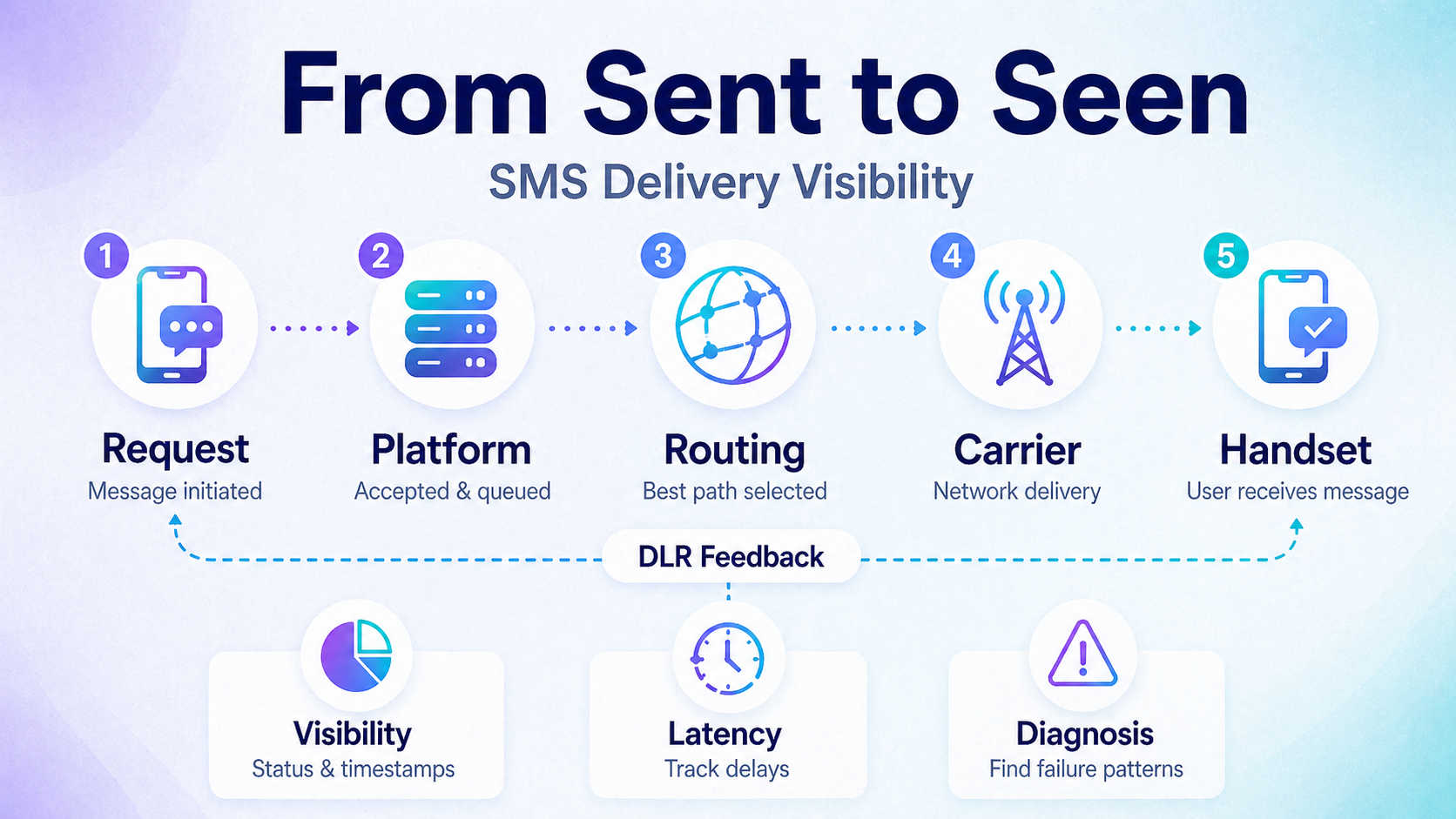
Delivery Receipts Should Show More Than a Sent Status
A delivery receipt should help you understand whether the message reached the handset, failed, expired, or remained uncertain. A simple “sent” status only confirms that the provider accepted or attempted the message. It does not always confirm that the user received it.
A strong transactional SMS provider should help you interpret:
- Status: delivered, failed, expired, rejected, pending, or unknown.
- Reason: carrier rejection, invalid number, filtering, timeout, or route issue.
- Timing: how long delivery took from request to final status.
This level of detail matters when product, operations, and support teams need to answer a basic user complaint: “Why didn’t I receive the code?”
Latency Patterns Can Reveal Reliability Problems Before Failure Rates Rise
Latency is an early warning signal. A route may still show acceptable delivery rates while messages start arriving too late for the business flow.
For example, a one-time password that arrives after the user has already requested a second code can create duplicate verification attempts. An account alert that arrives late may still be technically delivered but lose its protective value. A delivery update that arrives after the customer contacts support creates avoidable tickets.
When evaluating a transactional SMS provider, ask whether the provider can show latency patterns by region, carrier, route, or sender type. If the provider only reports final delivery status, your team may miss reliability issues before they become visible failures.
Monitoring Dashboards Should Help Teams Investigate Failed or Delayed Messages
A dashboard should not be decorative. It should help your team investigate delivery problems.
At a minimum, an SMS delivery provider should give operations teams access to message status, timestamps, failure categories, region-level performance, and searchable message logs. The dashboard should also support escalation: your team should be able to export evidence, share message IDs, and open a route investigation without rewriting the issue from scratch.
The strongest dashboards reduce support time. They let teams move from “users are not receiving messages” to “messages to this region are delayed after this timestamp on this sender type.” That difference matters.
If your team also needs to understand how transactional workflows connect to automation, reporting, and callbacks, the next technical layer is usually the transactional SMS API. Provider selection should come first, then the API evaluation should confirm whether the operational visibility is usable.
How Trust, Consent, Sender Identity, and Message Classification Affect Reliable Delivery
Reliable transactional SMS delivery depends on trust and classification signals because carriers, filters, and users all react differently to recognizable, expected, and properly classified messages. A provider that only talks about routing may miss part of the reliability problem.
This section is where provider evaluation needs more discipline. Consent, sender identity, and message purpose are not legal footnotes. They influence whether messages are accepted, recognized, reported, filtered, or trusted.
Consent Readiness Reduces Filtering and Compliance Risk
A transactional SMS provider should help you understand consent and message-permission expectations for the markets where you send. This does not mean the provider becomes your legal team. It means the provider should help your team avoid obvious messaging mistakes that increase compliance and filtering risk.
In the United States, FCC materials and rulemaking connect text-message regulation with TCPA consent requirements, including prior express consent concepts and protections against unwanted or illegal texts [2]. That makes consent readiness part of vendor evaluation, especially when business messages can be confused with marketing or unwanted traffic.
Ask the provider:
- Confirm what consent records your team should maintain.
- Explain how opt-out handling works where applicable.
- Flag markets or message types that need extra review.
- Separate transactional and promotional flows where rules or expectations differ.
The article does not need to become a legal guide. But your provider should know when messaging practice affects delivery risk.
Sender Identity Support Helps Users Recognize Business-Critical Messages
Sender identity helps users recognize that a message comes from the expected business. It also helps reduce impersonation risk where sender ID registration or protection systems exist.
The UK National Cyber Security Centre advises organizations to make SMS and telephone messages consistent and trustworthy so that customers can distinguish official communications from attempted deception [3]. MEF also describes SMS SenderID protection as a way to help identify and block fraudulent SMS texts and limit fraudsters’ ability to impersonate a brand [4].
For provider evaluation, this means you should ask about sender identity support before launch, not after users begin reporting confusion.
A provider should explain:
- Which sender ID types are available in your target markets.
- Where registration is required or recommended.
- How sender changes may affect trust and filtering.
- What happens if unauthorized variants or spoofing risks appear.
Sender identity is not only a branding concern. For transactional SMS, it can affect user recognition, fraud perception, and trust in the message.
Message Classification Discipline Keeps Transactional SMS From Looking Promotional
Transactional SMS should serve a functional purpose: verification, confirmation, alerting, status updates, or service communication. When messages mix service content with promotions, discounts, upsells, or re-engagement copy, classification becomes harder.
That is a provider-selection issue because a good provider should help teams separate message flows and avoid avoidable risk. A payment confirmation should not behave like a campaign blast. An OTP should not carry an offer. A delivery update should not become a loyalty promotion.
If your team is still deciding whether a message belongs in a service flow or a marketing flow, compare promotional vs transactional SMS before you approve templates. Provider reliability depends partly on keeping these boundaries clear.
Practical classification discipline includes:
- Separating promotional and transactional templates.
- Keeping transactional copy focused on the user action or service event.
- Avoiding unnecessary links, urgency language, or marketing offers in sensitive messages.
- Reviewing mixed-purpose messages before they go live.
The provider does not own your copy strategy. But if the provider cannot explain why classification matters, that is a red flag.
Fraud and Spoofing Risk Should Be Part of Provider Evaluation
Fraud risk affects trust in the whole messaging channel. The FTC warns consumers not to click links in unexpected texts asking for personal or financial information and notes that legitimate companies will not ask for account information by text [5]. NCSC also notes that telecom systems cannot always reliably tell recipients who originated a phone call or SMS, which allows criminals to mimic legitimate organizations [3].
This matters when choosing a transactional SMS provider. If users are trained by fraudsters to distrust account alerts, delivery updates, bank messages, or verification prompts, your legitimate transactional messages must be more consistent and recognizable.
Ask the provider how it handles spoofing risk, suspicious traffic patterns, sender identity abuse, and route-level fraud signals. You are not asking the provider to solve every fraud problem. You are asking whether it understands that reliable delivery and trustworthy delivery are connected.
How Support Accountability Separates a Reliable Transactional SMS Provider From a Basic Sender
A reliable provider should help diagnose delivery issues, explain failure patterns, and own escalation when business-critical messages are delayed or blocked. Support accountability is where many provider differences become visible.
Before signing, evaluate the support process as carefully as the sending price. When transactional SMS fails, your users do not wait for a generic ticket response. They retry, abandon, complain, or contact support.
Support Teams Should Help Explain Delivery Issues, Not Just Close Tickets
A weak support team responds with status labels. A strong support team helps explain what those labels mean and what should happen next.
Provider support should be able to answer questions like:
- Explain whether the issue is route-specific, carrier-specific, region-specific, or sender-specific.
- Identify whether failures are isolated or part of a wider pattern.
- Recommend next steps without pushing every issue back to your internal team.
- Provide evidence that product, operations, and support teams can use.
This is especially important when the business impact is high but the technical signal is messy. Not every delivery problem has a clean answer. Still, the provider should help narrow the problem.
Escalation Paths Matter When OTPs, Alerts, or Account Messages Fail
Escalation is not a nice-to-have for transactional messaging. It is part of the service.
- If login codes fail during a traffic spike, your team needs more than a support mailbox.
- If payment alerts are delayed in one country, you need a path to route investigation.
- If account notifications are filtered, you need someone who can help interpret the pattern.
Before choosing a transactional SMS provider, ask:
- Confirm support hours for priority regions.
- Define escalation thresholds for delayed or failed messages.
- Request the process for route investigation.
- Clarify who owns follow-up when the issue spans carrier, route, sender, and message content.
The answer does not need to be perfect. It needs to be concrete.
Provider Ownership Should Be Clear Before an Incident Happens
Provider ownership should be defined before incidents happen. Otherwise, every delivery issue becomes a blame loop.
The provider may not control every carrier, handset, user setting, or local rule. That is true. But it should still own investigation within its part of the delivery chain. MEF’s guidance on securing A2P SMS business messaging emphasizes the end-to-end delivery chain and the need for stakeholder best practices across messaging providers, enterprises, and operators [1].
For the buyer, this means asking one practical question: when something breaks, what does this provider actually do?
How to Compare Transactional SMS Provider Pricing Against Failure Cost
Transactional SMS pricing should be judged against the cost of failed messages, including abandoned logins, missed alerts, support tickets, and reduced user trust. A low unit price can still be expensive if reliability is weak.
This does not mean the highest-price provider is automatically best. It means price should be evaluated with reliability, visibility, and support together.
Failed or Delayed Messages Can Cost More Than the SMS Fee
The direct SMS fee is usually small compared with the business process behind the message. A login code supports account access. A payment alert supports security. An order update reduces customer uncertainty. A delivery notification reduces support pressure.
Failure cost can include:
- Support tickets from users who did not receive a message.
- Drop-offs from failed login, signup, checkout, or payment flows.
- Retries that increase message volume without improving experience.
- Trust loss when users stop believing business-critical messages.
When comparing transactional SMS providers, estimate the cost of failure in the workflows that matter most. That gives pricing a business context.
Cheap Routes Can Increase Support Load, Drop-Offs, and User Trust Problems
Cheap routes are not always bad. But cheap routes with poor visibility, unstable latency, or weak support can create hidden cost.
A route that saves a fraction of a cent per message may still lose money if it increases OTP retries, support contacts, or abandoned sessions. This is why provider evaluation should include live testing, regional route review, monitoring access, and escalation quality.
Do not ask only, “What is the price per SMS?” Ask, “What does this provider do when delivery quality drops?”
Pricing Should Be Evaluated With Reliability, Visibility, and Support Together
A useful comparison should put price next to operating quality. For each provider on your shortlist, compare:
- Reliability: route quality, regional consistency, peak-traffic behavior.
- Visibility: DLR detail, latency monitoring, error reporting, dashboard access.
- Support: escalation process, issue diagnosis, route investigation, response time.
- Risk: consent support, sender identity, message classification, fraud awareness.
- Cost: unit price, retries, support load, failed transaction impact.
That gives you a better view of total value. Not perfect. Better.
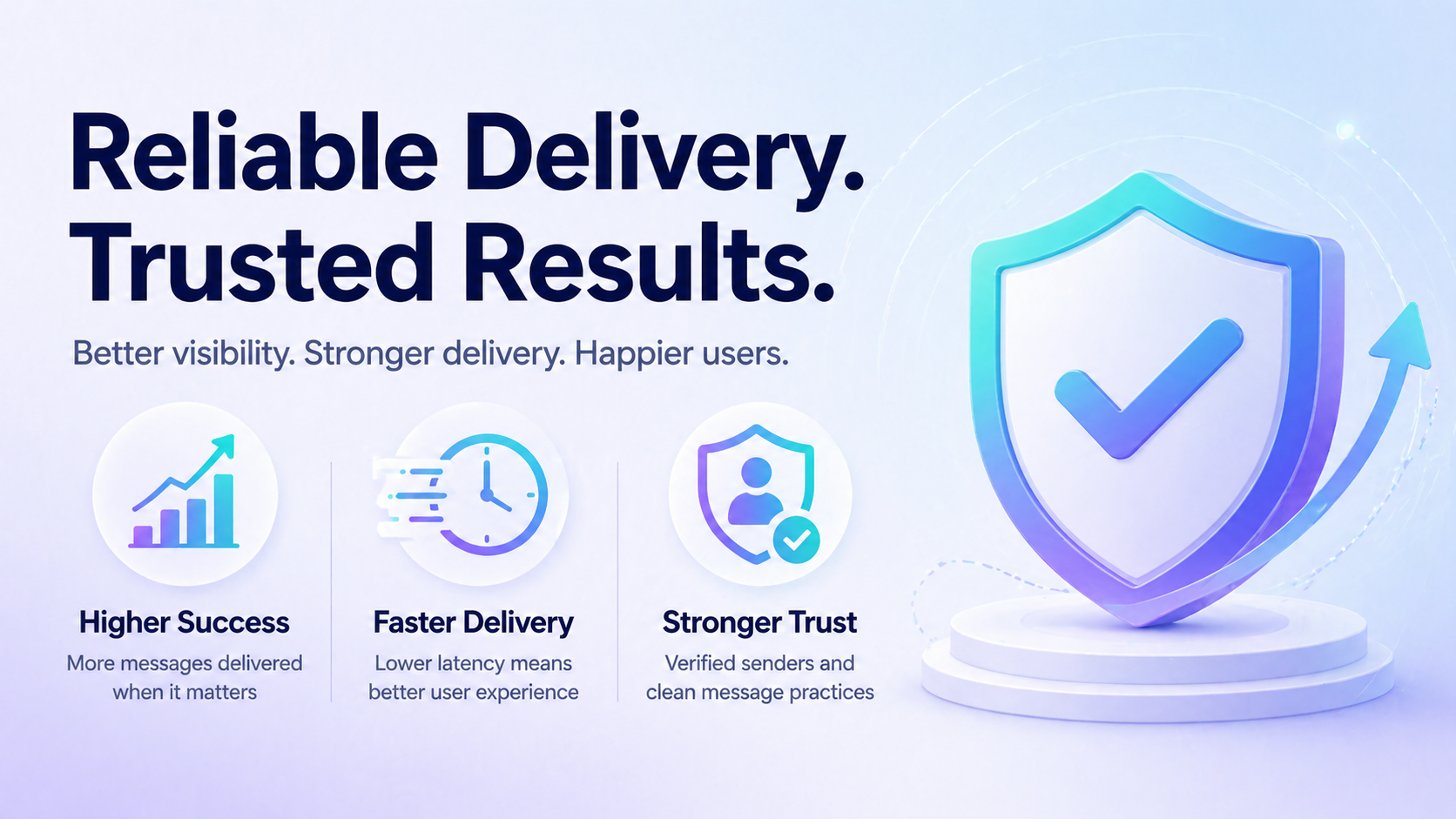
Transactional SMS Provider Shortlist Checklist for Reliable Delivery
A strong transactional SMS provider shortlist should compare routing reliability, delivery visibility, compliance readiness, trust support, support accountability, and realistic pricing together. The goal is not to find the provider with the longest feature list. The goal is to find the provider least likely to fail silently when business-critical messages matter.
Use this checklist as a decision tool, not a template to fill mechanically.
Questions to Ask Before Choosing a Transactional SMS Provider
Before choosing a transactional SMS provider, ask questions that reveal how the provider handles real delivery risk:
- Explain how routing quality is managed in your priority regions.
- Show what delivery receipts and failure reasons are available.
- Describe how latency is monitored and escalated.
- Clarify sender ID support and registration requirements by market.
- Separate transactional and promotional message handling expectations.
- Confirm what consent and opt-out support is available where relevant.
- Define escalation paths for failed OTPs, alerts, or account messages.
- Provide examples of how delivery issues are investigated.
- Identify the operational contacts involved during incidents.
- Compare pricing against retry volume, support load, and failure cost.
A provider that answers these clearly is easier to evaluate. A provider that avoids them may be selling sending capacity rather than delivery reliability.
Red Flags That Suggest Delivery Reliability Risk
Some red flags are easy to miss during vendor evaluation because they sound like normal sales language.
Watch for these signs:
- Guaranteed delivery claims without method, region, or measurement details.
- No clear explanation of DLR statuses or failure categories.
- Limited visibility into latency or regional route performance.
- Vague answers about sender ID registration or local requirements.
- Weak separation between transactional and promotional message handling.
- No clear support escalation path for business-critical failures.
- Pricing that looks attractive but cannot be tied to route quality.
- Support that cannot explain what happens after a message is delayed or blocked.
MEF’s work on A2P SMS fraud and business messaging security points to the complexity of the messaging ecosystem and the need for better supply-chain awareness [1]. In buying terms, that means vague answers are not harmless. They are risk signals.
Final Decision Criteria for a Reliability-First Provider Shortlist
The final shortlist should be narrow. Three providers are usually easier to evaluate deeply than ten providers compared by surface-level feature tables.
A reliability-first shortlist should prioritize providers that can:
- Prove route quality in priority markets.
- Show delivery visibility beyond “sent.”
- Support sender identity and message classification discipline.
- Explain consent-related messaging risks without turning the conversation into a legal lecture.
- Investigate failed or delayed messages with useful evidence.
- Escalate business-critical issues through a clear support path.
- Price routes in a way that makes sense against the cost of failure.
The best choice is rarely the cheapest sender. It is the provider that gives your team the best chance to keep critical customer messages timely, explainable, and trusted.
FAQ About Choosing a Transactional SMS Provider
What should I look for in a transactional SMS provider?
You should look for routing reliability, delivery visibility, consent readiness, sender identity support, message classification discipline, support accountability, and pricing that reflects failure cost. A provider that only talks about price or high delivery rates is not giving you enough information. For example, ask whether you can see DLR status, latency patterns, and route-level issues for your priority markets.
How do I know if a transactional SMS provider is reliable?
A transactional SMS provider is reliable when it can prove how messages are routed, monitored, diagnosed, and escalated. Look for concrete evidence: delivery receipts, latency reporting, regional route knowledge, sender ID support, and a clear incident process. If the provider cannot explain what happens when OTPs or alerts fail, reliability is not yet proven.
Is the cheapest transactional SMS provider a bad choice?
The cheapest transactional SMS provider is not automatically a bad choice, but price should never be evaluated alone. A low per-message fee can become expensive if it increases failed logins, repeated OTP requests, support tickets, or user distrust. Compare price with delivery visibility, support quality, route stability, and failure cost.
Why do transactional SMS messages fail or arrive late?
Transactional SMS messages can fail or arrive late because of route congestion, carrier filtering, sender identity issues, invalid numbers, local market rules, message classification problems, or weak monitoring. Some failures are technical; others come from trust or compliance signals. A good provider should help you distinguish these causes instead of giving only a generic failed status.
Should a transactional SMS provider support sender identity?
Yes, a transactional SMS provider should support sender identity where the market allows or requires it. Sender identity helps users recognize business-critical messages such as login codes, account alerts, and payment notifications. It can also reduce confusion with fraudulent or spoofed messages, especially in markets with sender ID registration or protection systems.
What questions should I ask before choosing a transactional SMS provider?
Ask how the provider manages routing quality, what delivery statuses are available, how latency is monitored, how sender ID is handled, how transactional and promotional traffic are separated, and how support escalates failed messages. Also ask what happens when a route underperforms in one country or carrier. These questions reveal whether the provider can support reliable delivery in real workflows.
Do I need to understand SMS API integration before choosing a provider?
You do not need to study SMS API integration deeply before choosing a provider, but you should understand what operational visibility and reporting you will get. API details belong in a separate technical evaluation. For this decision, focus on whether the provider can support reliable transactional SMS delivery through routing quality, monitoring, classification support, and issue ownership.
References
[1] MEF — Securing A2P SMS Business Messaging. Used for A2P delivery-chain risk, supply-chain awareness, fraud mitigation, and provider accountability.
[2] FCC / Federal Register — Targeting and Eliminating Unlawful Text Messages; TCPA implementation. Used for consent, illegal text, and robotext risk context.
[3] UK National Cyber Security Centre — Business communications: SMS and telephone best practice. Used for trustworthy SMS communication, sender consistency, customer recognition, and fraud-risk framing.
[4] Mobile Ecosystem Forum — SMS SenderID Protection Registry. Used for sender identity, brand impersonation, smishing, spoofing, and fraudulent SMS blocking context.
[5] FTC Consumer Advice — How to Recognize and Report Spam Text Messages. Used for spam text, suspicious account-message, phishing, and user-trust risk.