

RCS is richer than SMS, but richer does not mean SMS is obsolete. For business messaging, the practical SMS vs RCS question is whether RCS can reach the user under real device, OS, carrier, market, and business messaging support conditions—or whether SMS fallback is still needed to protect reliable reach.
That is the core of a fallback strategy. RCS can improve the message experience with richer media, suggested replies, branding, and more conversational flows, but SMS often remains the safer baseline when a business cannot afford a reach gap. For teams comparing rich messaging with baseline reach, it helps to understand what affects SMS deliverability before removing SMS from a fallback plan.
Why SMS vs RCS Is a Fallback Strategy, Not a Replacement Question
SMS vs RCS is not mainly about replacing one channel with another; it is about deciding when rich messaging needs SMS fallback to protect reach. A replacement question asks, “Which channel is better?” A fallback strategy asks, “What happens when the richer channel is not available?”
That difference matters for cross-border growth teams, product operations, and messaging infrastructure owners. A beautiful RCS message can still fail the business goal if the recipient’s device, carrier, operating system, region, or RCS Business Messaging environment cannot support it.
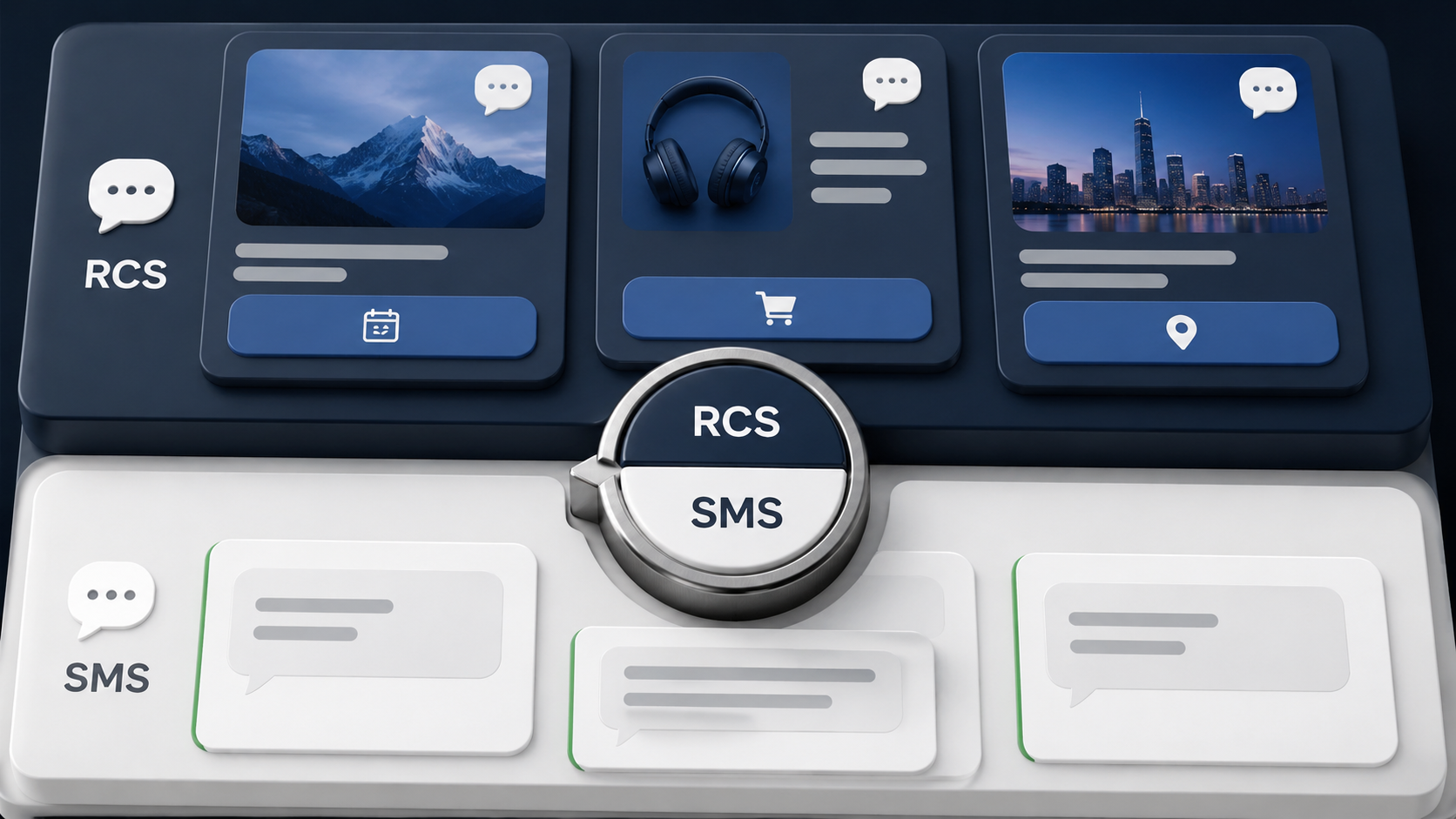
Why Richer RCS Messages Do Not Remove the Need for SMS
RCS can offer a stronger customer experience than plain SMS in many cases. It can support richer media, suggested replies, rich cards, and more guided conversations through RCS for Business agents [2]. That makes it useful for product discovery, delivery updates, appointment flows, customer support, and promotional campaigns where interaction matters.
But reach is not the same as experience. A richer message only helps if the user can actually receive it. If the user’s device is not RCS-enabled, Google’s RCS for Business guidance says the business should use another communication method such as SMS [3].
Where the “RCS Replaces SMS” Assumption Breaks in Business Messaging
The “RCS replaces SMS” assumption breaks when a team treats feature richness as the only decision factor. Business messages are often tied to time, trust, and operational outcomes: a delivery notice, a limited-time offer, a support prompt, a fraud alert, or a verification-sensitive message.
In those cases, the safer question is not “Can RCS do more?” It is: Can this RCS message reliably reach this user in this market, at this moment, before the message loses value?
What SMS, RCS, RCS Business Messaging, and SMS Fallback Mean
SMS, RCS, RCS Business Messaging, and SMS fallback each play a different role in a business messaging flow. The article uses these terms in a business operations sense, not as a deep telecom protocol guide.
| Term | Practical meaning for business messaging |
|---|---|
| SMS | A text messaging channel used as a broad baseline for simple, time-sensitive, and widely reachable business messages. |
| RCS | Rich Communication Services, a messaging standard that modernizes traditional SMS with richer features such as group chats, file sharing, and read receipts [1]. |
| RCS Business Messaging | A business-facing RCS model where agents send messages, receive responses through webhooks, and use rich cards, media, and suggestions to guide user interactions [2]. |
| SMS fallback | A backup path that sends an SMS or other supported message when RCS is unavailable, undelivered, expired, or unsuitable for the user’s device or context [3][4]. |
What SMS Provides as the Reliable Reach Layer
SMS provides the reliable reach layer in this strategy. It is not always the most expressive channel, and it is not designed for the same rich interface as RCS. Its value is that it can remain in the delivery path when rich messaging support is uncertain.
For teams working across countries, carriers, and device types, that baseline matters. SMS fallback can reduce the risk that a user misses a message simply because RCS support is incomplete.
What RCS Adds to Business Messaging
RCS adds more expressive message experiences. According to Google’s RCS for Business documentation, agents can use rich cards, media, and suggestions to guide users through business conversations [2]. Apple also describes RCS messaging as supporting texts, high-resolution photos and videos, links, delivery receipts, read receipts, and typing indicators on supported iPhone plans [5].
That is a real upgrade for many customer journeys. RCS can make a message easier to understand, easier to act on, and more brand-recognizable. But it still depends on support conditions.
What SMS Fallback Means in an RCS Business Messaging Flow
SMS fallback means the business does not leave the message outcome entirely dependent on RCS delivery. If a user is not RCS-enabled, if delivery is not confirmed, or if a time-sensitive message expires before delivery, the system can move to SMS or another fallback method.
Google’s best-practice guidance is direct on this point: before starting a conversation, verify that the user’s device can receive RCS; if it cannot, set up fallback communication such as SMS [3].
SMS vs RCS Comparison: Where Rich Experience Ends and Reliable Reach Begins
SMS and RCS differ most in reach, media depth, branding, interactivity, and support dependency. The comparison should not end with “RCS has more features.” For business messaging, the more useful comparison is which channel protects the message goal under real-world conditions.
| Dimension | SMS | RCS / RCS Business Messaging | Fallback implication |
|---|---|---|---|
| Reach role | Broad baseline reach | Richer reach where supported | Keep SMS in the path when support is uncertain |
| Media | Plain text and basic links | Rich cards, media, PDFs, suggested replies/actions [2][6] | Use RCS when richer context improves action |
| Branding | Sender identity depends on local setup and sender type | More branded, guided business experiences through RCS agents [2] | Stronger branding does not remove support checks |
| Interactivity | Simple replies and links | Suggested replies, actions, conversational flows [2] | Best for guided journeys, not every urgent message |
| Support dependency | Less dependent on RCS-specific support | Depends on RCS-enabled devices and support conditions [3][5] | SMS fallback protects unsupported users |
| Time sensitivity | Useful for short, urgent messages | Useful when delivery and support conditions are known | Use TTL and fallback rules for time-sensitive RCS [4] |
Reach, Media, Branding, Interactivity, and Support Dependency
RCS wins on experience depth. SMS often wins on baseline simplicity and fallback value. That is why the SMS vs RCS decision should be made by message outcome, not by channel preference.
A product card, a delivery flow, or a guided support path may benefit from RCS. A short urgent alert may still need SMS as the safer fallback layer, especially when the recipient environment is unknown.
When RCS Creates a Better Experience Than SMS
RCS creates a better experience when the user can receive it and the message benefits from interaction. Examples include a retail offer with a product image, a support flow with suggested replies, or a delivery update where the user can choose a next action.
The value is not only visual. RCS can reduce friction by keeping the action inside the messaging flow. But this is only useful when the user’s device and market support the experience.
When SMS Remains Safer Than RCS for Reach
SMS remains safer when reach matters more than richness. Examples include urgent alerts, simple delivery notices, basic appointment reminders, or fallback copies of time-sensitive messages.
This does not mean SMS is always “better.” It means SMS is often the safer fallback when the business goal is to get essential information to the user with fewer support assumptions.
Why RCS Support Conditions Decide Whether SMS Fallback Is Needed
RCS support conditions decide whether a rich message can reach the user before fallback is needed. A team can design a strong RCS experience and still need SMS fallback because support is not determined by creative quality alone. When support conditions are unclear, it is useful to separate channel availability from broader causes of why SMS messages are not delivered.
| Support condition | Why it matters | Evidence position |
|---|---|---|
| Device capability | The user’s device must be able to receive RCS. | Google advises capability checks before starting RCS conversations [3]. |
| OS support | The operating system must support RCS messaging. | Apple requires iOS 18 for RCS on iPhone [5]. |
| Carrier support | The user’s cellular plan and carrier must support RCS. | Apple states RCS requires a carrier plan that supports RCS on iPhone [5]. |
| Region / market | Availability can vary by region and carrier. | Apple states availability varies by region and carrier [5]. |
| Business messaging enablement | RCS Business Messaging is not the same as every consumer RCS chat. | Google describes RCS for Business agents, APIs, webhooks, and business flows [2]. |
Device and OS Support: Why User Compatibility Comes First
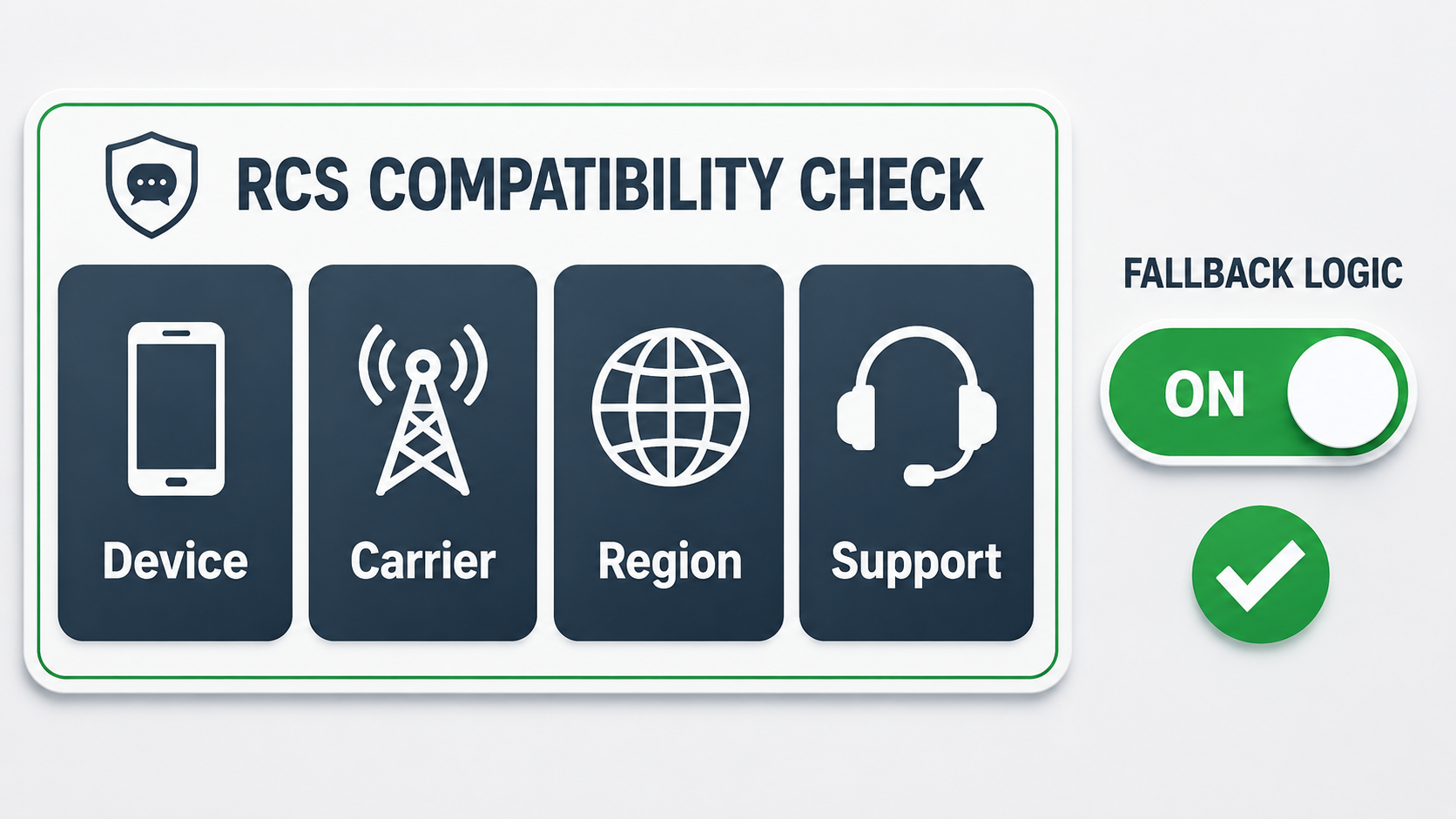
Device and OS support comes first because RCS cannot be assumed at the user level. Apple’s support page says iPhone users need iOS 18 and a cellular plan from a carrier that supports RCS messaging on iPhone [5]. Google’s best practices also tell businesses to verify device capabilities before starting an RCS conversation [3].
That makes compatibility a pre-send question. If the user cannot receive RCS, the fallback path needs to be ready before the campaign goes live.
Carrier and Market Support: Why Cross-Border Reach Can Vary
Carrier and market support create more complexity for cross-border messaging. A campaign that works in one country or carrier environment may not work the same way elsewhere.
Apple’s carrier support pages are organized by country, region, and carrier features, which is a practical reminder that messaging support is not universal across every market [7]. For global teams, that means the fallback strategy should be built into rollout planning, not added after support gaps appear.
Business Messaging Enablement: Why RCS Availability Is Not Automatic
RCS availability for person-to-person messaging does not automatically mean every business messaging use case is ready. RCS for Business involves agents, messages, events, requests, APIs, webhooks, and business-side logic [2].
That is why infrastructure owners should separate three questions: Can this user receive RCS? Can this business use RCS Business Messaging for this market and use case? And what happens if the answer changes at delivery time?
When SMS Fallback Protects RCS Business Messaging from Reach Gaps
SMS fallback protects business messaging when RCS cannot reliably reach every intended user. The fallback layer is not a sign that RCS failed as a channel. It is a design choice that protects the business outcome.
SMS fallback checklist before removing SMS from an RCS flow
- Check whether the user’s device can receive RCS.
- Confirm whether the user’s carrier and market support the required RCS experience.
- Define when an undelivered RCS message should expire.
- Verify delivery receipts before sending a fallback SMS.
- Revoke the original RCS message when needed to reduce duplicate-message risk.
- Trigger SMS fallback for critical or time-sensitive messages when delivery is uncertain.
- Review delivery evidence after rollout before changing channel priority.
Google’s RCS for Business guidance supports this operational approach: it recommends checking delivery receipts before fallback, matching TTL to connection timeout where possible, and attempting revocation before sending fallback SMS [3]. Google’s send-message documentation also says message expiration can be a cue to invoke a fallback messaging strategy for time-sensitive messages [4].
Unsupported Users: When SMS Keeps the Message Path Open
Unsupported users are the simplest reason to keep SMS fallback. If the user’s device is not RCS-enabled, Google says to set up fallback communication such as SMS [3].
For cross-border teams, this is not an edge case to ignore. Device mix, carrier support, user settings, and regional availability can vary enough that fallback planning becomes part of basic campaign readiness.
Time-Sensitive Messages: When Delay Costs More Than Rich Media
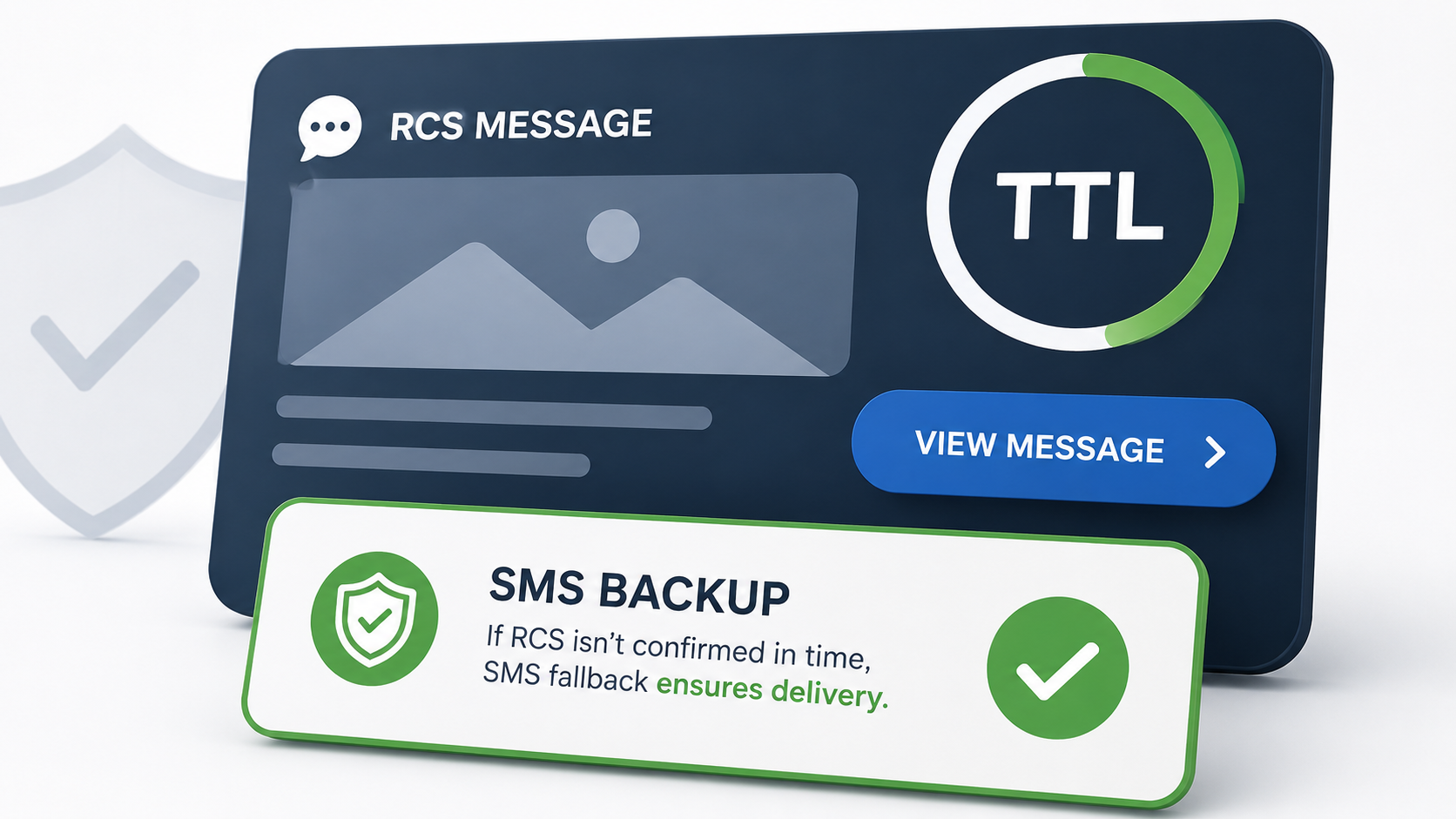
Some messages lose value quickly. OTPs, limited-time offers, and appointment reminders are not useful if they arrive too late. Google’s send-message documentation explains that TTL can define how long an RCS message remains valid and that expiration can help prevent stale content from reaching offline users later [4].
This is where SMS fallback becomes operationally important. If the message is critical and the RCS status is uncertain, the fallback path should protect timing first. Teams building automated service messages can also compare this with a transactional SMS API workflow, where callbacks, delivery receipts, and failure handling matter after the send request.
Cross-Border Rollouts: When SMS Reduces Regional Coverage Risk
Cross-border rollouts create uneven conditions. One market may support a rich RCS journey; another may need SMS as the main delivery path. A third may require a hybrid approach.
SMS fallback reduces regional coverage risk by giving the business a baseline option. It does not remove the need for local compliance, consent, routing, sender identity, or delivery monitoring. It simply prevents the messaging strategy from depending on one rich channel everywhere.
SMS vs RCS Use-Case Matrix: Which Message Types Need Fallback?
The need for SMS fallback changes by message type, urgency, region, and user support condition. A good SMS vs RCS use-case matrix does not ask which channel is more modern. It asks which channel best protects the intended user action.
| Message type | RCS role | SMS role | Fallback recommendation |
|---|---|---|---|
| Promotional offers | Rich visuals, product cards, suggested actions | Broad campaign coverage | Use RCS where supported; keep SMS fallback for unsupported users |
| Order updates | Branded updates, richer context | Short reliable status notices | Use SMS when reach matters more than visual detail |
| Urgent alerts | Useful only if support and delivery are strong | Strong fallback for immediate reach | Keep SMS in the delivery path |
| Customer support prompts | Guided replies and actions | Simple reminders or support links | Use RCS for interaction; SMS for fallback prompts |
| Verification-sensitive messages | Limited use where timing is controlled | Short, time-sensitive fallback messages | Keep SMS fallback for critical flows; avoid overpromising identity orchestration |
Promotional Offers: Use RCS for Engagement and SMS for Coverage
Promotional offers can benefit from RCS when rich cards, images, suggested actions, and guided replies improve engagement. A product launch, limited-time sale, or loyalty offer may become easier to act on when the user sees more context inside the message.
But promotional reach still matters. If a segment cannot receive RCS, SMS fallback can keep the campaign from excluding reachable users.
Order Updates and Alerts: Use SMS When Reliable Reach Comes First
Order updates and alerts often need to be understood quickly. A short SMS can be enough for “your order shipped,” “your appointment is tomorrow,” or “your delivery window changed.”
RCS may add value when the message includes action buttons, rescheduling choices, or rich delivery details. But if the message is time-sensitive, SMS fallback should be planned before launch.
Support and Verification-Sensitive Messages: Keep SMS in the Delivery Path
Support flows can benefit from RCS because suggested replies and guided actions reduce user effort. Verification-sensitive messages are different. They are usually time-bound, short, and operationally sensitive.
The safe position is not to make verification the center of the RCS story. Keep SMS in the delivery path where timing and reach matter, and treat OTP or authentication-related use cases as selective scenarios rather than a broad identity-system promise.
How to Build an SMS vs RCS Decision Framework for Reliable Reach
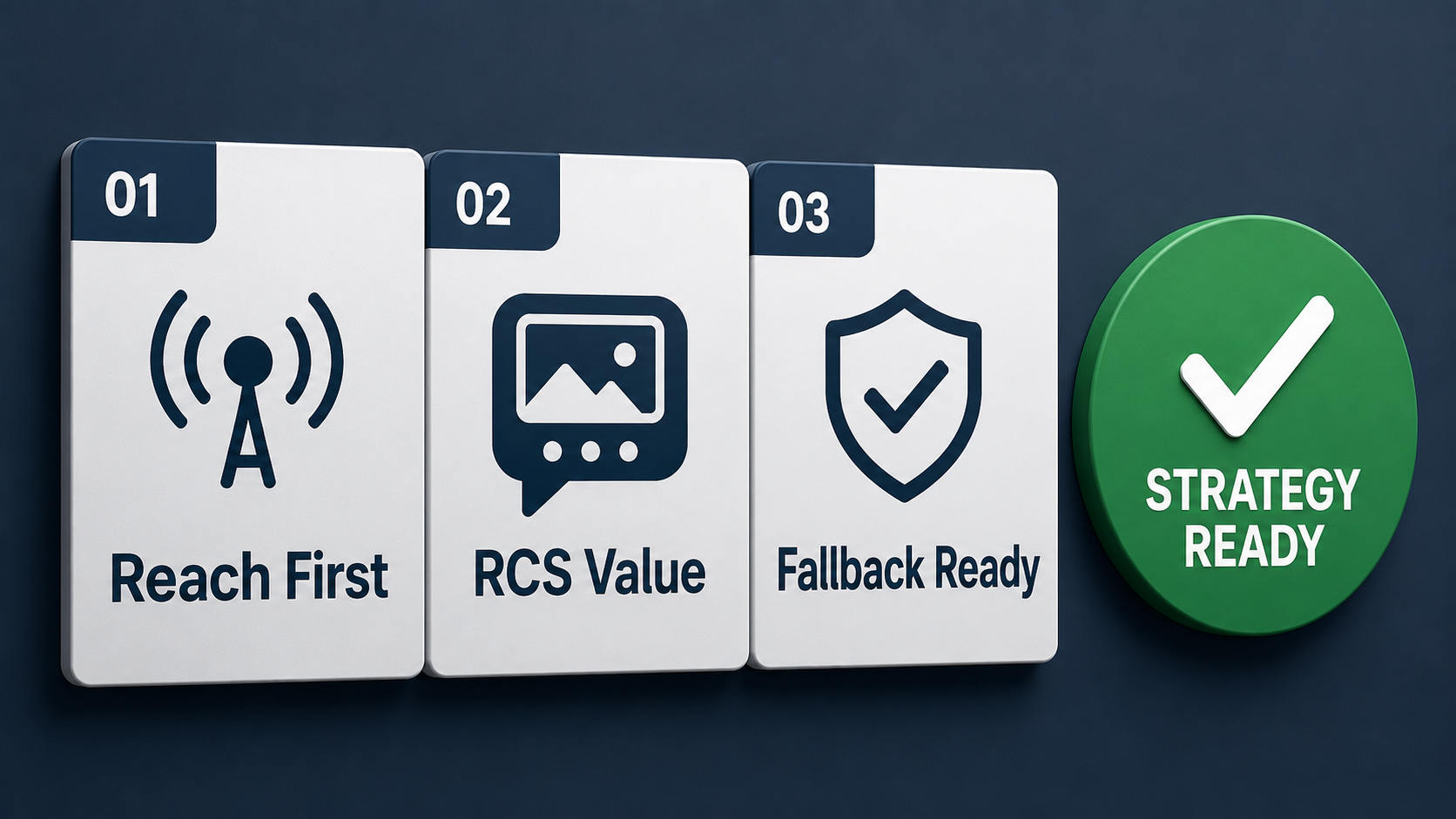
A practical SMS vs RCS decision framework should check reach first, then rich experience value, then fallback rules. The goal is not to pick one channel forever. The goal is to define which channel leads, which channel supports, and when fallback activates.
Step 1: Check the Reach Requirement Before the Rich Messaging Value
Start with reach. Ask whether the message must reach nearly every eligible user, whether it is time-sensitive, and whether the campaign spans multiple markets.
If reach is the primary requirement, SMS should remain in the path. If rich interaction is the primary requirement and support is known, RCS can lead.
Step 2: Match RCS Value to the Message Type
Use RCS when the message gains clear value from rich presentation or interaction. Examples include guided support, product discovery, onboarding choices, appointment changes, or delivery actions.
Do not use RCS just because it looks better. If the user only needs a short status update, SMS may be enough—or at least necessary as fallback.
Step 3: Define SMS Fallback Rules Before Launch
Fallback rules should be defined before launch, not after delivery issues appear. Decide what counts as unsupported, undelivered, expired, or uncertain.
Google’s best practices make this operational: verify delivery receipts before fallback, attempt to revoke the original message before sending fallback SMS, and avoid assuming that a timeout means the RCS message was never delivered [3].
Step 4: Review Delivery Evidence After Rollout
After rollout, review evidence instead of relying on assumptions. Look at capability checks, delivery receipts, TTL or revocation notifications, fallback sends, response patterns, and market-level gaps. If messages are blocked, delayed, or treated inconsistently, the issue may belong closer to SMS filtering than to the channel comparison itself.
The decision may change by region or use case. That is normal. A strong strategy lets RCS improve the experience where it is ready, while SMS fallback protects reach where support is incomplete.
FAQ About SMS vs RCS Fallback Strategy
Is RCS Going to Replace SMS for Business Messaging?
RCS is not replacing SMS for every business messaging scenario. RCS improves the experience where it is supported, but SMS still plays an important fallback role when reach, timing, or market support is uncertain. A safer model is RCS plus SMS fallback, not RCS instead of SMS.
When Should a Business Use SMS Instead of RCS?
A business should use SMS instead of RCS when the message is short, urgent, broad-reach, or being sent into a market where RCS support is uncertain. Examples include urgent alerts, simple appointment reminders, and fallback copies of time-sensitive messages. RCS can still be used for richer journeys when capability and support checks confirm that users can receive it [3].
Does RCS Business Messaging Always Fall Back to SMS?
RCS Business Messaging does not mean fallback should be assumed without design. Google’s documentation says that if a device does not support RCS, the platform returns an error and the agent should fall back to another technology such as SMS [2]. Best practices also say businesses should verify delivery receipts and attempt revocation before fallback to avoid duplicate messages [3].
Is SMS Fallback Still Needed for Cross-Border Campaigns?
SMS fallback is often still needed for cross-border campaigns because RCS support can vary by device, OS, carrier, and region. Apple’s support guidance states that RCS availability varies by region and carrier [5]. Cross-border teams should check support conditions market by market rather than assuming one RCS rollout model works everywhere.
How Should Teams Decide Between SMS, RCS, and Fallback?
Teams should decide by reach requirement, message type, urgency, market support, and delivery evidence. Use RCS when rich interaction improves the user action and support is confirmed. Keep SMS fallback when the message must reach users despite uncertain support conditions.
Which Message Types Need SMS Fallback Most?
Time-sensitive and operational messages need SMS fallback most. Examples include appointment reminders, delivery alerts, urgent service notices, and verification-sensitive messages. These messages can lose value if delivery is delayed or unsupported, so fallback rules should be defined before launch [4].
How Should Teams Compare SMS vs RCS for Reliable Reach?
Teams should compare SMS vs RCS by asking what each channel protects. RCS protects richer interaction where supported. SMS protects broader reach when support is uncertain. A reliable business messaging strategy often needs both roles.
References
GSMA. Rich Communication Services overview.
Google for Developers. How RCS for Business works.
Google for Developers. RCS for Business best practices.
Google for Developers. Send messages: TTL, revocation, and fallback handling.
Apple Support. Turn on RCS messaging on your iPhone.
Google for Developers. Send messages: rich cards, media, suggested replies, and suggested actions.
Apple Support. Wireless carrier support and features for iPhone.
Soft Evaluation Path After the Decision Framework
If your team is reviewing SMS vs RCS for cross-border business messaging, the safest next step is not to remove SMS from the plan too early. Start by checking market support, fallback readiness, routing reliability, delivery evidence, and coverage risk.
SMSBoosting focuses on SMS routing, reliable delivery, and A2P messaging performance. For teams that need to protect reach while evaluating richer messaging options, a practical review of SMS fallback rules can help reduce avoidable coverage gaps without turning the strategy into a hard channel switch.
Talk to SMSBoosting


