SMS compliance defines who can send business text messages, what they can send, and how consent must be handled. In practice, it’s enforced by regulators, industry bodies, and mobile carriers—and it directly impacts whether your messages land in inboxes or get filtered.
If you ignore SMS compliance, the results are predictable: blocked traffic, throttled delivery, account suspension, and sometimes fines.In this guide, we’ll explain who sets SMS compliance rules, how they’re enforced, and why compliance is one of the biggest factors behind strong SMS deliverability.

Source: Designed by Freepik
What is SMS Compliance?
SMS Compliance refers to the set of rules and policies established by government and official authorities for businesses to send text messages to customers. These rules are established to protect customers from spam, fraud, and unnecessary messages while keeping mobile networks stable. They apply to all message types, including:
- Marketing Promotions
- Transactional Alerts
- One-Time Passwords (OTP)
- Account Notifications
- Service Updates
When businesses follow these rules, carriers trust their traffic—and messages reach inboxes consistently.
If service providers and businesses fail to comply with these laws, carriers step in with filtering, blocking, or full account shutdowns. Carriers deeply monitor these messages to ensure proper compliance and consumer data protection.
Why Does SMS Compliance Exist?
SMS compliance exists to protect users, maintain network integrity, and ensure relevant messages reach inboxes—especially in SMS marketing, where consent, sending frequency, and content transparency directly affect carrier filtering and long-term deliverability.
From a carrier’s perspective, every unwanted message hurts network trust. From a user’s perspective, spam kills confidence in SMS as a channel.
That’s why compliance focuses on:
- Preventing spam and fraud before it reaches consumers
- Protecting user consent and opt-out rights
- Maintaining carrier network integrity
- Ensuring legitimate traffic gets priority delivery
In simple terms, compliance tells carriers which senders deserve inbox access—and which ones don’t.
Who Sets and Enforces SMS Compliance Rules in the United States?
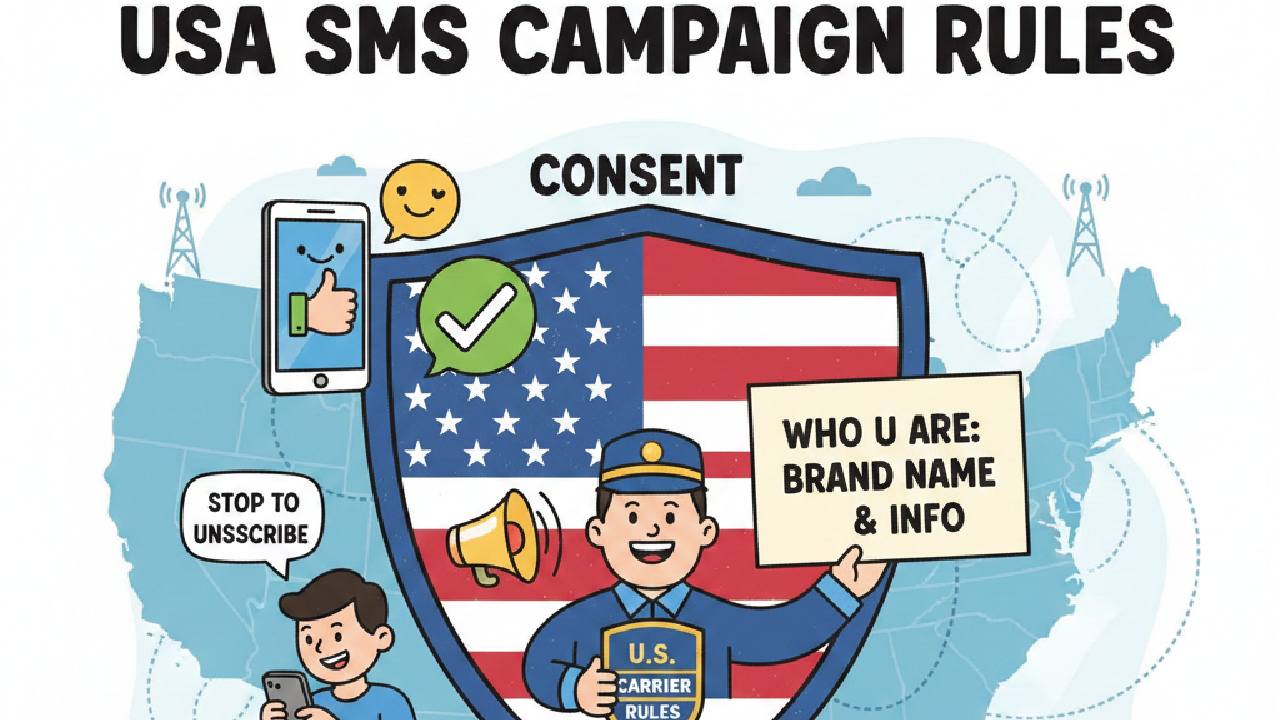
In the U.S., SMS compliance isn’t controlled by one single authority. It’s enforced through multiple overlapping layers.
i) Federal Communications Commission (FCC) & Telephone Consumer Protection Act (TCPA)
The FCC enforces TCPA rules, which define how businesses can contact consumers via text and calls.
TCPA focuses heavily on:
- Express written consent
- Clear opt-in language
- Consumer protection from unsolicited messages
Violations can lead to lawsuits, fines, and forced shutdowns.
ii) Cellular Telecommunications Industry Association (CTIA)
CTIA sets industry standards that carriers follow.
These include rules around:
- Opt-in and opt-out handling
- Brand identification
- Content categories
- SHAFT restrictions (Sex, Hate, Alcohol, Firearms, Tobacco)
- SMS audit
Carriers actively audit traffic against CTIA guidelines.
iii) Federal Trade Commission (FTC)
The FTC focuses on deceptive or misleading messaging practices, especially scams. This department works in parallel with FCC to protect customers’ personal data and ensure scam-free campaigns.
If your SMS content misrepresents offers, pricing, or identity, FTC enforcement can come into play—even if carriers haven’t blocked you yet.
iv) Mobile Network Operators (Carriers)
Ultimately, carriers make the final delivery decision.
They enforce:
- 10DLC registration
- Content filtering
- Rate limiting
- Automatic spam detection
If carriers don’t trust your traffic, compliance on paper won’t save your deliverability.
How 10DLC Registration Improves Compliance and Deliverability?
10DLC registration is mandatory for most U.S. business messaging—and it’s one of the strongest deliverability signals carriers use.
10DLC is a 10-digit long code assigned by U.S. carriers to service providers. It aligns with FCC and TCPA policies to ensure legitimacy and provides a regulated message channel for business messaging on standard 10-digit phone numbers.
When you complete 10DLC registration:
- Your brand identity is validated
- Message use cases are disclosed
- Sending limits are clearly defined
From the carrier’s view, this separates legitimate businesses from anonymous bulk senders. On the customer’s end, it creates a clear, transparent communication flow that fosters trust and makes it easy to opt in.
Even transactional traffic like OTP SMS is closely monitored by carriers, especially when message patterns resemble bulk sending or lack consistent sender identification.
There is no inclusion of spam, fraud, or extra promotional messages. The 10DLC is proof that a messaging service provider is reputable.
How Global Standards Like GDPR Influence SMS Compliance?
General Data Protection Regulation (GDPR)
GDPR governs how personal data is collected, stored, and used—including phone numbers used for SMS. Even non-EU businesses must comply if they message EU residents.
Key GDPR requirements include:
- Get consent from each recipient before sending SMS messages.
- Personal data must be secure and used only for the stated purpose.
- Customers should have access to delete their data at any time.
- Every policy by the service providers should be transparent and clear.
Penalties for violations can reach up to 4% of global annual revenue, which is why carriers take GDPR signals seriously.
How EU Privacy Rules Differ From U.S. Carrier-Based Compliance
EU privacy rules and U.S. SMS compliance rules aim to protect users—but they focus on very different risks.
In simple terms, EU regulations focus on how personal data is handled, while U.S. rules focus on how messages are sent and perceived on carrier networks. This difference affects how businesses prepare, document, and monitor their SMS programs.
To make the contrast clearer, here’s a side-by-side comparison:
| Aspect | EU Privacy Rules (GDPR) | U.S. Carrier-Based Compliance |
| Primary Focus | Personal Data Protection | Network Integrity & Message Behavior |
| Main Enforcement Body | Government Regulators | Mobile Carriers |
| Core Risk Area | Data Collection, Storage, Usage | Sender Identity, Content, Sending Patterns |
| Consent Requirements | Strict, Documented, Auditable | Required, Behavior Closely Monitored |
| Penalties for Violations | Revenue-Based Fines (Up to 4%) | Message Blocking, Throttling, Account Suspension |
| Enforcement Scope | Universal Across EU | Jurisdictional and Carrier-Specific |
| Typical Business Impact | Legal & Financial Exposure | Immediate Deliverability Loss |
For businesses operating across regions, this is why SMS compliance isn’t a one-size-fits-all checklist—it’s an ongoing operational discipline.
Because these systems operate differently, global SMS senders must satisfy both frameworks at the same time. Strong data privacy practices alone won’t protect deliverability in the U.S., and clean sending behavior won’t offset poor data handling in the EU.
What Are The Key SMS Compliance Requirements You Must Follow?
To stay compliant and protect deliverability, every sender must handle these basics correctly.
i) Obtain Explicit Consent (EWC) and Use Double Opt-In When Possible
You must obtain Express Written Consent (EWC) before sending messages. Double opt-in adds an extra layer of protection and carrier trust. If these conditions are not met, you will face penalties under the TCPA and GDPR. It will lower SMS message deliverability and increase the risk of account suspension.
ii) Provide Clear, Easy Opt-Out Instructions in Every Message

It must be the customer’s right to opt out or stop receiving messages at any time. There must be a clear opt-out procedure. Use keywords such as Stop, Cancel, and Unsubscribe in your SMS message. Ignoring this can lead to message filtering, spam, and violations of legal rules and regulations.
iii) Identify Your Brand Clearly to Ensure Transparency
A clear, transparent presentation of your brand positively impacts customers’ perceptions. Include brand name, product name, and registered sender ID in every sms message. If not, the messages can be considered spam and blocked or filtered by carriers. Customers will feel confused about trusting your brand.
iv) Follow Content Restrictions, Including SHAFT Policies
SHAFT policies control the messages that are based on sexually explicit, hateful, abusive, fraudulent, alcohol, firearms, tobacco promotions, and threatening content. CTIA is primarily responsible for enforcing the SHAFT rules to protect customers and the integrity of the network carriers. Violating these rules can cause account suspension, delivery issues, and damage the reputation.
Conclusion
SMS compliance isn’t just about avoiding penalties—it’s about earning carrier trust. Businesses and SMS service providers must comply with the rules and regulations introduced by the US or EU authorities. It positively impacts SMS deliverability, brand recognition, service providers’ reputation, and return on investment (ROI).
If you’re running business SMS campaigns, compliance is not optional. It’s the foundation that keeps your messages moving.If you’re looking for a platform that prioritizes Tier-1 routes, carrier compliance, and long-term deliverability, SMS Boosting helps brands stay compliant while scaling responsibly.
FAQs
1. Why are my SMS messages compliant but still getting filtered or delayed?
Compliance alone does not guarantee delivery. Carriers also evaluate sending behavior, message frequency, user engagement, and historical complaint rates. Even compliant messages can be throttled if volume spikes suddenly, opt-out rates rise, or engagement drops.
2. How long does it take for carriers to trust a new SMS sender?
New senders typically go through a “trust warm-up” period that can last several weeks. During this time, carriers closely monitor delivery patterns, opt-outs, and complaint signals. Gradual volume increases usually lead to better long-term deliverability than sending at full scale on day one.
3. What happens if my SMS account gets suspended by carriers?
Carrier suspensions often require corrective actions such as traffic audits, content adjustments, re-registration, or proof of opt-in records. In some cases, traffic restoration takes days or weeks, depending on the severity of the violation.
4. Is using short codes safer than long codes for compliance?
Short codes generally offer higher trust and throughput but come with higher costs and longer approval times. Long codes with proper registration and clean sending behavior can still achieve excellent deliverability when managed correctly.