

Every time a customer checks their inbox for a shipping update and finds nothing, trust erodes by a fraction. Over hundreds of orders, those fractions compound into churn. Ecommerce SMS notifications bridge this gap — turning the post-purchase silence into a structured communication flow that keeps buyers informed, reassured, and engaged. This guide covers the three core notification types (order updates, delivery alerts, and customer reminders), when and how to send each, and what compliance and infrastructure choices determine whether your SMS program strengthens or weakens the customer relationship.
The Real Cost of Silence in Ecommerce Post-Purchase Communication
Why "Where Is My Order?" is the Most Expensive Question in Ecommerce
The "Where Is My Order?" (WISMO) inquiry is the single most frequent support contact for online retailers. Each conversation costs support time, frustrates the customer, and — critically — signals a failure in communication, not delivery. According to industry benchmarks, brands that implement proactive SMS notification flows reduce WISMO tickets by 20–35% [1]. The savings are not just operational: customers who receive structured updates are measurably less likely to check competitor sites during the delivery window.
The Shift from Silent Delivery to Proactive Notification Strategy
The expectation has shifted. A decade ago, an email confirmation was sufficient. Today, 75% of consumers prefer SMS for order and delivery updates over email [2], citing speed and convenience. SMS messages are read within three minutes on average, compared to hours or days for email [3]. The practical implication is clear: if your post-purchase communication relies primarily on email, a significant portion of your customers are operating with less information than they expect.
What This Guide Covers and Who It Is For
This guide is for ecommerce operators, marketing managers, and customer experience teams evaluating or expanding their SMS notification strategy. It covers the three notification pillars, timing and frequency best practices, compliance requirements across major markets, and the operational metrics that determine whether a notification program drives retention or annoyance.
The Three Pillars of Ecommerce SMS Notifications
flowchart LR
    A[Customer places order] --> B[Order Confirmation SMS]
    B --> C[Shipping / Carrier handoff]
    C --> D[Delivery Updates
In-Transit Scan]
    D --> E[Out for Delivery Alert]
    E --> F[Delivery Confirmation]
    F --> G{Post-Purchase}
    G --> H[Review Request]
    G --> I[Replenishment Reminder]
    G --> J[Abandoned Cart
Recovery]

    style B fill:#E8F0E6,stroke:#5D765F,color:#132019
    style D fill:#E8F0E6,stroke:#5D765F,color:#132019
    style F fill:#E8F0E6,stroke:#5D765F,color:#132019
    style H fill:#F0EDE0,stroke:#9A8C6F,color:#132019
    style I fill:#F0EDE0,stroke:#9A8C6F,color:#132019
    style J fill:#F0EDE0,stroke:#9A8C6F,color:#132019
Order Confirmation — The First Signal of Trust
The order confirmation SMS serves a role beyond transaction recording: it is the first post-purchase touchpoint and the strongest signal that the purchase was successful. Best practice is to send it within 30 seconds of payment confirmation, containing:
- Order number and a brief summary of items purchased
- Expected delivery window or a link to tracking
- Customer support contact information
An order confirmation that arrives instantly feels competent. One that arrives an hour later raises doubt — even if fulfillment proceeds smoothly.
Delivery Updates — Real-Time Visibility Builds Customer Confidence
Delivery updates span the entire fulfillment journey: shipment dispatch, carrier handoff, inbound scan, out for delivery, and delivered confirmation. Each event is an opportunity to reduce uncertainty. The most effective ecommerce SMS notifications use a "scan-triggered" model, where each logistics event automatically fires a message.
The key distinction is between status-change updates (triggered by carrier scans) and scheduled check-ins (sent at fixed intervals). Status-change updates feel timely and relevant; scheduled check-ins without actual movement feel like noise.
Customer Reminders — Gentle Nudges That Drive Revenue
Customer reminders fall into two categories: lifecycle reminders (abandoned cart, restock alerts, back-in-stock) and post-purchase follow-ups (review requests, replenishment reminders for consumables). The compliance boundary here is critical — these messages are generally classified as promotional rather than transactional, meaning opt-in and opt-out handling requirements are stricter.
Abandoned cart SMS sequences, when sent as a single gentle reminder 60 minutes after abandonment, can recover 5–15% of lost sales [4]. The key is restraint: one well-timed reminder outperforms three aggressive ones in both conversion and opt-out rates.
Timing and Frequency: The Non-Intrusive Notification Framework
Optimal Send Windows for Each Notification Type
Notification timing should match the customer's information need, not the brand's broadcast schedule:
| Notification Type | Optimal Send Window | Rationale |
|---|---|---|
| Order Confirmation | Within 30 seconds of purchase | Confirms transaction success; reduces immediate anxiety |
| Shipping Confirmation | Within 5 minutes of carrier handoff | Signals that fulfillment has begun |
| In-Transit Update | At each scan event (not daily) | Feels real-time without being repetitive |
| Out for Delivery | 1–2 hours before delivery window | Prepares customer to receive the package |
| Delivery Confirmation | Within 10 minutes of delivery | Provides proof and satisfaction signal |
| Abandoned Cart Reminder | 60 minutes after abandonment | Long enough to be intentional, short enough to stay relevant |
| Review Request | 24–72 hours after delivery | Aligns with unboxing and first-use experience |
Frequency Boundaries and the 3–5 Message Limit per Order Lifecycle
Per-order message volume is the most common area where brands over-communicate. A practical upper bound is 3–5 messages per order lifecycle (order confirmation → shipping → delivery → post-delivery). Each additional message beyond this range increases opt-out probability without proportional engagement benefit [5].
The exception is delivery exceptions: delayed shipments, address issues, or failed delivery attempts warrant immediate, separate notifications. In these cases, the extra message is valuable rather than intrusive.
Handling Exceptions: Delayed Shipments, Failed Deliveries, and Service Outages
Exception handling is where SMS notification programs differentiate themselves. A delayed shipment notification that arrives proactively (before the customer contacts support) significantly reduces frustration. Best practice for exception messages includes:
- Clear statement of the issue and expected resolution time
- A link to tracking or support if resolution time exceeds 24 hours
- Avoidance of vague promises (e.g., "shipping soon" without a date)
Compliance Architecture for Ecommerce Transactional SMS
flowchart TD
    A[SMS Message Content] --> B{Primary purpose?}
    B -->|Facilitate or confirm
customer-initiated transaction| C[Transactional / Operational]
    B -->|Market, promote, or
encourage purchase| D[Promotional / Marketing]

    C --> E[Opt-In Required?]
    E -->|No - under CTIA/GDPR| F[No prior consent needed]
    E -->|Best practice| G[Include STOP/HELP anyway]
    C --> H[Routing: A2P 10DLC
Standard Brand Registration]

    D --> I[Opt-In Required?]
    I -->|Yes| J[Express consent needed]
    D --> K[Routing: A2P 10DLC
Separate Campaign Registration]

    style C fill:#DCE8D4,stroke:#5D765F
    style D fill:#F0EDE0,stroke:#9A8C6F
    style F fill:#E8F0E6,stroke:#5D765F
    style J fill:#F0EDE0,stroke:#9A8C6F
Transactional vs. Promotional: The Legal Distinction That Matters
Under CTIA guidelines and similar frameworks in other markets, transactional SMS (also called operational or notification SMS) is defined as messages that facilitate or complete a transaction the customer has already initiated. Order confirmations, shipping notifications, and delivery updates fall under this category. These messages do not require prior express consent under most regulations [6].
Promotional SMS — including abandoned cart reminders when framed as marketing — requires opt-in, opt-out handling, and in the United States, A2P 10DLC campaign registration. The boundary is sometimes blurry: a cart reminder that includes a discount code is promotional; one that simply says "your items are still waiting" can be classified differently depending on interpretation.
A2P 10DLC, Sender ID Registration, and Country-Specific Requirements
Ecommerce brands sending notification SMS to U.S. numbers must register their use case under A2P 10DLC. Standard brand registration covers transactional messaging, but promotional use cases require separate campaign registration. The registration process includes:
- Brand verification (EIN or comparable business identifier)
- Campaign type selection (transactional, promotional, mixed)
- Message flow description and opt-out mechanism verification
- Trust Score evaluation (higher scores improve delivery rates)
In other markets, requirements vary: the EU requires clear identification of the sender (alphanumeric sender ID where allowed), India mandates DLT registration for all transactional SMS, and markets like Brazil and the UAE have their own registration frameworks.
Opt-Out (STOP) Protocols and Preference Management Best Practices
Even for transactional ecommerce SMS notifications, best practice — and legal requirement in some jurisdictions — is to include a clear opt-out instruction. The standard STOP/HELP protocol (reply STOP to unsubscribe) should be present in every message, including transactional ones.
Preference management goes beyond the binary opt-in/opt-out. Brands that allow customers to select notification types they want to receive (e.g., delivery updates only, no promotional reminders) see lower overall opt-out rates and higher engagement on the messages they do send.
Measuring the Impact: How SMS Notifications Affect CLV and Support Costs
WISMO Reduction: The Direct Support Cost Savings
The most immediately measurable impact of an SMS notification program is the reduction in WISMO tickets. For a mid-size ecommerce operation processing 1,000 orders per day, a 25% reduction in WISMO inquiries translates to approximately 75–100 fewer support contacts daily. At an average cost of $3–5 per ticket, the monthly savings range from $6,750 to $15,000.
These savings partially offset the cost of the SMS infrastructure itself, making notification programs — unlike promotional campaigns — a cost center that can demonstrate direct ROI independent of revenue attribution.
Repeat Purchase Rates and Post-Purchase Communication Correlation
There is a structural correlation between the quality of post-purchase communication and repeat purchase behavior. Customers who receive proactive delivery updates consistently rate their satisfaction higher and return sooner than those who receive only an order confirmation email [7]. The causality is not direct — better communication does not single-handedly drive repeat purchases — but the absence of good communication is a measurable drag on retention.
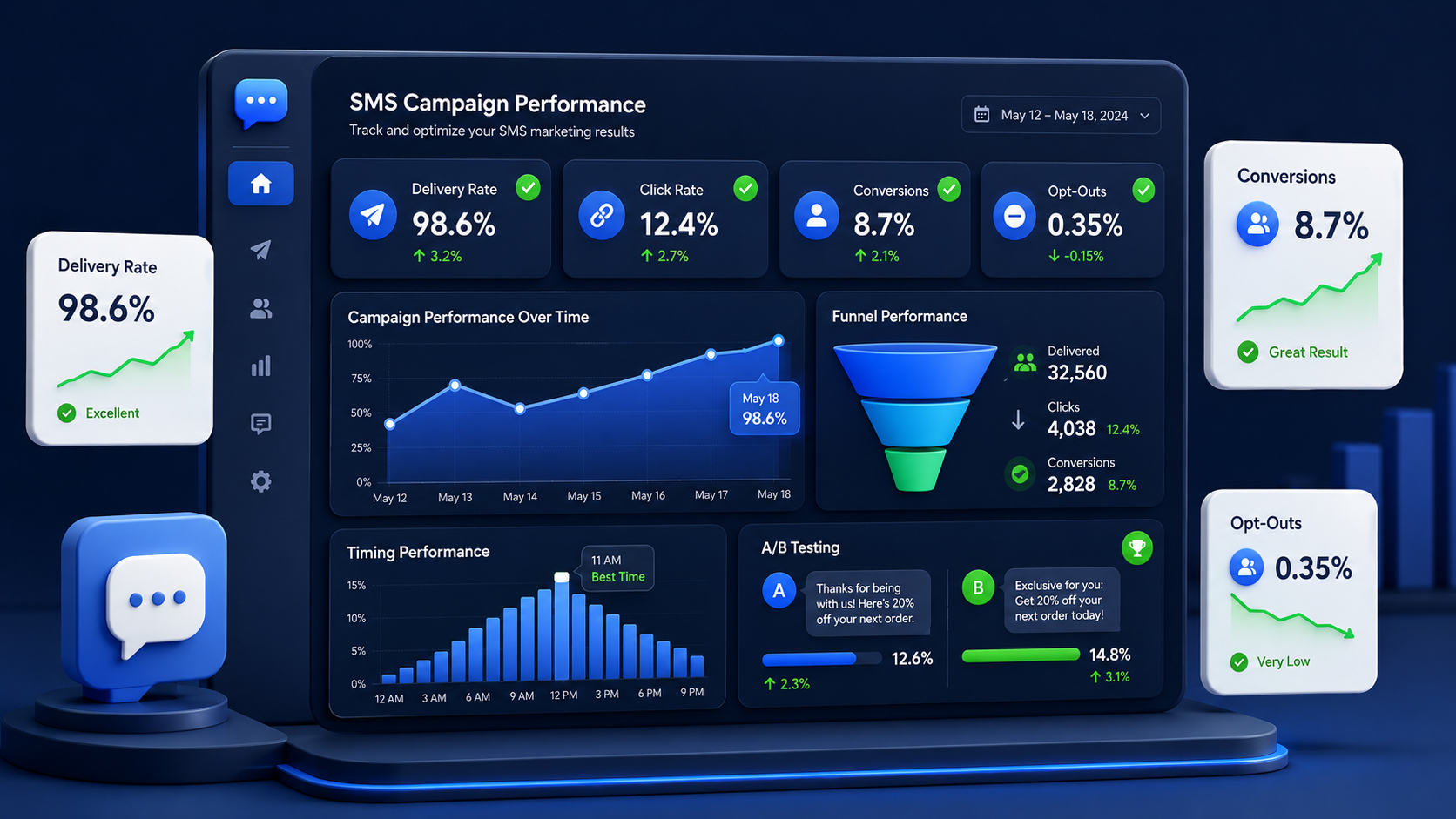
Key Metrics to Track: Delivery Rate, Read Rate, Conversion After Notification
| Metric | What It Measures | Actionable Threshold |
|---|---|---|
| SMS Delivery Rate | Percentage of messages arriving at carrier | Target >95%; below 90% suggests routing issues |
| Read Rate (within 3 min) | Immediate engagement | >90% is typical for notification SMS |
| WISMO Ticket Volume | Support load reduction | Track week-over-week after notification launch |
| Opt-Out Rate per Message | Notification fatigue signal | Above 0.5% per message warrants frequency review |
| Conversion After Reminder | Effectiveness of lifecycle reminders | Compare with email-only baseline |
Practice Application: Building Your Ecommerce SMS Notification Flow
flowchart LR
    subgraph Customer Journey
        A[Browse / Add to Cart] --> B[Checkout]
        B --> C[Payment Confirmed]
        C --> D[Order Processing]
        D --> E[Shipped / Carrier Handoff]
        E --> F[In Transit]
        F --> G[Out for Delivery]
        G --> H[Delivered]
        H --> I[Post-Purchase]
    end

    subgraph SMS Triggers
        T1[Order Confirmation SMS]
        T2[Shipping Notification]
        T3[In-Transit Update]
        T4[Out for Delivery Alert]
        T5[Delivery Confirmation]
        T6[Review Request / Replenishment]
    end

    C -->|within 30s| T1
    E -->|within 5 min| T2
    F -->|per scan event| T3
    G -->|1-2h before| T4
    H -->|within 10 min| T5
    I -->|24-72h later| T6

    style T1 fill:#E8F0E6,stroke:#5D765F
    style T2 fill:#E8F0E6,stroke:#5D765F
    style T3 fill:#E8F0E6,stroke:#5D765F
    style T4 fill:#E8F0E6,stroke:#5D765F
    style T5 fill:#E8F0E6,stroke:#5D765F
    style T6 fill:#F0EDE0,stroke:#9A8C6F
Mapping Your Customer Journey Touchpoints to SMS Triggers
The most common mistake in notification strategy is sending SMS at every possible touchpoint. Instead, map the customer journey and identify the moments where information delay causes the most friction:
- Checkout → Payment confirmation gap: This is the highest-anxiety moment. Confirm immediately.
- Processing → Shipping carrier handoff: The gap between "ordered" and "shipped" is where WISMO calls spike. Send at the carrier scan, not before.
- In transit → Out for delivery: A single "out for delivery" alert outperforms daily tracking updates.
- Delivery → Post-purchase: A delivery confirmation with delivery photo (when available) provides closure and reduces disputes.
Notification SMS Sending Checklist (Before You Go Live)
Infrastructure setup:
- [ ] A2P 10DLC brand and campaign registration completed (for U.S. traffic)
- [ ] Sender ID registered in target markets (alphanumeric, short code, or long code per market)
- [ ] Fallback routing configured for low-deliverability regions
- [ ] Opt-out (STOP) handling tested end-to-end
- [ ] Preference center integrated for notification type selection
Content and timing:
- [ ] Each message template reviewed for timing: is it triggered by a customer action, not a fixed schedule?
- [ ] Per-order message count set to 3–5 maximum (before exceptions)
- [ ] Exception templates written and approved (delay, failed delivery, address issue)
- [ ] Brand name or sender ID clearly visible in every message
- [ ] STO
Scenario Comparison: Different Trigger Types and Their Optimal Routing
| Trigger Type | Traffic Classification | Recommended Routing | Priority Level |
|---|---|---|---|
| Order Confirmation | Transactional | Direct-to-carrier | High — deliver within seconds |
| Shipping Update | Transactional | Direct-to-carrier | High — real-time |
| Delivery Alert | Transactional | Direct-to-carrier | High — time-sensitive |
| Abandoned Cart | Promotional | A2P 10DLC campaign | Medium — 60-min delay acceptable |
| Back-in-Stock | Promotional | A2P 10DLC campaign | Low — batch send |
| Review Request | Promotional | A2P 10DLC campaign | Low — 24–72 hour delay |
Core Conclusions and Next Steps
The Three Principles of Effective Ecommerce SMS Notifications
First: send what the customer needs, not what the brand wants to say. Every notification should answer a question the customer has at that moment. Second: timing is the message. A well-timed delivery alert builds more trust than any amount of promotional content. Third: bounded frequency preserves the channel. Brands that respect the 3–5 message limit per order keep the SMS channel open for high-impact communication; those who push beyond it degrade both engagement and opt-out rates.
Recommended Reading and Internal Resources
To deepen your understanding of related topics, explore these complementary areas within the SMS ecosystem:
- Transactional SMS — Understanding the infrastructure that powers notification delivery
- SMS Deliverability — Routing quality and carrier relationships that determine whether notifications arrive
- A2P SMS Deliverability — Compliance and registration requirements for business messaging
Exploring Notification and Transactional SMS Solutions
If your team is evaluating a notification SMS provider, start by mapping your current post-purchase touchpoints, message volume by market, and compliance requirements. The right infrastructure partner should demonstrate strong carrier relationships in your target markets, transparent deliverability reporting, and support for both transactional and promotional routing within the same platform — without compromising compliance.
FAQ
Q: Do ecommerce SMS notifications require customer opt-in?
A: Order confirmations, shipping updates, and delivery alerts are generally classified as transactional or operational messages and do not require opt-in under CTIA, GDPR, and similar frameworks. However, promotional reminders like abandoned cart messages or review requests typically require opt-in. Always verify requirements with your provider for your specific markets.
Q: How many SMS notifications should I send per order?
A: A practical upper bound is 3–5 messages per order lifecycle (order confirmation, shipping alert, out-for-delivery, delivery confirmation, optional post-purchase follow-up). Each additional message increases opt-out probability. Exception notifications (delays, failed deliveries) are valuable extras that customers appreciate.
Q: What is the difference between transactional SMS and promotional SMS for ecommerce?
A: Transactional SMS facilitates or confirms a transaction the customer initiated (order confirmation, delivery status, payment receipt). Promotional SMS markets or encourages a purchase (sale announcements, abandoned cart with discount codes). The distinction matters for compliance: transactional has fewer opt-in requirements but must not contain marketing content.
Q: How fast should order confirmation SMS be sent?
A: Industry best practice is within 30 seconds of payment confirmation. The goal is to reach the customer before they close the browser tab or check their email. Delays beyond one minute start to erode the trust signal that instant confirmation provides.
Q: Can I use the same SMS provider for both notification and promotional messages?
A: Yes, most enterprise SMS providers support both use cases. The key requirement is that they handle A2P 10DLC registration for promotional traffic and maintain separate routing profiles for transactional and promotional messages. Mixing the two in the same campaign registration can cause compliance issues.
Q: What should I do if my delivery rate for notification SMS drops below 90%?
A: Start by checking carrier filtering, sender ID registration status in your target markets, and whether your message content triggers spam filters. Work with your SMS provider to review routing logs and identify whether the issue is carrier-specific, region-specific, or content-related.
Q: Do SMS notifications work for international ecommerce?
A: Yes, but requirements vary by market. Some countries require specific sender ID registration (India's DLT, Brazil's HTTP-based registration), while others restrict certain message types. Work with an SMS provider with carrier relationships in your target markets rather than relying on a single aggregator for all regions.
References
- Gorgias. Ecommerce Support Benchmarks Report. https://www.gorgias.com/blog/ecommerce-customer-support-benchmarks — Provides WISMO ticket reduction data for brands using proactive SMS notifications
- Klaviyo. Consumer SMS Preferences Survey. https://www.klaviyo.com/research/sms-marketing-statistics — Supports the 75% consumer preference for SMS over email for order and delivery updates
- CTIA. Messaging Principles and Best Practices. https://www.ctia.org/ — Provides the 90% SMS read rate within 3 minutes industry benchmark
- SaleCycle. Abandoned Cart Recovery Benchmarks. https://www.salecycle.com/blog/features/abandoned-cart-statistics/ — Supports abandoned cart SMS recovery rate of 5–15%
- Twilio. SMS Marketing Best Practices Guide. https://www.twilio.com/en-us/blog/best-practices-sms-notifications — Provides frequency boundary and opt-out rate data
- CTIA. A2P 10DLC Messaging Guidelines. https://www.ctia.org/a2p-10dlc — Defines transactional vs promotional classification and registration requirements
- Yotpo. Post-Purchase Communication and Retention Data. https://www.yotpo.com/blog/post-purchase-communication/ — Supports correlation between delivery update quality and repeat purchase behavior