
This playbook is for teams that know the basics of international SMS. It focuses on the work needed to run country launches. For the framework-level definition, read international SMS for business messaging. This page starts with a defined use case. It then shows which records, checks, tests, and owners are needed for launch.
Begin with one country launch matrix. Create one record for each country-and-message-type combination. Record the number format, user group, permission basis, sender setup, rule source, route, cost basis, test proof, owner, decision, and retest trigger. The matrix turns open points into assigned work.
Use the same operating sequence in every market: define the case, check current rules, apply the route-fit gate, compare costs on the same basis, and test the exact setup. Then monitor each evidence layer and retest after a material change.
Build one country launch matrix before choosing a route
A launch matrix gives operations, product, procurement, and growth one shared record. It should hold confirmed facts, open questions, decisions, and observed results. Use one record for each country and message type. Do not treat several countries as if their rules or setup needs were the same.
Copy this structure into a spreadsheet or operating document:
Scope
- Country: [Country]
- Number format: [Format to check]
- Message or traffic type: [Use case]
- Recipient and permission basis: [Basis to record]
Rules and sender setup
- Sender type or identity: [Sender to check]
- Current rule source and checked date: [URL and date]
- Registration or approval check: [Confirmed or open]
- Content, language, and encoding: [Conditions]
Route and commercial basis
- Route under evaluation: [Provider term]
- Quoted cost basis: [Currency and assumptions]
Test and decision
- Test window: [Dates and time zone]
- Sending or delivery evidence expected: [Expected records]
- Owner: [Name or role]
- Decision: [Go, hold, or revise]
- Retest trigger: [Change that needs a new test]
Number format: Record how you will store and submit recipient numbers. E.164 is the international public telecommunication numbering plan maintained by the International Telecommunication Union. Use it to guide number-format planning. Do not use it as proof that a message meets sender, consent, registration, template, timing, or content rules. The current E.164 recommendation defines that numbering scope.
Message and recipient: Name the business use case. Then record the recipient group and the permission basis your organization relies on. This is an operating record, not a substitute for legal review.
Sender and rules: Write down the sender type or identity you plan to use. Add a current primary source for the destination and the date checked. List each open registration or approval point, and give it an owner.
Route and cost: A route is the path used to move a business message toward the destination network. Keep the provider’s exact route label and status terms because wording can vary. Preserve the quote date, currency, volume basis, encoding condition, and each stated fee.
Test and decision: Set the test window and list the evidence you expect. Name the decision owner. Record a go, hold, or revise decision, plus the change that will require a new test.
The matrix coordinates deeper work; it does not replace it. Use the cross-border SMS routing checklist when a route needs full due diligence. Keep destination-specific details in the relevant country guide and link that source from the country record.

Verify number format, sender identity, and country rules separately
Number format and destination rules solve different problems. E.164 provides an international numbering framework. It does not decide which sender identity you may use, whether registration is required, how permission must be documented, or whether a template or content restriction applies.
Use the same verification workflow for each country:
- Define the exact case. Record the destination, message type, recipient group, planned sender identity, and content category. A broad label such as “international campaign” is not specific enough.
- Check a current primary source. Use the relevant regulator, registry, carrier, or other official authority. Save the URL, page title, requirement, and checked date in the matrix. Country rules can change, so an undated note is weak evidence.
- Assign each open point. Mark the item as confirmed, unresolved, or waiting for implementation. Give every open sender, registration, approval, template, or content question a named owner.
- Confirm and recheck. Ask the selected provider how the documented requirement maps to the planned setup. Check the primary source again before launch and after a material rule, sender, route, or content change.
Number-format boundary: A correctly formatted number does not settle sender identity, registration, permission, template, timing, or content treatment.
This workflow is educational operating guidance, not legal advice. Do not copy one market’s rule into another market’s row. When a destination needs detailed treatment, place that detail in its country guide. The launch matrix should keep the decision, source, checked date, and owner.
Once those checks are recorded, the team can judge a proposed route against the actual message and sender setup instead of a country name alone.
Match message type, sender setup, and route evaluation by country
Route fit is not a label that applies to a country in every case. It is a bounded decision about one documented setup. A route is ready for a controlled test only when the team can assess it against seven inputs: destination, message type, sender eligibility, required approvals, content and encoding, expected test evidence, and quoted basis.
Use a simple gate:
Proceed to a route test only when all seven inputs are recorded. If one is missing or unresolved, keep the decision open and assign the gap to an owner. Do not treat a listed route, a quote, or one past result as proof of fit.
The destination and message type set the scope. Sender eligibility and approval checks show whether the planned identity can be assessed for that case. The exact content and encoding keep the quote and test tied to the same message conditions. Expected evidence states what the team needs before making a go, hold, or revise decision. The quoted basis preserves the provider’s route term, currency, quote date, volume assumption, and stated conditions.
For more on how business traffic moves through providers and destination networks, see A2P SMS routing. The narrower task here is to decide whether a proposed route has enough setup, quote, and evidence detail to enter a controlled test.
Provider interfaces may show route choices in different ways. In SMSBoosting, teams can select a country and channel and review available routes and route status. Treat these as configuration fields: confirm that a route is available for the account and fits the documented use case before testing it.
Encoding is the way characters are represented for sending. It can change how content splits into message segments. Keep the exact content and encoding with the quote and test. Do not infer a universal segment count from the draft alone.
This rule does not rank routes or predict delivery. It tells the team whether the proposed route can be tested on a defined basis. Once that basis is complete, procurement can compare its cost without mixing unlike conditions.

Compare international SMS costs on the same basis
A headline rate is hard to compare when the terms behind it differ. Build a cost record for the exact country and message setup, then ask each provider to fill the same fields.
For every item, record the provider’s quoted value, its source, and the quote date. Then document the condition that applies and the question that still needs an answer.
| Cost item | Provider quote | Conditions to confirm |
| Destination and message type | [Value, source, quote date] | Does the quote match the intended country and use case? |
| Currency and quoted unit | [Value, source, quote date] | Is billing per message, segment, or another unit? |
| Sender or setup requirement | [Value, source, quote date] | Which sender, registration, or setup conditions apply? |
| Route or quality basis stated by provider | [Value, source, quote date] | What does the provider’s route label include? |
| Content encoding and segment assumption | [Value, source, quote date] | How will the exact content be encoded and segmented? |
| Expected volume and period | [Value, source, quote date] | Which volume band and billing period does the quote assume? |
| Registration or setup charge, if stated | [Value, source, quote date] | Is the charge one-time, recurring, or destination-specific? |
| Inbound or reply requirement | [Value, source, quote date] | Are replies required, supported, and priced separately? |
| Support scope, if documented | [Value, source, quote date] | Which support activities are included or excluded? |
| Other stated fee or condition | [Value, source, quote date] | What could change the final charge? |
Keep the provider’s own route and pricing terms. Two similar labels may not mean the same thing. Ask what the quoted unit covers, which conditions can change the charge, and how a content or encoding change affects the quote. Encoding can change message length and segmentation. The SMS character-limit documentation offers a technical example of why this condition belongs in the record.
Keep the quote date and currency. Save a later quote as a new record rather than erasing the old one. If setup, registration, inbound messaging, or support is part of a quote, record it only when the provider states the scope and charge.
Not every provider will expose the same cost components. The table is a comparison framework, not a claim that they do. Its purpose is to reveal terms that do not match and questions that remain open. With those assumptions fixed, the team can test the configuration it is actually considering.
Run a controlled prelaunch test for each country and sender setup
A useful test preserves the exact setup and the evidence produced by that test. It does not prove that future messages will behave the same way, and it does not prove that the setup meets every legal requirement.
Before sending, capture:
- country and message type;
- sender configuration and route under test;
- exact content version, language, encoding, and segment condition;
- test numbers and their owner;
- planned send time and time zone;
- platform or API acceptance evidence expected;
- provider or carrier delivery-state evidence expected, where available; and
- the person who will approve, hold, or revise the setup.
Run the test within the saved window. Keep the content and recipient set unchanged. If either changes, make it a separate test case.
In SMSBoosting, a controlled send can use fixed or dynamic content, a selected route, and recipients entered manually, imported from a parsed file, or selected from an uploaded number file. Save the exact configuration used for each test. Confirm file formats, validation behavior, account limits, and route availability separately; the controls alone do not establish sending performance.
After sending, save the platform response, status history, timestamps, observed errors, and any available delivery-state evidence. A delivery status is a system’s recorded state for a message at one point in its processing path. Its meaning depends on the source that produced it. Do not treat completion, acceptance, or a success label as proof that a person saw or read the message.
Check any gap between the evidence you expected and the evidence you received. Give the result owner enough context to choose go, hold, or revise. If the decision is go, define a staged next step. Do not invent one sample size or pass threshold for all cases.
Retest after a material change to the sender, route, content, encoding, destination rule, or provider setup. If the route needs deeper analysis, use the route-quality evaluation guide. The fixed test record now becomes the baseline for post-launch monitoring.
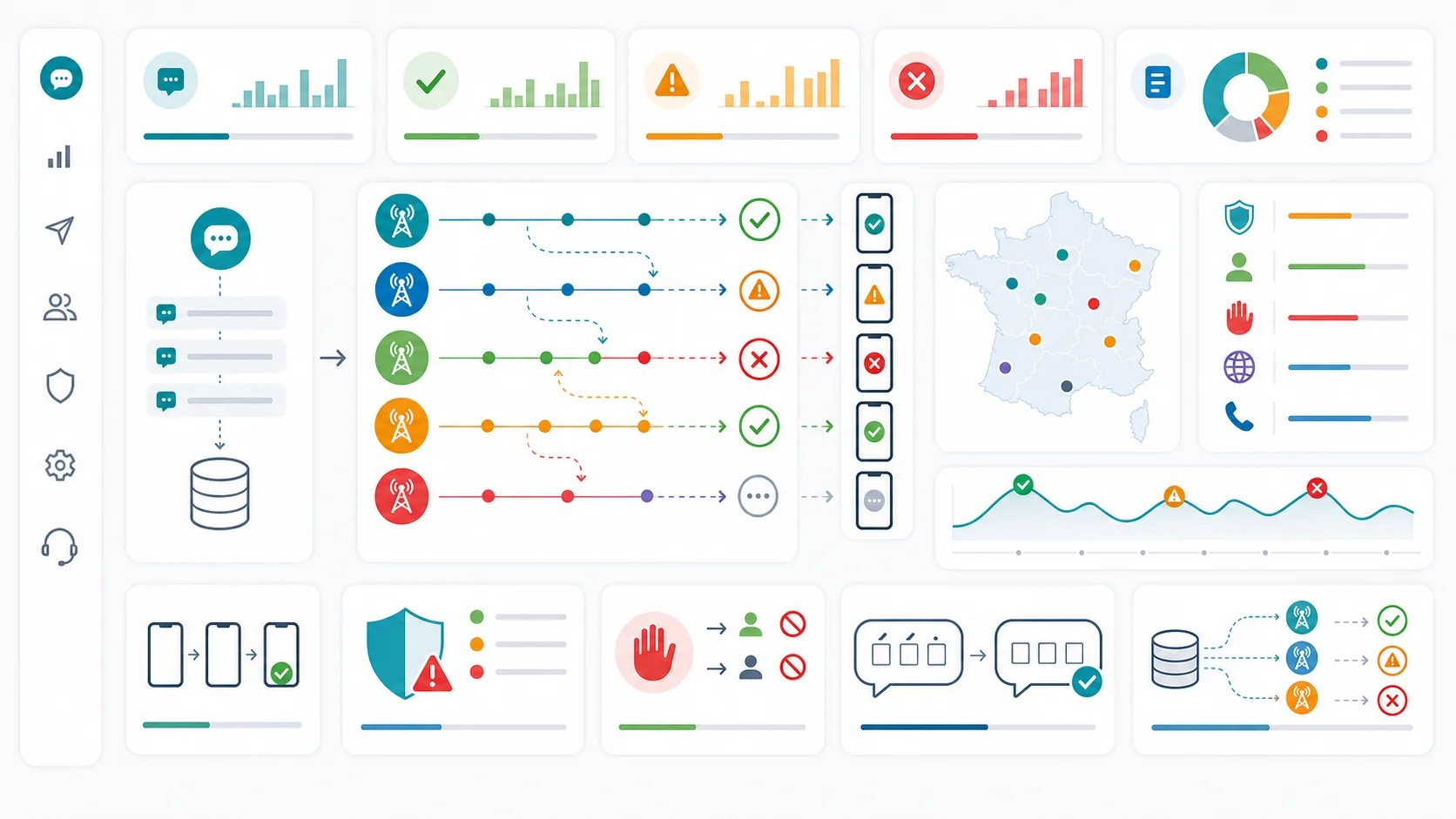
Monitor sending, delivery states, and business outcomes as separate layers
Do not turn every status into one delivery metric. Track three layers, and record what each signal can and cannot establish.
- Application acceptance and processing
- Example evidence: API reply, task state, submission progress.
- Can establish: What the app saved about the request.
- Cannot establish: Carrier delivery, phone display, reading, or business result.
- Owner: Messaging operations.
- Escalation inputs: Task ID, time, country, sender, route, and file ID.
- Provider or carrier state
- Example evidence: Status event, receipt, or error code.
- Can establish: The state and error from that source.
- Cannot establish: Reading, response, sale, or future result.
- Owner: Messaging operations and provider contact.
- Escalation inputs: Message ID, state history, error, route, sender, and time zone.
- Business result
- Example evidence: Login, booking, sale, or other product event.
- Can establish: The event saved by that system.
- Cannot establish: That the SMS caused the business result without a reliable attribution method.
- Owner: Product or growth owner.
- Escalation inputs: Work ID, event meaning, time span, and user group.
Set a baseline for one exact setup. Include the country, message type, sender identity, route label, content version, encoding, and test window. Track later change against that baseline. Before you interpret or report a change, split the records by those same seven fields. This shows whether the change affects one setup or several.
SMSBoosting’s dashboard shows HTTP and SMPP API entry points, API management, country distribution, and aggregate send data. Its task view includes task status, submission progress, total send count, success count, fail count, filters, and refresh controls. Because “success” and “fail” are platform labels, define what they mean before using them as carrier-delivery metrics. These labels alone do not establish a delivery rate.
Use a repeatable operating loop:
- Detect a change in the relevant signal layer.
- Segment it by the exact country and configuration fields above.
- Inspect status history and errors without overstating what they prove.
- Escalate with the complete matrix and test record.
- Log the explanation and any setup change.
- Retest when the sender, route, content, encoding, destination requirement, or provider setup changes.
This split gives all teams one shared record. It keeps system states apart from user actions and business results. It also shows a provider which setup, signal, and change needs review.
Evaluate providers against your actual country set
Replace a broad coverage question with written evidence requests for the countries and message types you plan to use. Add each answer to the launch matrix so procurement, operations, product, and growth review the same conditions.
Setup
- Which sender options are eligible for this country and message type?
- What customer inputs, registrations, or approvals are required?
- How does the provider define each route or option in the proposal?
- Which content, language, encoding, or segment conditions must be preserved?
Cost
- What is the quoted unit, currency, date, destination, volume assumption, and route basis?
- Which setup charges, stated fees, reply needs, or other conditions apply?
Testing
- How should the exact sender, route, content, and recipient setup be tested?
- Which records and status evidence will be available, and what does each state mean?
Monitoring and change control
- Which reporting fields can be exported or referenced during escalation?
- What identifiers and evidence should accompany an investigation?
- How are relevant route, sender, requirement, or reporting changes communicated?
- Which changes should trigger a new test?
Questions are not capability claims. Require written answers for the actual destination and configuration rather than assuming that a general feature or country list applies. For route concepts and architecture, continue with the SMS routing guide instead of turning the launch matrix into a routing manual.
Prepare the five inputs for a scoped route and testing discussion
Build the matrix first. Check current destination requirements. Compare costs on the same basis. Test the exact setup, then monitor each evidence layer on its own.
For a scoped operational discussion with SMSBoosting, prepare five inputs: your target countries, message type, expected volume, sender requirements, and test window. With that brief, the discussion can clarify route options, setup steps, test needs, and monitoring fields for evaluation. It does not promise route availability or approval, and it does not replace current country checks, controlled testing, or your approval process.



