
An SMPP API is an interface built on SMPP (Short Message Peer-to-Peer), a telecom messaging protocol used to exchange SMS traffic between external applications, SMS gateways, aggregators, and message centers. It supports persistent connections, asynchronous message submission, two-way traffic, and delivery receipts.
For most businesses, however, the important question is not whether SMPP is powerful. It is whether operating an SMPP connection provides enough benefit over an HTTP SMS API to justify the additional engineering and operational work.
This guide explains how SMPP works, what a direct integration requires, and how to decide which interface fits your messaging operation.
What is SMPP?
SMPP stands for Short Message Peer-to-Peer. The SMPP v3.4 specification defines it as an open protocol for transferring short-message data between message centers and external SMS application systems.
Two roles anchor an SMPP connection:
- SMSC or Message Center: a system that receives, stores, routes, or forwards messages. It may belong to a mobile operator, aggregator, or messaging provider.
- ESME (External Short Message Entity): an external application or messaging system that connects to the message center to submit or receive messages.
When people say “SMPP API,” they usually mean access to an SMPP endpoint. The customer operates an ESME that connects to a provider, aggregator, or carrier-facing message center.
SMPP is widely used in carrier, aggregator, gateway, and messaging-platform infrastructure. It is a published protocol, so different organizations can implement compatible endpoints while still setting their own limits, optional features, and operational rules.
Two versions are relevant:
- SMPP v3.4: the most common interoperability baseline in provider integrations.
- SMPP v5.0: the latest specification, adding capabilities such as congestion-state reporting, cell broadcast operations, and expanded support for other messaging functions.
A version number alone does not tell you which features are available. Providers may support different PDUs, optional parameters, receipt formats, bind modes, window sizes, and error codes. Confirm those details during integration.
Defining the protocol raises the next question: what happens when two systems establish an SMPP session?
How SMPP works: sessions, binds, and PDUs

SMPP is an application-layer protocol that normally runs over TCP/IP. Most SMPP operations use a request and a corresponding response PDU. PDU stands for protocol data unit: the binary structure used to carry each SMPP operation. The alert_notification PDU is a one-way notification and does not have a corresponding response.
Sessions start with a bind
Before messages move, the ESME opens a session by sending a bind request. A bind authenticates the ESME and declares what the session can do:
- bind_transmitter: the ESME submits messages to the message center.
- bind_receiver: the ESME receives messages and delivery receipts.
- bind_transceiver: the ESME can send and receive over one session.
A transceiver bind is convenient for two-way traffic, but support should not be assumed. Some providers require separate transmitter and receiver sessions. The specification also tracks session states such as OPEN, BOUND_TX, BOUND_RX, BOUND_TRX, and CLOSED, and only certain operations are valid in each state.
The core PDU set
Most integrations rely on a relatively small group of operations:
- submit_sm: submits one message; submit_sm_multi can address several recipients in one request.
- submit_sm_resp: confirms whether the message center accepted or rejected that submission.
- deliver_sm: carries inbound messages and delivery receipts back to the ESME.
- deliver_sm_resp: acknowledges a deliver_sm request.
- enquire_link: checks that the session is still responsive.
- query_sm, cancel_sm, and replace_sm: query, cancel, or replace a previously submitted message when the peer supports the operation.
- unbind: closes the session cleanly.
Asynchronous submission and windowing
SMPP can keep several requests outstanding instead of waiting for each response before submitting the next message. Responses may arrive out of order, so the client must match them to requests by sequence number.
The number of unacknowledged requests is commonly called the window. A larger window can improve submission throughput, but only within the limits supported by both peers and the downstream route. Window size, provider TPS limits, and final carrier delivery speed are separate constraints. The specification does not define a universal maximum window or throughput rate.
Sending is only half the story. The next question is how the sender learns what happened after submission.
Store-and-forward and delivery receipts
SMPP commonly supports store-and-forward messaging. After accepting a message, the message center may store it and continue attempting delivery until it reaches a final state or the validity period expires. Operations such as query_sm, replace_sm, and cancel_sm depend on the provider and on whether the message is still eligible for that action.
A successful submit_sm_resp is not a delivery confirmation. It means the peer accepted the submission for processing. To request later status information, the ESME sets the registered_delivery field in submit_sm. The message center can then return a delivery receipt through deliver_sm or data_sm.
In a receipt, message_state describes the reported outcome, while receipted_message_id ties the receipt back to the original submission. Common final or intermediate states include:
- ENROUTE
- DELIVERED
- EXPIRED
- DELETED
- UNDELIVERABLE
- ACCEPTED
- UNKNOWN
- REJECTED
A delivery receipt is an operational signal, not proof that the recipient read or acted on the message. In some markets or routes, the strongest available signal may be acceptance by a downstream message center rather than a device-level confirmation. Receipt availability, format, timing, and state mapping can also vary by provider, gateway, carrier, and destination.
That distinction keeps the lifecycle clear: submitted, accepted, routed, and delivered are not interchangeable states.
Where SMPP sits in the SMS delivery chain
A business message can move through several layers:
- The business application creates the message.
- An HTTP API or SMPP interface accepts the submission.
- A messaging provider or gateway selects a route.
- An aggregator or carrier-facing connection passes the message downstream.
- A mobile network attempts delivery to the recipient device.
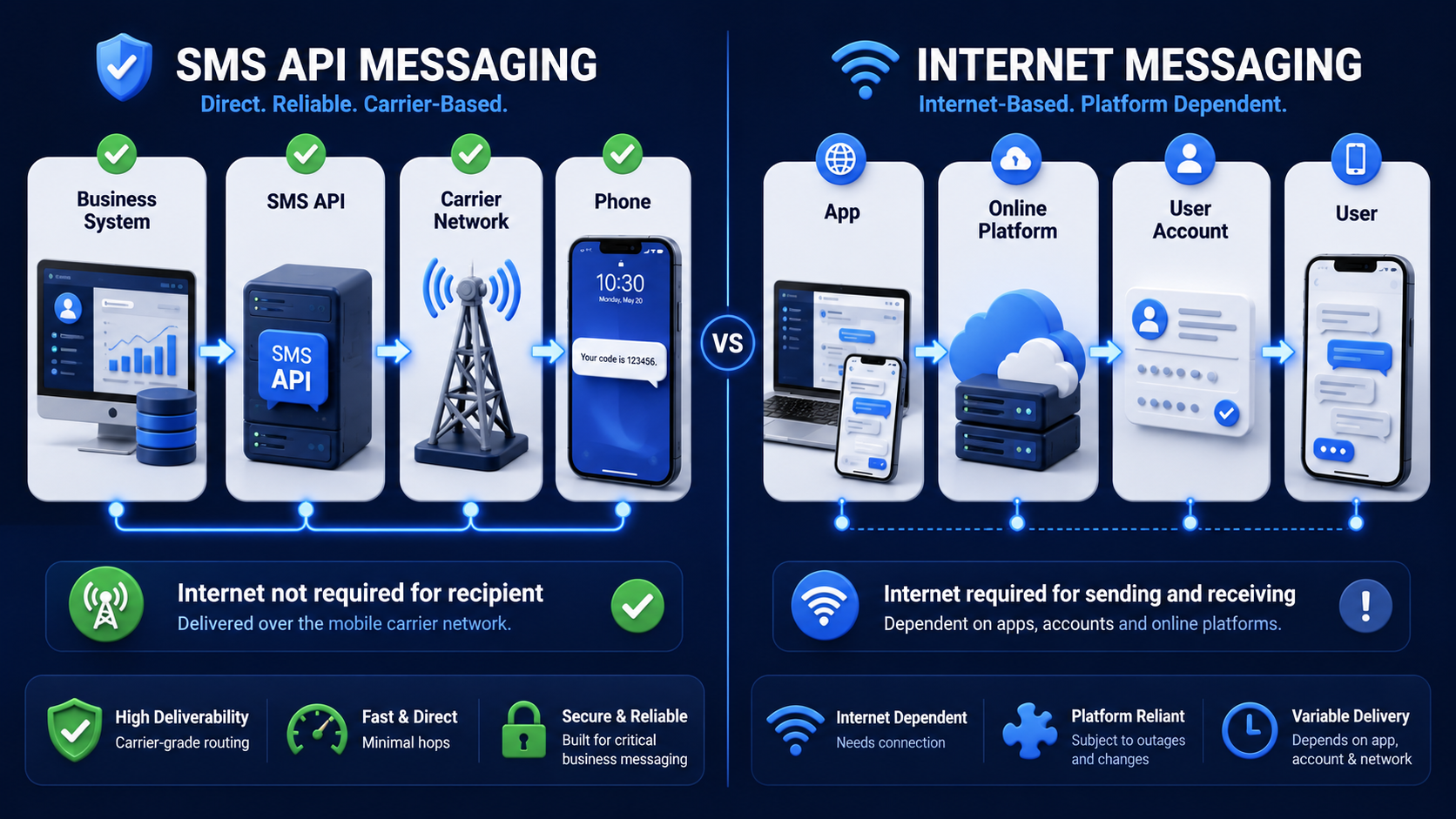
SMPP and an HTTP API are not always competing end-to-end delivery systems. A business may submit messages through HTTP while its provider uses SMPP or another telecom interface downstream.
This distinction separates the customer-facing interface from the carrier-connectivity layer. An SMS gateway manages routing and connectivity, while an SMS API exposes selected messaging functions to an application. Some providers offer both HTTP and SMPP access; others expose only one interface to a given customer or account.
Most businesses therefore do not need to operate SMPP themselves. They integrate at the API layer while the provider manages persistent sessions, routing, and carrier handoffs. For a fuller view of those layers, see how an SMS platform connects to mobile networks and the role of an SMS aggregator.
SMPP vs HTTP/REST SMS APIs
The right comparison is not simply “high volume versus low volume.” It is a comparison of connection model, control, operational responsibility, and the interfaces a provider actually offers.
| Decision factor | HTTP/REST SMS API | Direct SMPP |
| Connection model | Individual web requests | Persistent authenticated session |
| Payload | Commonly JSON over HTTP | Binary PDUs |
| Integration effort | Lower for most web teams | Requires an SMPP client and protocol knowledge |
| Session management | Managed by the provider | Managed by your team |
| Outstanding requests | Usually abstracted by the API | Controlled through an agreed window |
| Delivery reports | Webhook, callback, or polling | deliver_sm or data_sm receipts |
| Two-way messages | Usually delivered to a webhook | Receiver or transceiver bind |
| Advanced protocol fields | Limited to what the API exposes | PDU and supported TLV access |
| Transport security | Usually HTTPS | Requires an agreed protected transport |
| Typical fit | Application and business-system workflows | Specialized messaging and telecom operations |
Neither protocol choice guarantees faster handset delivery. An SMPP session may improve submission efficiency or expose more controls, but routing, filtering, carrier behavior, device reachability, and provider limits still sit downstream.
For a typical web-stack team sending transactional SMS API traffic, an HTTP API usually provides the simpler operating model. Teams new to that model can start with what an SMS API is.
Do you actually need SMPP?
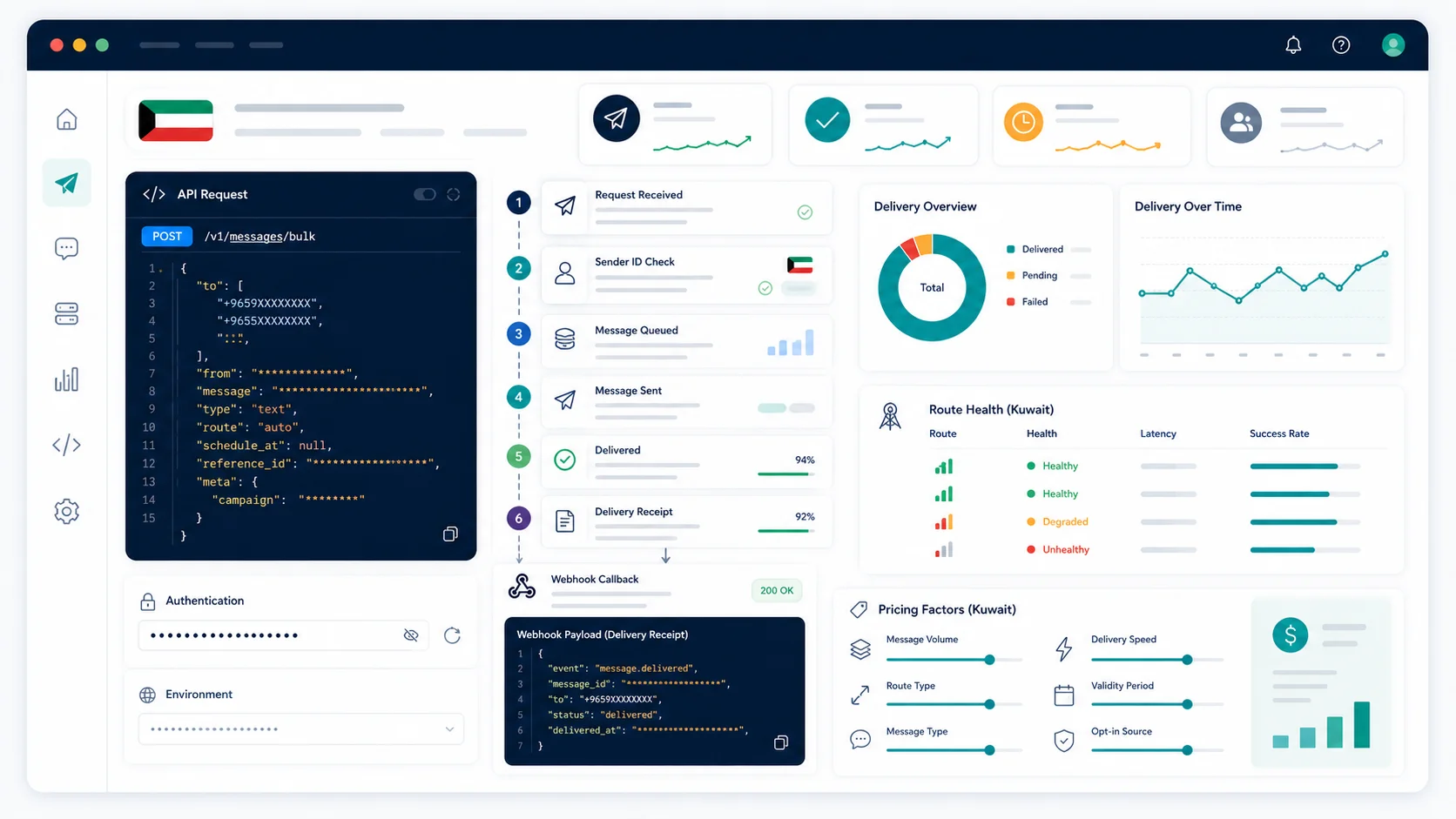
The SMPP specification does not define a business-volume threshold for adopting the protocol. Providers may set their own commercial eligibility, throughput limits, and connection requirements. Make the decision from measured operational needs rather than a generic message count.
SMPP is worth evaluating when
- Your provider explicitly offers a direct SMPP connection.
- Sustained throughput or burst behavior cannot be met reliably through the available HTTP API.
- You need session-level control over binds, outstanding windows, receipts, or supported TLVs.
- Your team already operates messaging or telecom infrastructure.
- Engineers can maintain reconnect logic, throttling, receipt correlation, monitoring, and security around the clock.
- You are integrating as an aggregator, carrier, gateway, or platform with multiple downstream messaging peers.
An HTTP API is usually the better fit when
- You are connecting a website, app, CRM, SaaS product, or internal business system.
- Your team already works with HTTPS and JSON.
- You do not want to maintain persistent telecom sessions.
- The provider’s API meets your measured peak traffic and latency requirements.
- You mainly need automated OTPs, notifications, transactional messages, or marketing campaigns.
- You want the provider to manage carrier-facing connectivity and protocol operations.
Choose SMPP because of a measured requirement, not because the protocol is associated with enterprise messaging. If the available HTTP API already meets the workload, direct SMPP adds operational responsibility without automatically improving delivery.
If SMPP still looks appropriate, assess the operational work before committing.
The operational realities of running SMPP
A direct SMPP connection is infrastructure ownership. Before choosing it, assign responsibility for:
- Client implementation: select and maintain a compatible SMPP library or client.
- Bind lifecycle: authenticate, detect dead sessions, reconnect, and re-bind without creating duplicate traffic.
- Keepalives: send and monitor enquire_link traffic according to the peer’s policy.
- Window control: limit outstanding requests and match responses by sequence number.
- Throttling: slow down, queue, and retry appropriately when the peer returns ESME_RTHROTTLED or another temporary error.
- Receipt correlation: store provider message IDs and match later delivery receipts to the original business event.
- Duplicate handling: make submissions and receipt processing resilient to retries and repeated events.
- Encoding and segmentation: handle GSM-7, Unicode, multipart messages, and provider-specific limits correctly.
- Observability: monitor bind state, submit responses, receipt latency, failures, queue depth, and reconnect frequency.
- Credential and network controls: rotate credentials, restrict source IPs where supported, and avoid exposing sensitive data in logs.
- Continuity: plan failover, maintenance, and recovery when a peer or route is unavailable.
The security model: protect the transport
SMPP does not provide modern transport encryption by itself. The v5.0 specification warns that traffic over open media can be intercepted or impersonated and describes transport-level protections.
Do not expose an SMPP session over the public internet without an agreed protection layer. Depending on the provider, that may be TLS, a VPN, private connectivity, a secure tunnel, or a controlled leased connection. IP allowlisting can restrict where a connection originates, but it does not encrypt credentials or message content.
This operational burden is why a direct connection should follow a demonstrated requirement rather than a general preference for lower-level access.
Is SMPP still used in 2026?
Yes. SMPP remains widely used in carrier, aggregator, gateway, and high-volume messaging infrastructure. Providers continue to support SMPP alongside HTTP APIs because the two interfaces serve different integration and operational needs.
Newer carrier APIs may complement SMPP for specific network capabilities, but they do not currently provide a universal replacement for SMPP-based SMS interconnection. For an implementation decision, current provider support matters more than predictions about when an established protocol might be replaced.
Planning your SMS integration?
You do not need to operate SMPP to benefit from provider-side carrier connectivity. Many businesses submit messages through HTTP while their provider manages downstream routing, carrier interfaces, and delivery reporting.
Our published SMS API uses HTTP GET/POST and JSON for functions including message submission, balance queries, delivery reports, inbound-message queries, push-URL reports, and scheduled jobs. The documentation supports smaller GET sends and batch POST submissions of up to 10,000 numbers. This model lets business applications automate messaging without maintaining persistent SMPP sessions themselves.
Not sure whether you need SMPP or an HTTP SMS API? Start with your peak traffic, target countries, message types, latency requirements, reply needs, and delivery-reporting workflow. Contact our team to review whether the current HTTP API fits and to confirm which connection options are available for your account.
FAQ
What is the difference between SMPP and an SMS API?
SMPP is a specific telecom messaging protocol. “SMS API” is a broader term for any application interface used to send or manage SMS, including HTTP APIs and SMPP endpoints. A business can use an HTTP SMS API while its provider uses SMPP downstream.
What is SMPP used for?
SMPP exchanges messages between external messaging systems and message centers. It supports outbound submission, inbound messages, delivery receipts, persistent sessions, and asynchronous request handling.
Is SMPP faster than REST?
Not automatically. SMPP can submit multiple requests over a persistent session and gives the client direct control over the outstanding window. Final performance still depends on provider limits, routing, carrier behavior, filtering, and destination networks. Compare the interfaces under your own peak workload.
Does SMPP guarantee SMS delivery?
No. A successful SMPP submission confirms only the state reported by the receiving peer. Later delivery receipts can provide additional status, but their availability and meaning vary, and they do not prove that the recipient read the message.
Does SMPP support two-way SMS?
Yes, when the provider and sender setup support inbound traffic. An ESME can receive messages through a receiver or transceiver bind, commonly in deliver_sm PDUs.
Is SMPP encrypted?
Not by default. A secure deployment needs an agreed transport protection such as TLS, a VPN, private connectivity, or a secure tunnel. IP allowlisting alone is not encryption.
Which SMPP version should I know about?
SMPP v3.4 is the common interoperability baseline in many provider integrations. SMPP v5.0 is the latest specification and adds further capabilities. Confirm the exact version, PDUs, TLVs, receipt behavior, and limits supported by your provider.
How do I know whether my business needs SMPP?
Evaluate SMPP when an available HTTP API cannot meet a measured requirement for throughput, session-level control, receipt handling, or infrastructure integration—and when your team can operate the connection reliably. Otherwise, an HTTP API is usually simpler.
Can I use SMPP with SMSBoosting?
Our public documentation describes an HTTP GET/POST SMS API with JSON, reporting, inbound-query, and push-URL functions. Contact our team to confirm the connection options available for your destinations, traffic profile, and account. Do not assume that a direct SMPP bind is included unless it is confirmed for your service.
Fake Text Message



