
What Are SMS Reminders and Why They Matter
SMS reminders sit between customer communication and operational efficiency. Unlike promotional messages aimed at new purchases, they serve a functional purpose: reducing friction in an existing process by prompting a specific, time-sensitive action.
How SMS Reminders Support Customer Follow-Up
The value of SMS reminders comes from immediacy. Text messages are usually read within minutes, which makes them a better fit than email for time-sensitive follow-ups. For businesses that already collect phone numbers through consent-based touchpoints — account signup, service booking, order confirmation — reminders extend a channel the customer already uses. That said, SMS reminders are not a one-size-fits-all tool. Their results depend on timing, frequency, and permission. Too many messages, or messages at the wrong time, produce opt-outs and complaints instead of better outcomes. The practical question is how to match each reminder to the scenario and to the customer’s expectation.
Common SMS Reminder Scenarios
Four scenarios cover most reminder use. Appointments target attendance, renewals target continuity, payments target collection, and service follow-ups target the next step in an interaction. Each scenario has its own timing logic, message structure, and consent considerations, which the following sections address in turn.
Appointment Reminder SMS
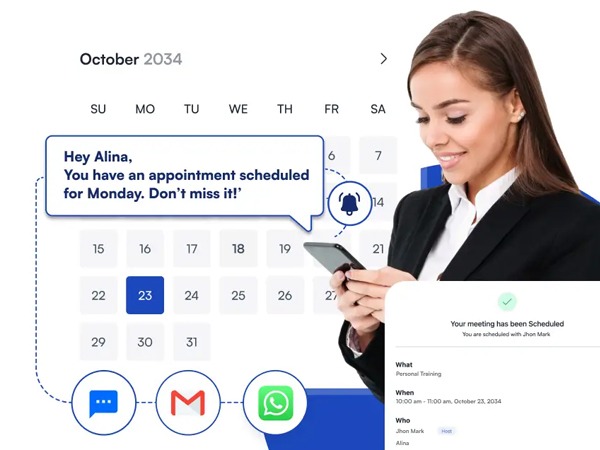
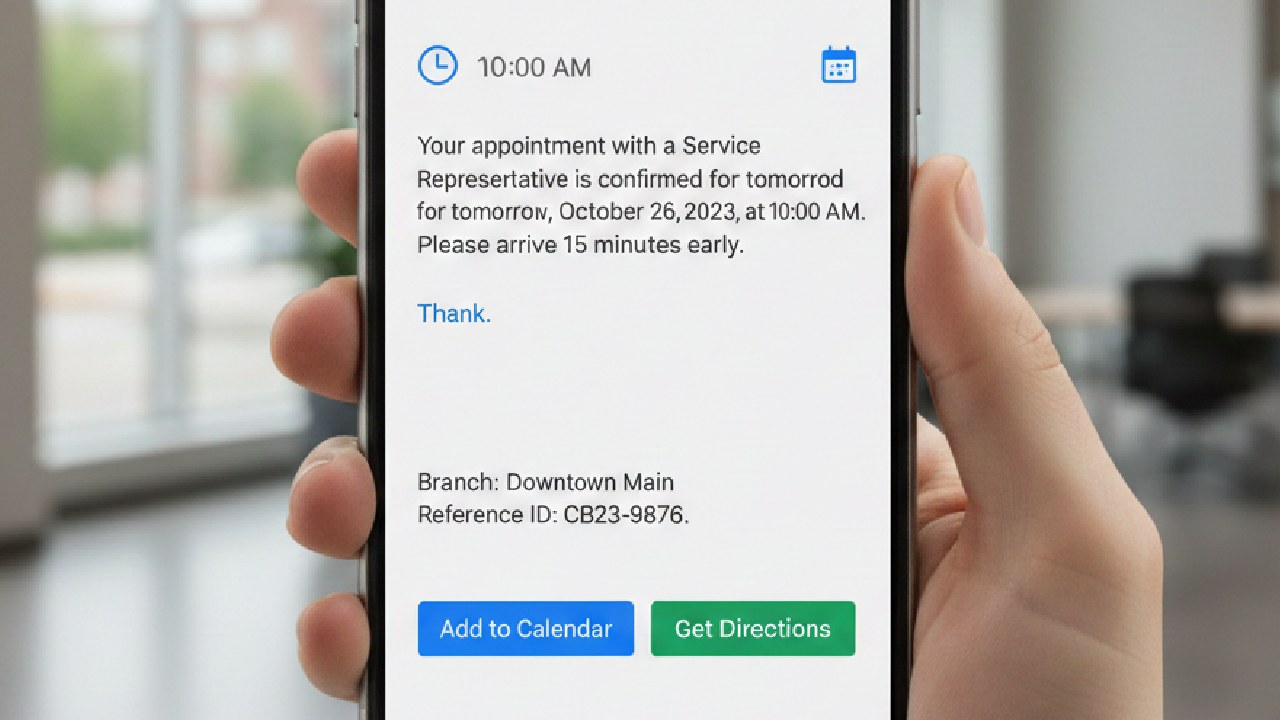
Missed appointments cost service businesses directly. Whether the slot belongs to a healthcare consultation, a sales meeting, or an onboarding session, an empty calendar means lost revenue and wasted staff time. Appointment reminder SMS messages give customers a clear nudge before the scheduled time and give the business a chance to refill the slot if someone cannot attend.
Best Timing and Frequency for Appointment Reminders
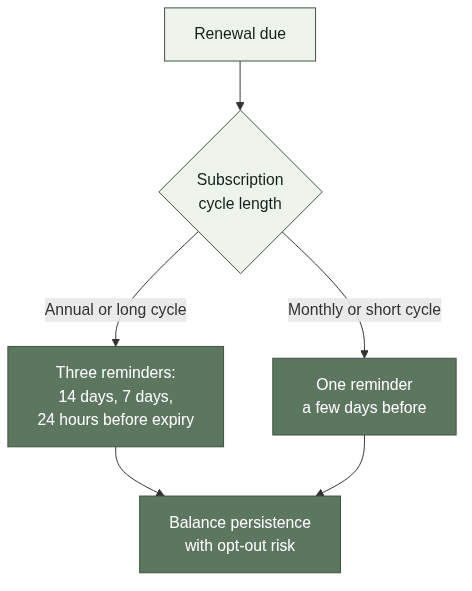
A common pattern is a two-message sequence: a first reminder about 48 hours before the appointment and a second reminder a few hours ahead. For bookings made far in advance, a confirmation right after booking plus a reminder one week before can improve attendance. For same-week bookings, a single reminder on the day may be enough. What matters more than the exact schedule is that the customer has time to act. A reminder sent ten minutes before an appointment does not help someone who needs thirty minutes to travel. A reminder sent a week early can be forgotten again by the day itself. The right lead time balances enough advance notice with enough recency to matter. The effect of this kind of nudge is measurable. In a 2019 randomized study at Kaiser Permanente Washington, an additional targeted text reminder reduced no-shows by about 7% for primary care visits and 11% for mental health visits [4]. Those figures come from one US health system and compare one reminder against two, so treat them as directional rather than universal. Messaging providers such as Twilio likewise describe appointment reminders as a common use case for reducing missed appointments [1].
Permission and Opt-In Requirements
Before any SMS reminders go out, the business needs prior consent from the recipient. In many markets, businesses are required to obtain prior opt-in consent before sending commercial or informational SMS messages, per general industry compliance guidance [2]. The rules vary by country and by whether the message is transactional or promotional, so the safe move is to collect permission at the point of data capture. For US-based senders, A2P 10DLC registration may be required, as carriers have introduced this framework for business messaging [3]. Registration asks the business to disclose its use case — appointment reminders included — and to follow carrier rules on consent and message frequency. Businesses outside the US should check local telecommunications rules, since consent requirements differ across regions.
Renewal Reminder SMS
Subscription businesses — SaaS platforms, memberships, service contracts — depend on renewals to keep recurring revenue stable, yet customers frequently forget renewal dates until service is interrupted. A well-timed SMS reminder prevents that disruption and keeps the relationship intact.
Best Timing and Frequency for Renewal Reminders
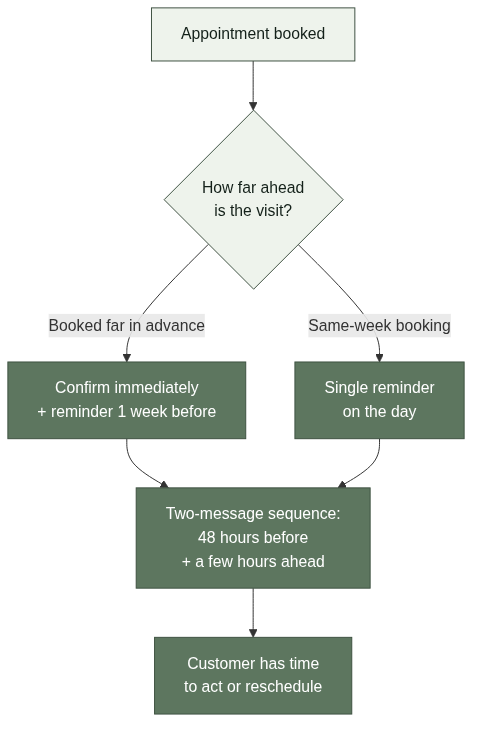
Renewal cycles differ, so the reminder sequence should follow the cycle length. For annual plans, a common pattern is a first reminder 14 days before expiry, a second 7 days before, and a final reminder 24 hours ahead. For monthly plans, one reminder a few days before renewal is usually enough; a longer sequence only adds noise. Frequency matters as much as timing. Daily renewal messages for weeks before the due date read as spam and push customers to opt out. Shorter cycles need fewer reminders, while longer cycles can absorb a spaced sequence. The threshold is simple: each message should give the customer new information or a clear action, not just repeat the previous one.
Structuring Renewal Reminder Messages
A renewal reminder should state what is expiring, name the renewal date, and give one direct action. A message that buries the deadline under promotional language confuses the reader and reduces the chance of action. Early reminders can include a link to review or confirm renewal details; the final reminder should be more direct, making clear that action is needed soon to avoid interruption. Renewal reminders also differ from billing notifications in tone: a billing notification confirms that a payment was processed, while a renewal reminder gives the customer a chance to decide whether they still want the service.
Payment Reminder SMS
Late payments strain cash flow and create follow-up work for finance and support teams. Payment reminder SMS messages prompt customers to complete a transaction before it becomes overdue, which reduces the need for dunning emails and manual collection calls.
Payment Reminder Timing and Escalation Flow
A common payment reminder sequence has three steps: a pre-due-date notice, a due-date confirmation, and a post-due-date follow-up. The first message, sent two to three days before the payment date, gives the customer time to arrange funds or update payment details. The second confirms that the payment is expected that day. If the payment is still unpaid after the due date, a follow-up can be sent within one to three days, depending on the business’s payment terms. Each escalation step should become clearer but not more aggressive; the goal is to prompt action, not punish a customer for forgetting. A post-due-date message can include a payment link and a neutral note about late-fee policy, while avoiding language that damages the relationship.
Balancing Persistence With Customer Experience
The line between a helpful reminder and an annoying one is thin. For payment reminders, match the escalation pace to the payment cycle. Businesses with weekly invoices have little room for multiple messages and may combine the pre-due and due-date notices into one. For monthly or quarterly billing, a three-step sequence works well. What matters is that each message adds value — a payment link, a summary of what is being paid, or a way to update billing details. A message that only says “your payment is due” without context or action steps helps no one and reads as nagging.

Service Follow-Up Reminder SMS
Follow-ups after a service — satisfaction surveys, feedback requests, or next-step prompts — are often missing from reminder planning. They play a different role: they continue the conversation after the interaction instead of asking for a new action.
Follow-Up Reminder Timing for Different Services
Timing for follow-ups depends on the moment the customer can act. A delivery confirmation with a rating request works best within hours of delivery. A pending verification step in account setup should be reminded within a day or two, while the setup is still fresh. Post-visit care instructions are most useful in the first days after the appointment. The common thread is that the reminder serves the customer’s interest in completing the interaction. A follow-up that explains what the customer gains — faster service next time, access to post-visit resources — performs better than one that only asks for a rating.
Measuring Follow-Up Engagement
Appointment and payment reminders have clear success metrics: attendance and payment completion. Follow-ups need a defined engagement goal first. That could be a click-through rate on a resource link, a survey completion rate, or a repeat booking rate after the follow-up. The metric should match the message purpose. A survey follow-up should be judged on completion rate, not clicks. A resource follow-up should track access and downstream behavior, such as repeat visits. Without a metric tied to the specific scenario, it is hard to tell whether the reminder strategy works or needs adjustment.
Best Practices for SMS Reminder Timing, Frequency, and Consent
Understanding Consent Requirements Across Jurisdictions
Compliance starts with knowing where customers are and which rules apply. In many markets, businesses are required to obtain prior opt-in consent before sending commercial or informational SMS messages [2]. Some jurisdictions treat all business-originated messages as commercial; others separate transactional reminders from marketing messages. The safest approach is to collect opt-in consent at the point of data collection — account registration, service booking — and record the channel, date, and scope of consent. That works in every jurisdiction and leaves a defensible record if compliance is questioned. When the rules are unclear, treat the message as commercial and require opt-in; that is rarely the wrong call.
A2P 10DLC Registration for US Business Messaging
For businesses sending SMS in the United States, A2P 10DLC registration may be required, as carriers have introduced this framework for business messaging [3]. The registration step covers campaign use cases and message flow, and it applies to operational messaging such as SMS reminders sent at scale. Companies that skip registration risk delivery problems, so it belongs on the checklist for any US reminder program.
Tools for Automating SMS Reminder Campaigns
Running reminder sequences across appointments, renewals, payments, and follow-ups becomes unmanageable without automation. A useful platform should support conditional scheduling based on event dates, templates with merge fields, and automated opt-out handling. Integration with a CRM, booking system, or billing engine separates a scalable setup from one that needs manual work for every message. Reminder strategy also fits into the broader SMS picture. The SMS Marketing Use Cases Beyond Promotions article shows how SMS reminders relate to other customer communication, and the Appointment Reminder SMS guide goes deeper into that single scenario. For teams ready to implement, the Notification SMS Service page describes delivery capabilities suited to reminder campaigns at scale.
FAQ
References
Twilio. “Appointment reminder texts and emails.” https://www.twilio.com/en-us/use-cases/appointment-reminders. Accessed August 5, 2026.
Twilio. “Global Regulatory & Compliance Guide for Marketers.” https://www.twilio.com/en-us/lp/global-regulatory-compliance-guide-marketers. Accessed August 5, 2026.
Twilio. “10DLC (10-digit long code numbers).” https://www.twilio.com/en-us/phone-numbers/a2p-10dlc. Accessed August 5, 2026.
The Permanente Journal. “Pragmatic Randomized Study of Targeted Text Message Reminders to Reduce Missed Clinic Visits.” https://pubmed.ncbi.nlm.nih.gov/35609163/. Accessed August 5, 2026.