

Expanding your ecommerce brand into new countries is exciting — more customers, more revenue, more growth. But your SMS strategy does not scale the way you might expect. Sending promotional alerts or delivery notifications to customers in five countries is not five times the work of sending to one. It is closer to twenty-five times the complexity, because every destination brings its own compliance rules, sender ID requirements, routing quirks, time zones, and customer expectations.
This article walks through the key factors growing brands must evaluate before scaling cross-border SMS for ecommerce, and explains why treating international SMS as "the same message, more countries" leads to blocked campaigns, delayed deliveries, and frustrated customers.
Why Cross-Border SMS Is Not "One Message, Many Countries"
Most teams discover the hard way that cross-border SMS for ecommerce requires more than a new API endpoint. A single message sent to a customer in Germany, Japan, Brazil, and the UAE will behave differently in each market — not because SMS is unreliable, but because the infrastructure and regulations that govern it change at every border.
The Telerivet team put it well: "Most SMS programs that fail internationally do not fail because someone broke a law. They fail because a team designed a workflow for one market, assumed the architecture transferred, and discovered too late that it did not" [1].
This gap between assumption and reality is where campaigns stall. Delivery rates drop without obvious cause. Sender names get replaced with random numbers. Messages arrive at 2 AM. Customers stop responding. And the team spends hours investigating instead of building.
The hidden cost of complexity
The financial impact is real. Cross-border ecommerce brands that expand into multiple markets without adapting their SMS operations often see cost estimates vary by 18–25% or more from final reviewed costs [2]. For a growing brand on a limited marketing budget, that level of unpredictability makes SMS hard to plan as a reliable channel.
flowchart TD
    A[Brand expands to new market] --> B{Check SMS requirements}
    B --> C[Country compliance
Opt-in, content rules]
    B --> D[Sender ID
Alpha / Short code / Long code]
    B --> E[Routing design
Premium vs cost-optimized]
    B --> F[Time zone & language
Local adaptation]
    C --> G[Launch market]
    D --> G
    E --> G
    F --> G
    G --> H[Monitor per-market
Delivery rates & opt-outs]
The Compliance Maze — Every New Market Brings a New Rulebook
Regulatory compliance is the first gate a cross-border SMS for ecommerce program must pass, and it is rarely straightforward.
Opt-in standards vary by market
In most countries, you can only send SMS to customers who have explicitly opted in. But the definition of "explicit" varies. Informational or transactional messages (like delivery updates or OTPs) typically require "prior express consent" (PEC), while promotional messages require "prior express written consent" (PEWC), which must be documented and verifiable [3]. Some markets no longer accept implied opt-in at all.
A single opt-in flow designed for one country may fail to meet the legal bar in another. Brands that operate across multiple jurisdictions need consent management that adapts per market — not a single checkbox on checkout.
Sender ID registration requirements
What shows up on the customer's phone when they receive your message depends on where they are. In some countries you can use your brand name as a Sender ID. In others, that name gets replaced or rejected.
Real examples from current market rules:
- Mexico: Every branded sender name is automatically replaced with a short code by carriers [1].
- UAE: Promotional sender IDs require an "AD-" prefix, or the message fails entirely [1].
- Vietnam: The brand name must appear in the message body itself, not just in the sender field [1].
- Japan: Major carriers aggressively filter URLs in SMS, which affects both promotional and transactional messages [1].
In at least six major markets, two-way A2P SMS is simply not available as a standard channel [1]. If your program depends on customers replying to messages, those markets require a different approach.
Content restrictions
Even where promotional SMS is permitted, most countries impose restrictions on specific categories: gambling, alcohol, adult content, political messaging, and religious topics are among the most commonly regulated [3]. Some markets also limit message length below the standard 160-character threshold.
Sender Identity and Routing Reliability — The Infrastructure Layer
Once compliance is handled, the operational question becomes: how does the message actually reach the customer?
Route choices directly affect deliverability
Cross-border messages travel through a series of carrier agreements that vary per destination. A route that works well in Western Europe may have different latency, cost, and reliability characteristics in Southeast Asia or Latin America.
The key variables in route choice include:
- Direct carrier connections — A provider with direct agreements in a market can typically deliver faster and more reliably than one routing through aggregators.
- Network quality monitoring — Real-time data on delivery success rates per destination allows dynamic route switching when a primary path degrades.
- Cost vs. speed trade-offs — Transactional messages (OTP codes, delivery alerts) benefit from premium routing focused on speed. Promotional messages may accept slightly lower speed in exchange for better unit economics.
Brands scaling across multiple markets need a messaging provider that offers per-market route intelligence, not a single routing table for "international."
Sender identity consistency
Customers recognize your brand by who the message appears to come from. But maintaining a consistent sender identity across markets requires active management:
| Sender type | Where it works | What to watch |
|---|---|---|
| Alphanumeric (brand name) | EU, UK, Australia, parts of Asia | Pre-registration required in many countries |
| Short code | US, Canada, parts of LATAM | Expensive, long setup, limited character set |
| Long code | Most markets | May not support high volume; some carriers block |
| Dynamic sender ID | Requires provider support | Must adapt per destination, adds complexity |
flowchart LR
    subgraph Sender["Sender Type Options by Market"]
        A1[Alpha Brand Name] --> A2[EU / UK / AU / Asia]
        B1[Short Code] --> B2[US / CA / LATAM]
        C1[Long Code] --> C2[Most markets
Volume-limited]
        D1[Dynamic Sender ID] --> D2[Provider-dependent
Per-market adapt]
    end
    A2 --> P[Pre-registration required]
    B2 --> S[Expensive / long setup]
    C2 --> V[Carrier filtering risk]
    D2 --> C[Complexity management]
The goal is not to use the same sender type everywhere. The goal is to ensure that in every market, the customer sees something that builds recognition and trust.
Notification Scenarios — One Strategy Does Not Fit All
A brand's SMS program typically serves multiple use cases. Treating them as a single category is a common source of friction.
Transactional messages: OTP and delivery updates
These are high-priority, time-sensitive communications. A late OTP means a failed login or abandoned checkout. A missing delivery notification triggers a customer support inquiry.
Transactional messages benefit from:
- Premium routing with low-latency guarantees
- Direct carrier connections in each target market
- Delivery receipts (DLR) for each message
- A secondary route if the primary path fails
Because these messages support core purchase activity, reliability matters more than cost.
Promotional messages: seasonal campaigns and re-engagement
Promotional SMS plays a different role. It is planned, timed, and measured against marketing KPIs. The operational requirements shift:
- Quiet hours compliance — Some markets restrict promotional messages to specific hours. Sending outside those windows risks complaints or carrier penalties.
- Seasonal timing — Black Friday, Cyber Monday, Singles' Day, Ramadan sales, and year-end holidays all have different peak windows across regions. A promotional schedule built for US holidays will be misaligned for Asian or European markets.
- Frequency management — Customers in some markets tolerate higher SMS frequency than others. Tolerance thresholds vary by culture and local norms, not just opt-in status.
Two-way SMS limitations
If your program asks customers to reply (for example, "Reply YES to confirm" or "Reply STOP to unsubscribe"), you need to confirm that two-way A2P SMS is supported in each target market. In at least six major markets, it is not available as a standard channel [1]. Brands that depend on two-way interaction must either use an alternative channel (like WhatsApp where available) or restructure the interaction flow.
Language, Time Zones, and Local Experience — Beyond Translation
SMS is an intimate channel. It lands on the customer's personal device, often alongside messages from family and friends. The experience needs to feel local, not generic.
Time zone management
A campaign that sends at 10 AM in your headquarters' time zone will reach customers across a 12-hour window. Some will receive it during business hours. Others will get it in the middle of the night.
Best practice for cross-border campaigns:
- Segment sends by destination time zone, not by "send time" at the source
- Apply local quiet hour rules per market (these are not uniform)
- For promotional messages, test engagement windows per region rather than assuming global patterns
Language and cultural fit
flowchart TD
    M[Incoming message] --> T{Message type?}
    T -->|OTP / Verification| P1[Premium route
<5 sec delivery]
    T -->|Shipping Update| P2[Premium with failover
>98% DLR]
    T -->|Promotional| P3[Cost-optimized route
Budget-friendly]
    T -->|Cart Recovery| P4[Premium during window
Conversion focused]
    T -->|Re-engagement| P5[Balanced route
Opt-out monitoring]
    P1 --> D[Deliver to customer]
    P2 --> D
    P3 --> D
    P4 --> D
    P5 --> D
Translation is the minimum bar. Effective cross-border SMS for ecommerce requires:
- Conciseness that fits the character limit in the target language (some languages compress poorly)
- CTAs that are culturally appropriate for each market
- Awareness of date formats, currency symbols, and measurement conventions
- Testing with local speakers before campaign launch
Message frequency expectations
Customers in different markets have different tolerances for SMS frequency. A strategy that works in one country may generate opt-out rates 3-4x higher in another simply because the frequency feels aggressive. Monitoring per-market opt-out rates by campaign type gives an early signal.
Building a Cross-Border SMS Operation — Action Guide
Cross-border SMS for ecommerce readiness checklist
Before expanding to a new market, confirm each of these:
- Sender ID compatibility — Can you use an alphanumeric sender? Is pre-registration required? Are there prefix or format requirements?
- Consent requirements — Does the market require PEC or PEWC? Does your current consent flow meet the local standard?
- Content restrictions — Are there limits on URLs, specific industries, or message categories?
- Routing design — Do you need premium routing for transactional messages and a cost-optimized path for promotional sends?
- Time zone scheduling — Have you mapped quiet hours and optimal send windows for this market?
- Two-way capability — Does the market support two-way A2P? If not, what is your fallback?
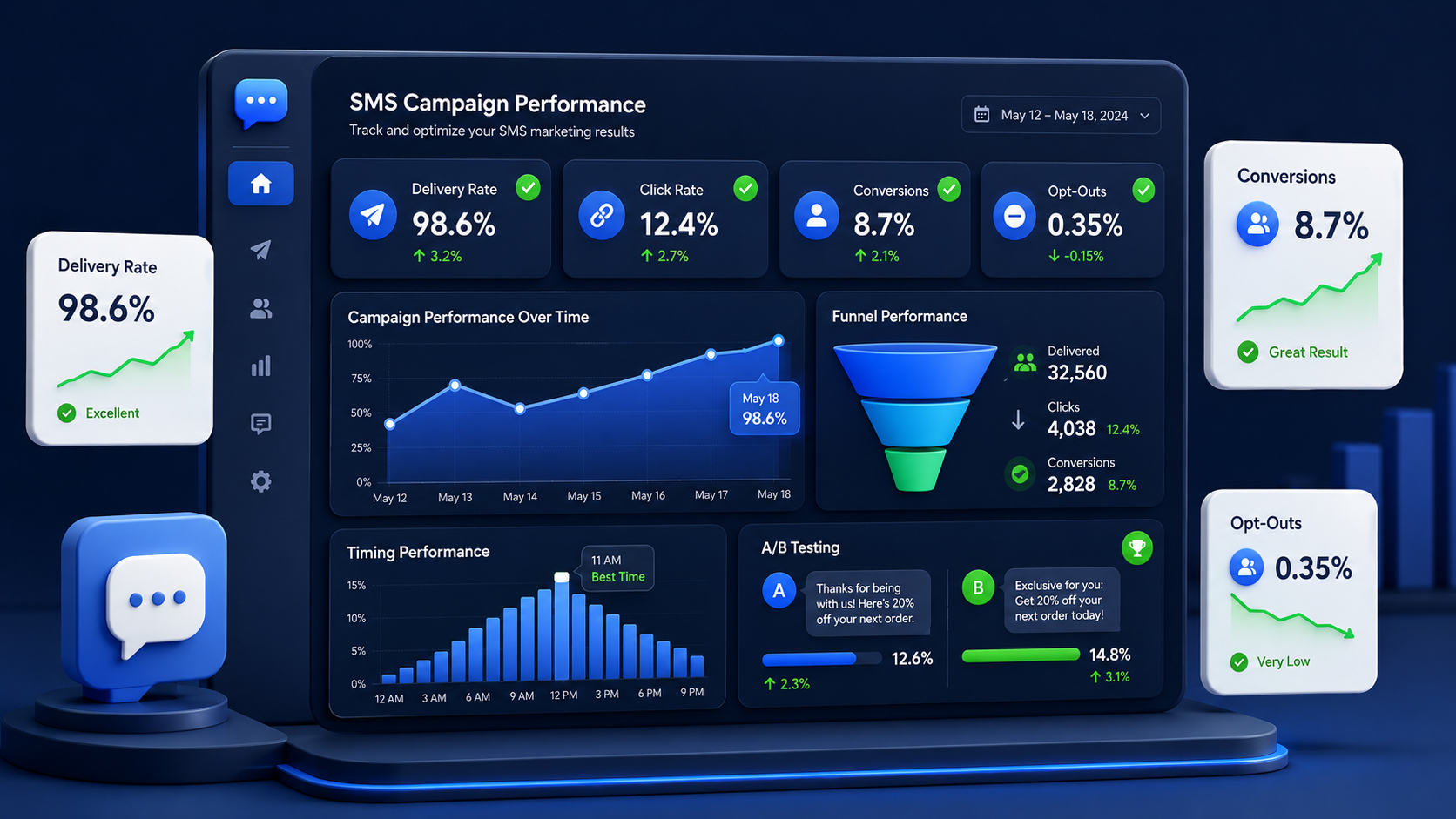
- Monitoring setup — Do you have per-market DLR tracking and alerting for delivery anomalies?
Decision framework: matching message types to routing
| Message type | Recommended routing priority | Key metric | Cost sensitivity |
|---|---|---|---|
| OTP / verification | Highest — dedicated premium route | Delivery time < 5 seconds | Low |
| Shipping / delivery update | High — premium route with failover | DLR rate > 98% | Low to medium |
| Promotional campaign | Medium — cost-optimized route | Cost per message sent | High |
| Cart recovery | High — premium route during window | Conversion rate impact | Medium |
| Subscription / re-engagement | Medium — balanced route | Opt-out rate | Medium |
Monitoring what matters
Post-campaign review should compare each market independently — not just aggregate delivery rates. A 95% delivery rate across 10 markets can hide one market where the rate dropped to 70%.
Frequently Asked Questions
Q: Is cross-border SMS more expensive than domestic SMS?
A: It depends on the destination. Some markets have highly competitive pricing due to multiple carrier options; others have regulatory costs or limited carrier access that drive prices higher. Per-market cost analysis is recommended before committing to volume.
Q: Do I need a separate SMS provider for each country?
A: Not necessarily. Many global providers route through carrier networks in multiple countries. The key is verifying that your provider has direct carrier relationships in your target markets rather than routing through intermediate aggregators.
Q: How do I handle opt-out requests from international customers?
A: Opt-out handling must respect local regulations. In most markets, replying "STOP" is sufficient, but some jurisdictions require specific language or a confirmed subscription management process. Centralized opt-out management that applies per-market rules is the recommended approach.
Q: Can I use the same SMS template for all countries?
A: Rarely. Character limits, language requirements, cultural norms, and regulatory content restrictions differ by market. Templates should be adapted per destination, not copied.
Q: How do quiet hours work across different time zones?
A: Quiet hours are typically defined by the recipient's local time, not the sender's. Campaign scheduling systems should segment sends by destination time zone and respect each market's specific quiet hour regulations.
Q: What delivery rate should I expect for cross-border SMS?
A: Delivery rates vary significantly by market due to carrier infrastructure, regulatory filtering, and content type. Rather than expecting a universal rate, establish a baseline per market and monitor changes over time.
Q: Do I need to pre-register my sender ID for every country?
A: In many countries, yes. Requirements range from simple registration with a local carrier to approval processes that take several business days. Recommended lead time: plan 1-2 weeks for sender ID setup in new markets.
Q: How often should I review my cross-border SMS performance?
A: Monthly review is recommended for active markets, with deeper quarterly analysis comparing delivery rates, cost trends, and opt-out patterns across markets.
Conclusion
Cross-border SMS for ecommerce is not a volume problem — it is an architecture problem. Each new market adds regulatory, operational, and experience variables that compound unpredictably when treated as a single program.
The brands that succeed approach international SMS as a per-market discipline:
- They verify compliance requirements before launching.
- They design routing per message type, not per destination.
- They adapt sender identity, language, and timing to local conditions.
- They measure performance per market, not in aggregate.
If your current SMS setup was designed for one market, review whether it is ready for the next one. Start with the checklist above, build per-market baselines, and invest in a messaging partner that brings route intelligence, regulatory awareness, and operational transparency — not just an API key.
Learn how SMSBoosting supports cross-border SMS for ecommerce brands
References
Telerivet, "SMS Regulations by Country: Global Compliance Guide 2026" — Country-by-country analysis of sender ID rules, two-way availability, and key regulatory constraints across 25 markets. https://www.telerivet.com/blog/sms-compliance-by-country-global-guide
KF TEL SMS, "How to Choose an International SMS API for Cross-Border E-commerce" — Guide covering OTP delivery, API integration, global routing, compliance and cost control for cross-border ecommerce. https://www.kftelsms.com/blog/rolf-2
Infobip, "A Guide to Global SMS Compliance Laws" — Overview of opt-in standards, content restrictions, sender ID rules, and message length limits across jurisdictions. https://www.infobip.com/blog/a-guide-to-global-sms-compliance-laws