
TL;DR (Pin This)
- Recommended sends (promo): Start with 3–5 promotional sends across the 14-day IWD window (most people 2–3, plus +1 for high-intent if behavior-justified). Calibrate to your baseline.
- 14-day cadence: Warm-up → March 8 (Day-of) → Winback
- Warm-up: set tone + reveal offer
- Day-of: activate high-intent + VIP
- Winback: thank-you + make-good/feedback (don’t out-discount day-of)
- Monitoring points (make it operational):
- First 15–60 minutes after each send: delivery/blocks, CTR, opt-outs
- End of day: CVR + revenue outcomes vs baseline
- If opt-outs spike:
1) Pause the next broad send (don’t “remind harder”)
2) Check segment logic + suppression (wrong audience is the usual culprit)
3) Review offer clarity + tone (IWD sensitivity)
4) Switch to high-intent/trigger-only until metrics stabilize
Regional reality check (important):
Opt-in rules, opt-out keywords (e.g., STOP), quiet hours, sender ID/registration expectations, and carrier filtering behavior vary by country, carrier, and use case. Treat this guide as operational defaults—not universal rules. Validate requirements for your target market(s) before you send.
Related SMSBoosting guides:
The counter-intuitive IWD 2026 rule: fewer sends, higher trust (and fewer opt-outs)
International Women’s Day is a high-sensitivity moment. If your plan is “more texts + louder urgency,” you can get a short spike — and a longer hangover (opt-outs, complaints, fatigue).
For IWD 2026 SMS marketing, the safer default is usually the quieter default: fewer promotional sends, tighter targeting, clearer consent evidence, and faster monitoring.
Two grounding notes:
- IWD context matters. The UN frames International Women’s Day as a call to action for women’s rights and equality — not a shopping-themed holiday. [1]
- Stereotypes are a real risk surface. UN Women research highlights how advertising can reinforce harmful gender stereotypes and why avoiding them matters. [2]
The direct answer for International Women’s Day SMS marketing: run a 14-day cadence
Run IWD 2026 as a two-week operating cadence:
- Warm-up → March 8 → Winback
- Segment first (every message must have a reason)
- Set frequency caps + quiet hours as “safe defaults”
- Track with short links + UTM, then monitor list health fast
A more defensible “3–5 promotional sends” default (without over-claiming)
“3–5” isn’t a universal rule — it’s a conservative operating range many teams use for a 14-day window because it aligns with common frequency guidance and helps protect list health.
- Frequency examples you’ll see from major platforms include 1–2 texts/week or 3–4 texts/month for many brands (directional guidance, not a promise). [3]
Over a two-week IWD window, that roughly maps to 2–4 promo sends — plus a peak-day send if your list health stays stable → 3–5 as a cautious default.
When “3–5” applies (so it doesn’t get misused):
Use this range only if your list is already “stable” (documented opt-in, consistent engagement, no recent deliverability shocks, and your usual campaign opt-outs/complaint-signals are within normal variance). If your list is new, recently imported, recently reactivated, or you’ve seen a recent opt-out spike, start more conservatively (e.g., 1–2 promotional sends total) and let high-intent triggers carry the rest.
Important nuance:
- For many mature lists, keeping campaign opt-outs under 1% is often a great target line — but opt-out rates vary by industry, audience, and platform definitions. Some benchmark pages can show higher “average unsubscribes” because they mix campaign + automation traffic. [5]
- So treat benchmarks as context, and use your own baseline + abnormal spikes as the real guardrail.
Monitoring cadence (make “near-real time” operational)
After any major send, watch two time horizons:
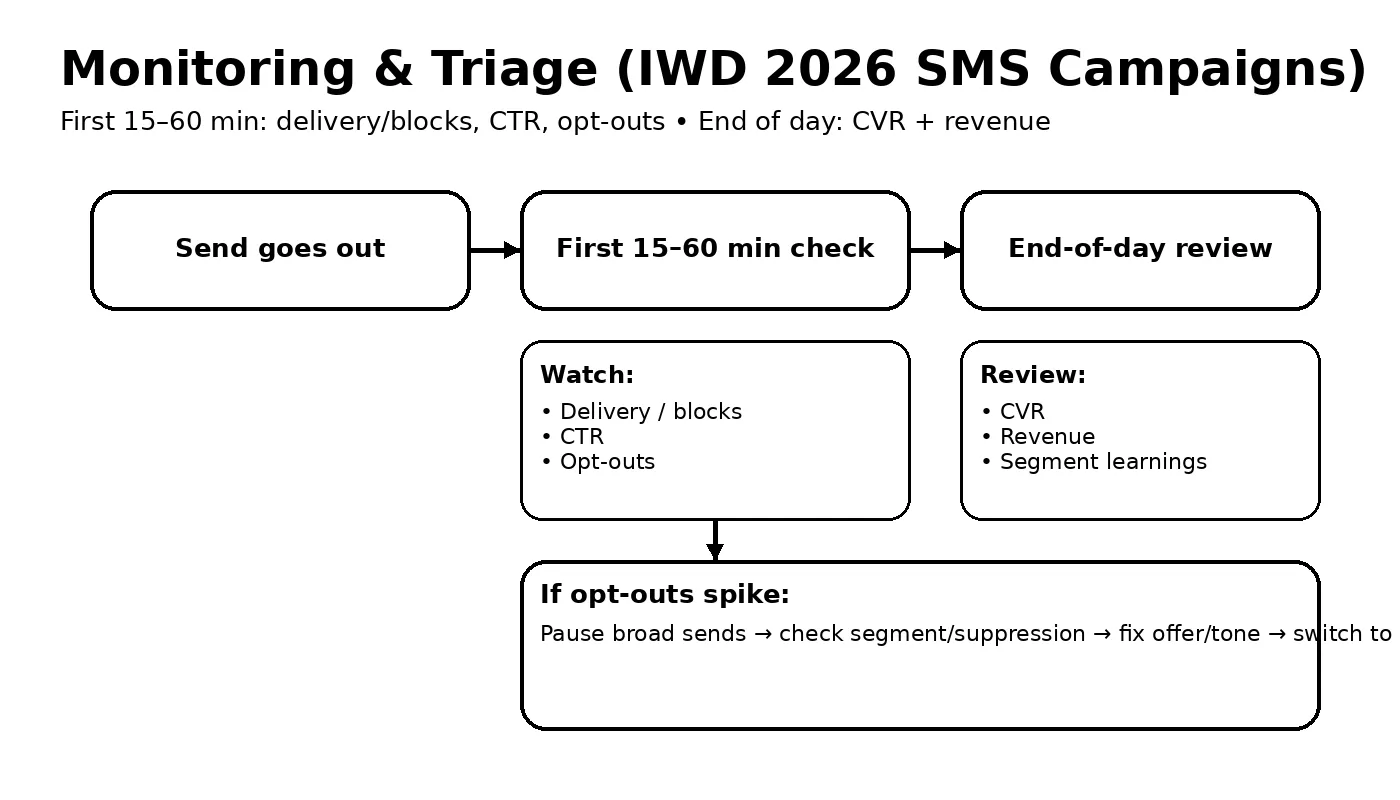
- First 15–60 minutes: delivery/blocks, CTR, opt-outs (early warning).
- End of day: CVR and revenue outcomes (what actually moved).
If your opt-outs spike right after a send, the next action is rarely “send another reminder.”
IWD 2026 SMS marketing calendar (table): Warm-up → March 8 → Winback
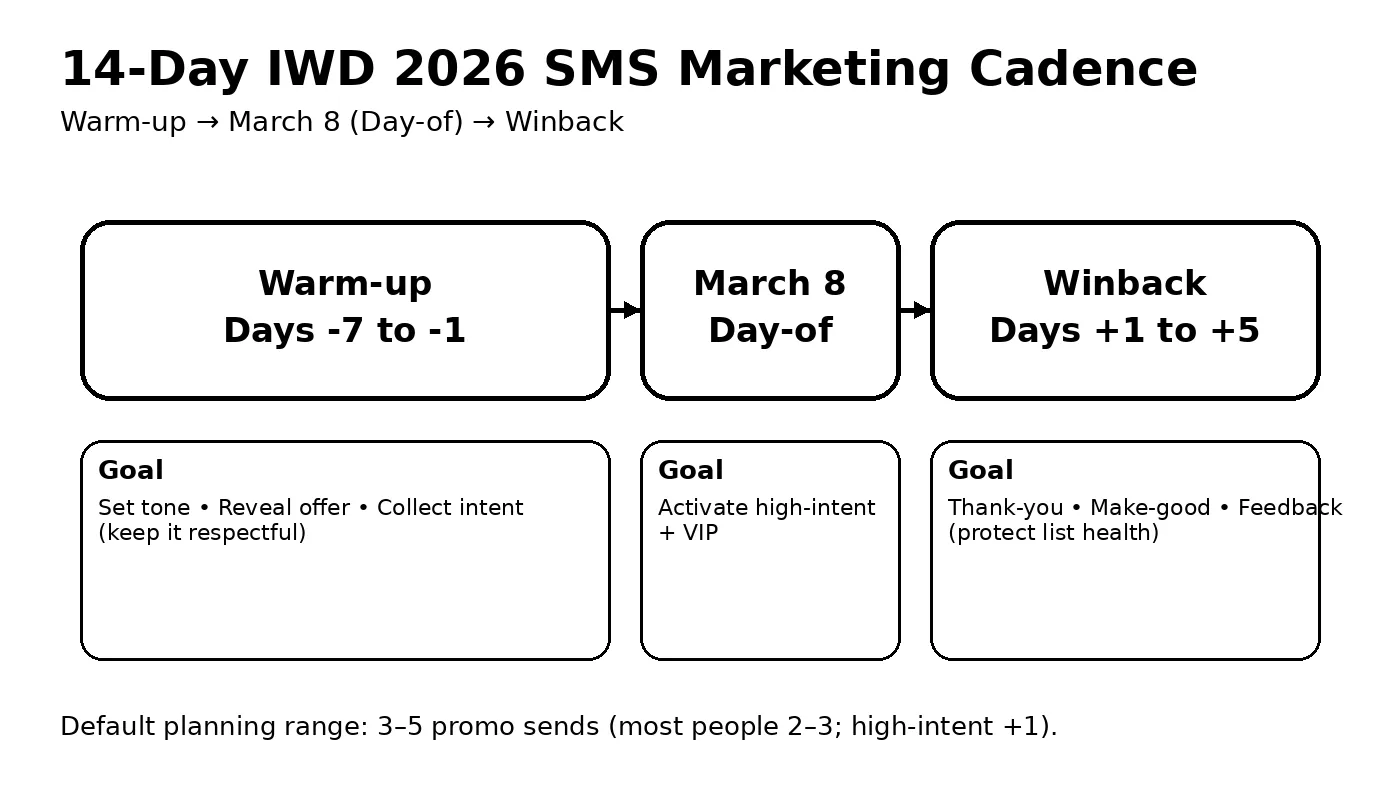
This is a 14-day operating plan, not “send daily.” Choose 3–5 promotional sends that match your audience and offer, then let triggers handle high-intent moments.
| Day | Stage | Objective | Who (default) | Send? | Message shape | Notes |
|---|---|---|---|---|---|---|
| -8 | Setup | Guardrails | Everyone | No | Internal checklist | Segments, suppression, caps, quiet hours, UTMs, landing page alignment. |
| -7 | Warm-up | Set tone + trust | All opted-in | Optional | Value-first | No discount yet; earn attention. |
| -3 | Warm-up | Offer reveal | Core segments | Common send #1 | Offer + deadline | First real push. Keep it clean. |
| -1 | Warm-up | Countdown | High-intent only | Optional | Short countdown | Don’t resend to clickers/converters. |
| 0 (Mar 8) | Day-of | High-intent window | High-intent + VIP | Common send #2 | Urgency / last call | Split by segment + local time. |
| +1 | Winback | Gratitude | Purchasers/participants | Optional | Thank-you | Low pressure builds trust. |
| +2 to +5 | Winback | Reactivation loop | Clicked/no buy + warm audience | Optional | Make-good / feedback | Keep winback smaller than day-of. |
Warm-up (Days -7 to -1): International Women’s Day 2026 pre-heat objectives
Warm-up is where you earn the right to convert: relevance, value, and respectful tone.
If your list is fragile, compress warm-up to one strong send (-3) and one high-intent-only reminder (-1).
Day-of (March 8): Women’s Day / IWD 2026 high-intent windows and “last-call” mechanics
On March 8, you’re not trying to reach “everyone.” You’re trying to activate people who are already receptive.
Segmenting beats shouting.
Winback (Days +1 to +5): International Womens Day post-campaign reactivation loop
Winback is where you protect list health and collect learning. If opt-outs rose on day-of, don’t push harder — tighten.
International Women’s Day 2026 SMS marketing templates (by objective)
Use placeholders like [FirstName], [City], [Time], [ShortLink]. Add opt-out language where required.
Warm-up templates: trust, perk, and intent-signal prompts
1) “Hi [FirstName] — quick IWD 2026 note: we’re sharing a small Women’s Day perk this week. Want first access? [ShortLink]”
2) “For IWD 2026, what’s most useful? A) gift B) discount C) early access. Choose here: [ShortLink]”
IWD / Women’s Day day-of templates: urgency, limited-time, and store/online switches
3) “Women’s Day 2026 perk is live. Ends [Time]. Code [CODE]: [ShortLink]”
4) “Happy IWD 2026, [FirstName]. [City] pickup is available today — see what’s in stock: [ShortLink]”
Post-IWD templates: gratitude, feedback, and winback offers
5) “Thanks for being here for IWD 2026, [FirstName]. Want the next drops? [ShortLink]”
6) “Quick follow-up: missed IWD 2026? Here’s a smaller make-good perk until [Date]. [ShortLink]”
“Do-no-harm” rewrites: International Women’s Day messaging do’s & don’ts (160-char mindset)
Copy rewrites are necessary — but IWD risk is bigger than wording. It’s about what you claim and what you can stand behind.
Use a simple decision rule:
- Lead with cause/action only if you can be specific and accountable (real program, measurable support, clear destination of funds or action).
- Otherwise, keep it to community benefit (member perk, useful value, access) and avoid borrowing moral credit.
UN Women’s work on stereotypes and advertising is a strong north star: avoid stereotypes, avoid pandering, and keep portrayals and language respectful and real. [2]
Women’s Day 2026 segmentation map for SMS marketing (who gets what, who gets suppressed)
Below are defaults you can copy-paste. Adjust with your own baseline.
VIP / high-AOV segment: premium perk angles
Default threshold: top 10–20% by spend in last 180 days OR ≥2 purchases in last 90 days.
Rule: VIP gets early access; suppress after purchase.
New customers: low-friction first-win offers
Default threshold: first purchase in last 30 days OR newly opted-in within 14 days.
Rule: keep it to one clean send; don’t “welcome spam” them.
Returning customers: “upgrade the basket” prompts
Default threshold: purchased in last 31–90 days.
Rule: warm-up offer reveal + day-of (if list health is stable).
Lapsed customers: reactivation-first winback angles
Default threshold: no purchase in 90–180 days, and no click in 60+ days.
Rule: day-of or +2 make-good — not both.
High-intent (browse/cart) overlays: triggered SMS rules
Default threshold (pick what you can measure):
- cart abandonment within 15–60 minutes, or
- product view/add-to-cart in last 48 hours, or
- clicked any SMS link in last 7 days
Rule: high-intent can receive one extra last-call because it’s behavior-justified.
Suppression & frequency caps: list-health guardrails for IWD 2026
Two practical guardrails:
- Most recipients: 2–3 promo sends across the window
- High-intent: +1 behavior-justified message
And a critical nuance:
- Treat campaign opt-out <1% as a great target line for many mature lists, but don’t argue benchmarks with benchmarks. Platform definitions vary (campaign vs automation; sent vs delivered). Use your baseline + spike detection as the truth. [5]
How to implement this IWD calendar inside an SMS platform (platform-ready, 6 steps)
If you’re using an SMS platform or aggregator, the goal is to make this campaign repeatable (segments, suppression, tracking, and a 15–60 minute “watch plan”).
1) Build segments (make them measurable):
- VIP, New, Returning, Lapsed, High-intent overlays (browse/cart/click recency).
2) Wire suppression rules (prevent accidental over-sends): - Suppress converters (post-purchase), suppress clickers for broad reminders, suppress “recent opt-outs/complaint-risk” cohorts.
3) Set frequency caps + quiet hours as defaults: - Start with conservative caps; loosen only when list health stays stable.
4) Create short-link + UTM templates once, then reuse: - Standardize
utm_campaign=iwd2026_[stage]_[day]and keep denominators consistent (delivered vs sent).
5) Schedule by local time (especially on March 8): - Use timezone-based scheduling where possible; if not, choose a conservative send window and tighten caps.
6) Run the watch plan after each send (15–60 minutes): - Delivery/blocks → CTR → opt-outs.
- If opt-outs spike: pause next broad send, inspect segment/suppression, switch to high-intent triggers until stable.
Next step (optional): If you want to implement this playbook in a workflow, explore Marketing SMS or contact our team for a setup walkthrough.
Short link + UTM tracking for International Women’s Day 2026 SMS marketing
Note on metric definitions (for consistent reporting):
Different tools define CTR and opt-out differently (sent vs delivered; campaign vs automation). In this guide, assume “delivered” as the denominator for CTR and opt-out, and compare numbers only when the denominator matches. Dotdigital explicitly defines opt-out as unsubscribes ÷ delivered. [4]
A simple UTM naming convention for IWD campaigns
utm_source=smsutm_medium=smsutm_campaign=iwd2026_[stage]_[day]utm_content=[segment]_[offer]_[variant]
Conversion window rules (what counts as “IWD lift”)
- Day-of: same-day or 24h window
- Warm-up/winback: 24–72h window
Pick one and stick to it.
Landing page alignment checklist (message → page → checkout)
- Headline matches the SMS promise
- Offer terms visible without scrolling
- Code applies cleanly on mobile
A/B test log: hooks, tone, incentive, timing
Test one lever at a time: hook, incentive, timing, or segment split.
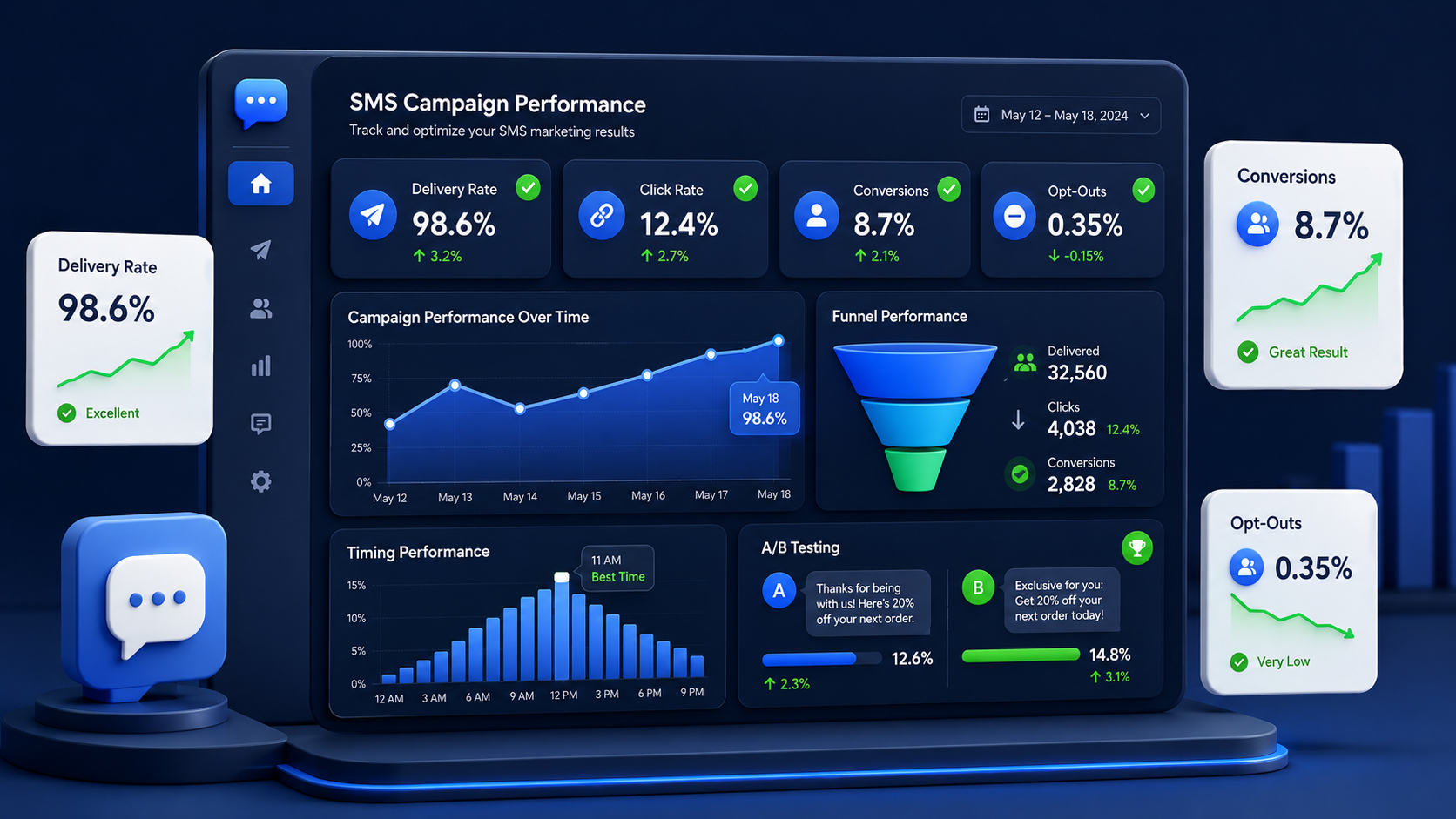
IWD 2026 SMS marketing metrics dashboard (mini)
Deliverability & routing signals (delivery rate, blocks, throughput)
Watch in the first 15–60 minutes for delivery/blocks. If deliverability shifts, pause broad sends.
Related SMSBoosting guides:
Engagement signals (CTR, reply rate)
CTR is your early “fit” signal — but only comparable with the same denominator.
Conversion signals (CVR, revenue per send, AOV lift)
Review at end-of-day and compare to baseline.
List-health signals (opt-outs, complaint proxies, frequency impact)
Opt-outs are your sharpest early warning. If opt-outs spike after a send, diagnose before sending again.
List-health & compliance baseline for International Womens Day / IWD campaigns (non-legal)
Not legal advice — just operational defaults that reduce risk.
Opt-in proof checklist (what to capture, what to keep)
CTIA’s Messaging Principles and Best Practices is a useful operational reference for consent expectations and program basics. [6]
Capture: who consented, when, how, and what was shown.
Related SMSBoosting guides:
Opt-out flow baseline (STOP handling + blacklist sync)
UK ICO guidance is clear on making opt-out simple, including “text STOP” patterns. [7]
Quiet hours + time-zone sending windows
Local time zones matter. If you can’t localize, choose a conservative window and cap frequency harder.
What to pause when opt-outs spike (risk triage rules)
1) Pause the next broad send
2) Check segment logic
3) Review copy + offer clarity
4) Switch to high-intent only until stable
Mid-article checkpoint: a 10-minute IWD 2026 “health scan”
- One source of truth calendar
- Thresholds implemented (not “VIP-ish” vibes)
- Suppression rules verified
- STOP tested end-to-end
- 15–60 minute watch plan ready (delivery/blocks, CTR, opt-outs)
- End-of-day review plan (CVR, revenue, learnings)
Execution runbook checklist: prep → launch → monitor → learn (repeatable for any holiday)
Prep (T-8 to T-3)
- Segments + thresholds set
- Suppression lists wired
- Frequency caps + quiet hours set
- UTMs standardized
- Landing page checked
Launch (T-3 to Day-of)
- Start with your safest segment if unsure
- Watch the first 15–60 minutes for deliverability + list health
- Hold back extra reminders unless performance is clean
Monitor (Day-of to +2)
- Pause quickly if opt-outs spike
- Move to high-intent only if needed
Learn (+3 to +7)
- Save the kit: calendar + thresholds + winning templates + what you won’t repeat
FAQ: International Women’s Day (IWD) 2026 SMS marketing
How many texts should an IWD campaign send?
Default: 3–5 promo sends across the two weeks is a cautious operating range that aligns with common frequency guidance and reduces list-health risk — but calibrate to your baseline and watch for spikes. [3]
When should I schedule IWD 2026 messages (time-of-day)?
Local time zones and conservative windows are safer when you can’t localize. Quiet hours vary by region; keep it practical and risk-aware.
How do I avoid “cringe” International Women’s Day marketing copy?
Don’t overperform emotion. Avoid stereotypes. Keep it specific, useful, and respectful — UN Women’s work on stereotypes is a strong north star. [2]
What if opt-outs spike during Women’s Day 2026?
Pause broad sends, diagnose segment/offer mismatch, and switch to high-intent targeting until stable.
Can I reuse this calendar for other holidays?
Yes. The system (cadence, thresholds, caps, monitoring) transfers.
References
- United Nations — International Women’s Day observance page
- UN Women — Advertising and stereotypes (PDF)
- Mailchimp — SMS frequency guidance
- dotdigital — SMS basics and metric definitions
- Postscript — SMS benchmarks
- CTIA — Messaging Principles and Best Practices (PDF)
- UK ICO — Direct marketing by electronic mail guidance