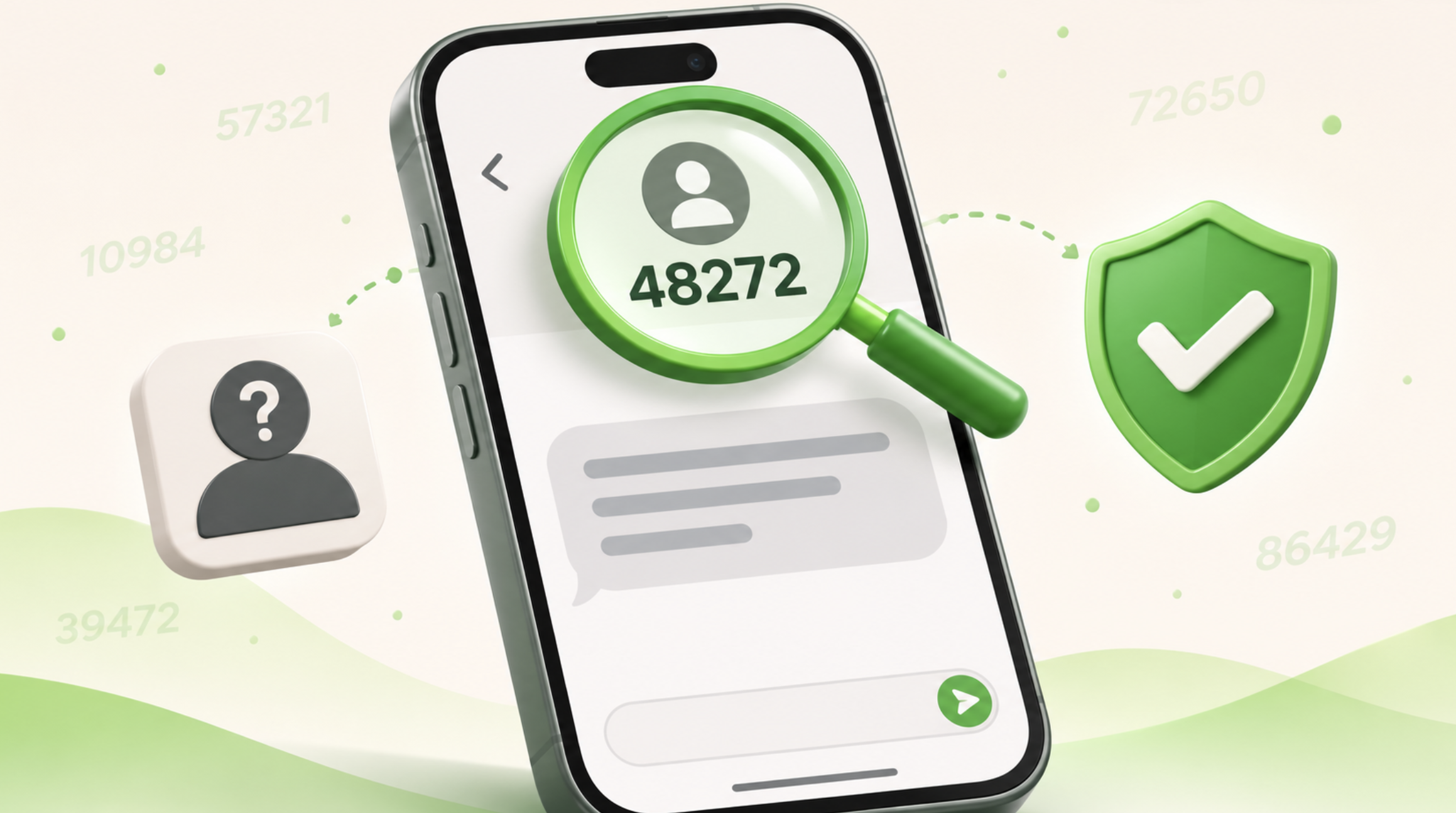
To perform a short code lookup, copy the number that sent the text, identify the country where you received it, and search a relevant short code directory or official resource. Then check the claimed sender through the brand’s independently published website or support channel. A matching directory entry is a useful clue—not proof that the message itself is genuine.
What Is a Short Code Lookup?
A short code lookup searches for information associated with a shortened SMS number, such as a brand, messaging program, contact details, or registration status.
Short codes carry verification codes, alerts, and promotions. U.S. and Canadian common short codes typically contain five or six digits, but formats vary internationally. [1] [2]
Suppose an unexpected account alert comes from five digits. An ownership lookup seeks the associated organization or program. An availability lookup asks whether a business can select or lease the number. It cannot identify the sender of that text.
For background on the number or name shown in an SMS sender field, see SMS Sender ID: What It Is, Types, and How It Works.
How to Find Out Who Owns a Short Code
-
Step 1 — Identify the Short Code and Country
Copy every digit of the sender number and note the country where the text arrived. Don’t add a country code or assume the same digits identify the same business internationally.
-
Step 2 — Check Official Short Code Resources
Find the local registry, industry directory, or carrier resource. Check whether it lists existing programs or tests number availability. Some official registries focus on selecting and leasing codes rather than identifying senders for consumers. [1]
-
Step 3 — Search a Short Code Directory
If official listings don’t help, try Shortcodes.org, which provides number searches and user-submitted reports. Community reports are leads, not verified ownership records. [3]
Look for a brand, program purpose, information source, and update date. Treat unsupported or old entries cautiously.
-
Step 4 — Verify the Sender Through Official Brand Channels
Find the brand’s website yourself and check its SMS terms or help center. Otherwise, contact support using independently sourced details—not those in the message. The FTC recommends this approach for unexpected texts. [4]
A confirmed brand-code association still does not authenticate the message. Without independent confirmation, treat the sender as unverified.
-
Step 5 — Review the Message Before Taking Action
Check whether you recently signed in, ordered something, or requested an alert. Watch for unusual links, payments, passwords, or one-time-code requests. Don’t open unverified links or share sensitive information; report suspicious texts through your phone or carrier. [4]
Step What to Check What You Can Learn Limitation 1 Exact digits and receiving country Correct market to search Digits alone don’t identify a brand 2 Official registry or program list Availability or listed program The tool may not provide ownership 3 Independent directory Possible sender and user reports Records may be incomplete or outdated 4 Brand’s own support channels Whether the brand recognizes the code Doesn’t validate every message 5 Message context and requested action Whether to investigate or report No single clue guarantees safety
Where to Look Up SMS Short Codes by Country
United States Short Code Lookup
The U.S. Short Code Registry’s Find a Short Code page supports five- and six-digit number selection. Its registry tracks available, reserved, and registered codes; the public tool is not a comprehensive consumer sender directory. [5] [1]
For an unfamiliar text, supplement the registry with brand documentation or a carefully assessed directory, then contact the brand independently.
Canada Short Code Lookup
In Canada, the Current Short Code Programs directory lists codes, program names, and available support details. Check the program and confirm its contacts against the organization’s website. [6]
Canada’s separate Short Code Availability Search checks desired numbers or tradenames, not received-message authenticity. [7]
United Kingdom and Other Countries
In the UK, Ofcom’s Premium Rate Service Checker identifies available provider details for premium-rate services found in texts or phone bills—not all business SMS senders. [8]
Three’s shortcode checker can also identify service or payment details, sometimes naming an intermediary rather than a merchant. [9]
Elsewhere, consult local regulators, carriers, or industry bodies. Public ownership directories may not exist, and U.S. results do not identify foreign senders. See International SMS Sender ID for market context.
| Country | Lookup Resource | Lookup Purpose | Information Available | Limitations |
|---|---|---|---|---|
| United States | U.S. Short Code Registry | Code selection and availability | Registry status during selection | Not a complete public sender-owner directory [1] [5] |
| Canada | Current Short Code Programs | Existing program identification | Code, program, available contact details | Does not authenticate individual messages [6] |
| Canada | Short Code Availability Search | Number or tradename availability | Availability response | Not an ownership certificate [7] |
| United Kingdom | Ofcom Service Checker | Premium-rate service identification | Provider details where held | Doesn’t cover all business texts [8] |
How to Read Short Code Lookup Results
Short Code Number
Match every digit and the receiving country. A match from another market is not evidence of identity.
Owner or Brand Name
Results can name a brand, registrant, operator, provider, or intermediary—different entities. Three warns that shared UK codes can serve multiple merchants, with only an intermediary shown. [9]
Program Name and Message Purpose
Programs may cover verification, account notifications, customer service, or marketing. This helps explain context, not whether a particular link or request is genuine.
Status and Last Updated Information
Status labels vary: active may refer to a program; available to number selection; reserved/unavailable to allocation; and unknown/no record to missing information. The U.S. registry distinguishes available, reserved, and registered codes. [1]
“Available” does not establish a number’s history; “reserved” does not establish an active campaign. Check the update date.
Source and Verification Confidence
Compare official entries with the brand’s own SMS policy. Third-party listings provide clues; anonymous comments carry less weight. None authenticates an individual message.
Illustrative example only — fictional data, not an actual lookup:
| Field | Example Result | What It Means | What It Does Not Prove |
|---|---|---|---|
| Short code | XXXXX |
Digits to search in the receiving country | Global uniqueness |
| Program | Example Account Alerts | A possible program label | That the text came from that program |
| Status | Listed as active | Directory describes a current program | Message authenticity |
| Updated | Example: October 2026 | Date attached to the record | Real-time accuracy |
| Source | Community submission | A user supplied the information | Verified ownership |
How to Tell If a Short Code Text Is Legitimate
A legitimate-looking short code does not automatically make a text message trustworthy. Treat a lookup result as one part of a broader check.
Check Whether You Recognize the Brand or Service
Did you sign in, reset a password, place an order, or subscribe to alerts? An unrequested one-time code should never be shared or taken as proof of a successful identity check.
Verify the Sender Independently
Use the company’s official app, website, or established support number. The FTC cautions against relying on contact details in the unexpected text. [4]
Watch for Suspicious Links and Requests
Watch for demands for immediate payment, passwords, codes, or urgent account action. These are warning signs rather than automatic proof of fraud; verify the issue in your account. [4]
Be Careful With HELP and STOP Replies
Legitimate programs may support HELP/INFO for assistance and STOP for opting out. The Canadian Telecommunications Association documents these functions, which vary by service and market. [10]
Don’t blindly reply to suspicious texts, even with STOP or HELP. Verify or report instead; Ofcom advises against replying to unknown suspicious senders. [11]
Report Suspicious Short Code Messages
In the U.S., use your app’s spam reporting, forward SMS to 7726 (SPAM) where supported, or visit ReportFraud.ftc.gov. [4] Ofcom also documents 7726 in the UK; check local carrier support elsewhere. [11]
What If a Short Code Lookup Returns No Results?
No result doesn’t mean scam, and no result doesn’t mean safe. Possible explanations include:
- The code isn’t listed. The directory may cover only selected carriers, programs, or submission types.
- The information is outdated. An entry may not yet reflect a newly launched or changed program.
- The country is wrong. You might be searching a U.S. directory for a message received in Canada.
- The tool checks availability only. Its purpose may be number selection, not identifying an existing sender.
- The sender can’t be independently verified. Public information may be insufficient to reach a confident conclusion.
Recheck the digits and country, try another credible source, and independently contact the brand. Avoid questionable links; ask your carrier about suspicious messages or billing.
Short Code Lookup vs. Short Code Availability Search
What Is Short Code Ownership Lookup?
Ownership lookup seeks the business or program associated with an existing code. Records may be incomplete and may show an association rather than a legal owner.
What Is Short Code Availability Lookup?
Availability lookup checks whether a code can be selected or leased. “Available” does not grant use rights. In the U.S., leasing and carrier campaign approval are separate steps. [1]
How Do Businesses Check Short Code Availability?
Choose the destination market, consult its official availability channel, check the digits, and confirm eligibility, registration, and carrier requirements with the responsible provider.
When Should a Business Use a Short Code?
Choose a short code when your target market and messaging needs justify it. Long codes and alphanumeric sender IDs serve different circumstances. Compare them in SMS Sender ID vs Short Code. SMS Sender ID Registration addresses general registration issues, not a universal short code application.
| Comparison | Ownership Lookup | Availability Lookup |
|---|---|---|
| Search Goal | Identify an existing sender or program | Find a code a business might obtain |
| Primary User | Message recipient, support team | Business or messaging team |
| Typical Information | Program, brand, contact details | Number selection or availability status |
| Data Sources | Program directories, brand sites, carrier records | Official registry or availability portal |
| Main Limitations | Incomplete data; no message authentication | Does not grant use rights or approvals |
| Next Action | Verify the message independently | Confirm lease and campaign requirements |
The practical rule is simple: look up the code in the right country, identify what kind of data the source provides, and verify the sender separately.
FAQ
How can I find out who owns a 5-digit short code?
Identify the receiving country, search its official program listings or a clearly labeled third-party directory, and confirm any brand match using independently obtained contact details.
Is SMS short code lookup free?
Some official resources and community directories are publicly accessible without a search fee. Their coverage and the type of information returned differ; public access does not guarantee an ownership result.
Can I look up a 6-digit SMS short code?
Yes, where the destination country supports six-digit codes. Both the U.S. and Canadian systems include six-digit common short codes, but you must use a country-appropriate source. [1] [2]
Does a short code always belong to one company?
No. The listed entity may be a registrant, service provider, program, or brand. Some services also use shared codes, so don’t assume a globally unique company-to-number relationship. [9]
Does a short code mean a text message is safe?
No. A recognizable short code or matching directory listing is not proof that its message, link, or request is safe. Verify the claimed sender and the requested action independently.
What does it mean if a short code lookup shows no results?
It means that particular search did not return a usable record. Try the correct country, another credible source, and the claimed brand’s own channels before drawing conclusions.
Can I reply HELP or STOP to an unknown short code?
Legitimate programs may support those commands, but avoid responding blindly to suspicious or unsolicited messages. Verify the program first, or report the text through your phone or carrier. [10] [11]
How can businesses check short code availability?
Select the destination country, use its official availability tool where one exists, and then confirm leasing, eligibility, and campaign approval requirements with the relevant provider. [5] [7]