


Gaming SMS gives game teams a direct way to deliver a message when timing, account context, or player attention makes an inbox-only plan too fragile. It is most useful when it has a defined job inside a wider communication system, rather than becoming the default channel for every campaign or support update.
For product, lifecycle, and operations teams, the practical question is not whether text messaging is universally better. It is which player moment merits a concise mobile message, what permission and sender setup it needs, and what should happen when a player replies or does not receive it. This guide maps the common roles without treating them as a complete implementation manual.
Why Gaming Companies Use SMS in Player Communication
Gaming companies can use gaming SMS when a message needs a direct path to a player and the purpose is clear. A security step, a time-sensitive account notice, or an opted-in campaign may each justify a different message pattern. The general A2P SMS model also makes it useful to distinguish promotional, notification, and verification traffic instead of treating all texts as the same kind of communication [1].
The channel has limits. A game launch announcement might work better in an owned community or in-product surface when it needs rich context, while a short account alert can be easier to act on from a phone. A team should define the player action before it chooses the channel. When the action is unclear, sending a text can add interruption without helping the player complete anything.
The channel is therefore a coordination tool, not a substitute for product messaging, email, support, or account settings. Teams get more value by reserving it for moments where immediacy and clarity matter, then making the next step obvious. The article What Is an SMS Platform? provides related context on routing, tracking, and two-way reply handling as parts of that broader system.
Player Communication Characteristics That Shape Gaming SMS
Player communication changes with session state, account status, locale, and expectation. Someone who has just asked for access recovery has a different need from a player who opted in to receive event news. Those contexts should shape both the message category and the frequency policy. A campaign team that uses the same cadence for alerts and offers risks making important messages harder to recognize.
Consent and sender recognition belong in the planning stage, not as last-minute copy details. The configured sender-identity guidance explains that regional sender types and one-way or two-way capabilities can differ [3]. That means a team should decide what reply behavior it needs before selecting a sending approach. It should also leave a clear route for a player to change preferences or stop promotional messages.
These player communication characteristics are easier to govern with a simple message inventory: what event triggers the text, who can receive it, what the player should do, and where the conversation continues. This is especially helpful for teams operating across regions, where an identical player journey may not have identical sender options or delivery conditions. The goal is a predictable communication experience, not a claim that one setup fits every market.
Four Gaming SMS Use Cases: Marketing, Alerts, Verification, and Engagement
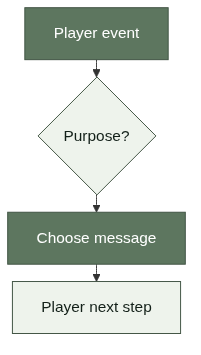
The four use cases are useful categories for planning, but they should not be treated as interchangeable templates. Marketing depends on permission and relevance. Alerts depend on urgency and accuracy. Verification depends on an account or device flow. Engagement depends on whether a message is genuinely useful enough to earn attention. Keeping those jobs distinct helps teams decide which messages deserve priority.
Gaming SMS Marketing
Gaming SMS marketing can support an opted-in campaign when the offer, event, or reminder is relevant to the receiving audience. The most important decision is usually segmentation, not clever phrasing. A player who expressed interest in a live event may need a different message than a player who has not interacted recently, and neither group should receive an operational alert disguised as promotion.
Teams should begin with a narrow campaign purpose and a clear destination, such as an event page or an in-product action. They should not assume that a message produces a commercial result simply because it was delivered. Timing, player preference, message content, and the receiving environment can all change the outcome. The configured Marketing SMS page is an appropriate cluster path for teams that need a deeper discussion of permission-based campaign communication.
Gaming SMS Alerts
Gaming SMS alerts are better suited to concise information that helps a player respond to an account or service-related moment. Examples may include a status update, a requested reminder, or a notice that directs the player to a secure in-product location. The message should say what happened and what the player can do next, without forcing the player to infer whether it is urgent.
An alert loses value when it is too frequent, vague, or mixed with promotional language. Operations teams can reduce that risk by defining escalation rules: what belongs in a text, what belongs in an email or in-product inbox, and what requires support handling. The configured Notification SMS page can support this branch of the communication cluster. It is also useful to separate delivery from resolution; a sent alert does not prove that the underlying player issue is resolved.
Gaming SMS Verification
Gaming SMS verification can be part of a one-time passcode flow for an account or device action. The relevant general documentation describes SMS-based verification as a client and service interaction, which is useful background for explaining the flow without presenting it as a full identity system [2]. A product team should define the exact event that triggers the code and the fallback experience when the player cannot complete the step.
Verification messages require a different tone from campaigns. They should be short, recognizable, and tied to an action the player initiated or can safely identify. Teams should avoid using this category to make broad security promises or to imply that a text alone resolves every account-risk question. SMSBoosting materials describe OTP support through existing routing resources; that boundary should remain clear in any implementation discussion.
Gaming SMS Engagement
Gaming SMS engagement works best when it extends a player relationship with a useful prompt, update, or reply-aware next step. It does not mean sending a message whenever activity falls. A player may welcome a relevant event reminder, yet view repeated generic nudges as noise. The difference comes from context, permission, and whether the communication gives the player a practical reason to engage.
For teams that want replies, the operational plan matters as much as the message. Someone must decide how replies are routed, what automated response is appropriate, and when a player needs human support. That is why engagement should be designed as part of a communication system rather than as an isolated campaign. Review the configured SMS platform overview when mapping routing, tracking, and reply handling around these interactions.
The Role of SMS in the Player Communication System
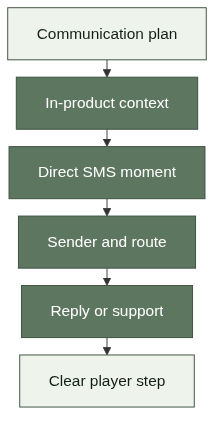
SMS has a focused role in the player communication system: it can carry a short, direct message while other channels provide richer context, persistent history, or support. A player may receive a text that points to an in-product screen, then complete the actual task within the game or account environment. This division reduces pressure to fit complex explanations into a single message.
A useful system map assigns an owner and a failure path to each message type. Product teams can own in-product prompts, lifecycle teams can govern permission-based campaigns, and support or operations teams can handle exceptions. The handoff is important because a text may generate questions that cannot be answered safely or clearly by the initial message alone. Two-way capability should be planned as a workflow, not merely selected as a feature.
The most effective system is not the one with the most messages. It is the one where player intent, channel choice, sender identity, and escalation routes align. For related considerations on consent, content risk, monitoring, and route quality, readers can use the configured SMS deliverability guidance. It supports a planning discussion without proving any particular delivery result.
Cross-Region SMS Delivery and Routing Considerations
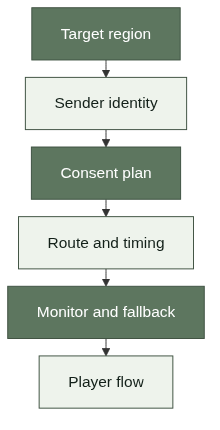
Cross-region SMS delivery and routing considerations begin with the destination context. Sender ID choices, long codes, short codes, and the availability of one-way or two-way interaction can vary by region [3]. A team should avoid designing a single player flow that assumes identical sender behavior everywhere. Instead, it can document which identity option, reply path, and fallback is intended for each operating context.
Permission, opt-out handling, recognizable sender information, and sensible timing are also operational inputs. The configured best-practices source identifies these as general SMS planning considerations [4]. They are not a substitute for a team’s own legal or compliance review, and they do not justify a claim that any message program will be accepted or delivered. They simply help teams identify the questions that must be resolved before launch.
Route quality and monitoring matter when an important player message is time-sensitive. Teams can watch for signals that suggest a routing, sender, content, or destination issue, then investigate the relevant layer rather than assuming a player ignored the message. The configured SMS Routing page gives a deeper cluster route for this topic. Gaming SMS should be planned with these delivery dependencies in mind, especially when the message supports a player action with a short useful window.
Planning Gaming SMS Without Turning It Into a Service Page
A sensible gaming SMS plan starts with a message-purpose checklist. For each proposed text, record the player event, audience, permission basis, sender identity, destination, reply expectation, regional constraints, and owner of any exception. This creates a decision trail that is more useful than a generic list of message ideas. It also makes it easier to remove messages that have no clear player benefit.
Prioritize the messages that are hardest to replace with another channel. A requested verification step or a time-sensitive account alert may deserve earlier design attention than a broad engagement concept. Marketing and engagement can then be tested against preference and relevance rules rather than being treated as automatic lifecycle additions. This sequence keeps the player communication system grounded in purpose and avoids turning the article into a catalogue of services.
For teams exploring the topic, the next step can be to compare their own player moments with the marketing, alert, verification, and engagement categories above. SMSBoosting can be a consultation option when a team needs to discuss gaming SMS use cases, routing context, or a communication plan. The right scope depends on the player journey, regional delivery conditions, and the internal workflow that follows each message.
FAQ
References
Twilio, SMS Foundations: general A2P SMS categories, sender identity, interaction patterns, and filtering context.
Twilio Verify documentation: general SMS OTP and account or device verification background.
AWS End User Messaging SMS, Phone Number Types: regional sender ID, long code, short code, and interaction capability context.
AWS End User Messaging SMS, Best Practices: general permission, opt-out, identity, timing, and list-governance considerations.